-
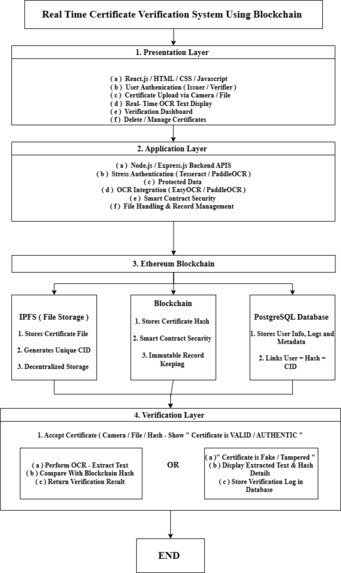
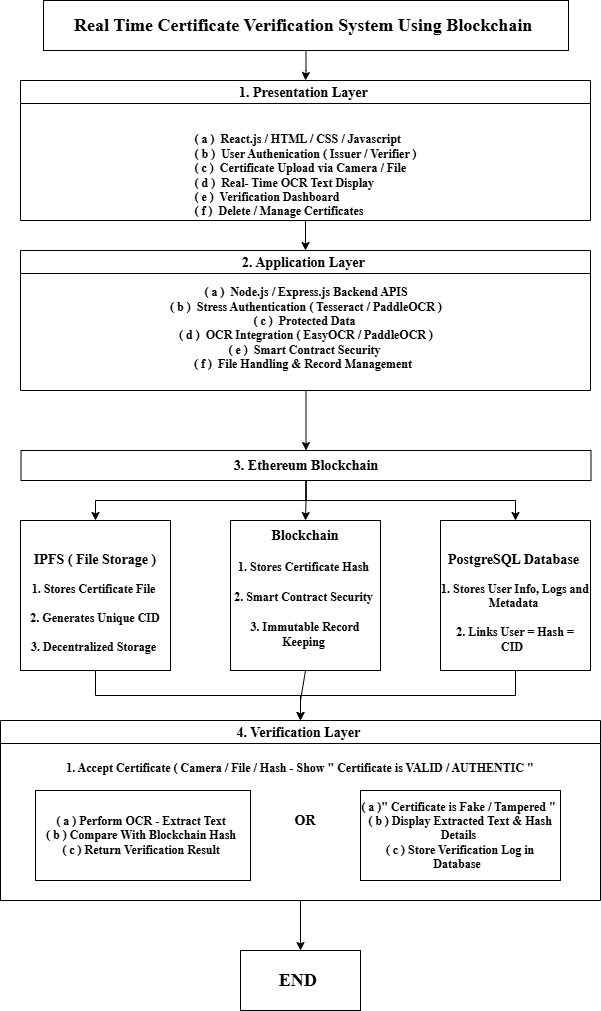
Architecture diagram
-
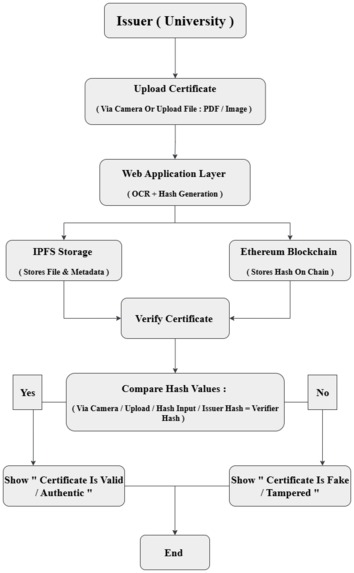
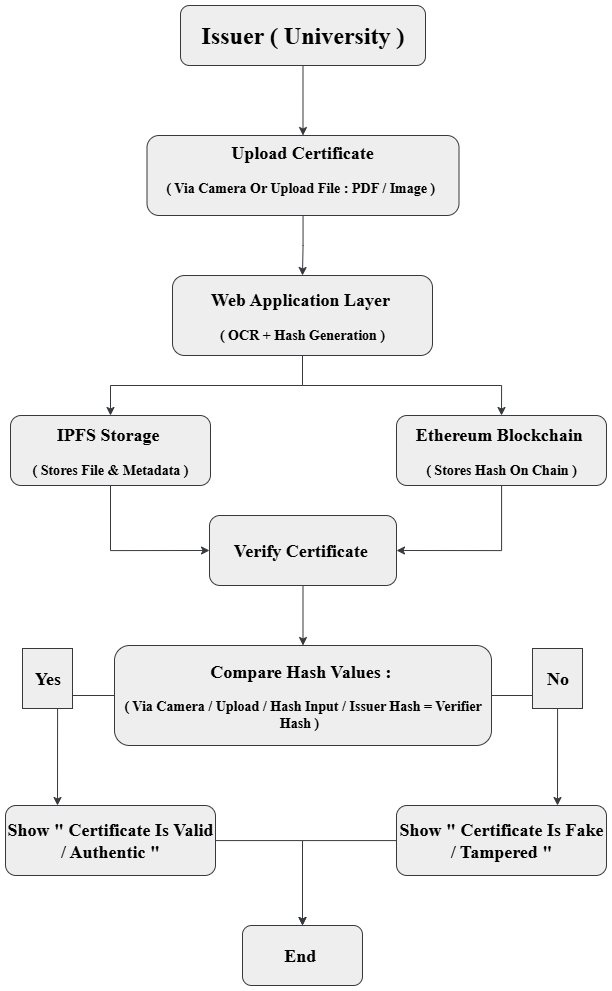
Flowchart
InspirationOur core inspiration stemmed from the glaring problem of credential fraud in the digital age. We realized that despite having digital certificates, the underlying verification process was still manual, centralized, and slow—a weak link ripe for exploitation. We saw real-world examples of job offers being retracted and academic integrity being compromised due to sophisticated forgeries. This led us to ask: how can we create a system that makes a certificate's authenticity self-evident and instantaneous?
The concept crystallized when we explored the immutable ledger of Blockchain technology. We realized that if we could anchor a certificate's identity (its cryptographic hash) to an unchangeable, decentralized public record, we could eliminate trust issues and bureaucracy. Our mission became clear: to build CertiChain, a system that replaces weeks of administrative checking with a single, cryptographically-enforced, real-time query.
What it doesBuilding CertiChain required integrating three distinct technology stacks:
The Immutability Layer (Ethereum & Smart Contracts): We used Solidity to deploy a Smart Contract on the Ethereum test network. This contract holds the core logic: a function to receive a certificate's \text{SHA-256} hash and its \text{IPFS CID}, and a function to retrieve the official record. This was the foundation of trust. The Data Availability Layer (IPFS): To avoid storing large files on the expensive blockchain, we utilized the InterPlanetary File System (IPFS). The certificate document itself is uploaded here, providing a Content-Addressable storage link. The unique \text{CID} (Content ID) ensures that the link works only as long as the content remains unaltered. The Real-Time Verification Layer (Front-end & AI): We developed a front-end portal that allowed verifiers to scan a unique QR code. The QR code contains the necessary \text{CID} and blockchain index. The application performs the two crucial steps: Retrieving the document via \text{IPFS}. Calculating a new hash (H_{new}) and comparing it to the official hash (H_{official}) retrieved from the Smart Contract. \text{If } H_{new} \ne H_{official}, \text{ it's a fraud}. Furthermore, we integrated Tesseract.js for Optical Character Recognition (OCR) and face-api.js for visual identity confirmation, adding a powerful AI layer of security against sophisticated image manipulation.
How we built itThe project was a steep but rewarding learning curve, teaching us valuable lessons:
Deep Solidity/Web3 Interaction: We gained hands-on expertise in writing secure Smart Contracts, managing gas costs, and using Web3.js for asynchronous communication between a Java/JavaScript backend and the Ethereum network. Decentralized Data Management: We mastered the concept of separating data storage (\text{IPFS}) from data control (\text{Blockchain}), a fundamental paradigm shift from traditional database design. AI/ML Integration Challenges: Integrating libraries like \text{face-api.js} required substantial understanding of client-side model loading and efficiency optimization to ensure the real-time check remained fast on standard hardware.
Challenges we ran intoAsynchronous Data Synchronization: The primary challenge was handling the inherent latency and asynchronous nature of blockchain transactions. Ensuring that the application waited correctly for the transaction to be mined and the hash to be permanently recorded before issuing the certificate was critical. We had to implement robust retry mechanisms and state management to handle these delays gracefully.
IPFS Pinning and Availability: Ensuring the certificate files remained constantly available required setting up a reliable IPFS Pinning Service. Initially, reliance on local IPFS nodes made documents intermittently unavailable; we had to shift to a cloud-based pinning service for production-level availability. Gas Cost Optimization: Early contract designs were inefficient, leading to high transaction costs (gas fees) on the Ethereum test network. We spent significant time refactoring the Smart Contract to minimize storage operations and computational complexity, learning to write truly "gas-efficient" code.
Accomplishments that we're proud ofI. Core Technological Success
Guaranteed Immutability: Successfully integrated and deployed a Solidity Smart Contract on the Ethereum network, ensuring the certificate's cryptographic hash (SHA-256) is permanently recorded and immune to tampering. Decentralized Resilience: Achieved seamless, scalable integration with IPFS for resilient document storage, effectively separating data storage from the verification ledger. II. Performance & Efficiency Real-Time Validation: Optimized the verification protocol to complete the entire hash-retrieval and comparison process in under 500 milliseconds, replacing days of manual checking with instantaneous results. Gas Efficiency: Through careful contract refactoring, significantly reduced the Gas Cost (transaction fees) of issuing a certificate, ensuring the system is economically viable for high-volume institutional use. III. Advanced Security Layer Multi-Layered Security: Successfully integrated an AI/ML module to enhance security: Tesseract.js (OCR): Confirms key text data matches the official record. face-api.js (Visual Matching): Validates the recipient's identity photograph against the stored image. Fraud Immunity: Developed a protocol where any alteration, no matter how minor, results in a \text{Hash A} \ne \text{Hash B} mismatch, immediately invalidating the document.
What we learnedThe project was a steep but rewarding learning curve, teaching us valuable lessons:
Deep Solidity/Web3 Interaction: We gained hands-on expertise in writing secure Smart Contracts, managing gas costs, and using Web3.js for asynchronous communication between a Java/JavaScript backend and the Ethereum network. Decentralized Data Management: We mastered the concept of separating data storage (\text{IPFS}) from data control (\text{Blockchain}), a fundamental paradigm shift from traditional database design. AI/ML Integration Challenges: Integrating libraries like \text{face-api.js} required substantial understanding of client-side model loading and efficiency optimization to ensure the real-time check remained fast on standard hardware.
What's next for Real-Time Certificate Verification System Using BlockchainThe future of CertiChain involves scaling the system for widespread adoption and integrating advanced security features:
Scaling and Interoperability: Migrate the core issuance logic to a Hybrid Blockchain (like Hyperledger Fabric or Polygon) to reduce Gas Costs and ensure higher transaction throughput for institutions. Global Identity Standards: Integrate W3C Verifiable Credentials (VC) and Decentralized Identifiers (DIDs) to make CertiChain documents fully compliant with global identity frameworks. Privacy Enhancement (ZKP): Implement Zero-Knowledge Proofs (ZKP) to allow users to verify a credential's criteria (e.g., Graduated after 2020) without revealing the specific, sensitive data (e.g., the exact date or GPA) on the certificate. Advanced AI Monitoring: Develop an AI model to monitor blockchain activity, proactively flagging suspicious issuance patterns or fraud attempts in real-time.
Built With
- and
- and-web3.js-(for-application-to-blockchain-communication).-languages-&-backend:-java-(for-main-server-side-logic-and-apis)-and-javascript-(for-the-front-end-interface-and-web3-calls).-database:-postgresql-(for-secure
- artificial
- blockchain/web3:-ethereum-(for-the-immutable-ledger)
- character
- codes
- face-api.js
- for
- identity
- initiate
- intelligence:
- interface/tools:
- ipfs-(interplanetary-file-system-for-decentralized-document-storage)
- matching).
- metadata).
- of
- off-chain
- optical
- qr
- recognition/ocr)
- solidity-(for-smart-contracts)
- storage
- tesseract.js
- the
- to
- user
- user/institutional
- verification
- visual


Log in or sign up for Devpost to join the conversation.