-
-
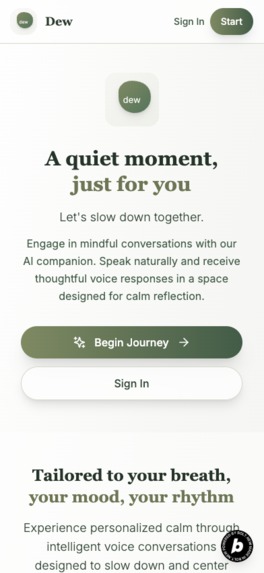
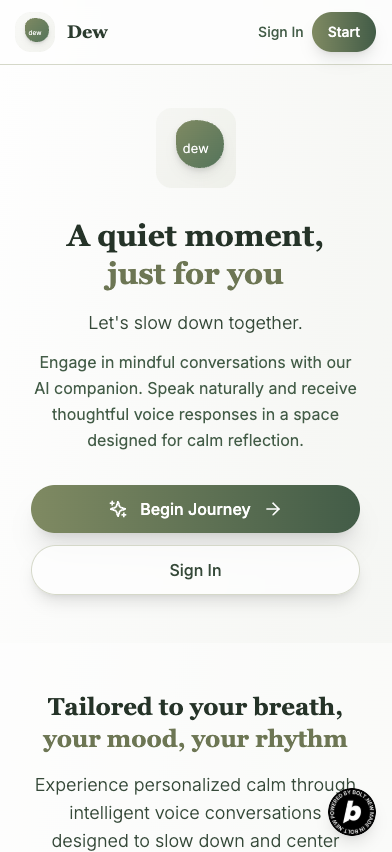
Homepage
-

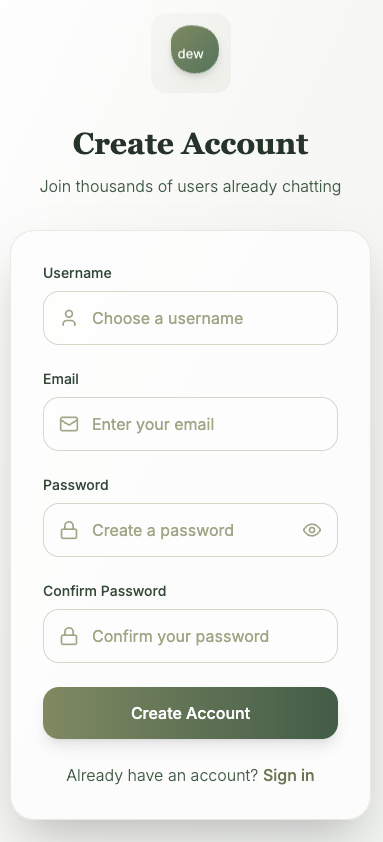
Login
-
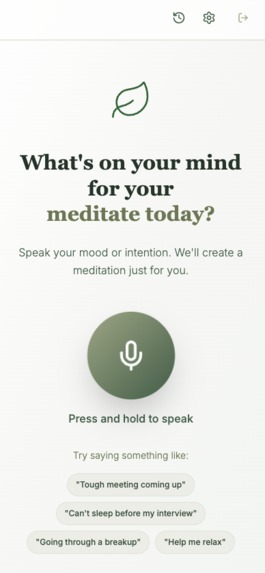
Welcome
-
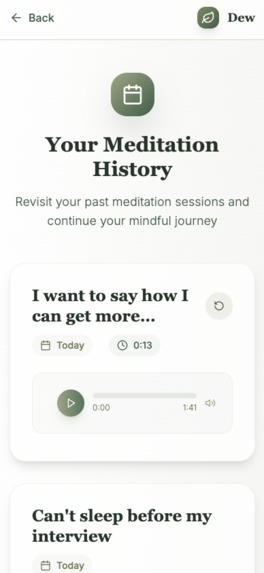
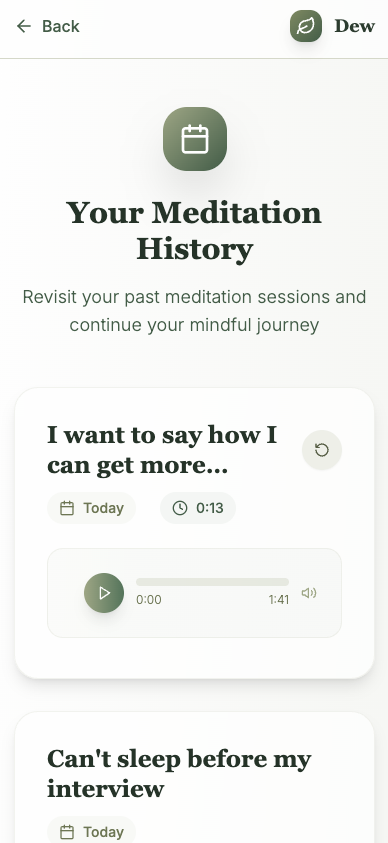
History
-
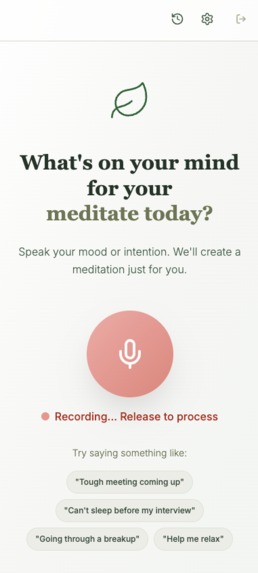
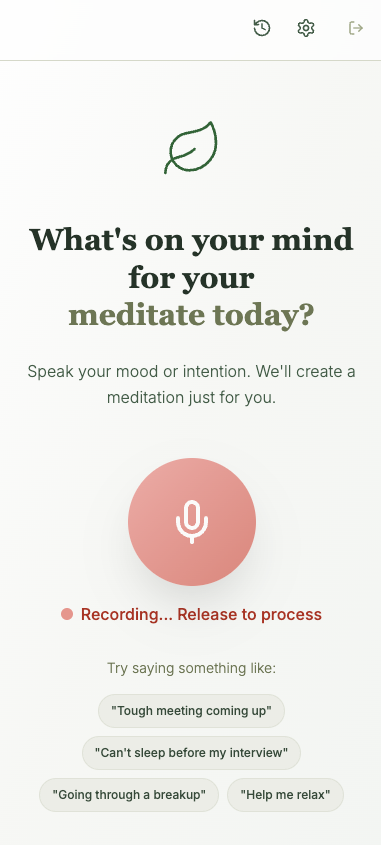
Speaking
-
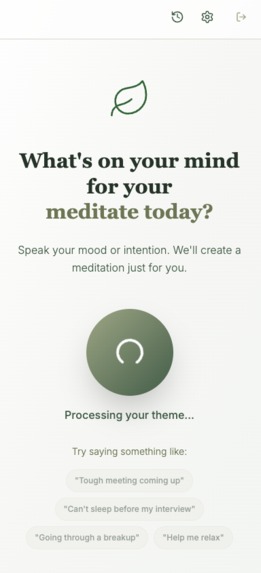
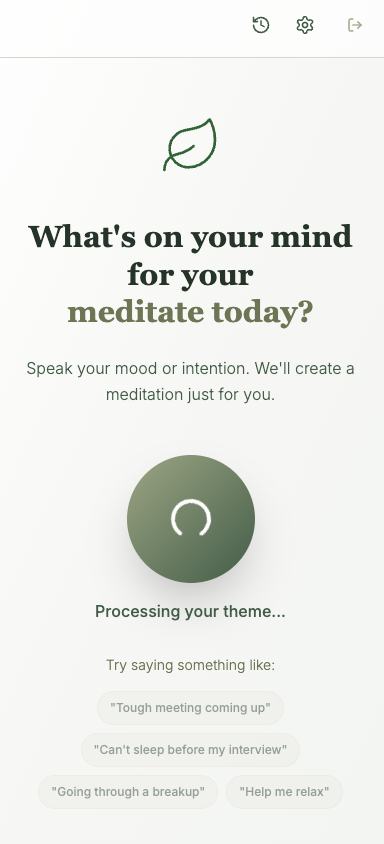
Generation
-
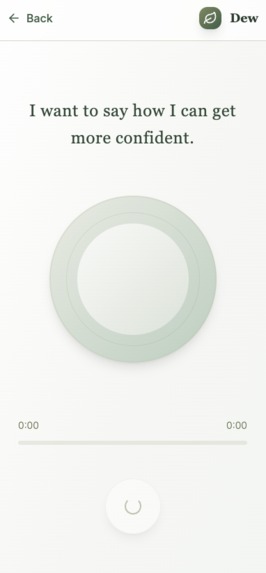
Meditation
Inspiration
We were inspired by a simple but painful truth: most people who need mental relief don’t have the energy to navigate it. Today’s meditation and wellness apps are cluttered with tracks, menus, and quizzes—offering generalized advice when what users really need is presence, simplicity, and empathy.
Dew was born from a belief that meditation should feel like being understood. In a world where AI can now generate tailored words, tones, and emotional context in real time, we saw an opportunity to create the most human meditation experience yet— one that starts with a voice, not a menu.
What it does
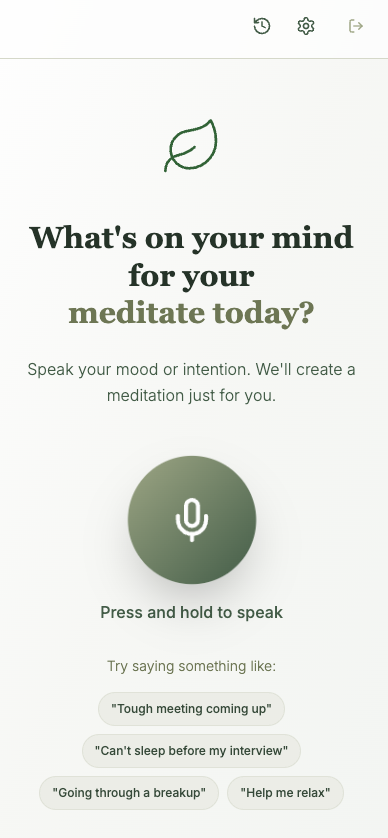
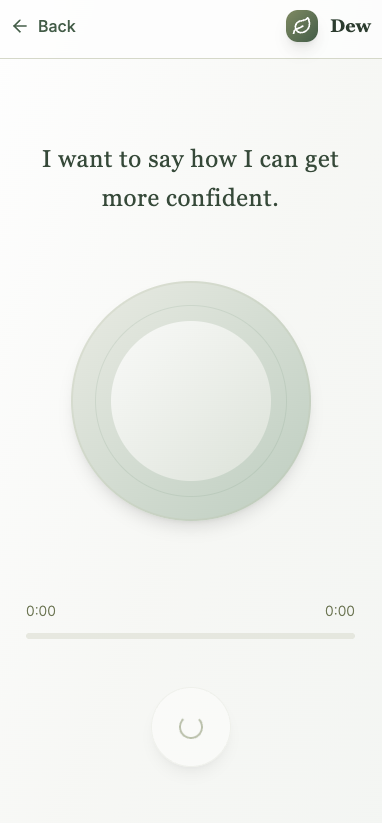
Dew is the first voice-based AI meditation app that listens to what a user is going through and generates a guided meditation and a mindful talk in real time—crafted specifically for that moment, in that emotional state. The experience feels like talking to someone who understands, then being gently guided inward through a meditation and a short supportive reflection.
How we built it
We combined several emerging technologies to bring Dew to life:
- LLM fine-tuned scripting for mapping user speech patterns and emotional tones into meditative logic (tone, pace, depth)
- Voice AI integration for seamless user input and playback, and generating expressive audio outputs.
- A lightweight mobile-first frontend with a calming, organic design system inspired by Zen and nature
We’ve also built in thoughtful safeguards to guide users to the right resources in case of emerging mental health concerns.
Tech Stack
Frontend Framework
- React 18.3.1 with TypeScript
- Vite as the build tool and development server
- React Router DOM 6.20.1 for client-side routing
Styling & UI
- Tailwind CSS 3.4.1 for utility-first styling
- Lucide React 0.344.0 for consistent iconography
- Custom color palette with nature-inspired themes (sage, forest, moss, cream)
- Responsive design with a mobile-first approach
Backend & Database
- Supabase as the primary backend service
- PostgreSQL database with Row Level Security (RLS)
- Authentication system
- Real-time subscriptions
- Edge Functions for serverless computing
AI & Voice Services
- OpenAI GPT-4 for meditation content generation
- OpenAI Whisper for speech-to-text transcription
- ElevenLabs for high-quality text-to-speech synthesis
- Vercel Blob Storage for audio file storage
Challenges we ran into
Emotional tone modeling: The bar for generating a meditation track that doesn’t feel robotic is extremely high. Simply using scripts generated by GPT models is bound to fall short. We broke down the key elements and techniques used by real meditation teachers, then creatively integrated those into both the prompt structure and voice delivery. As a result, we’re able to generate warm, grounded, and supportive outputs—at both the script and audio level—without sounding generic or artificial.
Latency in generating live audio: Even with ElevenLabs’ fastest Flash API and streaming mode, the current speed of audio generation is still about three times slower than we’d like. We’re optimistic that ongoing improvements in AI infrastructure will soon reduce this bottleneck.
Cost of generating real-time audio: Because Dew generates fresh, personalized audio for each session, the current cost using ElevenLabs remains high—making it difficult to scale affordably. We hope future pricing changes or model optimizations will allow us to bring Dew to more people at a lower cost.
Precision and QA in vibe-coded output is difficult: Small adjustments to output often feel like triggering a full system re-run, making it difficult to edit precisely or know what changed. Better control and versioning tools would help us maintain creative integrity across sessions.
Balancing minimal UX with user control: We aimed to remove friction by eliminating menus and choices, but had to carefully balance that with providing a sense of safety, clarity, and user agency.
Synthesizing a truly human voice: While ElevenLabs offers a wide range of voices, none have yet met our gold standard for meditation—natural, warm, grounded, and deeply caring. This remains an ongoing challenge for achieving emotional authenticity.
Accomplishments that we're proud of
- Designed an emotionally resonant user flow that mirrors real-world vulnerability moments—no onboarding, just speak and be heard.
- Created an LLM-powered meditation generation engine that adjusts tone, length, and content based on live emotional cues. The content is deeply relevant to user and, honestly, always impressed us with how insightful, helpful, and beautiful they can be.
- Developed a brand and visual language that feels calming, elegant, and distinct in a crowded wellness space.
- Created a whole brand marketing and demo video with AI tools
What we learned
- Emotion is the UX: The most meaningful interactions happen when people feel seen. AI can support that—if designed carefully.
- Voice input can create an intimate bridge between thought and relief, but it must be paired with mindful, not mechanical, output.
- Less truly is more: A product that removes decision fatigue actually becomes more powerful, not less.
What's next for Dew – AI Meditation That Knows You
- Expand our language, tone, and emotional model, allowing Dew to speak in a range of emotional “vibes” (calm, uplifting, grounding, reassuring, etc.) based on need, and in more languages
- Add reflection journaling after each session to deepen the user’s sense of growth and integration.
- Train a purpose-built small LLM specifically for meditative and mindful speech, reducing latency and cost.
- Launch a closed beta with therapists and coaches to co-develop new healing scenarios.
- Launch full version of iOS and Android Apps
- Build toward Dew becoming the most trusted voice for calm in the AI age.
Built With
- chatgpt
- edge
- elevenlabs
- lucide
- openai
- postgresql
- supabase
- tailwind
- typescript
- vercel
- vite
- whisper


Log in or sign up for Devpost to join the conversation.