-
-
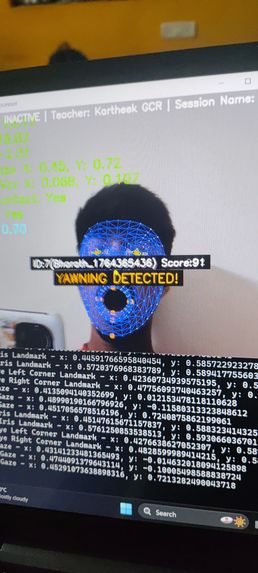
Yawning or drowsiness
-
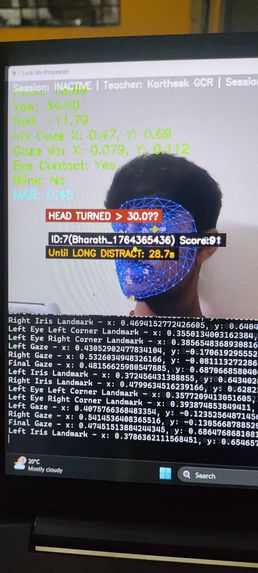
Head turned (If the student turned head more then limited time it considered as distraction sco
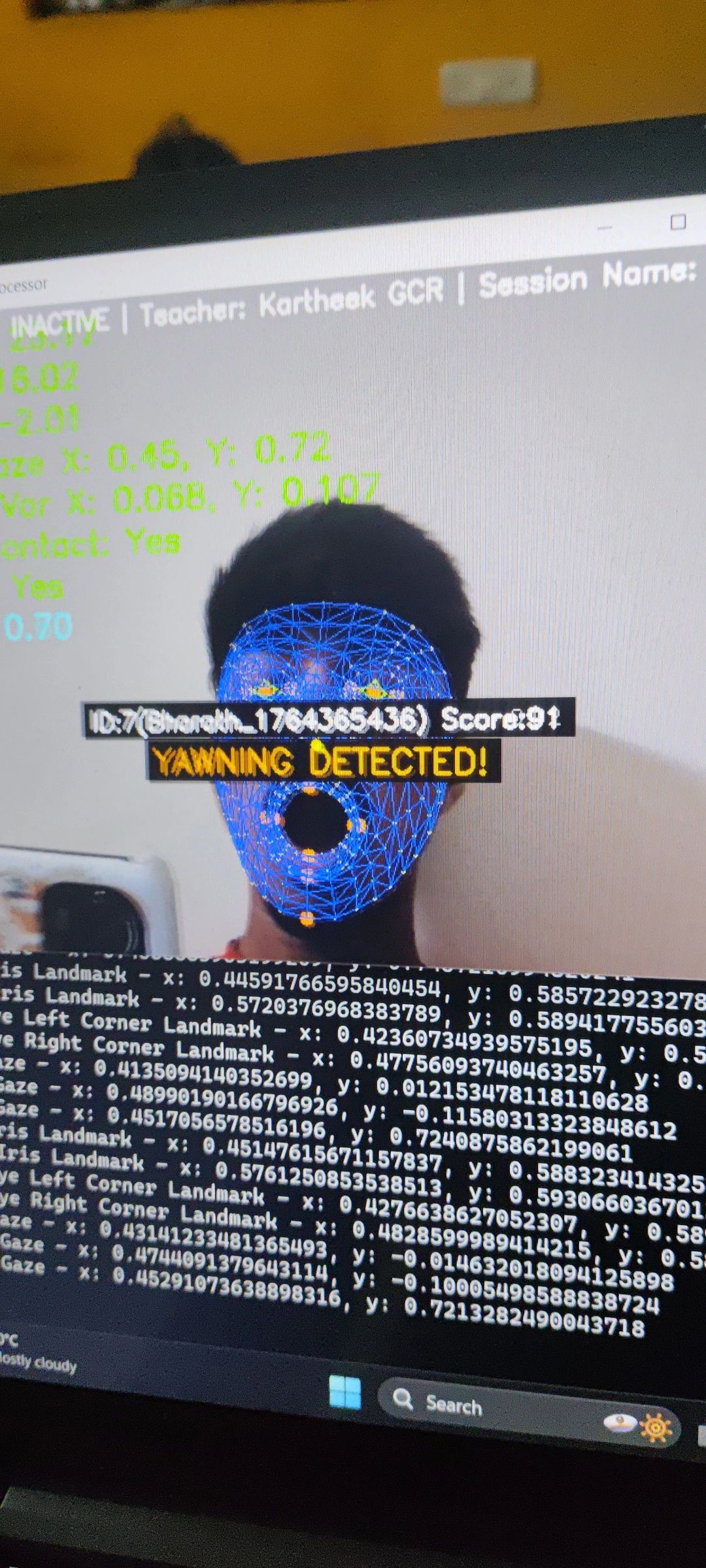
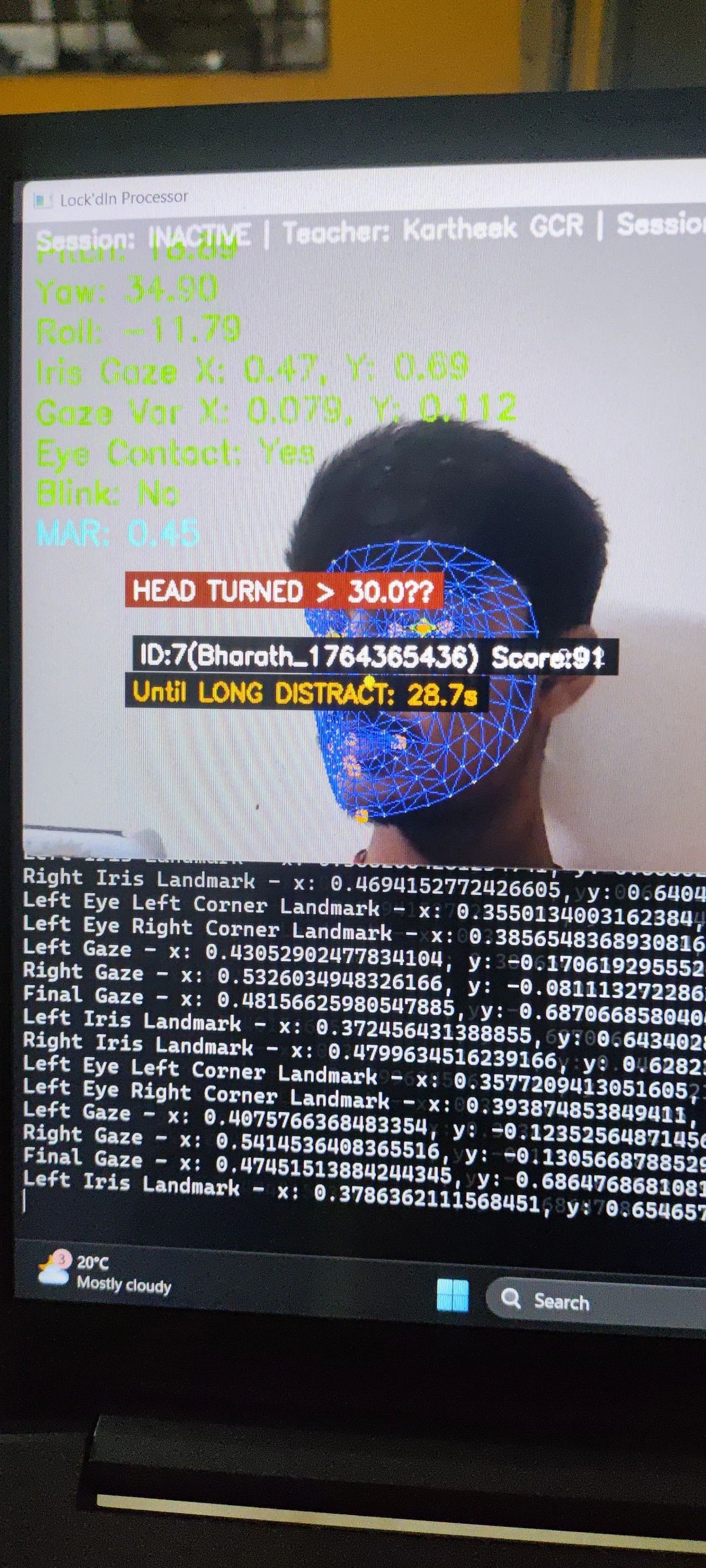
Real-Time AI Classroom Engagement Monitoring System
Problem statement
Despite smart classrooms and digital tools, student engagement and attendance are still monitored manually, leaving educators blind to real-time disengagement and unable to intervene before learning outcomes are affected.
Inspiration
In traditional classroom environments, particularly those with large student groups, instructors often find it challenging to accurately assess student attentiveness. Behaviors such as drowsiness, distraction, or disengagement frequently go unnoticed, limiting timely intervention. This challenge motivated us to explore how AI and computer vision can deliver objective, real-time insights into classroom engagement and enable data-driven teaching strategies.
What it does
The system monitors students in real time using a live camera feed and computer vision models. It analyzes facial and gesture-based cues such as eye activity, mouth opening, head movement, and hand-raise gestures to classify behavioral states including attentiveness, yawning, drowsiness, and distraction. Each student is uniquely identified through USN-based facial recognition, allowing individualized engagement tracking, real-time engagement scores, automated alerts, and detailed post-session analytics.
The system reduces instructor cognitive load while improving student accountability and learning outcomes through data-driven feedback.
How we built it
The system is developed using Python, OpenCV, MediaPipe, and TensorFlow to process live video streams captured through a high-resolution camera. MediaPipe’s facial landmark pipeline extracts precise facial features used for behavioral analysis. Head pose estimation determines attention direction, while hand landmarks enable reliable hand-raise detection.
A backend API manages data storage, real-time alerts, and analytics generation. Head movement is classified as distraction only when a student’s head remains turned away from the board/smartboard or teacher’s position beyond a predefined time threshold. Natural or brief head movements are ignored, significantly reducing false positives and improving detection accuracy.
At the end of each session, overall engagement reports are shared with the respective teacher, while individual activity records are securely stored under the registered USN or roll number.
Challenges we ran into
Key challenges included handling varying lighting conditions, maintaining accurate face recognition across continuous video frames, minimizing false positives in distraction detection, and ensuring smooth real-time performance without system latency.
Accomplishments that we're proud of :-
1.Accurate real-time classroom engagement detection
2.USN(Roll Number)-based individual student identification and tracking
3.Automated alerts and session-wise analytics
4.Scalable, modular, and extensible system architecture
5.Achieved real-time performance with low latency on standard classroom hardware.
6.Designed the system to support automatic attendance generation using USN(Roll Number)-based facial recognition, eliminating manual roll calls and reducing administrative effort.
What we learned
This project provided hands-on experience in computer vision, real-time AI systems, facial landmark analysis, and deploying AI solutions in educational environments. We also gained valuable insights into ethical considerations, privacy concerns, and responsible use of AI in classrooms.
What's next for the Real-Time AI Classroom Engagement Monitoring System
Future enhancements include multi-camera support for large classrooms, Learning Management System (LMS) integration, emotion recognition for deeper engagement analysis, mobile notifications for teachers, predictive analytics for academic performance, and a dedicated parent application to share individual student behavioral insights responsibly.
Built with a lightweight, real-time computer vision pipeline optimized for low-latency classroom environments.
Built With
- camera
- engagement-metrics
- fastapi
- localstorage
- mediapipe
- opencv
- pose
- python
- python-runtime
- pytorch
- socket.io
- tensorflow
- typescript

Log in or sign up for Devpost to join the conversation.