🏰 Passion Intelligence — Devpost Submission
Track 3: Agent Society — Global AI Hackathon Series with Qwen Cloud
Inspiration
I kept seeing the same injustice in hiring: resumes reward pedigree, polish, and network—not evidence. Meanwhile, the people genuinely obsessed with a problem are already building toward it in public: GitHub repositories at 2 a.m., hackathon weekends on Devpost, technical writing on Dev.to and Medium, and architecture diagrams hidden inside project READMEs.
Nobody reads all that evidence because it is scattered across the internet, inconsistent, and often behind bot protection. Small startups feel this most: they cannot outspend large companies, so they need to find the few people who already care deeply about their mission.
Passion Intelligence turns that search into an auditable investigation. It does not ask, “Who has the best résumé?” It asks, “What does this person repeatedly choose to build, and does that genuine obsession match our mission?”
What it does
Passion Intelligence finds builders already working toward your problem—by evidence, not résumés.
You describe a mission, then choose one of two paths:
- ✨ Free Discovery — provide no candidate names. The system searches GitHub from the mission’s technologies and domain, finds relevant builders who may never apply, and investigates them.
- 🎯 Match Applicants — provide GitHub handles and optional links. The system auto-discovers each person’s repositories, technical writing, hackathons, portfolio, and contact trail.
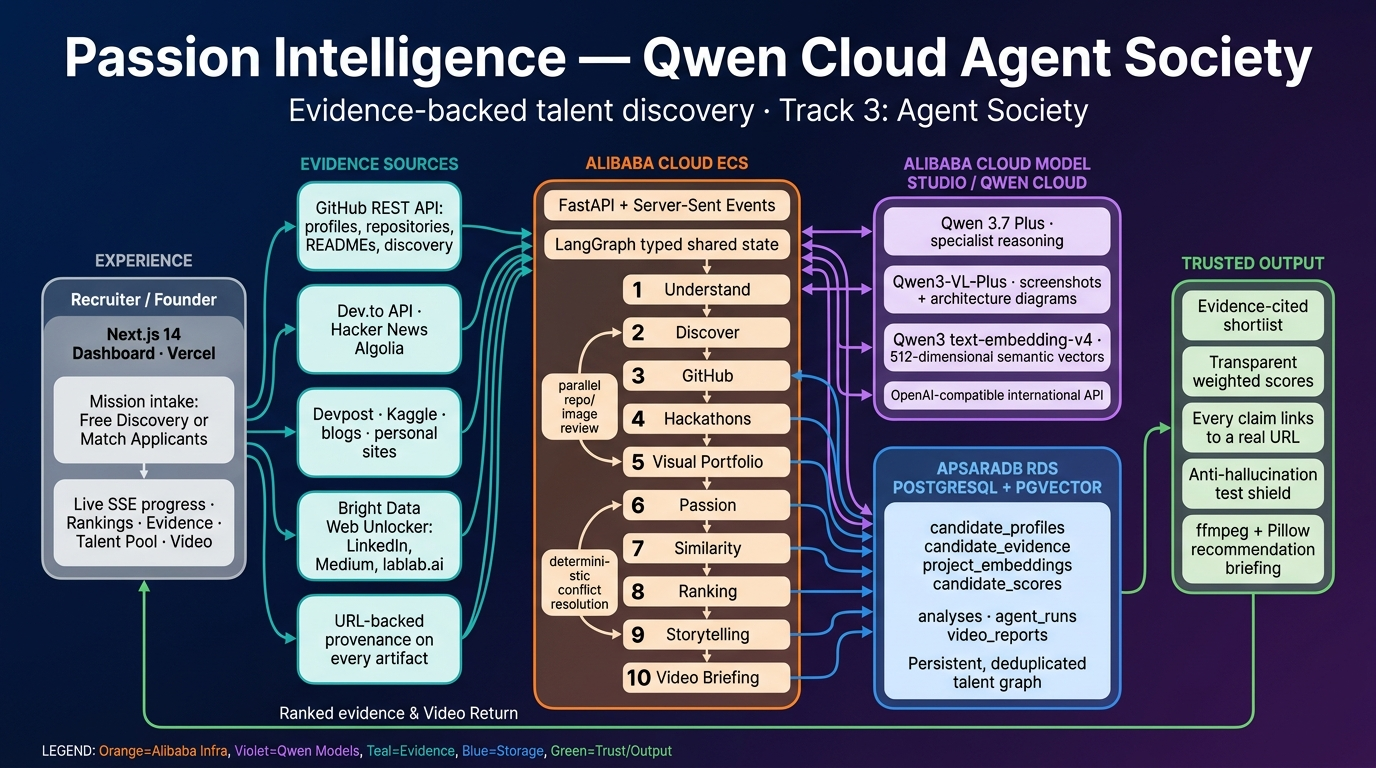
A ten-agent society then:
- structures the company mission;
- discovers public, URL-backed evidence;
- analyzes repositories and architecture;
- reviews hackathon work;
- uses Qwen-VL to inspect screenshots and diagrams;
- detects recurring passion signals;
- computes mission-to-evidence similarity with Qwen3 embeddings;
- resolves competing signals with transparent weighted ranking;
- writes an evidence-cited recruiter narrative; and
- produces a captioned recommendation briefing.
The results appear in a Next.js dashboard with live progress, ranked candidate cards, score explanations, visual portfolio analysis, source links, and a reusable talent pool. Every claim points to real evidence. Model-written prose cannot create evidence or override the deterministic ranking.
The impact: a self-taught engineer with years of relevant public work can outrank a polished résumé with no proof. It gives small teams a practical way to discover overlooked builders who are already committed to the problem.
How I built it
Qwen Cloud
- Qwen 3.7 Plus powers project understanding, repository analysis, passion interpretation, source verification, and evidence-grounded storytelling.
- Qwen3-VL-Plus reads real portfolio screenshots, product interfaces, and architecture diagrams.
- Qwen3
text-embedding-v4creates 512-dimensional multilingual/code-aware embeddings for mission-to-evidence semantic matching. - All three capabilities use Alibaba Cloud Model Studio’s OpenAI-compatible international API.
Agent Society
The agents are separate specialists, not copies of one persona. They collaborate through a typed LangGraph state containing the mission, candidate profiles, evidence, visual analyses, passion fingerprints, embeddings, scores, narratives, and video metadata.
Repository and image reviews fan out concurrently. Later agents consume the structured work of earlier agents instead of repeatedly rereading raw inputs. Disagreement is resolved by a deterministic scoring core: semantic similarity, domain alignment, technology overlap, builder consistency, voluntary effort, innovation, and evidence quality contribute inspectable weights. The storytelling agent may explain a decision but cannot alter it.
Evidence collection
- GitHub REST API — profiles, repository search, languages, READMEs, project activity, and portfolio images.
- Dev.to API — public technical writing.
- Hacker News Algolia API — Show HN and community activity.
- Devpost, Kaggle, blogs, and personal sites — directly collected public project evidence.
- Bright Data Web Unlocker — rendered access to bot-protected LinkedIn, Medium, and lablab.ai pages. Every collected item retains its source URL.
Product and infrastructure
- FastAPI + Server-Sent Events streams the ten-agent execution to the UI.
- Next.js 14 + Tailwind provides investigation, rankings, evidence, candidate maps, video, and talent-pool views.
- Alibaba Cloud ECS is the production backend host.
- ApsaraDB RDS PostgreSQL + pgvector is the persistence target for candidate profiles, evidence, vectors, scores, complete analyses, videos, and agent-run traces.
- Langfuse provides optional generation and agent observability.
- ffmpeg + Pillow render the recommendation briefing and synchronized captions.
Complete live investigation passed through GitHub, Devpost, Hacker News, Kaggle, Bright Data/Medium, Qwen reasoning, Qwen-VL, Qwen3 embeddings, ranking, visual analysis, and storytelling. The ECS instance exists; the first RDS deployment is awaiting creation of Alibaba’s
required PostgreSQL service-linked role. Until DATABASE_URL is active, the application safely falls back to in-memory state rather than pretending persistence exists.
Where candidate data is stored
When RDS is connected, data is written to purpose-specific PostgreSQL tables:
candidate_profiles— identity, GitHub handle, location, email, and verified LinkedIn URL;candidate_evidence— every discovered artifact with source, title, URL, description, technologies, domain tags, date, and confidence;github_projectsandhackathon_projects— deeper project-level analysis;project_embeddings— Qwen3 vectors used by pgvector cosine search;candidate_scores— transparent component scores, rank, explanation, and supporting evidence IDs;analyses— the complete serialized analysis so shared links survive backend restarts;agent_runs— status, latency, output summary, and trace ID for each agent;video_reports— generated briefing metadata.
The talent pool deduplicates people by GitHub handle and aggregates their evidence across analyses. Database failure never fabricates persistence: the API reports whether RDS is connected, and the pipeline continues in memory.
Challenges I ran into
- Keeping AI judgment auditable. An LLM can flatter any candidate. I inverted the design: source-backed evidence and deterministic math produce the ranking; Qwen explains the result within those constraints.
- Messy public evidence. The same person may use different handles across GitHub, Devpost, Medium, and LinkedIn. The discovery layer follows verified profile links, deduplicates URLs, preserves provenance, and treats an empty source as empty rather than inventing a fallback.
- Bot-protected sources. LinkedIn, Medium, and lablab.ai often return auth walls or anti-bot pages. Bright Data is isolated behind one adapter, with budget controls so paid derived sources are never queried accidentally.
Multimodal reliability. Portfolio images can be huge, duplicated, or irrelevant photos. The visual agent validates MIME types, caps downloads, deduplicates repository cards, retries transient failures, and filters people-centric images.
Embedding migration. Moving from 384-dimensional local vectors to 512-dimensional Qwen3 vectors required an explicit pgvector schema migration. The deployment rebuilds only the reproducible embedding table when dimensions change.
Accomplishments that I’m proud of
- A real ten-specialist agent society with shared state, parallel investigation, deterministic conflict resolution, and visible progress.
- Qwen reasoning, Qwen-VL vision, and Qwen3 embeddings all working through one production provider layer.
- Bright Data successfully returning and parsing bot-protected evidence while retaining source URLs.
- An anti-hallucination suite that rejects missing evidence IDs, nonexistent references, invented narrative projects, and evidence without URLs.
- Free Discovery that finds relevant builders who never applied.
- A persistent talent-graph design that reuses prior evidence instead of repeatedly scraping the same person.
- A complete product—not a notebook—with a web dashboard, API, live agent progress, explainable scoring, visual analysis, and video briefings.
What I learned
- Agent specialization is most valuable when each role has a distinct contract and produces structured state for the next role—not when agents merely have different names.
- The trustworthy division of labor is deterministic math for judgment and Qwen for interpretation, synthesis, and multimodal understanding.
- Provenance must be attached at discovery time. Trying to reconstruct citations after generation is too late.
- Graceful degradation is a production feature: a failed source should reduce evidence, not crash the investigation; a failed database should report in-memory mode, not silently claim persistence.
- OpenAI-compatible APIs made provider migration easy, but embeddings, vision routing, schemas, health reporting, deployment, and documentation still required deliberate engineering.
What’s next for Passion Intelligence
- Measure agent-society quality and latency against a single-agent baseline.
- Learn from recruiter feedback while expiring stale evidence and preserving an audit trail.
- Add conference talks, package registries, papers, and opt-in community sources.
- Build a “hidden gems” mode that explicitly boosts strong evidence relative to follower count, doubling down on evidence over privilege.
Built With
- alibaba-cloud
- qwen-3.7-plus
- qwen-cloud
- qwen3-vl-plus


Log in or sign up for Devpost to join the conversation.