-
-

Landing Page
-

Voting
-

Results
-
Summary
-
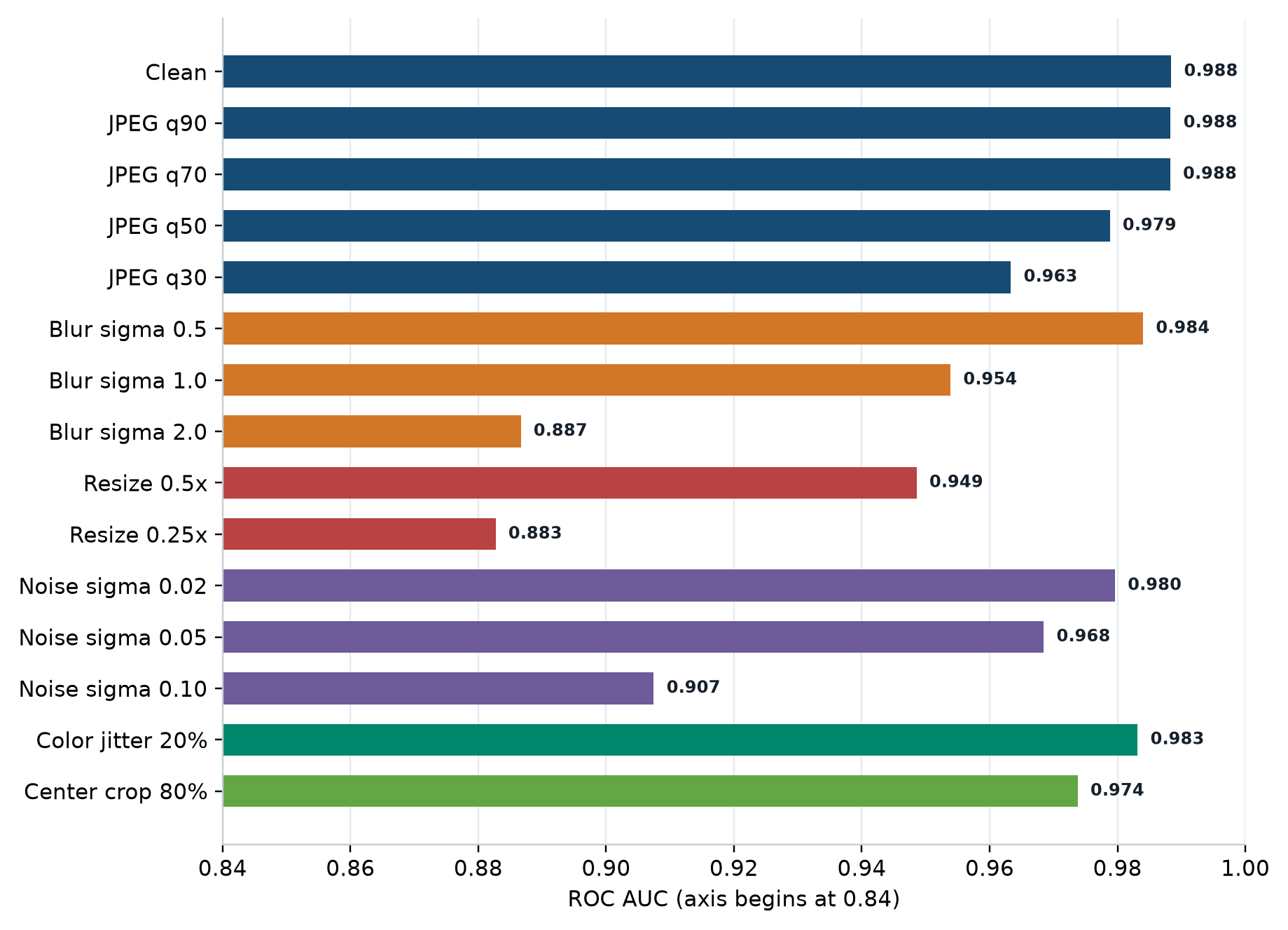
Individual Augmentation Robustness
-
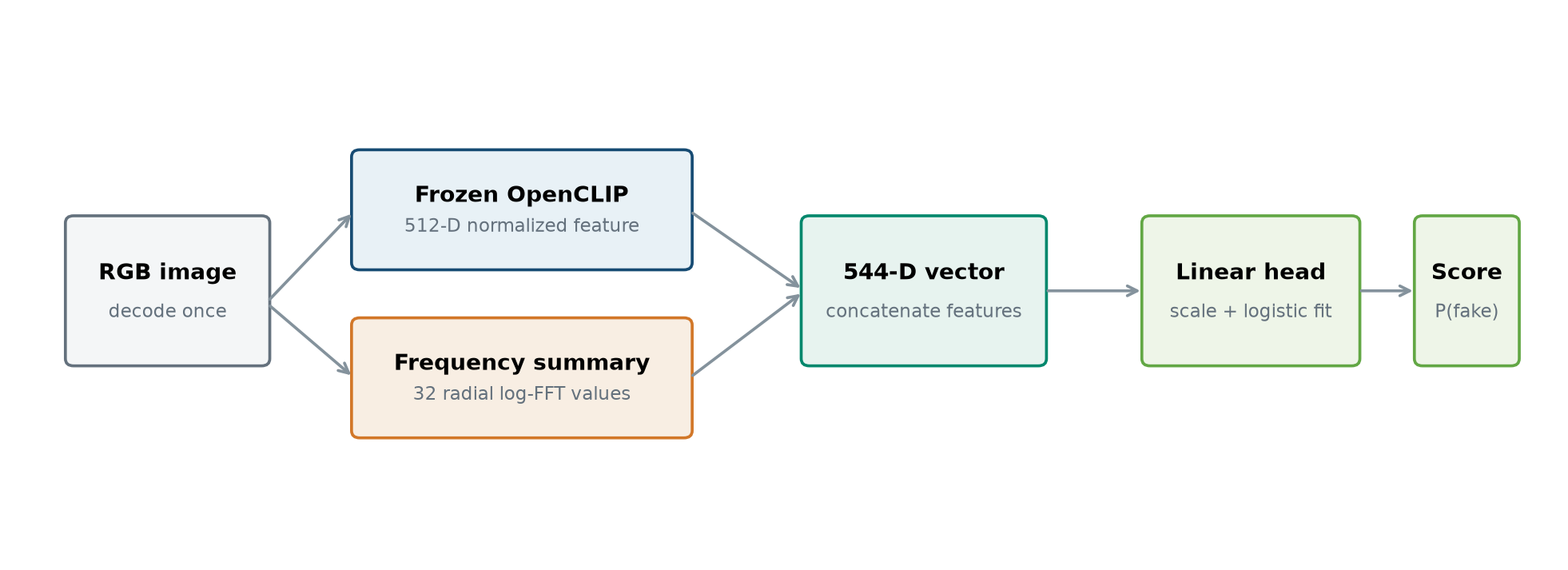
Architecture
-
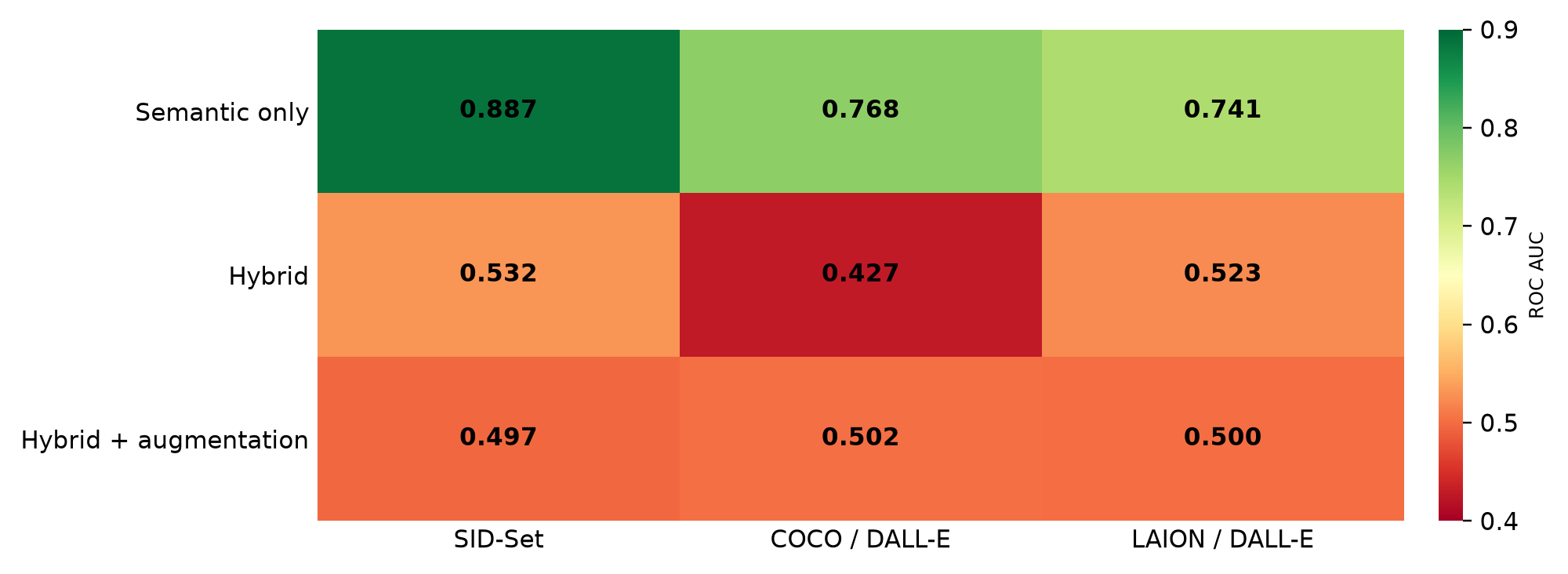
Testing with unseen data & later improving the model!
-
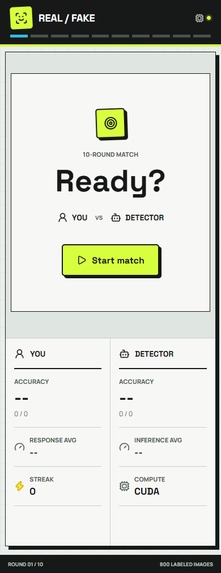
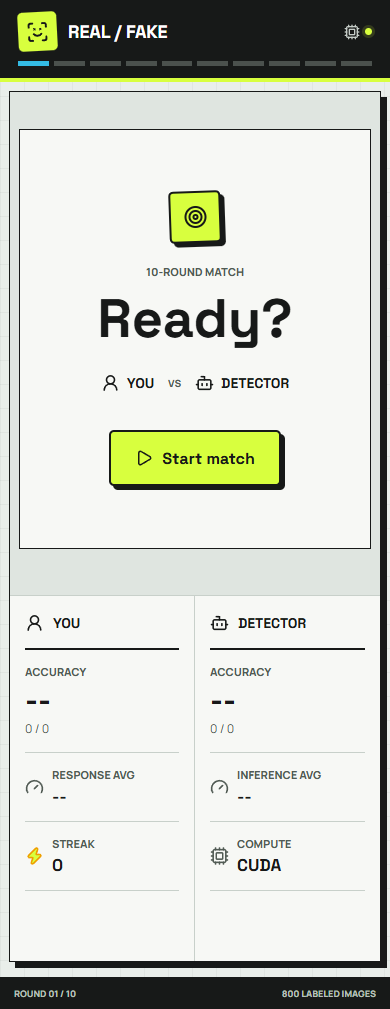
Mobile Landing
-
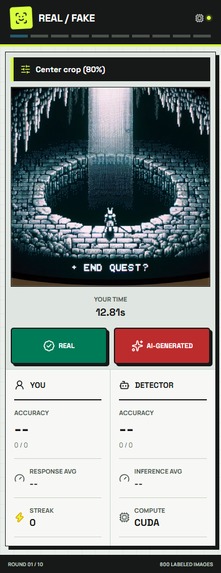
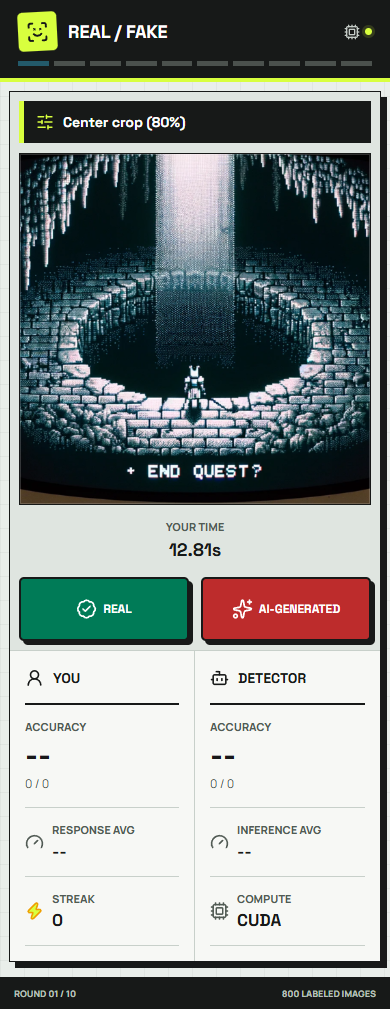
Mobile Voting
-
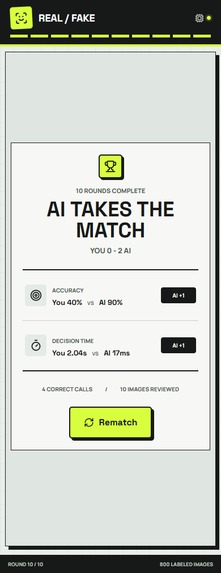
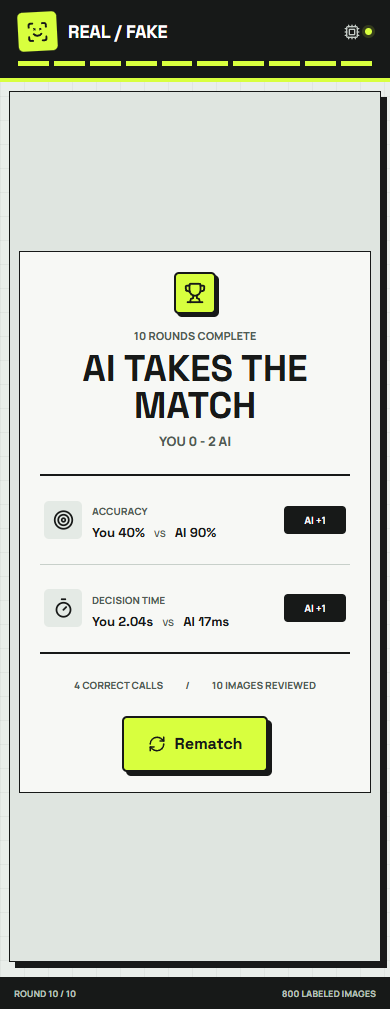
Mobile Summary



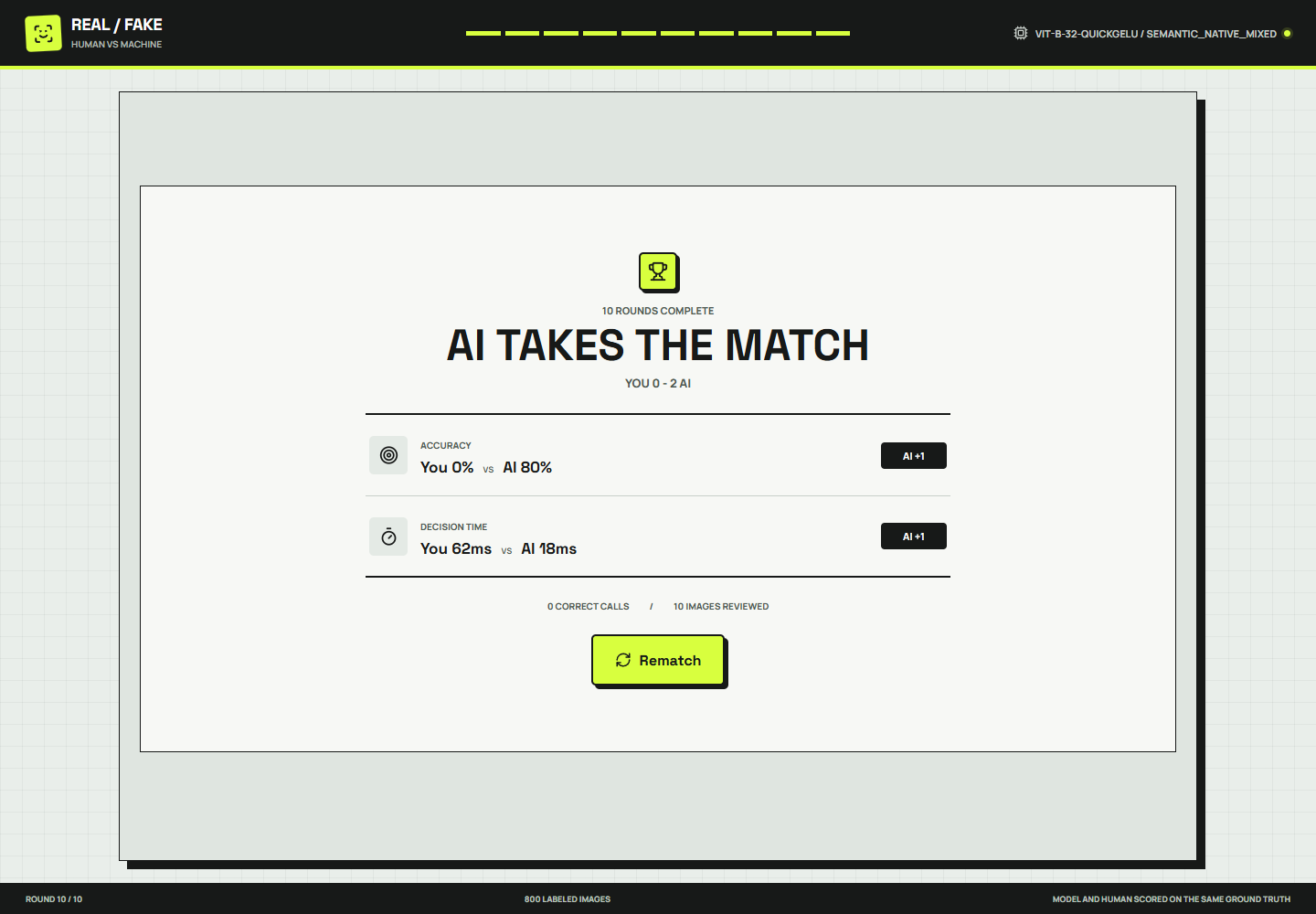
🔗 Live Demo
Play with the model I trained here: Real or Fake? Game Showcase
Download and read the full technical report (PDF)
💡 Inspiration
Most AI-image detectors look great on pristine benchmark files, but break down the second an image is compressed, blurred, or resized on social media.
Built for TikTok TechJam 2026 (Track 5: Robust Detection of AI-Generated Images Under Real-World Transformations), this project asks a simple question: Can a lightweight detector keep ranking synthetic images accurately even after real-world post-processing and edit distortions?
🎯 What It Does
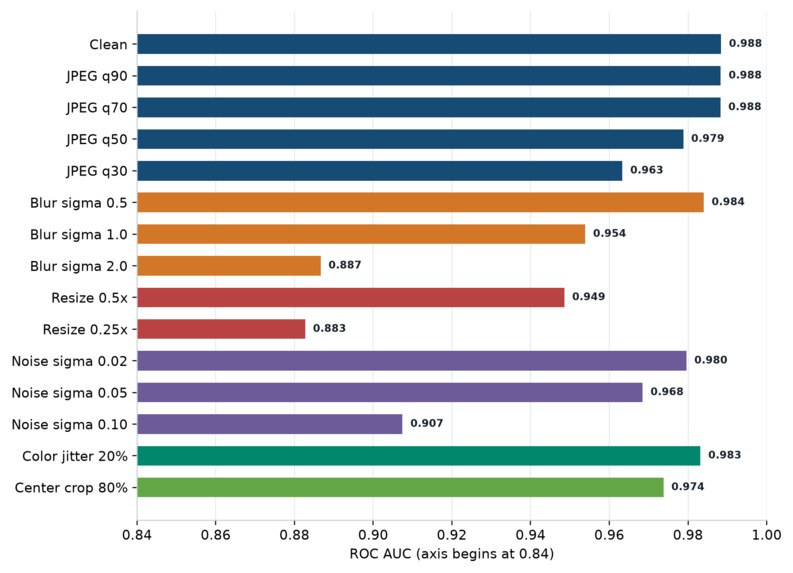
- 🧠 The Main Deliverable (Core ML Model): A lightweight, open-source detector trained to flag AI-generated images, built to stay accurate across 6 common real-world transformations (blur, noise, cropping, color edits, downscaling, JPEG compression).
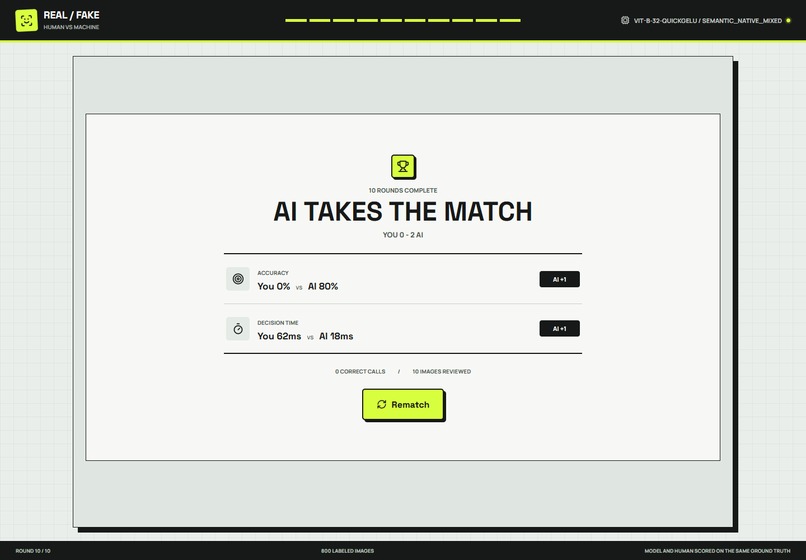
- 🎮 Interactive "Human vs Machine" Web App: A live 10-round game built as a fun proof-of-concept to let people experience the model in action. Players try to spot fake images alongside the AI in real time on identical transformed pixels.
- 🖥️ Reproducible CLI: A command-line tool that processes any image directory and returns continuous AI confidence scores in clean JSON format.
- ⚖️ 800-Image Diagnostic Pool: Evaluated on a balanced test set of 400 real and 400 fake images drawn from SID-Set and WildFake benchmarks.
⚙️ How It Works
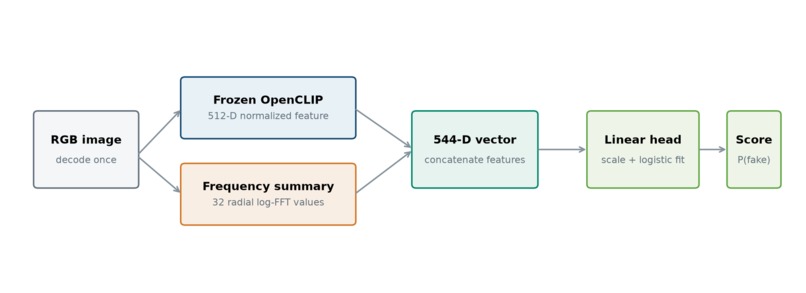
- Architecture: Uses a normalized 512-dimensional frozen OpenCLIP ViT-B/32 embedding paired with a custom-fitted logistic regression head.
- Robust Training: Trained on 48,000 image views across CIFAKE, SID-Set, and WildFake. Each original image gets paired with a clean view and an augmented view using one sampled transform (JPEG compression, Gaussian blur, downscaling, noise, color jitter, or cropping).
- Deterministic Pixel Sync: Server-side random seeds ensure the backend model scores the exact same transformed pixels served to the player in the browser, keeping ground-truth labels hidden until a guess is submitted.
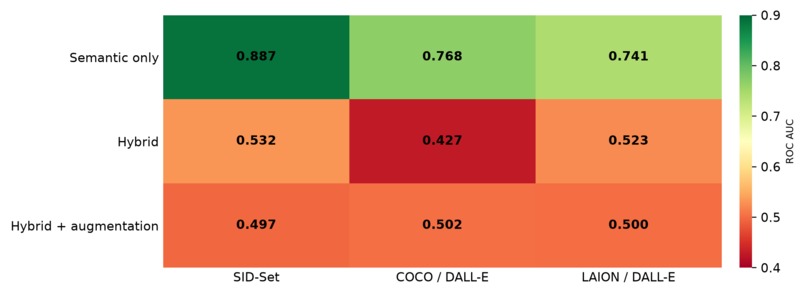
- Removing Frequency Shortcuts: I built and tested a 32-bin radial log-FFT frequency branch. Diagnostic tests showed that while frequency features boosted scores on synthetic benchmarks like CIFAKE, they failed on native-resolution images. I later removed them to ensure real-world reliability.
📊 Key Results
- Clean AUC:
0.9578 - Condition-Weighted Robust AUC:
0.8966 Workshop Composite Final Score:
0.9272Validation Promotion Gates Passed:
Held-Out SID Validation AUC:
0.9919COCO / DALL-E AUC:
0.9029LAION / DALL-E Matched AUC:
0.9127
🏆 What Makes It Different
- Model-First Engineering: Focuses on the competition's core goal with multi-domain dataset balancing, single-corruption training, and disjoint threshold calibration.
- Anti-Collapse Promotion Gates: Automatically catches and rejects candidate models that rely on unstable frequency shortcuts before deployment.
- Interactive Proof of Concept: Turns abstract robustness metrics into an intuitive game where users can test themselves against the detector on corrupted images.
🛠️ Built With
- Machine Learning & Core: Python 3.12, PyTorch 2.9.1 (ROCm 7.2.1), OpenCLIP 3.3.0, scikit-learn, NumPy, Pillow, joblib
- Hardware & Compute: Local training on AMD Radeon RX 7900 XTX / Ryzen 7 7800X3D; backend inference hosted on Modal (NVIDIA T4 GPU)
- Web App Showcase: FastAPI, React 19, TypeScript, Vite, Cloudflare Pages
- Datasets: Kaggle CIFAKE, SID-Set, WildFake
🥊 Challenges & Lessons Learned
- Time Constraints: I started late with 12 hours left for the hackathon due to other work, so I switched to the 32x32 CIFake dataset to get a working pipeline and fine-tune models quickly.
- Dataset Generalisation: When testing against a baseline, I realised the model struggled with real-world images. This showed me that 32x32 wasn't detailed enough, and I had to move to higher-resolution data.
🚀 What's Next
- Test combined transformations (like simultaneous blur and JPEG compression).
- Train on more generator-diverse, native-resolution image sources.
- Add opt-in aggregate player stats to compare human vs AI accuracy across specific edit types.
Built With
- cifake
- clip
- computer-vision
- fft
- image-classification
- jupyter
- machine-learning
- numpy
- open-clip
- pandas
- pillow
- python
- pytorch
- roc-auc
- scikit-learn


Log in or sign up for Devpost to join the conversation.