-
-
Real Life Student Balancer
-
Real Life Student Balancer
The Problem & Inspiration (The "Why")
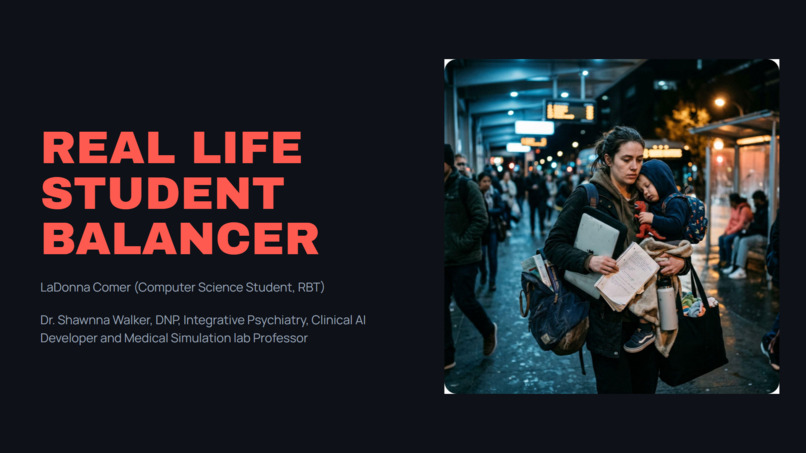
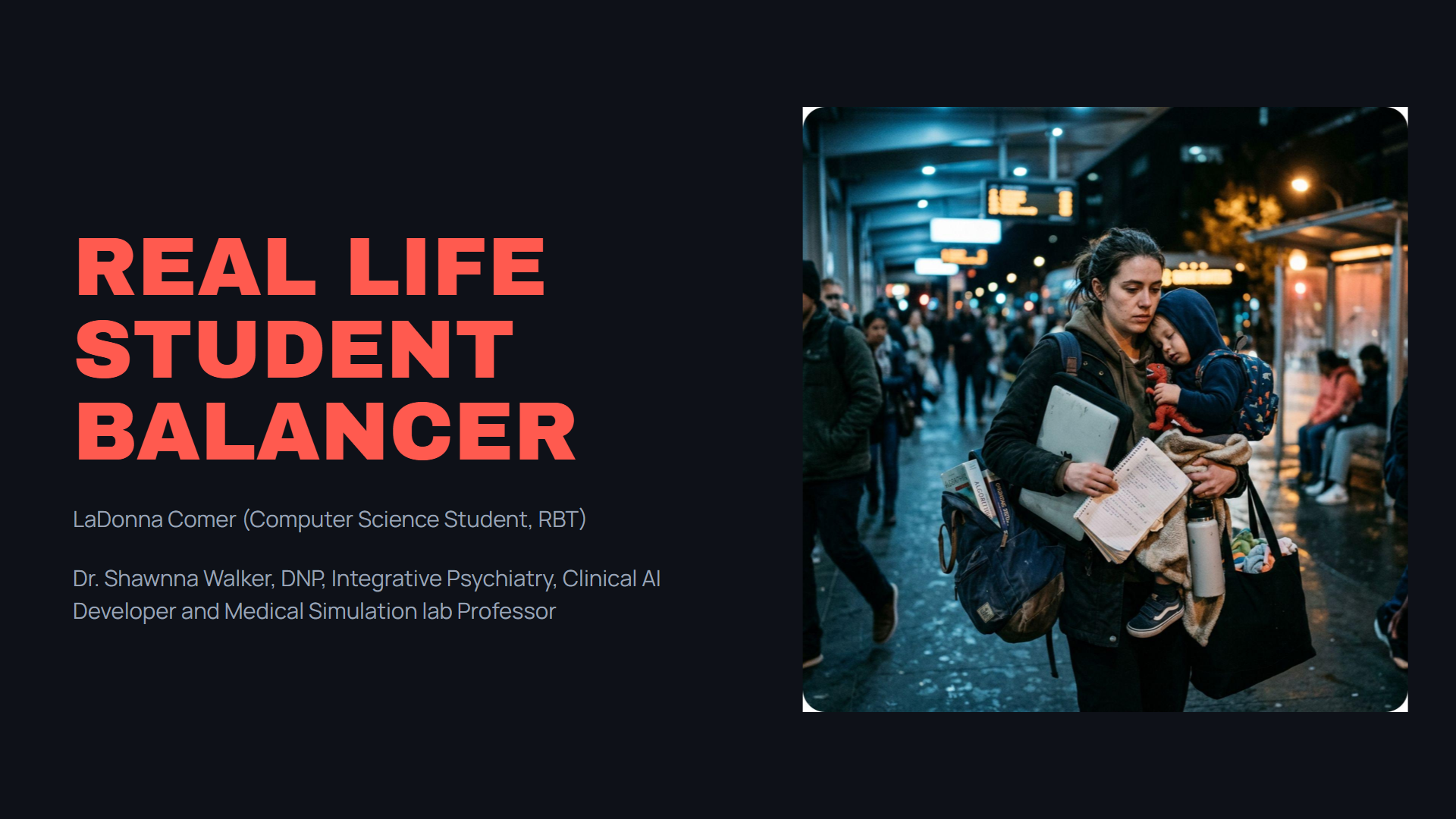
As a computer science student balancing a busy work schedule and family commitments, I know firsthand that academic success isn't just about grades—it's about managing limited time resources without hitting a wall. Most standard calendar tools expect students to have open schedules. We wanted to build a realistic "Student Balancer" tailored for real-life tracks, offering a safe, stigma-free space where students can audit their scheduling pace before reaching critical burnout thresholds.
What it does
The Real Life Student Balancer functions as a multi-tenant productivity portal and wellness engine:
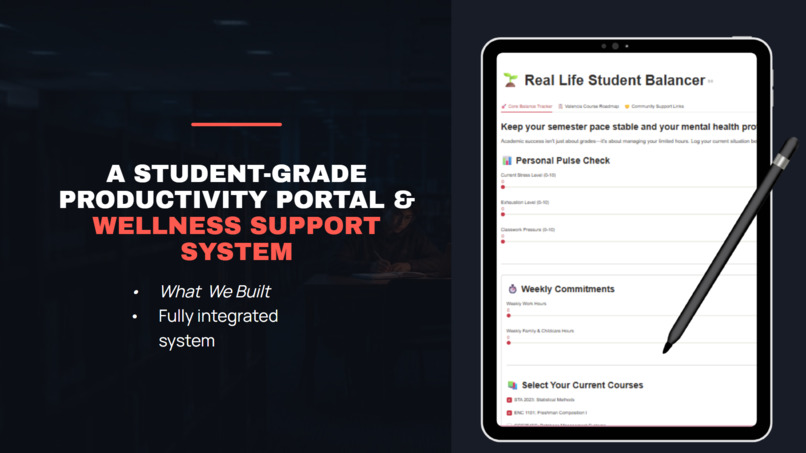
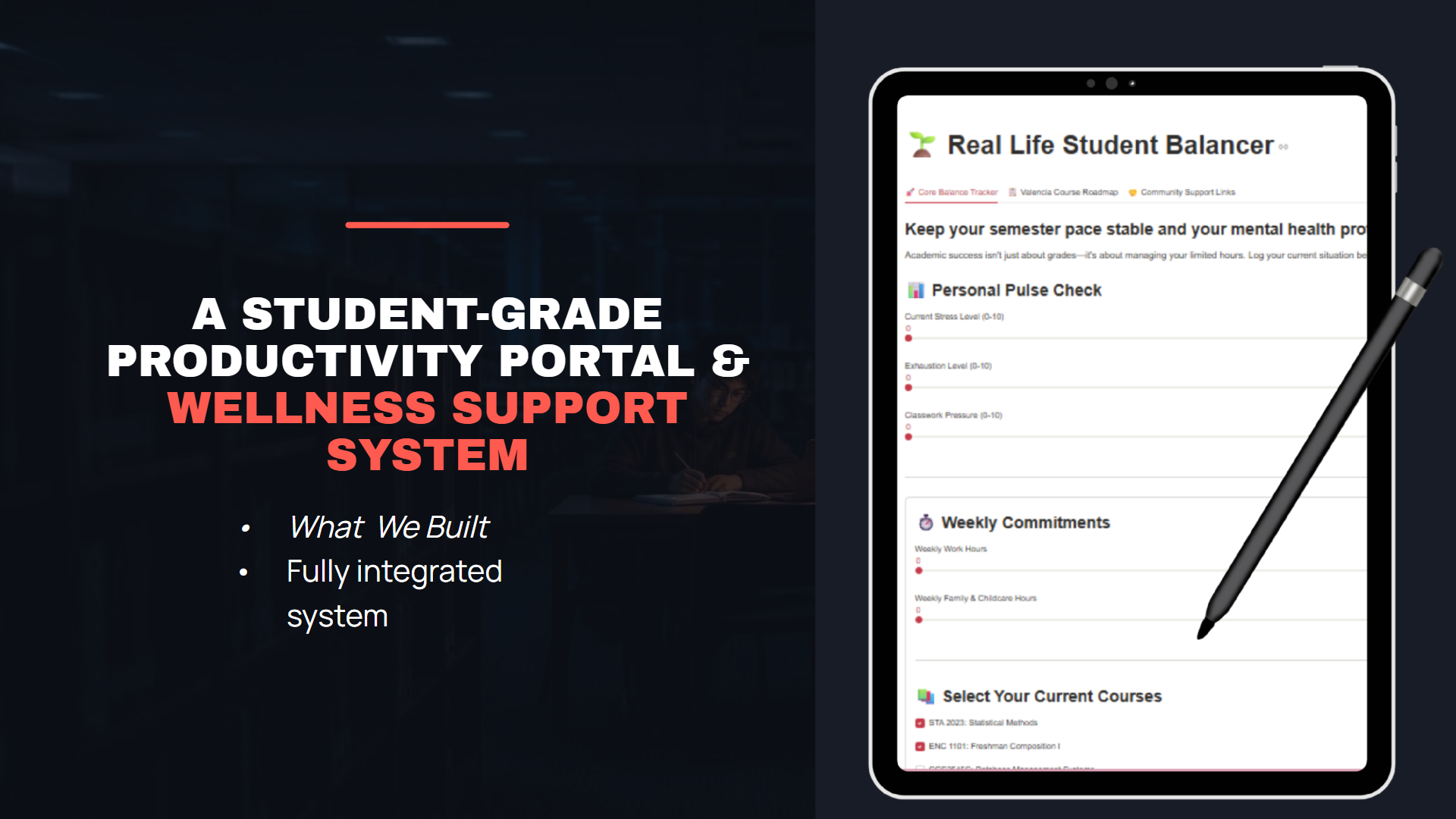
- Time-Resource Analyzer: Calculates weekly fixed commitments (employment, childcare) alongside estimated study loops (9 hours per course rule of thumb) to visually flag overloaded schedules.
- Instant Pulse Checks: Uses real-time slider metrics for Stress, Exhaustion, and Classwork Pressure. The exact split-second an input hits a high-risk zone (e.g., Stress 6+, Exhaustion 7+, Classwork Pressure 8+), it instantly flashes a supportive care module banner.
- Valencia Degree Mapping: Pulls course tracking arrays directly from the Valencia College A.S. Computer Programming & Analysis curriculum (including STA 2023 and ENC 1101) to simulate upcoming milestones.
- Community Care Hub: Dynamically loops critical advice boxes to a dedicated support tab featuring direct, confidential resources for crisis counseling (Heart of Florida 211), food security (Second Harvest Food Bank), and basic hygiene needs.
How we built it
The project architecture is structured into a clean, decoupled design:
- Frontend & Interactivity: Streamlit Web Framework, structured into column grids and collapsible expander containers.
- Typography & Styling: Styled cleanly using a customized Google Fonts API wrapper injecting the modern Poppins font ecosystem.
- Core Logic: Python 3 engine executing localized calculation filters and interactive state monitoring via Streamlit Session State.
- Secure Infrastructure: Configured via an encrypted environment dictionary, securely bridging internal backend loops without leaking private account metadata.
Challenges we ran into
- State Retention across Layout Tabs: Initially, submitting a form inside multi-tab components caused data rendering drops. We engineered a solution by routing inputs through persistent session memory keys to lock advice cards safely onto the screen.
- Real-time Event Triggers: Standard forms delay calculations until a button click. To create responsive warning notifications, we decoupled our Personal Pulse sliders from the form container so pages evaluate risk thresholds instantly.
What we learned
Our final project layout is the result of rapid prototyping and tough, real-time scoping decisions. Before landing on the final version, our duo cycled through and cancelled 4 prior project concepts that simply didn't fit our limited hackathon sprint window. This quick-failing strategy taught us how to spot when an idea is too bloated and gave us the confidence to pivot entirely to a focused utility that solves an immediate problem.
Beyond code, we significantly leveled up our team operations and technical workflows:
- Structured Communication and Delegation: We designed a clean project delegation model to split tasks based on individual strengths, dividing back-end data architecture routing from front-end styling.
- Technical Preparation Under Pressure: Participating in the technical communication workshops taught us how to pitch complex software mechanisms using clear, non-technical human stories—crucial for making our system digestible for reviewers.
- Cloud Hosting Mechanics: We learned how to transition our local workstation code repository smoothly to a live cloud pipeline environment, successfully managing secure cloud memory secrets without exposing private database metadata assets.
What's next for The Real Life Student Balancer
We plan to expand the prototype into a comprehensive, systemic ecosystem for student advisors and coaches. Our roadmap focuses on building out deep resource integrations and predictive trackers:
- Dynamic Advisor Alert Vectors: An automated tracking mechanism to securely forward high-risk student balance metrics straight to designated academic advisor portals for proactive support.
- Full Multi-Institution Degree Databases: A comprehensive database schema capable of hosting multiple distinct college graduation roadmaps simultaneously.
- Study Commitment Hour Calculators: A true hour-tracking script that automatically breaks down real-time homework loops and project time tracking against a student's selected courses.
- RateMyProfessor Course Matching: API integration pulling actual instructor ratings directly into the course picker panel to help students avoid high-stress scheduling combinations.
- Socioeconomic Resource Bridge (FAFSA -> Community care): A smart matching engine where financial aid inputs can automatically trigger localized, direct community care tickets—routing to mobile food banks, utility aid networks, or supply closets.
- On-Campus Counseling Outreach Forms: A direct, one-click ticket submission system that lets students immediately request a confidential mental health outreach follow-up from on-campus counseling systems.
