Inspiration
As a first-time homebuyer, I was overwhelmed by the dense legal and financial jargon in real estate contracts—words like "escrow" or "PMI" felt like a foreign language. I realized I wasn’t alone: friends renting or investing faced the same confusion. That’s when I decided to build a tool that translates these terms into plain, conversational language, making real estate accessible for everyone.
What it does
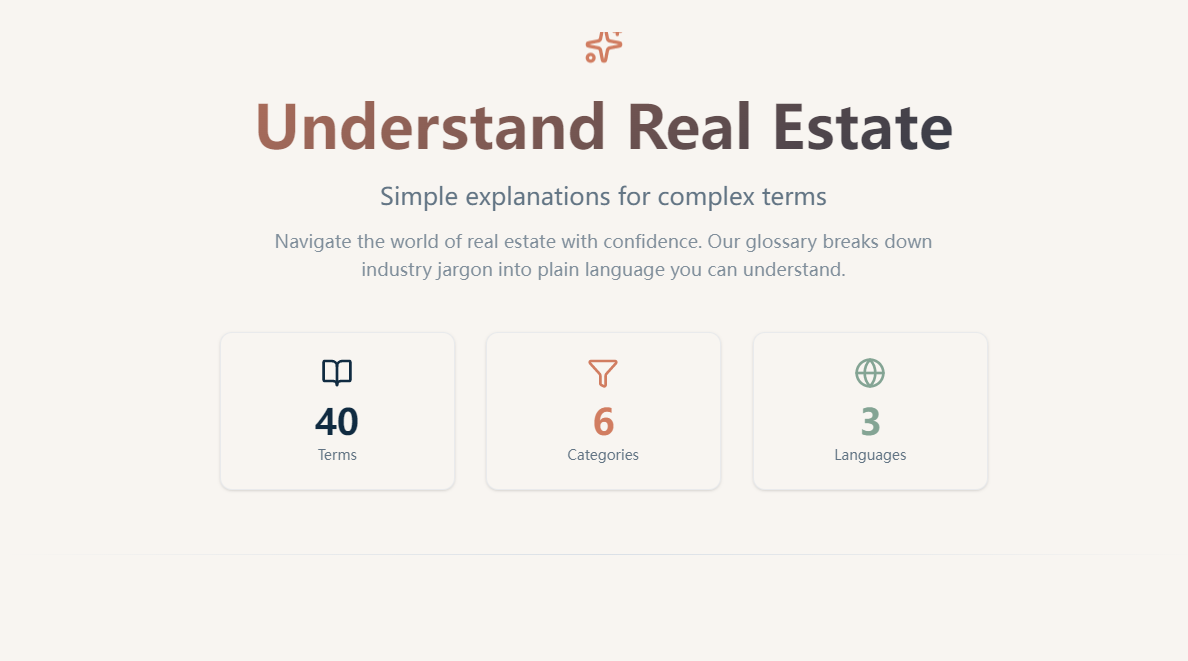
RealEstate Glossary is an AI-powered tool that explains 30+ real estate terms (spanning home buying, mortgages, contracts, etc.) in simple language. Users can search instantly, filter by category, switch between English/Spanish/French, bookmark favorite terms, and view their 5 most recent searches—all without login or complex setup.
How we built it
I started by curating realistic terms across 6 core categories, writing plain-language explanations and contract context examples for each. Using HTML/CSS/Bootstrap for the responsive UI, I built the search logic with vanilla JavaScript to match term names/explanations in real-time. For multilingual support, I integrated i18next to sync interface text and term content, and used LocalStorage to persist language preferences, bookmarks, and recent views.
Challenges we ran into
The biggest hurdle was ensuring language switching updated all content (not just UI text) instantly—initially, term explanations failed to load in Spanish/French without a reload. I also struggled with LocalStorage fallback: testing for disabled storage required building clear error notices without disrupting the user experience. Additionally, filtering terms by multiple categories meant reworking the logic to avoid duplicate results.
Accomplishments that we're proud of
We created a fully responsive tool that works seamlessly on mobile/desktop, with smooth multilingual switching and intuitive bookmarking. The search function returns relevant results as users type, and the category filter handles multiple selections flawlessly—all with zero backend dependency, making it fast and accessible offline (with cached content).
What we learned
I mastered client-side data persistence with LocalStorage, deepened my understanding of multilingual web development, and learned to prioritize user-centric design (e.g., limiting jargon in error messages). Most importantly, I realized how critical it is to test edge cases—like invalid term URLs or disabled storage—to ensure the tool works for all users.
What's next for this project
First, I’ll expand the term library to 100+ terms, adding more regional variations (e.g., US vs. EU mortgage terms). Next, I plan to add audio pronunciations for tricky terms and a printable "term cheat sheet" for users to take to appointments. Long-term, I want to integrate a lightweight backend to let users submit new terms and crowdsource explanations—keeping the glossary dynamic and community-driven.
Built With
- bootstrap
- googlefonts
- i18next
- localstorage

Log in or sign up for Devpost to join the conversation.