-
-
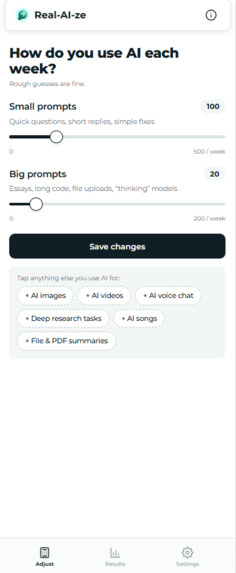
Edit AI Habits/Usage Section
-
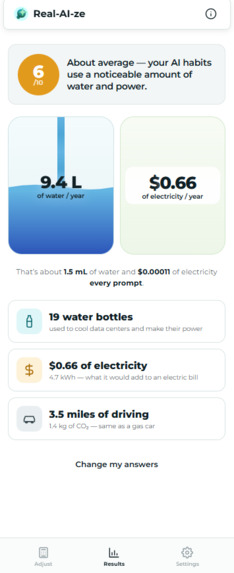
Results/Impact Section
-

Settings Section
-
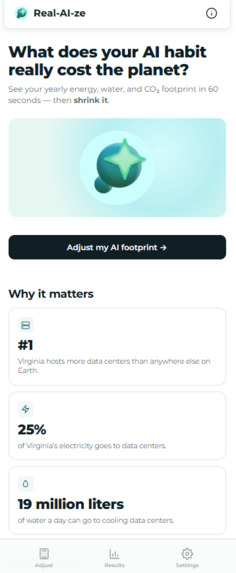
Home/Landing Page Screen
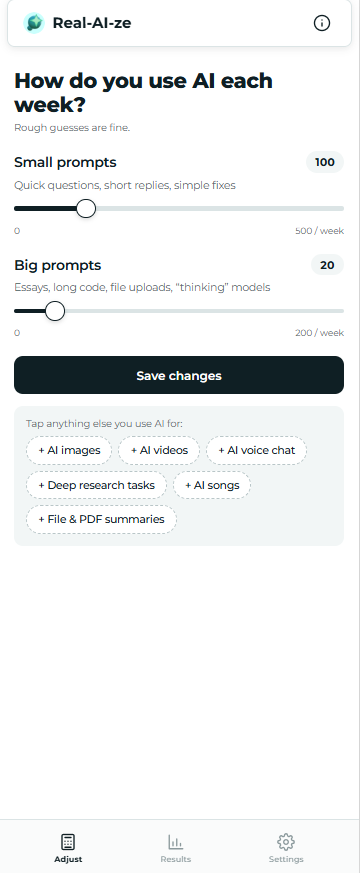

Inspiration
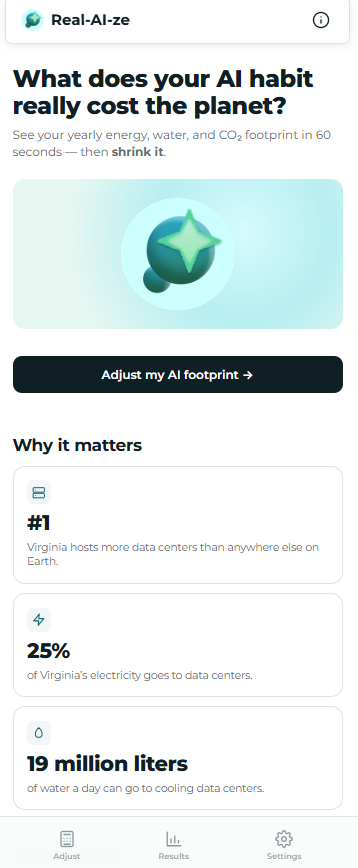
Virginia has more data centers than anywhere else on Earth, and they use huge amounts of electricity and water to stay running and cool. Moreover, Virginia is the exact region in which our team members reside, which fueled our passion and drive to illuminate the overarching environmental impact of increased AI usage. At the same time, AI has become part of our daily routine, such as homework help, image generators, and AI search. We realized none of us had any idea what our own AI use actually cost the planet and the "green" nature of the Earth. The cost is real but concealed, and people can’t change habits they can’t see. Therefore, we decided to build something that makes it visible, focused on Virginia: Real-AI-ze.
What it does
Real-AI-ze is a mobile app that turns your AI habits into a yearly environmental footprint. For instance, the "Adjust" section provides sliders for how many AI chats, images and videos you use, plus which kind of model and where you live. A live estimate of energy (kWh), water (liters) and CO₂ (kg) updates as you drag.
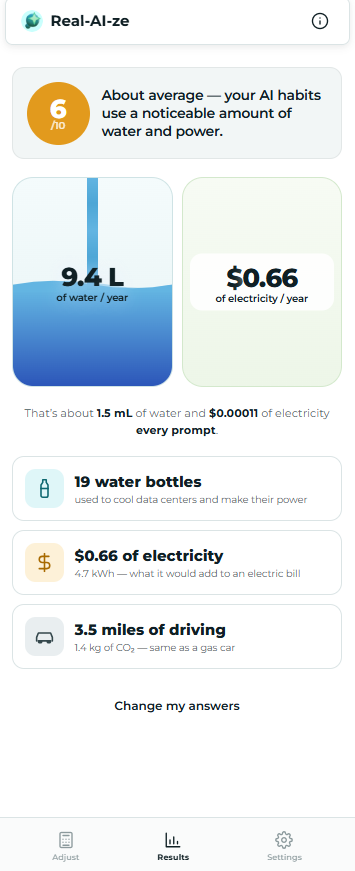
Moreover, our "Results" section shows your footprint as everyday comparisons (water bottles, phone charges, miles driven, hours of streaming, etc.), how you compare to the average student, and a “Virginia lens” showing the total if every high schooler in Virginia used AI the same way.
Additionally, our "Settings" section offers profile customization, app preferences, and a detailed breakdown of our environmental impact formulas and our reputable sources behind our findings and claims.
How we built it
Initially, we sketched wireframes in Figma and designed a clean app flow around a mobile-friendly top and bottom tab navbar. Moreover, in order to maximize speed, the entire application was built using HTML, CSS, and JavaScript without any complex frameworks or build steps. All screens exist inside a single HTML file, utilizing the HTML Canvas to generate AI-driven environmental impact insights among users. We wrapped the web application using Android Studio Capacitor, allowing the exact same codebase to run as a native mobile app in the Android OS. Finally, all environmental statistics were combined into a single file using local grid and data center energy metrics, while AI coding tools, specifically Claude and Codex, assisted us throughout the process in order to debug and rectify the code.
Challenges we ran into
To figure out how much energy and water a single AI prompt uses, we had to select reasonable values from widely varying data center statistics and keep them in one easy-to-update place for all users. Because yearly footprints can look extremely small, we gradually turned those numbers into comparisons and statewide Virginia totals to make them truly meaningful and insightful. We also had to learn Capacitor in a single day to successfully deploy our web application as a functional mobile app that holds elements like phone features and navbars. Midway through the project, our team completely restructured the app to move the page layout from JavaScript into HTML for easier collaboration and better readability, completely redefining the HTML Canvas structure. Finally, we had to confront major, unexpected merge conflicts in Git and GitHub's database, which decelerated our work effort. However, in the end, we ultimately finished and finalized our application with elevated functionality.
Accomplishments that we're proud of
- Constructing a working app that progresses from an idea to a wireframe to a tangible application in under 4 hours.
- Designing a real-time calculator that shows how your footprint changes as you drag a slider, making a thought transform into real-time statistics.
- The “Results” screen, which shows you exactly how much impact and influence your AI usage choices have on environmental conditions.
- Tying the ongoing problem of AI's environmental cost to Virginia’s abundant data centers.
What we learned
We gradually learned that data centers consume massive amounts of energy and water, placing Virginia as the global hub of this infrastructure acceleration. Meanwhile, we uncovered that the actual cost of AI varies drastically based on usage, with model size and media generation impacting expenses and fees far more than most people realize in today's world. Moreover, we found that, to confront these demands efficiently, developers can design mobile-first web applications like we did that ship using Capacitor and other frameworks and technologies, while managing stringent time constraints and pressure.
What's next for Real-AI-ze
In future years, we will continue to improve our data factuality by citing sources for every number and launching a Chrome extension that displays estimated costs and impacts directly next to AI prompts. Users will also be able to optimize their energy use with greater efficiency with AI tools and engage through school leaderboards that encourage classes to shrink their AI footprint and usage. Finally, we will make these features widely accessible by publishing the application to both Google Play and the App Store, increasing our reach and spreading our application to more populations.
Built With
- android-studio
- capacitor
- claude
- codex
- css
- html
- javascript


Log in or sign up for Devpost to join the conversation.