-
-
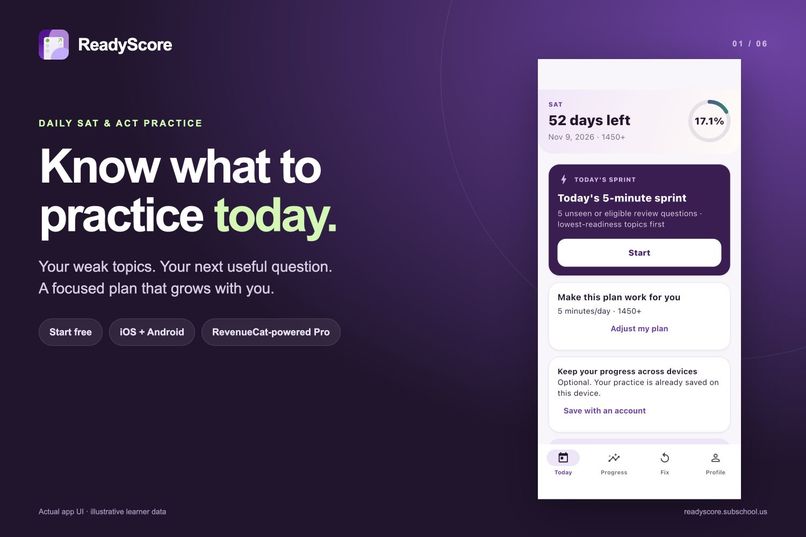
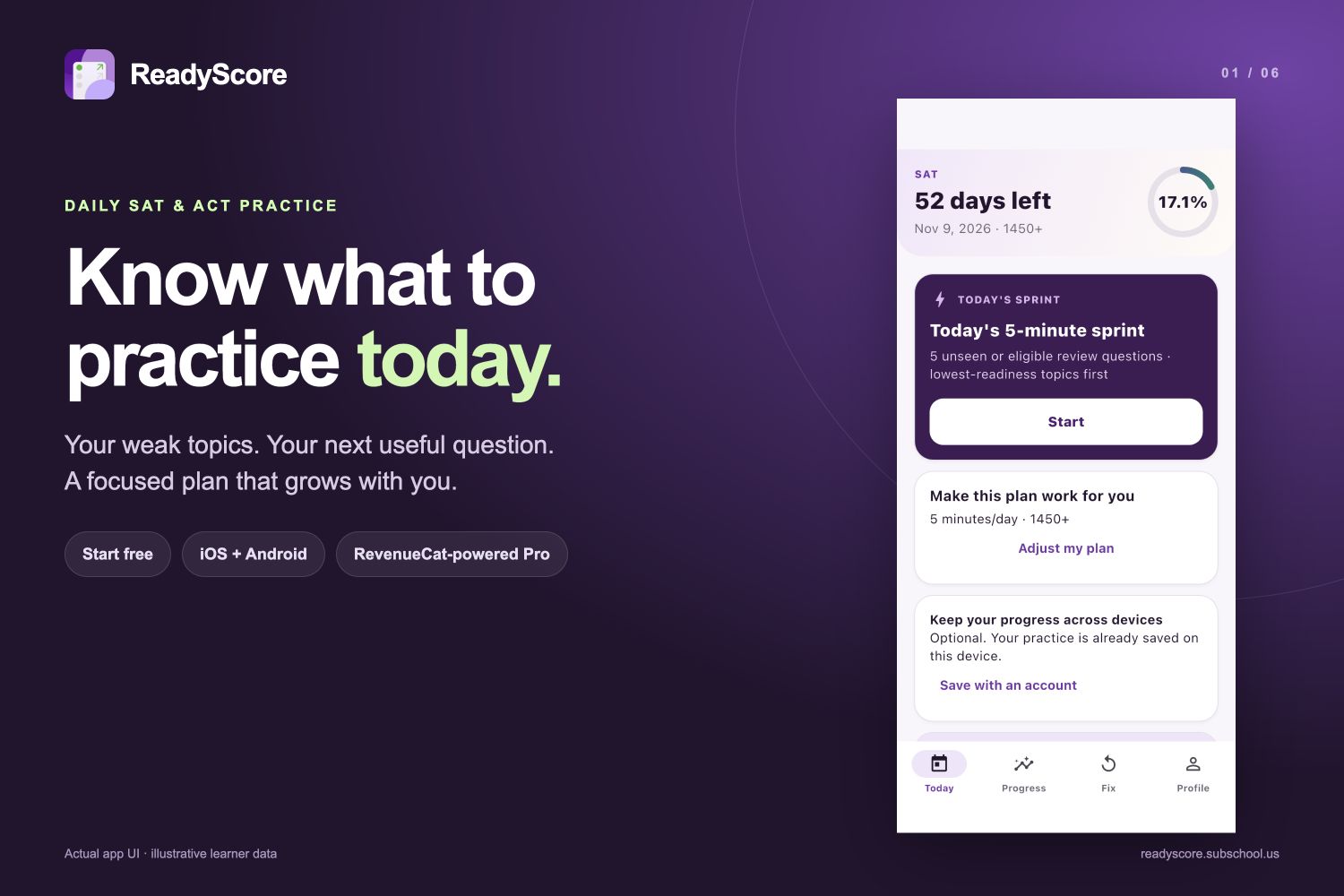
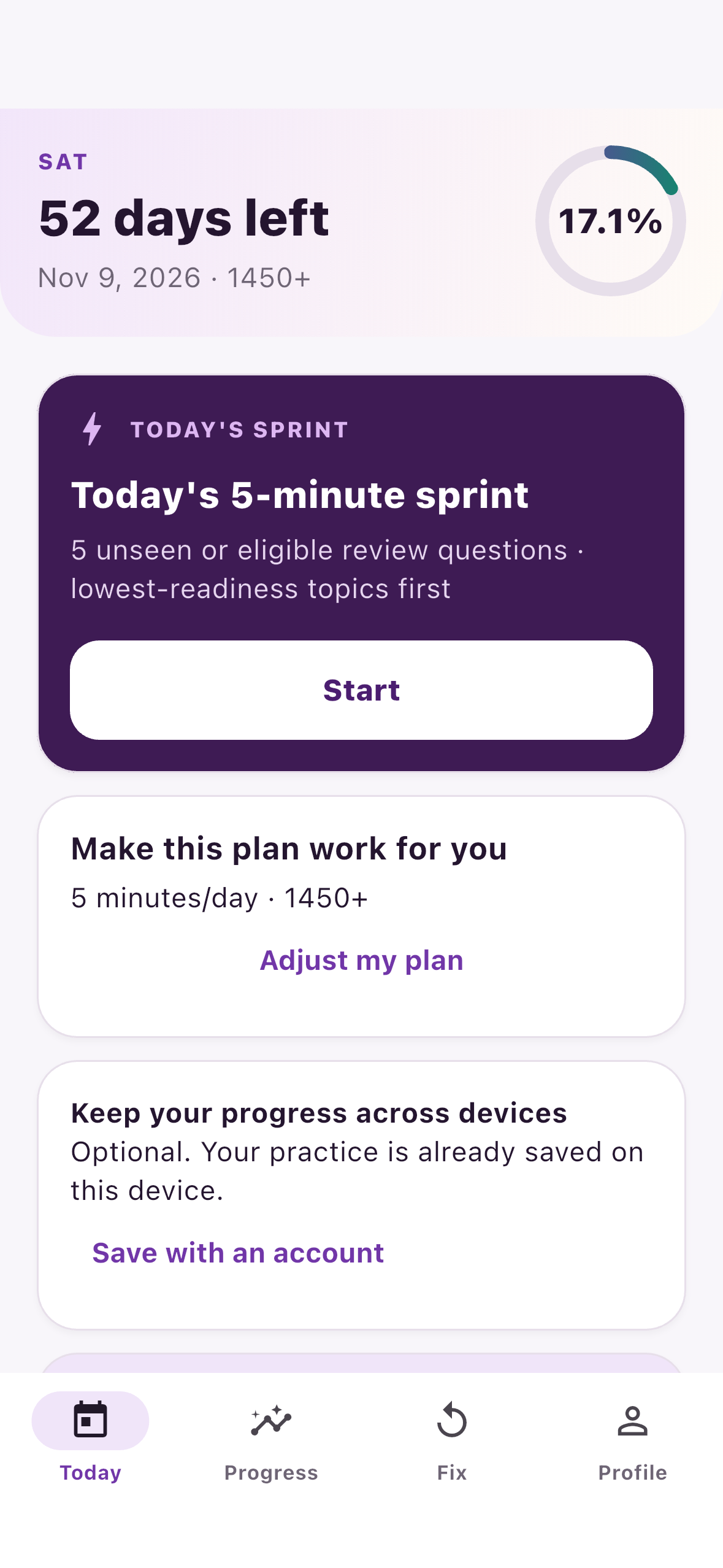
01 — Know what to practice today. Actual app UI; illustrative learner data.
-
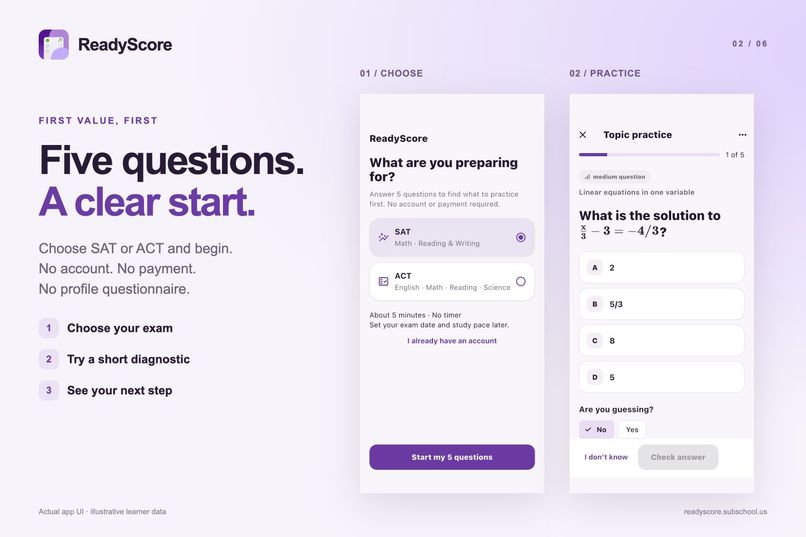
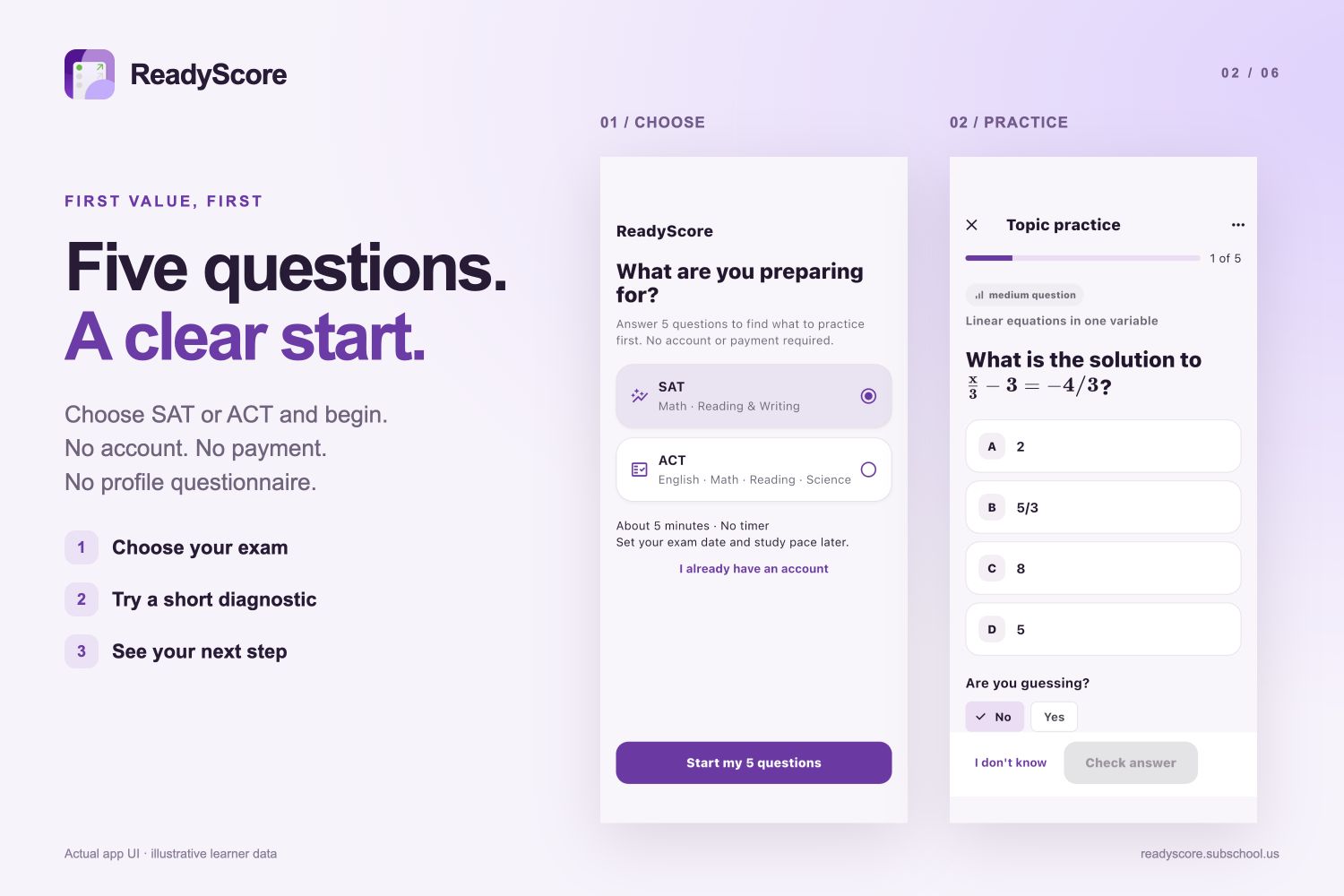
02 — Choose SAT or ACT, then practice. Actual app UI; illustrative learner data.
-
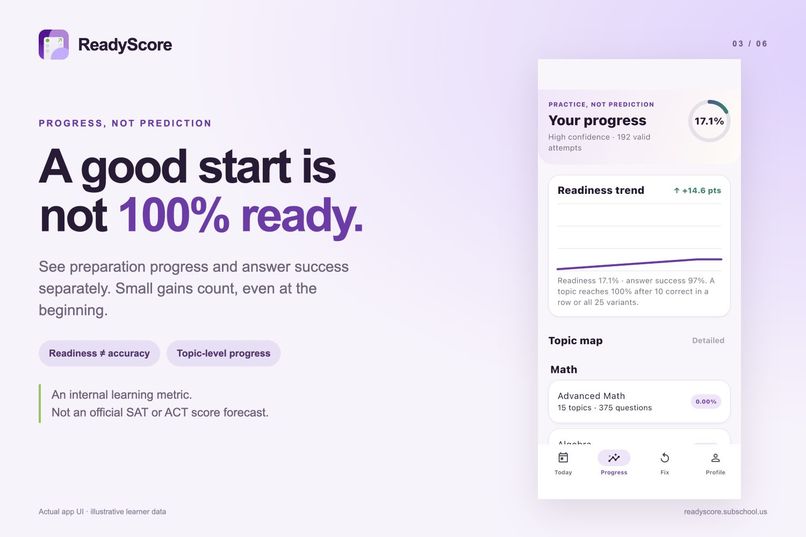
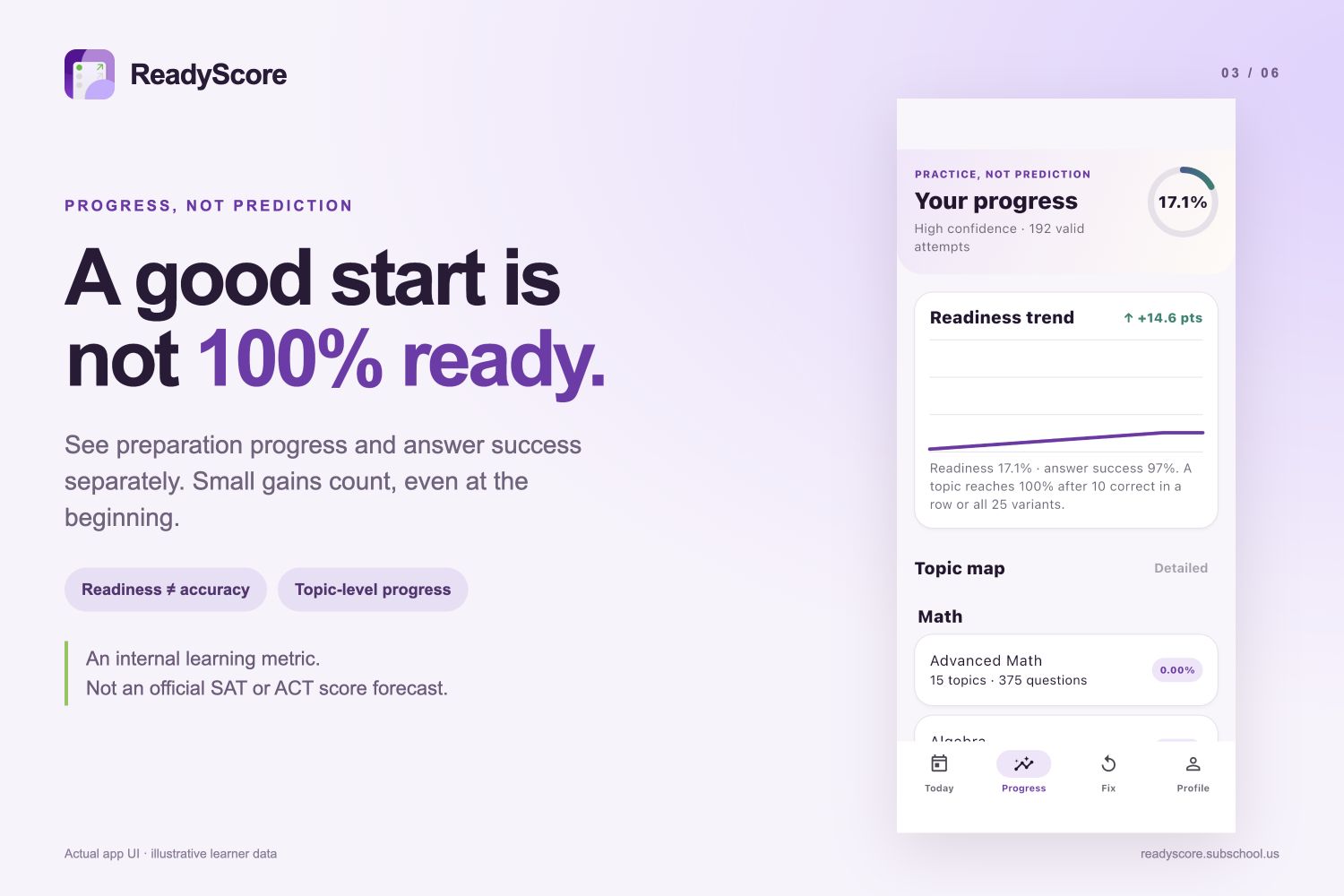
03 — Readiness and answer success are different. Actual app UI; illustrative learner data.
-
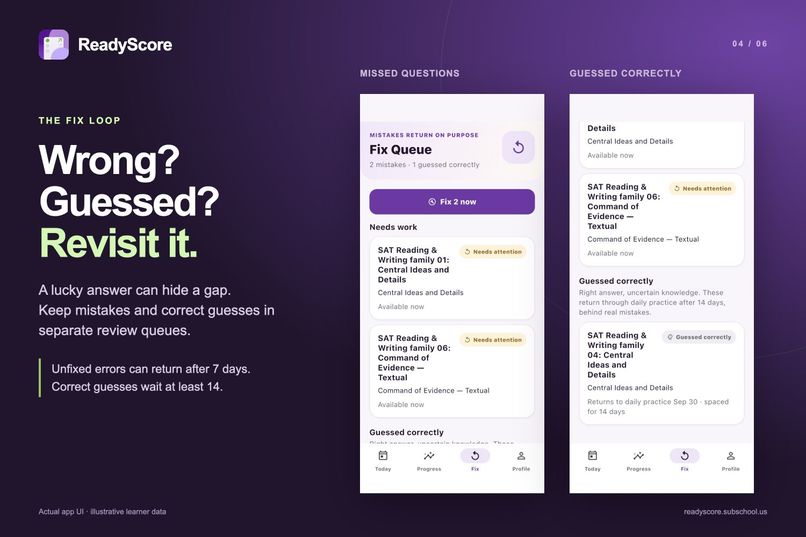
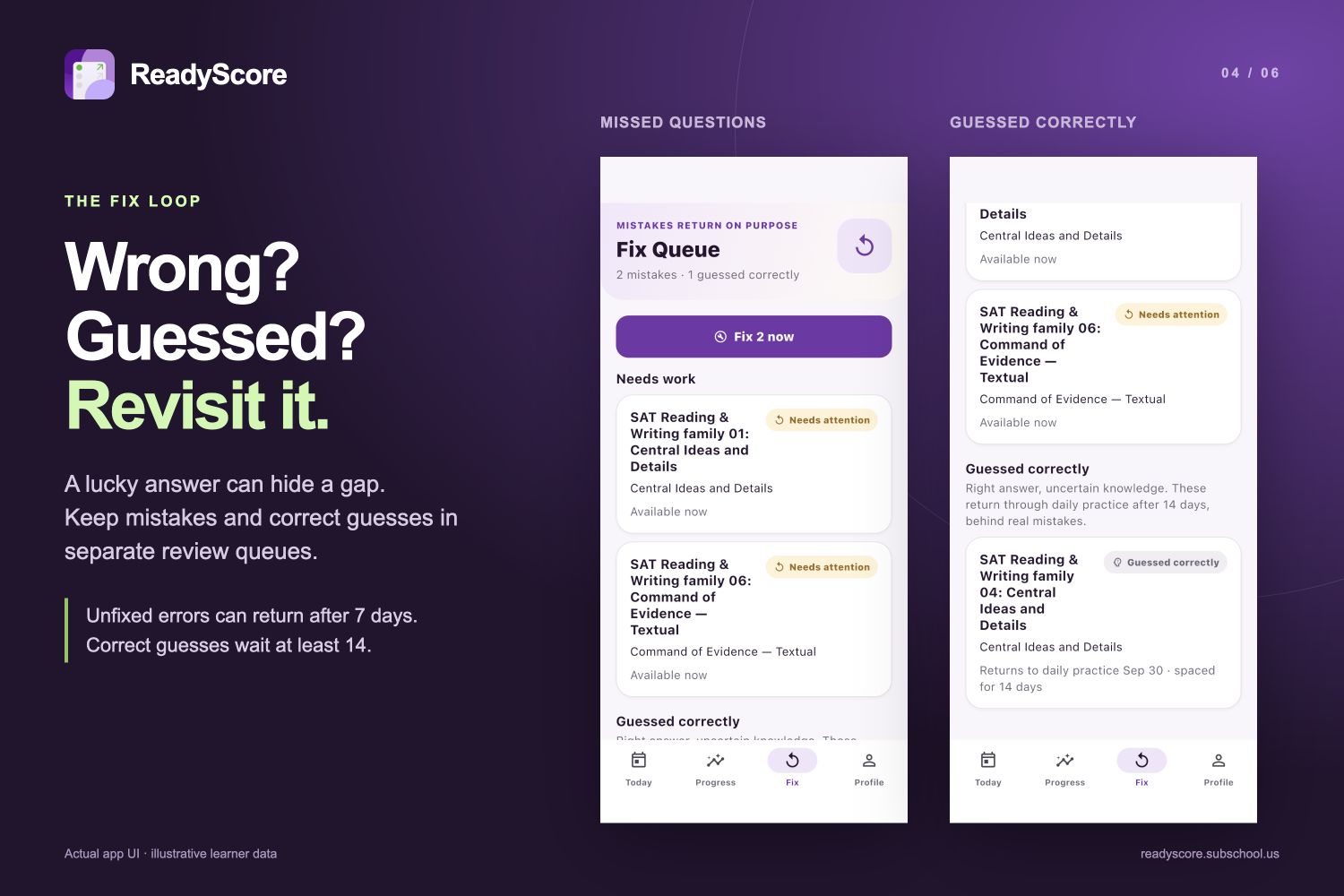
04 — Mistakes and correct guesses get their own review queues. Actual app UI; illustrative learner data.
-
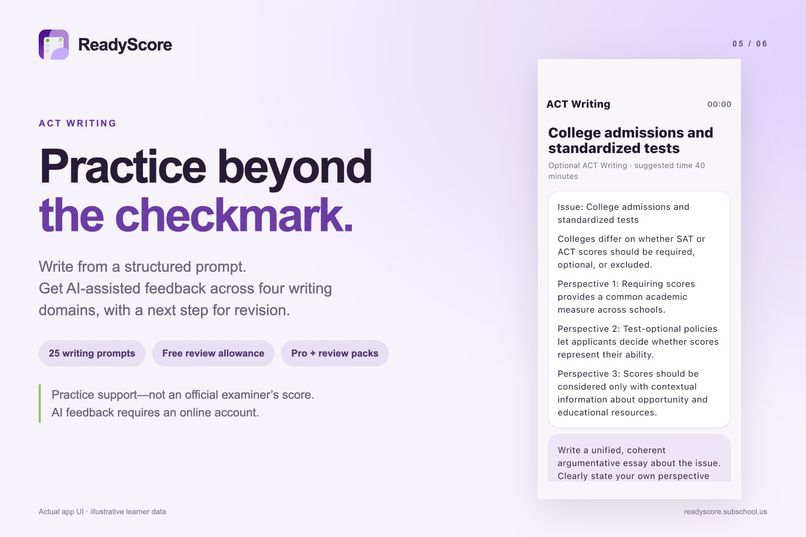
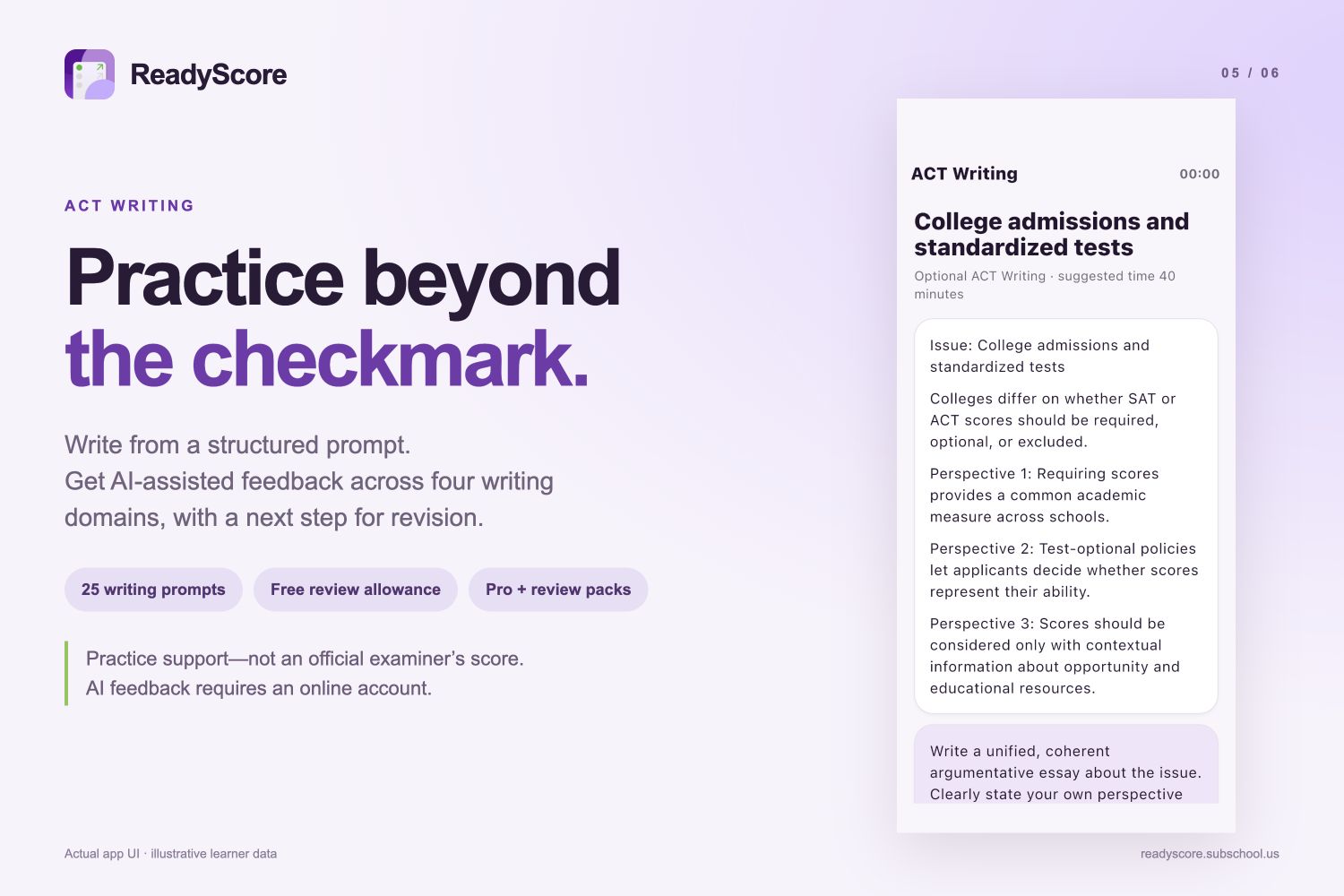
05 — ACT Writing prompts and AI-assisted practice feedback. Actual app UI.
-
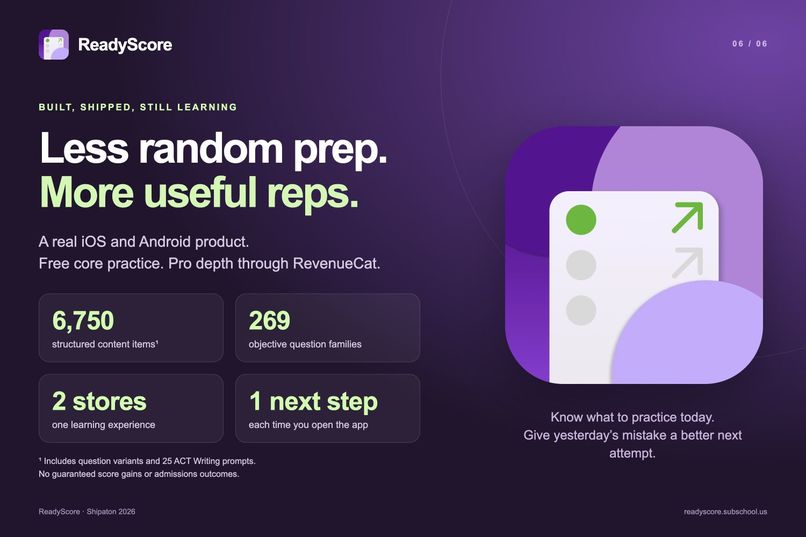
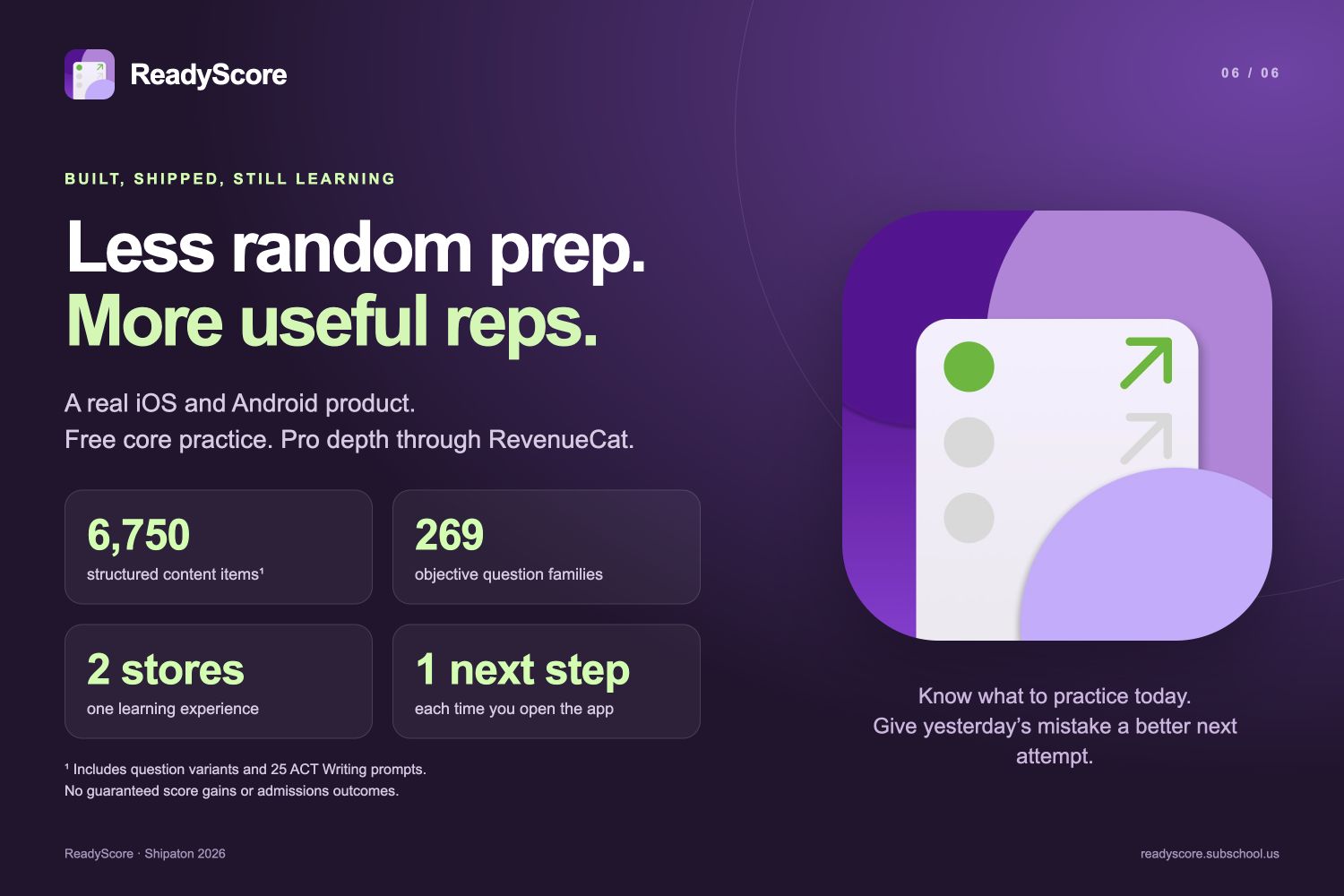
06 — Shipped on iOS and Android; 6,750 structured items, including variants and writing prompts.
-
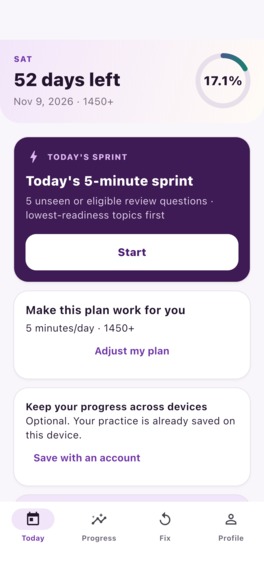
Unframed Today screenshot — 1179×2556. Actual app UI; illustrative learner data.
-
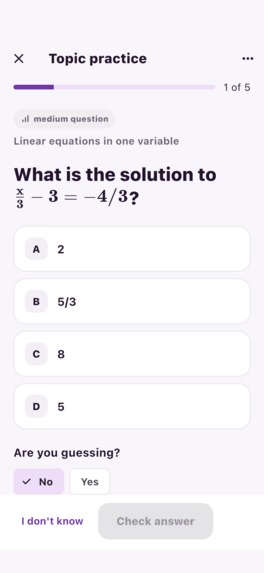
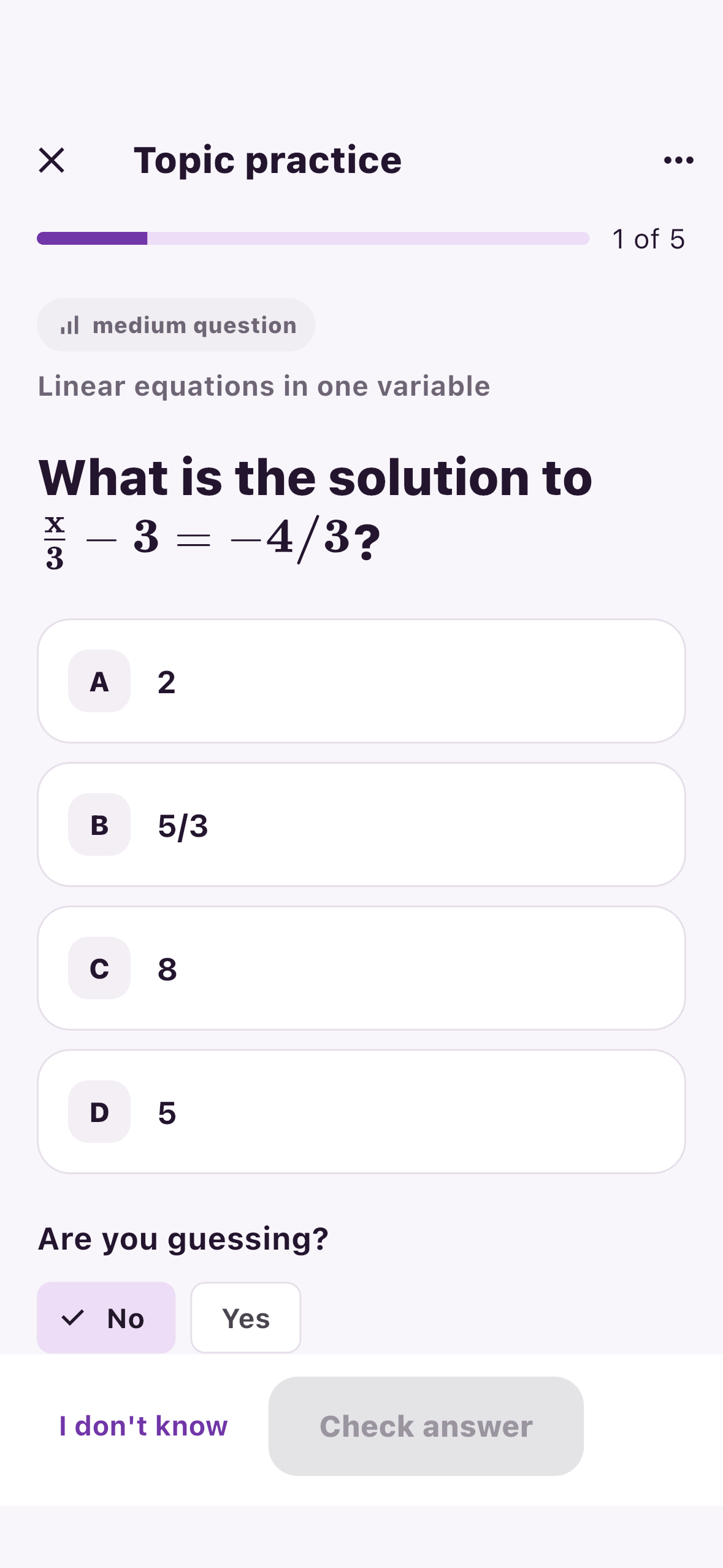
Unframed practice screenshot — 1179×2556. Actual app UI; illustrative learner data.
-
ReadyScore app icon — original uncropped 1024×1024.
Know what to practice today
ReadyScore turns SAT and ACT preparation into a focused daily plan—with a readiness map, explanations, and a Fix Queue that brings both mistakes and lucky guesses back into practice.
We created ReadyScore for Shipaton and shipped it on Android on August 10, 2026, followed by iOS on August 24. Since launch, we have improved onboarding, shifted acquisition toward meaningful first sessions, and reached our first paying subscriber.
By September 30, our app analytics recorded 3,090 user records, 274 completed onboardings, and 2,708 answered questions. The final 14 days of this reporting period accounted for 60.2% of all onboarding completions and 67.5% of all answered questions.
Inspiration: preparation needs a next step
“What should I study today?” is the question we built ReadyScore to answer.
A question bank gives students material. It does not, by itself, tell them which gap to work on, whether a correct answer was a guess, or when to revisit a mistake. We wanted to connect those decisions into one practical routine: start, find a gap, practice it, and come back with a clear next step.
That shaped the product from the beginning. Students can start free, without an account or payment details. The first interaction is a five-question diagnostic—not a registration form.
What students do in ReadyScore
Start with five questions. Students choose SAT or ACT and begin practicing immediately. The diagnostic gives the planner an initial signal; broader topic check-ins add coverage as the student progresses.
Open Today for a focused plan. The selector distributes practice across lower-readiness topics, prioritizes unseen material, and avoids duplicate questions within a set. Sessions adapt to the student's preparation and exam horizon.
Understand the answer—and revisit uncertainty. Questions include their required passages or supporting material, explanations, and appropriate response formats. Incorrect answers enter the Fix Queue. Correct answers marked as guesses are tracked separately, so a lucky result still leads to a later check. Unfixed errors can return to daily practice after seven days; correct guesses wait at least fourteen.
See both accuracy and breadth. The readiness map combines question-family coverage with consecutive correct answers, while answer accuracy is shown separately. Students can see where they are building consistency and where they still need practice.
Onboarding and active sessions resume after the app closes. Optional reminders support the daily routine, and optional Apple, Google, or email accounts add cross-device progress sync.
A structured content engine
ReadyScore ships with 6,750 structured practice items: 2,450 SAT question variants, 4,275 ACT objective-question variants, and 25 ACT Writing prompts. The objective content spans 269 question families, giving students repeated opportunities to work on the same underlying skills.
Our content pipeline turns structured source documents into a consistent bank organized by exam, section, domain, skill, family, response type, supporting material, answers, and explanations. SAT practice supports both multiple-choice and student-entered answers. ACT practice covers English, Math, Reading, and Science, with a separate Writing workflow.
The core bank is bundled with the app, so ordinary practice runs locally. ACT Writing adds online AI-assisted feedback across four writing domains, with a free allowance and additional reviews through Pro or consumable packs.
How we built it—and how RevenueCat powers the business
We built the mobile app with Flutter and Dart, backed by FastAPI/Python, PostgreSQL, and Azure OpenAI for essay feedback. Firebase Analytics captures mobile conversion events, while a web admin helps us track first opens, onboarding, practice activity, and paid transactions.
RevenueCat connects our monetization across iOS and Android. Its Flutter SDK powers App Store and Google Play purchases through shared offerings and the Pro entitlement. We support monthly and annual subscriptions, purchase restoration, and consumable essay-review packs. Our backend processes RevenueCat webhooks to update subscription state and review credits, with duplicate-event protection.
The model matches two different needs: ongoing preparation through Pro, and occasional extra essay feedback through review packs. Free core practice comes first; the paywall appears when a student wants more depth. Eligible new subscribers can use a seven-day store-managed trial. A separate launch offering lets us manage promotional availability independently of the trial.
This is now a live purchase flow with a real customer: two trials started, one converted into a paid subscription generating \$11 in reported revenue, and one remained active as of September 30. We report production purchases separately from sandbox tests and active trials.
What changed after launch
Shipping early gave us time to work on the full journey from install to practice to payment.
We shortened the path to first value. Early funnel analysis showed substantial onboarding loss. We removed the unused age step and deferred plan details while keeping the five-question diagnostic. Students now encounter the learning experience before account creation or a sales pitch.
We changed what we optimized acquisition for. Instead of treating every install as equally valuable, we instrumented onboarding and purchase events and changed Android acquisition to favor users likely to complete onboarding. We paired that with creative hypotheses around concrete student needs: choosing what to study, focused retakes, a short study break, and the difference between knowing and guessing.
We rebuilt the practice foundation. Testing exposed missing passages, repetitive sets, and distractors that made some answers too obvious. We replaced the original bank, added grouped content and response types, improved affected distractors, and tested selection and learner-progress scenarios. We also separated answer accuracy from readiness, so a strong five-question start would not suggest complete exam preparation.
We made interrupted practice recoverable. We fixed return navigation and session resumption, stopped consuming a free practice attempt just for opening an unanswered set, and ensured unanswered questions did not become artificial mistakes when a daily set expired.
We worked through production, not just the happy path. Store review and device testing surfaced sign-in, build configuration, and purchase-availability issues. Resolving them—and adding release and regression checks—was part of turning the prototype into a usable app on both platforms.
The central lesson was practical: we needed to improve the connection between acquisition, first value, and payment—not optimize each screen or campaign in isolation.
Launch results
Reporting cutoff: September 30, 2026. Our app analytics recorded:
3,090 user records, with 615 shown in the last-14-days view.
677 onboarding starts, including 348 in the last 14 days.
274 onboarding completions, including 165 in the last 14 days.
2,708 answered questions, including 1,827 in the last 14 days.
Most recorded onboarding completions and question answers occurred in the final two weeks of this reporting period. Alongside the first paid subscription, that gives us a concrete foundation for the next round of product and monetization work.
Acquisition experiments
Google Ads: The Android campaign reported 8,069 install conversions and 92 in-app action conversions on $317 spend between August 12 and September 30. The iOS campaign reported 63 install conversions on $106 spend between September 10 and September 30.
Noise: Between August 12 and September 30, we ran 131 posts generating 32,112 views on \$251 spend, exploring repeatable creative formats around the student's next useful study action.
TikTok Ads: Between September 7 and 12, the campaign reported 37,500 post views, 581 landing-page views, and 37 followers on \$102 spend.
Campaign conversions, social views, and app user records are separate measures from different systems. We use them to evaluate different stages of the journey, rather than combine them into one user total.
What comes next: a study habit and a sustainable business
Our next priority is to improve monetization and retention together, so ReadyScore can cover its acquisition and operating costs while keeping a useful free starting experience.
We plan to test when students see the paywall, how clearly Pro communicates its additional value, and how subscription and essay-review packaging fit different preparation needs. We will evaluate these changes through paid conversion, repeat practice, renewals, and revenue relative to acquisition and service costs.
Our dashboard currently reports 5.4% D7 retention and 1.1% D30 retention. Improving return-to-practice behavior is therefore a specific product priority alongside monetization. We will examine onboarding-to-return cohorts, refine reminders and mistake-review entry points, improve content flagged as ambiguous, and validate essay feedback against human review.
The broader goal is to make structured preparation easier to access: a student should be able to begin a useful study session without first arranging tutoring, creating an account, or paying. Local core practice supports that starting point; paid features support continued development and deeper assistance.
ReadyScore connects the next question, the next review, and the next study session—so students always have a practical way to move forward.
ReadyScore is an independent preparation tool, not affiliated with or endorsed by College Board or ACT. Readiness and AI essay feedback are practice aids, not official score predictions; topic check-ins are not full-length mock exams. Gallery screens show the actual app with illustrative learner data.


Log in or sign up for Devpost to join the conversation.