Inspiration
Two numbers, twelve months apart. In March 2025, AI-referred traffic converted 38% worse than everything else on a retail site. In March 2026 it converted 42% better (Adobe Digital Insights). Agent traffic stopped being a curiosity and became the channel that pays.
Then the other number: 78.6% of agent carts are abandoned (Presenc AI). And Shopify said on its Q1 2026 earnings call that a catalogue an agent can read converts 2× better than a page it has to scrape.
So the prize is real, it is arriving now, and most of it is being lost to a data problem. But a merchant hears "agentic commerce" and has no way to see which door is locked on their own store. Theme checkers grade the page a human sees. Nothing grades what an agent retrieves.
We wanted to build the instrument, and then — before claiming anything — point it at the field and find out whether the problem was real.
What it does
Paste your domain. Get a score, a fix list, and a receipt that names its source.
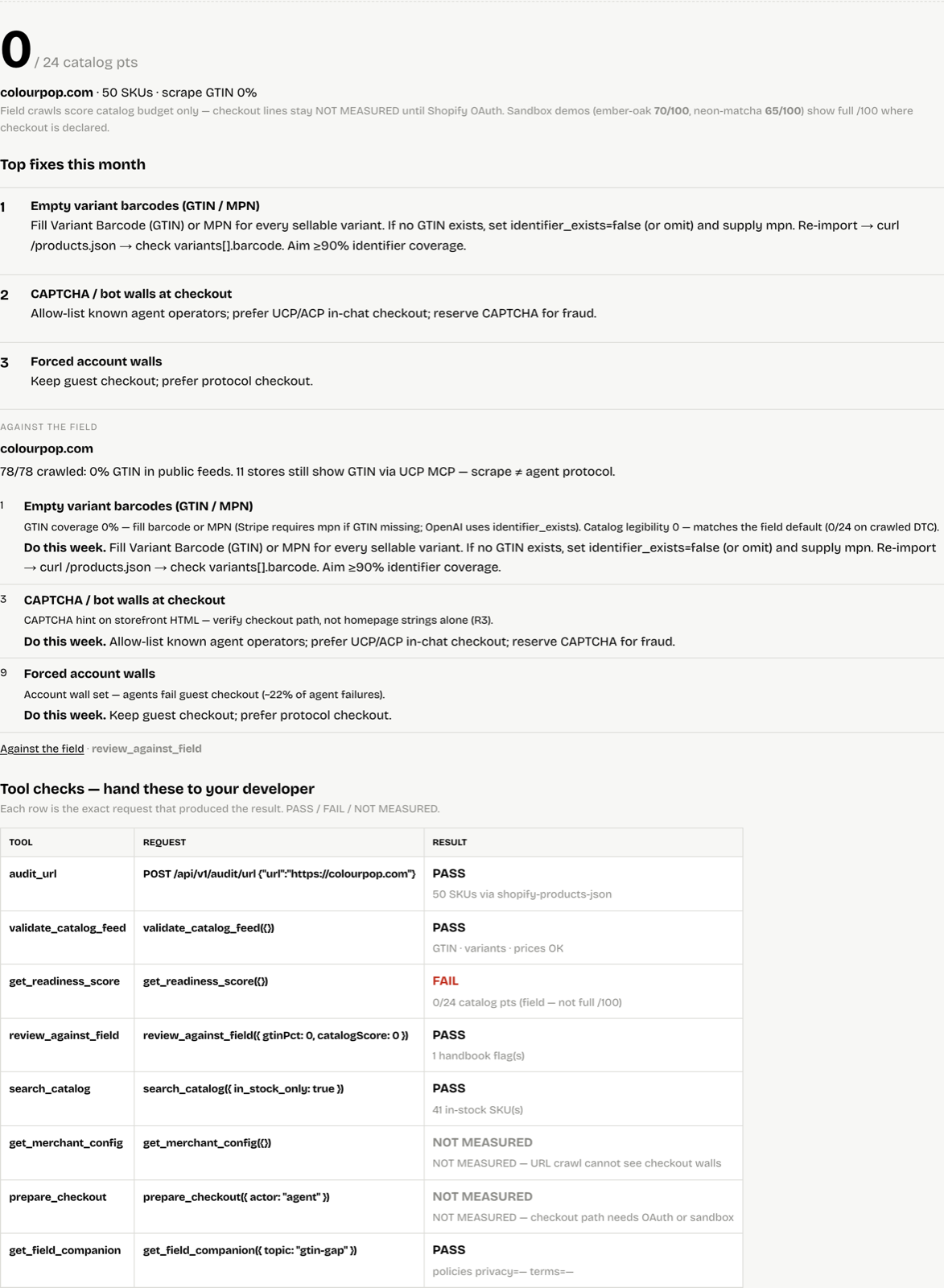
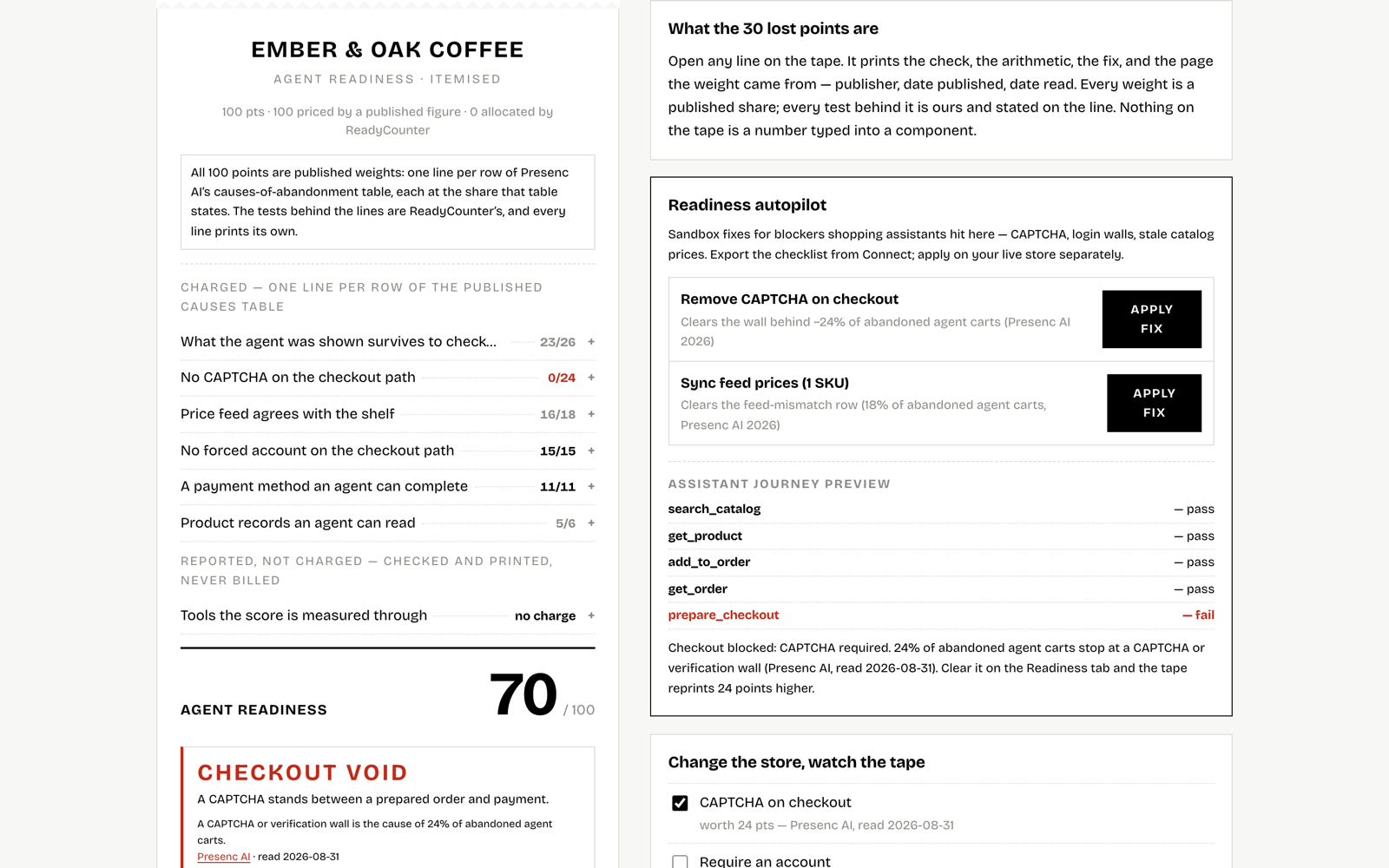
ReadyCounter asks your storefront for its catalogue the way a shopping agent asks, and prices what it finds against published research on why agent carts fail. Every point on the bill is one row of a published abandonment table, at the share that table states, with the publisher and the date we read it printed on the line. Nothing on the tape is a number we invented.
Three things a merchant can do with it:
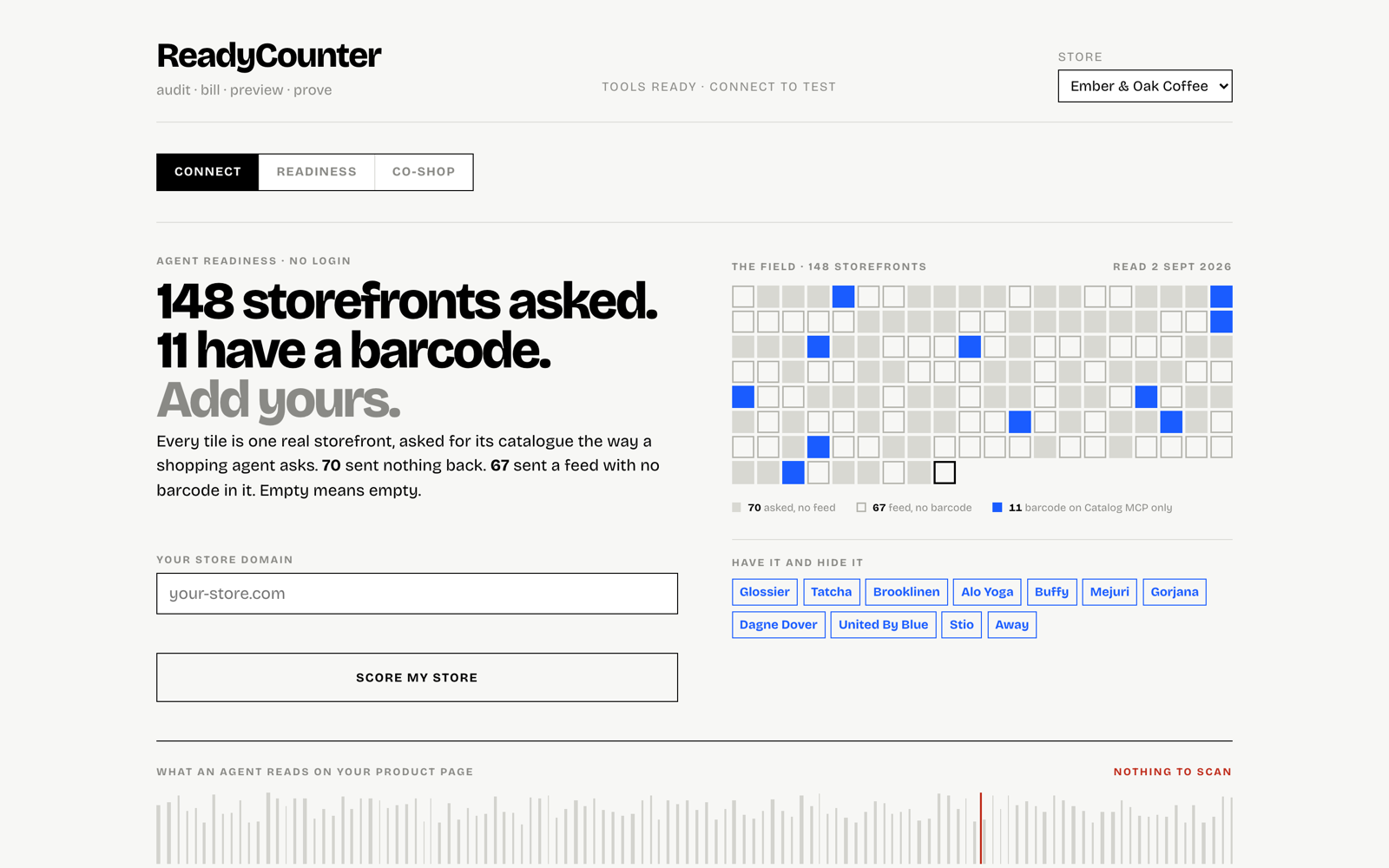
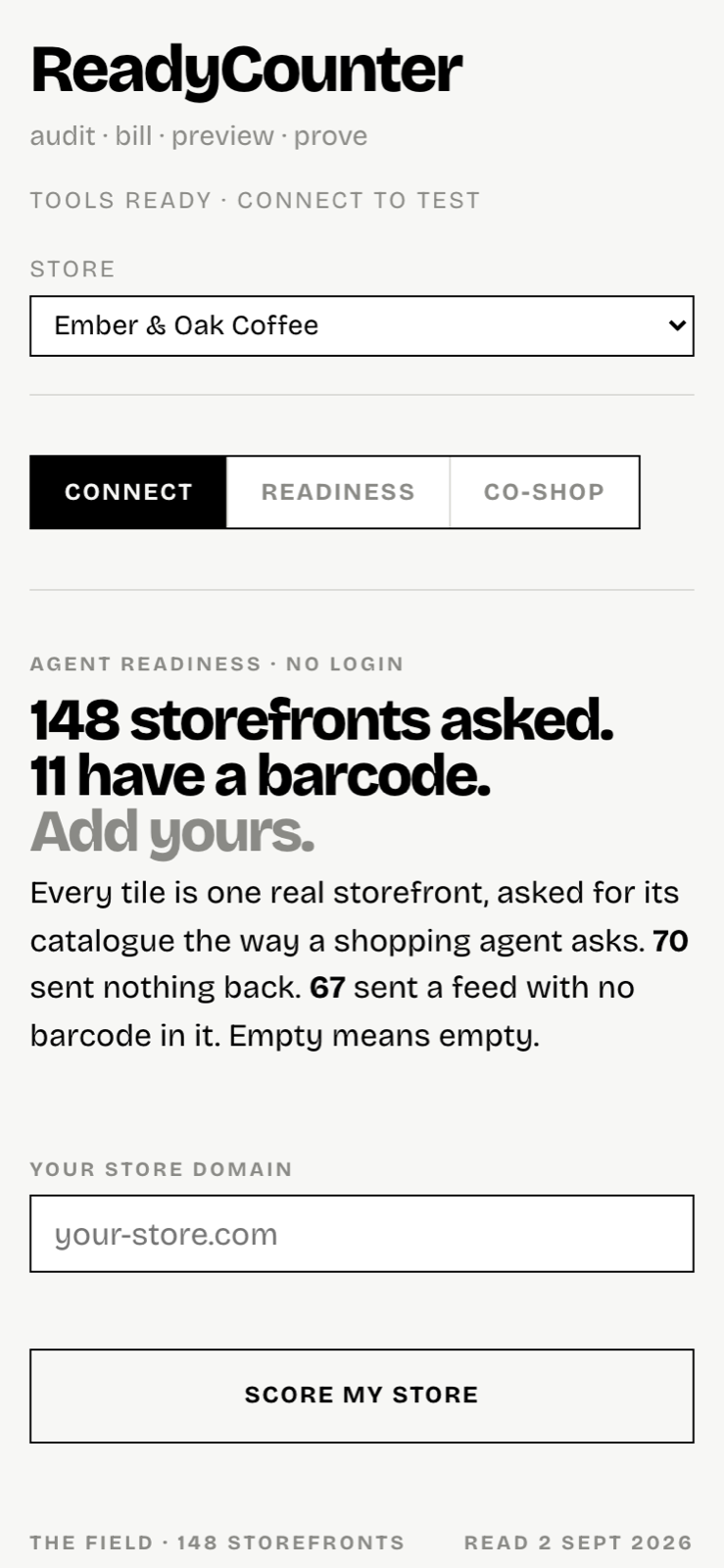
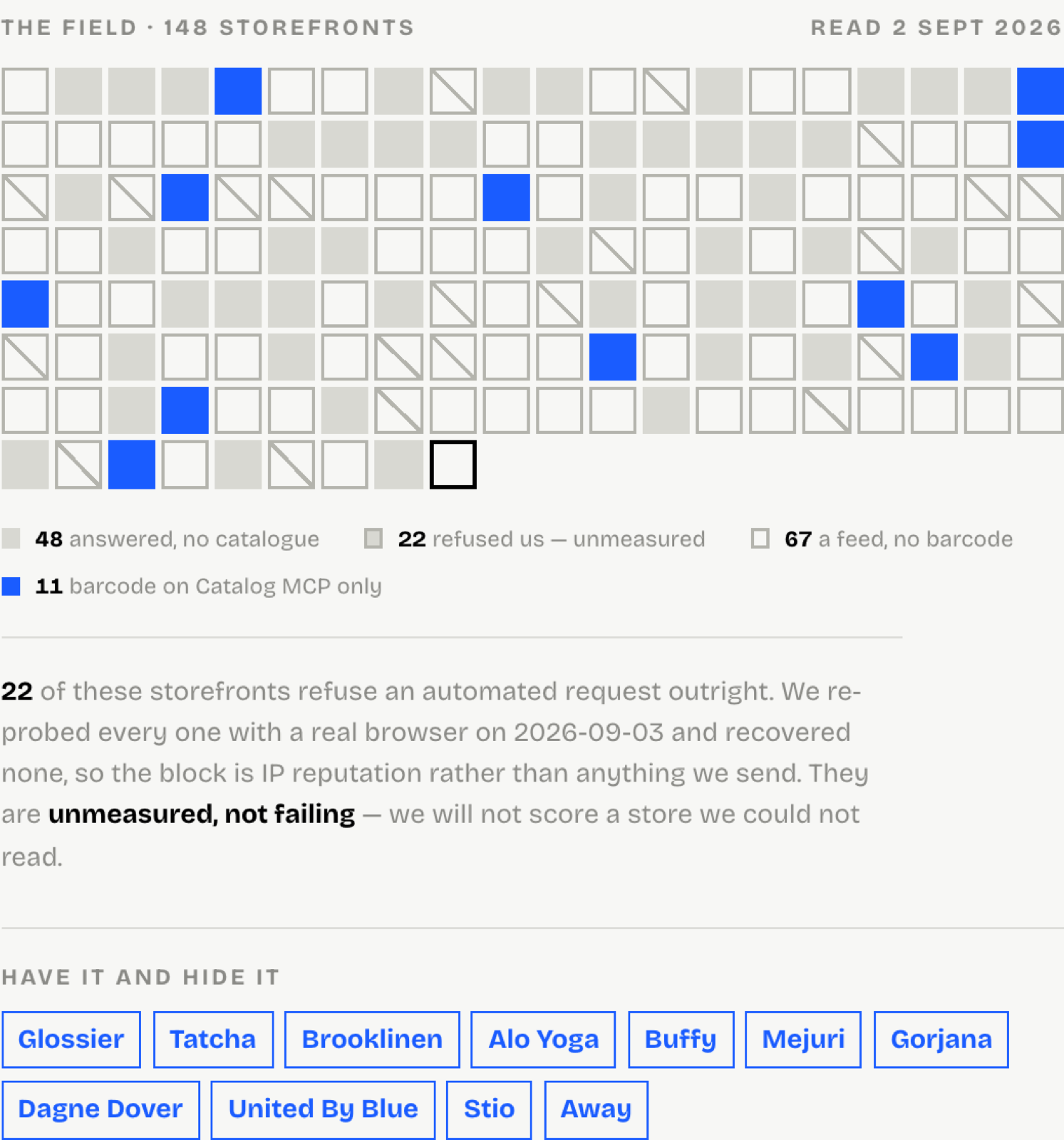
- See the field. We asked 148 curated DTC storefronts. 48 answered and sent no catalogue. 22 refused the request outright — and we say so rather than scoring them, because we re-probed every one with a real browser and recovered none, so the block is IP reputation and we genuinely cannot see them. Of the ones we could read, 67 sent a feed with no barcode in it and average barcode coverage is 0%. Your store joins that wall as tile 149.
- Read the blank barcode. The front page draws what an agent actually reads off your product page. A bar is inked only where a product exposes a GTIN, so at 0% the code is grey and unscannable. The emptiness is the measurement.
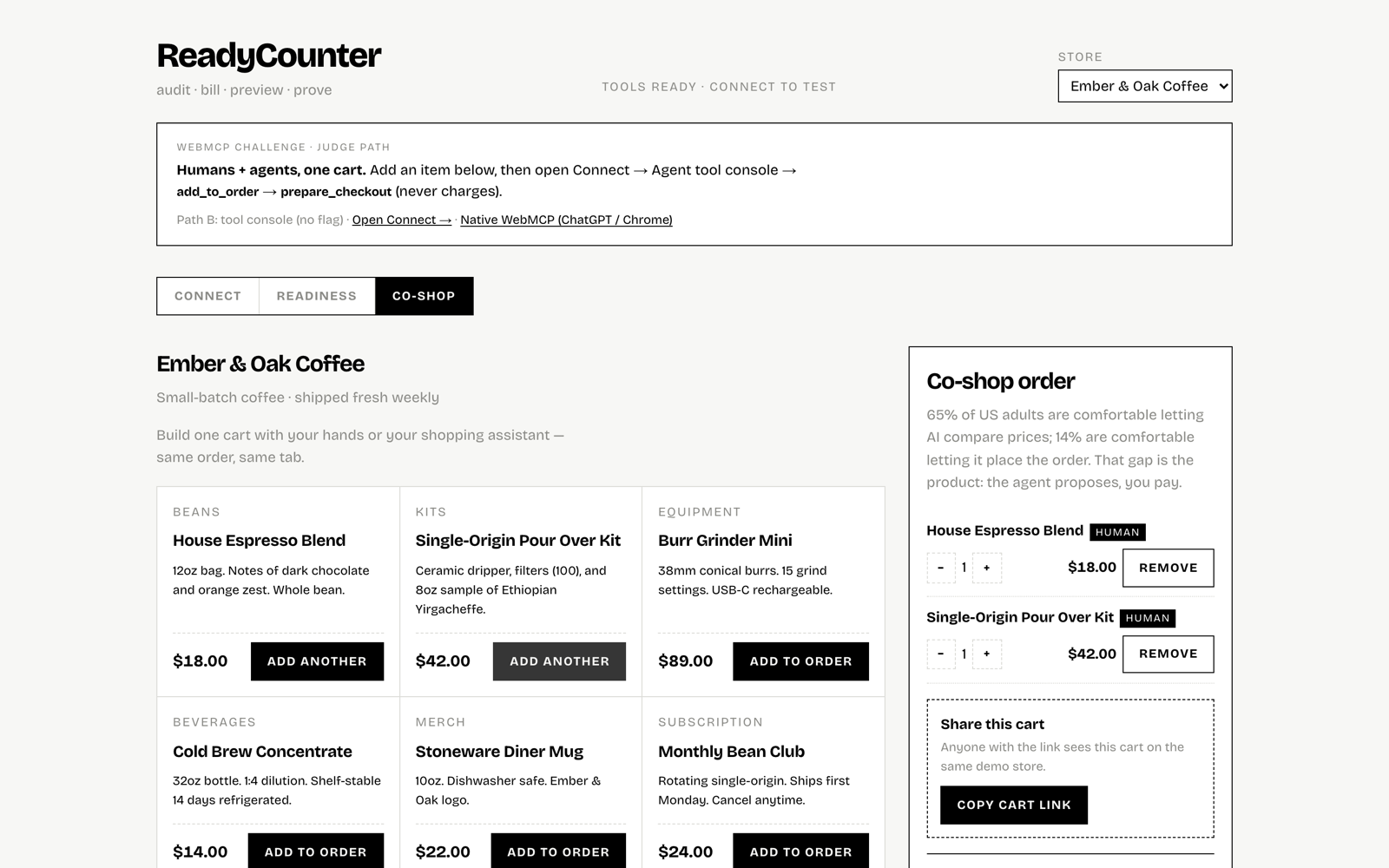
Co-shop with the agent. Eighteen WebMCP tools are registered in the open tab. A human click and an agent's
add_to_orderland on the same order, tagged HUMAN or AGENT.prepare_checkoutvalidates the total and never charges a card — the agent proposes, the person pays.Take the fix with you. The audit ends in a download, not advice: a CSV in Shopify's own import shape, pre-filled with the merchant's real product handles, with
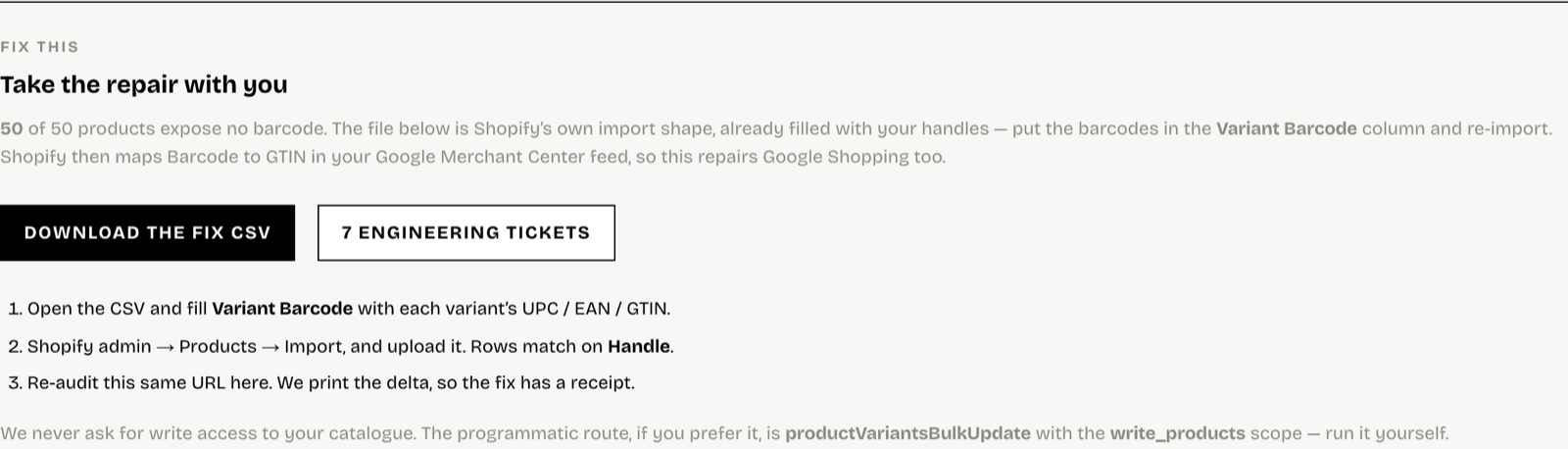
Variant Barcodeblank where it is missing. Fill it, Products → Import, re-audit, and the delta receipt proves it landed. We never ask for write access. And because Shopify maps Barcode to GTIN in the Google Merchant Center feed, the same afternoon of work repairs Google Shopping — which already has a budget line.
And you can watch a real model do it. On the Co-shop tab, a language model
is handed the 18 tool definitions and a shopping goal. It picks the calls, the
browser executes them through document.modelContext, and it gets stopped by
the same CAPTCHA a real customer's agent would hit — then explains the block in
its own words. Nothing in that sequence is scripted.
Deliberately, the model is the shopper and never the judge. The readiness score is arithmetic over a crawl: reproducible between runs, auditable line by line, and impossible to talk into a better number by putting words on your storefront. Model on the outside, deterministic instrument on the inside.
One finding surprised us enough to put it on the front page: eleven brands publish barcodes to Shopify's Catalog MCP and hide them on their own storefront — Glossier, Tatcha, Brooklinen, Alo Yoga, Buffy, Mejuri, Gorjana, Dagne Dover, United By Blue, Stio, Away. The protocol has the data. The scrape, which is what a shopper's agent reads, does not.
How we built it
React, TypeScript, Vite, Zustand for the shared order, deployed on Vercel.
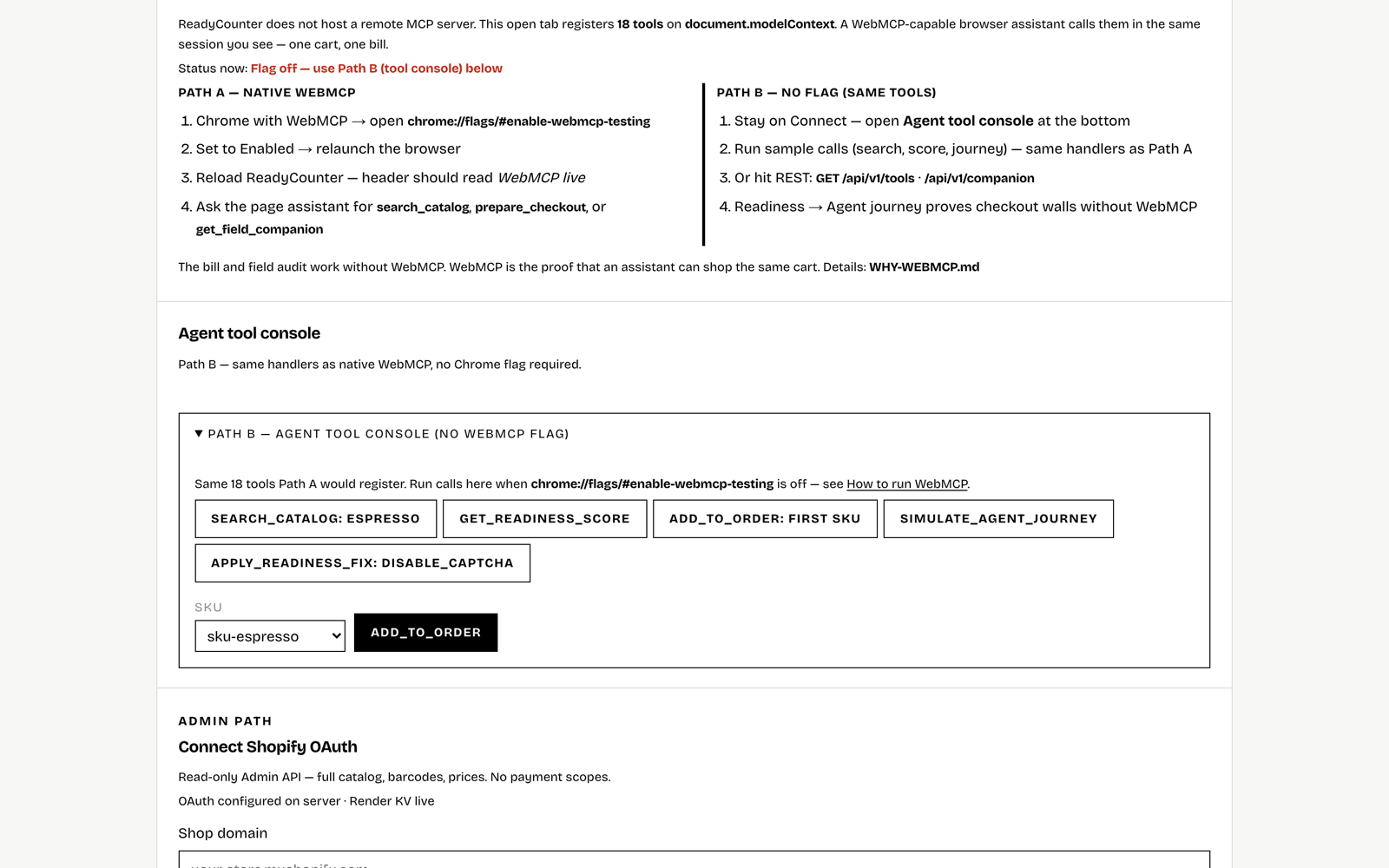
WebMCP. All 18 tools are declared in src/webmcp/registerTools.ts with
document.modelContext.registerTool(name, {description, inputSchema, execute}).
The same handlers serve two paths, so a judge never needs a Chrome flag to see
it work: Path A is native WebMCP (Chrome 149+), Path B is the in-page
Agent tool console, identical handlers, no flag.
We chose the browser API over a hosted MCP server deliberately. The thing being measured is what an agent can retrieve in the shopper's own session. A server-side MCP would read the catalogue with our credentials, not theirs, and would miss exactly the walls that matter — CAPTCHA, forced login, session-gated pricing.
Integrations, all live in this build:
- Shopify OAuth — read-only Admin API for the merchant's own catalogue, barcodes and prices. No payment scopes, ever.
- Shopify Catalog MCP (UCP) — the protocol side of the scrape-vs-protocol comparison. This is where the eleven-brand finding came from.
- Render Key Value — persists every merchant audit and every live co-shop
room across Vercel cold starts, plus a weekly cron that re-runs the field
batch.
GET /api/v1/render/statusshows it.
Verification. 13 npm run verify scripts assert the score arithmetic, the
source citations and the honest limits; 15 Playwright e2e tests run against
production, not a mock.
Challenges we ran into
The interesting one: scrape ≠ protocol. Our first field batch said 0% GTIN coverage and we nearly shipped that as "nobody has barcodes". Then we queried Shopify's Catalog MCP for the same stores and found 13 of 81 do expose GTINs there — 11 of them while their public scrape is empty. The honest finding was not "merchants have no data", it was "the data exists and the surface an agent reads does not carry it". That reframed the whole product.
Correcting our own scoring, publicly. We charged the forced-account-wall 24 points because we had reused the CAPTCHA row's weight. A re-read of the cited table on 2026-08-31 found the account wall has its own row at 15%. We changed the weight and left the note on the line. If a number moves, the receipt should say so.
A film that lied about itself. Our demo pipeline had hardcoded narration cues. Paragraph 7 ran 6.9 seconds past its slot and was mixed on top of paragraph 8, and the caption file claimed both were spoken cleanly. The build script printed that exact warning and exited 0, so nobody read it. Every duration is now derived from the rendered audio, the checks are fatal, and a separate verifier checks the file that actually ships rather than the parts it was made from.
Our own tools trapped an agent. Pointing a real model at the tool surface
found something no test had: get_product takes id, but add_to_order took
product_id. The model called get_product({id}), got a product back, carried
id forward — and looped six times on Product not found: with an empty value.
On a product whose whole thesis is making stores legible to agents, we would
have shipped a tool surface that confuses agents. Every product-taking tool now
reads product_id, id or sku, the schemas say so, and an empty id returns
an error that tells the agent what to pass instead.
Our own wall was lying by omission. "Asked, no feed" was one grey tile covering two different facts: 48 storefronts that answered and sent nothing, and 22 that refused the request outright. We proved the difference matters by trying to get in — six declared identities including GPTBot, ClaudeBot and a full Chrome string got 0 of 14; a real Chrome browser fetching from inside the page's own origin recovered 0 of 22. The block is IP reputation, so those stores are unmeasured, not failing, and painting "we could not look" as "you have no data" is exactly the error this product exists to catch in other people's dashboards. They now have their own struck-through tile.
The fix file would not have worked. Shopify matches a CSV import by Handle. We were storing the SKU as the product id ("Accessory-HairClipsGWP") and never capturing the handle ("hair-clips-gwp") at all — the type did not even declare it. The export would have matched nothing and looked like it worked. Caught by diffing our stored product against the store's live products.json before shipping the button.
A permanently empty third of the page. The layout reserved 21rem for a sidebar that only exists on one tab, so two of three tabs rendered a blank column and nobody noticed until we looked at a screenshot instead of the code.
Accomplishments that we're proud of
The field batch is a real measurement, not a demo fixture. 148 storefronts, 78 answered, 0% average barcode coverage, and you can re-run our exact query:
curl -s https://readycounter.vercel.app/api/v1/rankings \
  | jq '{succeeded,shopCount,avgGtinPct,ucp}'
Every point on the bill cites a publisher, a publication date and the date we
read it. Where our test cannot fully support a published claim, the line says
so in its own text. Checkout lines stay NOT MEASURED until OAuth rather than
being guessed.
Native WebMCP genuinely works. Verified on Chrome 152 with the WebMCP
feature enabled: 18 tools on document.modelContext, search_catalog →
add_to_order → the line appears tagged AGENT next to a human's →
prepare_checkout refuses with the CAPTCHA reason and its citation. No card is
ever touched.
No signup, no install, no key. A judge clicks one link and is inside the product.
What we learned
A check that says "no" is the one nobody audits. A false negative looks exactly like a working check. Our red lights needed verifying at the object more carefully than the green ones did.
Publishing a number means naming who published it. Once every weight on the tape had to carry a publisher and a date, three of our own numbers turned out to be assumptions wearing a citation. Two got corrected, one got deleted.
The measurement surface matters more than the data. Merchants are not missing barcodes. Eleven of them are publishing barcodes to a protocol while the surface their customers' agents actually read stays empty. That is a much more fixable problem, and a much less flattering one to discover.
What's next for ReadyCounter
- Become a signed agent. The 22 storefronts we cannot read are a roadmap
item, not a permanent hole. Web Bot Auth — an Ed25519 key, a JWKS at
/.well-known/http-message-signatures-directory,Signature-Agentheaders, and Cloudflare's signed-agent list, which covers an estimated 84% of identified AI browser traffic — is how an honest agent proves who it is. A product that argues stores should be able to tell an honest agent from a scraper should be one. - Finish the OAuth path so checkout lines stop reading
NOT MEASURED. The catalogue budget is scored today; the checkout half needs the merchant's own admin, and that plumbing is half built. - Delta receipts over time. Re-auditing the same URL already prints a before/after. The next step is a public, dated score a merchant can point at — the Lighthouse-report shape, for agent readiness.
- Widen the census past 148 and publish it on a schedule, so "0% coverage" becomes a trend line rather than a snapshot. The Render cron already runs weekly.
- ACP feed certification, deferred for this build and honestly out of scope for a hackathon weekend.
The ambition, plainly: every merchant runs this when they ship anything new, Shopify adopts the receipt format, and stores go public with their score.
Built With
- node.js
- playwright
- react
- render
- shopfiy
- typescript
- vercel
- vite
- webmcp
- zustand


Log in or sign up for Devpost to join the conversation.