-
-
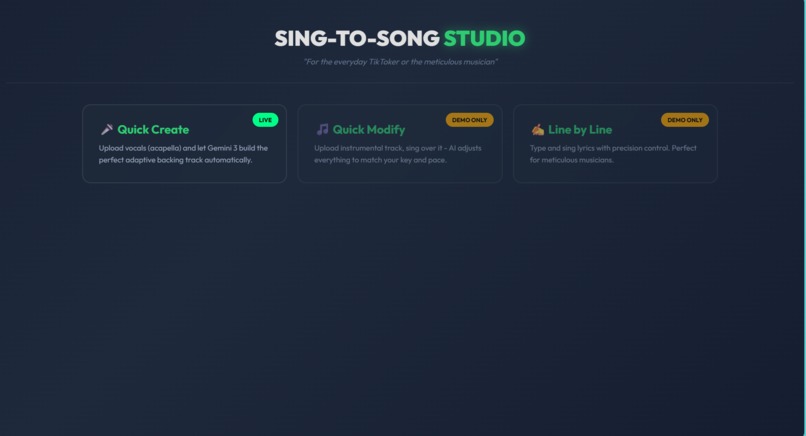
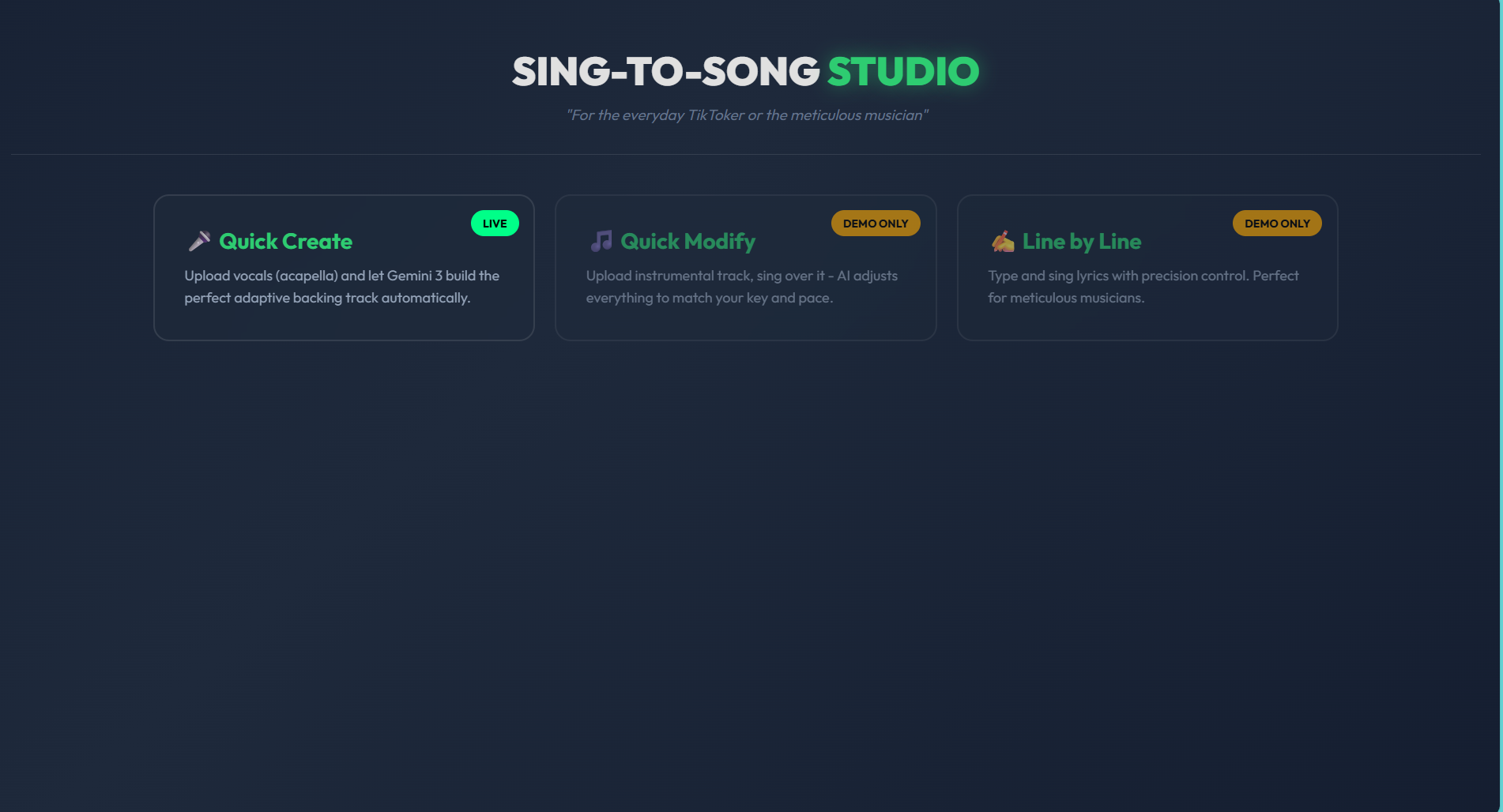
Sing to Song Interface v1
Inspiration I was looking for an app to get my singing career off the ground. I am a novice at the keyboard and wanted to accompaniment for my songs but could not find a musician so I created my own ready and available ai band with this app. My teammate suggested Gemini 3 to build and the rest is history.
What it does
Sing-to-Song is a musical intelligence layer that transforms any singer into a complete performer. Powered by Google Gemini 3's multimodal intelligence, the app listens to your voice in real-time—analyzing your key, pace, melody, and emotional tone—then builds a backing track that adapts to your unique performance. It re-engineers the musical foundation in real-time to fit your vocal range and style. If you shift keys mid-performance, the instruments follow. If you slow down for emotion, the track breathes with you. The AI becomes your accompanist, not your metronome.
How Gemini 3 Powers the Intelligence: At the core of Sing-to-Song is Gemini 3's multimodal audio analysis. When you upload vocals or sing line-by-line, Gemini 3 doesn't just hear sound—it understands musical structure. The model analyzes:
Key detection: Identifies what key you're singing in (C major, A minor, etc.) Tempo extraction: Determines your natural pace without forcing you to a grid Chord progression mapping: Builds harmonic context that supports your melody Vocal range analysis: Understands your comfortable pitch range to arrange instruments accordingly Emotional tone detection: Recognizes whether you're performing upbeat, melancholic, energetic, or introspective—and adjusts instrumentation to match
This analysis happens silently in the background. Gemini 3 also cross-references your performance against its vast musical knowledge base to enhance accuracy. The result is a backing track that feels hand-crafted for your voice.
Three Creator Modes:
Quick Create: Upload acapella vocals, select instruments (1 lead + up to 2 minor), and Gemini 3 generates a complete backing track that matches your key and pace. Quick Modify: Upload an existing instrumental track, then sing over it—the app then analyzes your voice and transposes the entire track to your key, adjusting tempo to follow your performance. Line by Line: Type and sing lyrics section-by-section, giving you granular control while still benefiting from AI's real-time adaptation Sing‑to‑Song is built to let anyone perform and create music that feels alive. The app’s core strength is its adaptive AI engine that listens to your melody in real time and builds a track that follows your performance. Whether you’re singing something original or covering a popular song, the app generates a backing track that responds naturally to your voice.
Sing-to-Song isn't karaoke. It's not a backing track library. It's an AI that treats you like the lead performer and itself like your session band—adapting, supporting, and enhancing your creative vision in real-time.
How we built it
Sing-to-Song was built through a "Meta-Conversational" development process. Rather than following a traditional waterfall model, we used Gemini 3 as both the product’s central intelligence and our primary development partner. Every feature, every design decision, and every line of code emerged from natural language conversations about what the product should do and how musicians actually perform. This approach meant we could rapidly prototype ideas, test musical concepts, and rebuild entire systems in hours rather than weeks emerged from natural language dialogues between the developer and the AI. This "Vibe Coding" approach meant we could rapidly prototype ideas, test musical concepts, and rebuild entire systems in hours rather than weeks. This allowed us to quickly when our conversational testing revealed that a "Cover Mode" was redundant due to Gemini’s inherent recognition capabilities, we removed it. When we realized that a rigid metronome was "anti-musical," we collaborated with Gemini to redesign a core engine that follows the singer rather than leading them.
Gemini 3: The Musical Wiz We architected the entire application around Gemini 3’s state-of-the-art multimodal reasoning. It serves as the bridge between raw human performance and structured musical theory.
• Multimodal Analysis Pipeline: Vocal recordings are sent directly to Gemini 3 via the Generative Language API. The model doesn’t just see a waveform; it analyzes the Harmonic DNA—key signatures, tempo, chord progressions, and even the emotional tone of the performance. By utilizing Structured JSON Output, we transform these nuanced insights into reliable data for our rendering engine.
• The "Silent Intelligence" Layer: We leverage Gemini 3’s vast parametric knowledge to work invisibly. If a user sings a known melody, Gemini recognizes the context and silently enhances the arrangement's accuracy. This creates a frictionless experience where the AI feels like an intuitive session musician rather than an outdated software tool.
• Agentic Real-Time Adaptation: Using Gemini 3’s "Thinking Level" (High Reasoning), the model acts as a Digital Composer. It generates accompaniment instructions for the Web Audio API (Tone.js) that respect the singer's natural pace. If the user transposes their voice or shifts their rhythm mid-take, Gemini 3’s analysis allows the system to adapt the instrumentation in real-time, ensuring the AI band stays in "lockstep" with the human elements of the song.
Challenges we ran into & Solutions: Engineering the "Relational Logic" Experience
Initial Hiccup: We thought we were using Gemini 3 but realized that we were not signed into the competition, but the model call was gemini-1.5flash. The prototype was fair but the full extent of what we wanted was limited.
Challenge 1: Making AI "Follow" the Singer • Problem: Most AI music tools force users to sing to a rigid, preset tempo, which kills natural performance. • Solution: We inverted the model—Gemini 3 detects the user's natural tempo first, then generates backing tracks that match it. The AI becomes the accompanist, not the conductor. Challenge 2: Avoiding False Song Detection • Problem: Early versions of song detection were demotivating; if Gemini misidentified an original song as a cover, it felt like it was "stealing" the user's creativity. • Solution: We implemented Silent Background Recognition. If Gemini 3 recognizes a melody, it uses that intelligence to improve chord accuracy and instrumental choices invisibly. The user gets a perfect result without the friction of "False Positives" dampening their creative spark. Challenge 3: The Cultural "Sample Desert" • Problem: Standard AI libraries are heavily biased toward Western Pop/Rock, often ignoring the nuanced rhythms of Soca and the Steel Pan. • Solution: We manually curated a culturally authentic sample library from open-source repositories. We then engineered the Instrument Manager to prioritize the Steel Pan as a "first-class" lead instrument, ensuring Caribbean identity is seasoned into the DNA of the app. Challenge 4: The "Baked-In" Export Problem • Problem: Many AI apps merge vocals and music into a single file, making the vocal stem uneditable for professional use. • Solution: We keep vocals and instrumentals on separate tracks throughout the process. Users can export vocals-only, instrumental-only, or the full mix—giving them Non-Destructive professional-level control Challenge 5: The "Signal-to-Noise" Barrier • Problem: Home recordings are plagued by room noise, breathing artifacts, and electrical hum, which confuse AI analysis. • Solution: We developed a Pre-Analysis Vocal Chain (Gate, 100Hz High-Pass, and De-Esser). This "cleans" the signal before it reaches Gemini 3, ensuring the AI is analyzing the music, not the background noise.
Why This Approach Worked For Us: Building conversationally allowed us to solve for "The Why" before the "The How." This philosophy then shaped every technical pillar:
- Multimodal Reasoning: Why use Gemini 3? Because it "hears" musical relationships (Key/Vibe) rather than just processing raw numbers.
- Structural Integrity: Why keep vocals separate? Because professional musicians require creative agency and non-destructive editing.
- Representation by Design: Why Caribbean instruments? Because AI tools should reflect the global diversity of the artists using them. The result is a product where the technology serves the artist, not the other way around.
Accomplishments that we're proud of
This was actually our first time getting so far in building an app. We are in no way experts in this area. I was so started when the results came so quickly. It seemed so good to be true. We love that Sing-to-Song's Studio doesn't just play audio; it uses a zero-latency DSP chain to ensure professional vocal delivery before the AI accompaniment is even rendered and that our Re-roll feature isn't just a randomizer; it's a non-destructive editing tool. It allows the musician to keep their precious 'Golden Vocal Take'—complete with our professional DSP polishing—while auditioning different AI-generated arrangements in real-time. This maintains the human's creative agency while leveraging Gemini 3's immersive musical capabilities.
What we learned
We learned that having no coding experience is not a hindrance in entering this space. We also learnt that there is always a solution you just have to keep regrouping, searching for better context, going back and forth, not being to be afraid to challenge the AI and one's self when you come to standstill. We also learnt not to accept the limitations that others previously accepted. Not being afraid to ethically exploit the gaps that others havent refined in their products. Have fun in the process.
What's next for Sing-to-Song
We're going global, baby!
Built With
- canva
- css3
- gemini
- gemini-3
- google-ai-studio
- html5
- javascript
- json
- pitchy.js
- recorder.js
- tone.js

Log in or sign up for Devpost to join the conversation.