-
-
Logo
-
Landing Page
-
Dashboard
Inspiration
What it does
The Story Behind ReadMyWay
Inspiration
Reading a document should never feel like solving a puzzle. Yet, for people with dyslexia and other reading difficulties, everyday documents—government forms, bills, instructions, and official notices—can become overwhelming barriers to information and independence.
We built ReadMyWay around one simple belief: everyone deserves equal access to information, without having to struggle to understand it.
Our vision was to create more than a text simplifier. We wanted to build an intelligent reading companion that adapts to the individual, making complex information easier to understand, navigate, and act upon.
What We Built
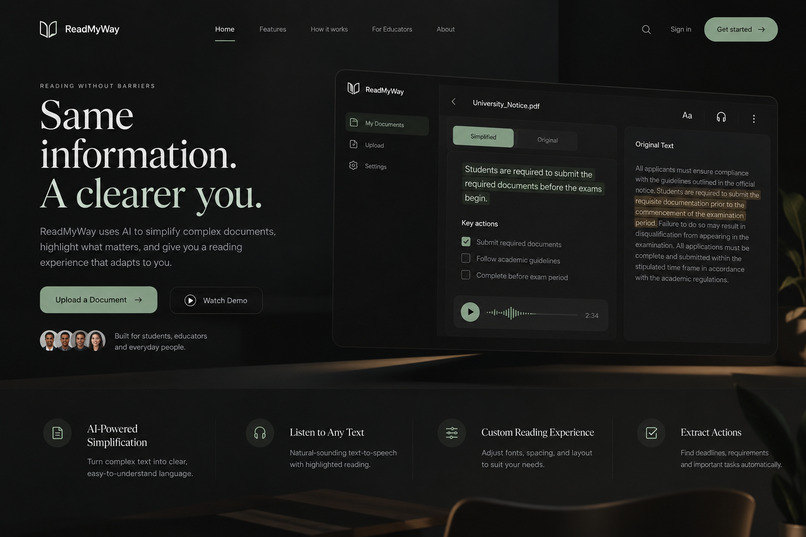
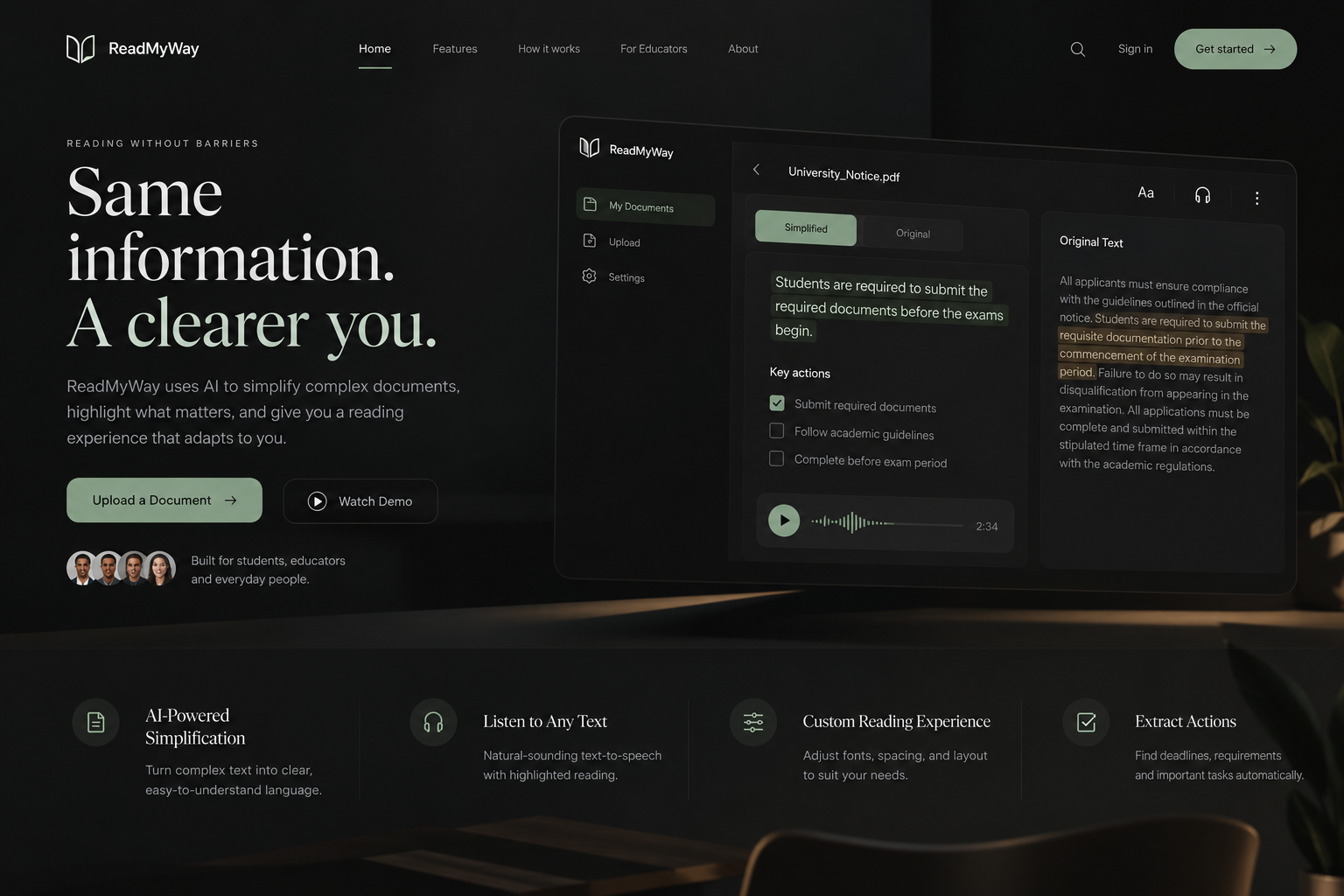
ReadMyWay uses AI to transform complicated documents into clearer, more accessible reading experiences. The platform brings together:
- AI-powered simplification: Rewrites complex language into easier-to-understand text while preserving the original meaning.
- Accessible reading: Supports personalized reading preferences, including text size, spacing, and visual themes.
- Text-to-speech: Helps users listen to content instead of relying solely on reading.
- Intelligent action extraction: Identifies important requirements, deadlines, and next steps hidden within lengthy documents.
The goal is not to remove information, but to remove the barriers that make information difficult to access.
How We Built It
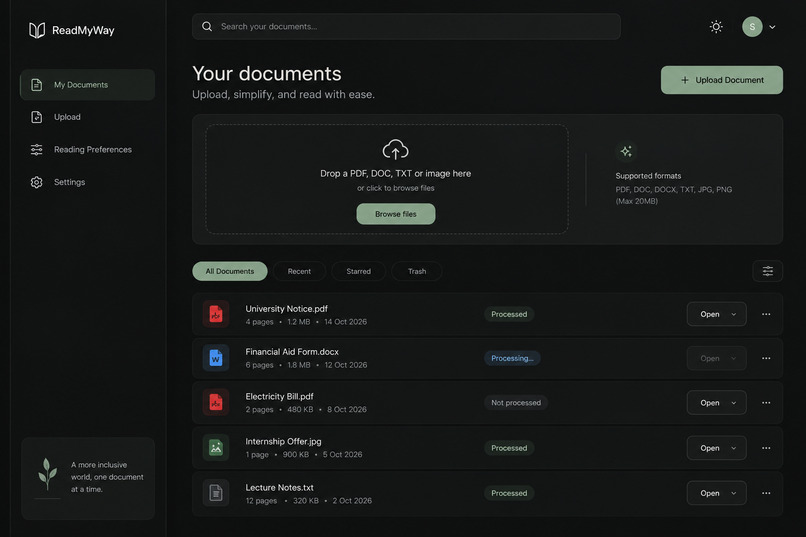
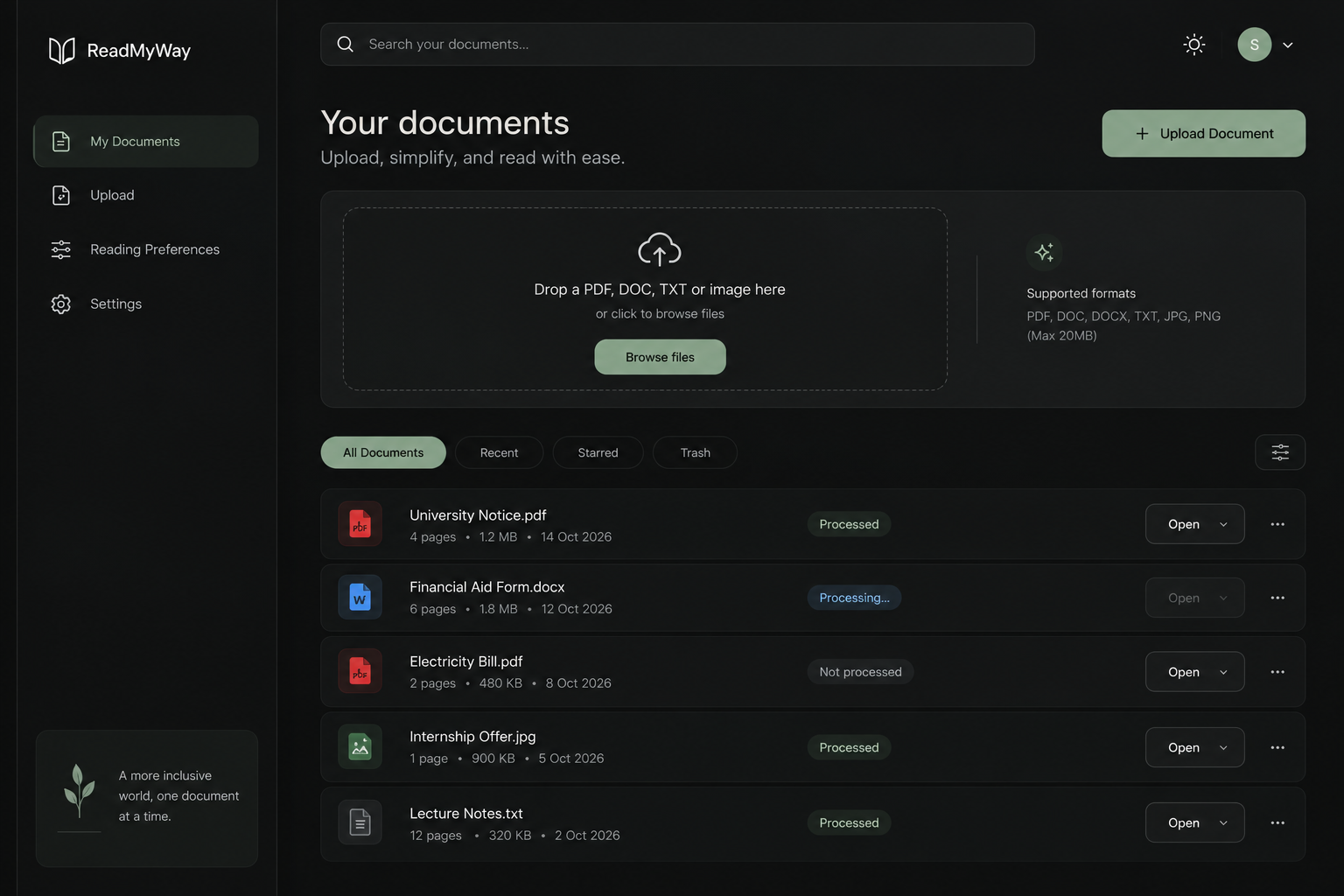
We approached ReadMyWay as an accessibility-first product, combining a clean, distraction-free interface with an AI-powered document workflow. Our development focused on making the experience intuitive: users should be able to bring in a document, understand its contents more easily, and identify what they need to do next.
We designed the interface around a restrained dark theme, clear typography, and carefully considered reading controls. We also structured the project to support document processing, AI-assisted simplification, and a more personalized reading experience as the platform evolves.
Challenges We Faced
One of our biggest challenges was balancing simplicity with accuracy. Simplifying a document is not just about replacing difficult words; it is about preserving critical details, context, obligations, and deadlines while making the content easier to understand.
Accessibility presented another challenge. Different people have different reading needs, so a single layout or reading style cannot work for everyone. We therefore focused on flexibility, readability, and reducing unnecessary visual distractions.
We also had to think beyond generating simplified text. A genuinely useful tool should help users understand information and take action on it, not leave them to figure out the next steps themselves.
What We Learned
Building ReadMyWay reinforced an important lesson: accessibility is not an optional feature added at the end of development. It should shape the product from the very beginning.
We learned to think about AI not merely as a way to automate tasks, but as a means of making essential information more approachable. We also recognized the importance of preserving meaning, designing for diverse needs, and treating user independence as a core product outcome.
Our Vision
ReadMyWay is built around a simple mission: make information easier to understand, so people can focus on what matters.
We envision a future where dyslexia and reading difficulties do not become barriers to accessing essential information, meeting deadlines, or making informed decisions.
Because the information should stay the same. The experience of understanding it should not have to.
How we built it
Challenges we ran into
Accomplishments that we're proud of
What we learned
What's next for ReadMyWay
Built With
- artificial-intelligence
- css3
- fastapi
- html5
- natural-language-processing
- python
- react
- rest-api
- text-to-speech
- typescript
- vite


Log in or sign up for Devpost to join the conversation.