-
-
Read-B
READ-B — Beyond Reading
Inspiration
Reading is one of the most powerful ways humans learn, yet for many people it is not easy. While working with long articles, research papers, and dense educational material, I often noticed how quickly reading fatigue appears. Even when the words are clear, the mind sometimes struggles with focus, comprehension, or cognitive overload.
This experience led me to an important realization:
Most reading tools are designed for text, not for the reader.
Every person processes information differently. Some readers struggle with long paragraphs, some with attention drift, and others with complex language structures.
This inspired the idea behind READ-B, which stands for Read Beyond — a platform designed to help readers move beyond simply seeing words and instead reach true understanding.
The goal was to explore how design and technology can reshape the reading experience so that it adapts to the reader rather than forcing the reader to adapt to the text.
The Idea
READ-B is built around a simple principle:
Reading should adapt to the way people think.
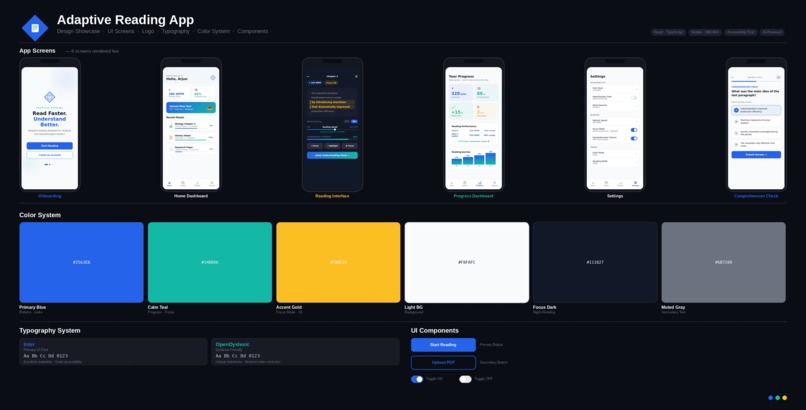
Instead of presenting text in a single static format, the platform introduces adaptive reading modes that change how information is visually structured and processed.
Some of these modes include:
- Chunk Reading — breaking text into meaningful groups to reduce cognitive load
- Bionic Reading — guiding eye movement by highlighting key parts of words
- Focus Mode — highlighting the current line to improve concentration
- Speed Reading Mode — presenting words in paced sequences for faster reading
- Simplified Text Mode — rewriting complex sentences into easier language
Together, these modes help readers interact with information in a way that feels more natural and accessible.
The goal is not just to read faster, but to understand better.
Understanding the Problem
Reading difficulty can often be modeled as a relationship between cognitive load, attention, and information density.
We can think of comprehension as:
$$ Comprehension = \frac{Attention \times Clarity}{Cognitive\ Load} $$
When cognitive load becomes too high (long paragraphs, dense vocabulary, or distractions), comprehension drops significantly.
READ-B attempts to reduce cognitive load and increase clarity through adaptive reading modes.
How I Built the Project
The project was designed using Figma, focusing on user experience, accessibility, and interaction design.
The development process followed this flow:
1. Brand Identity
The platform name READ-B was created with the tagline:
“Beyond Reading.”
The logo symbol represents information flowing inward toward knowledge and understanding.
2. Interface Design
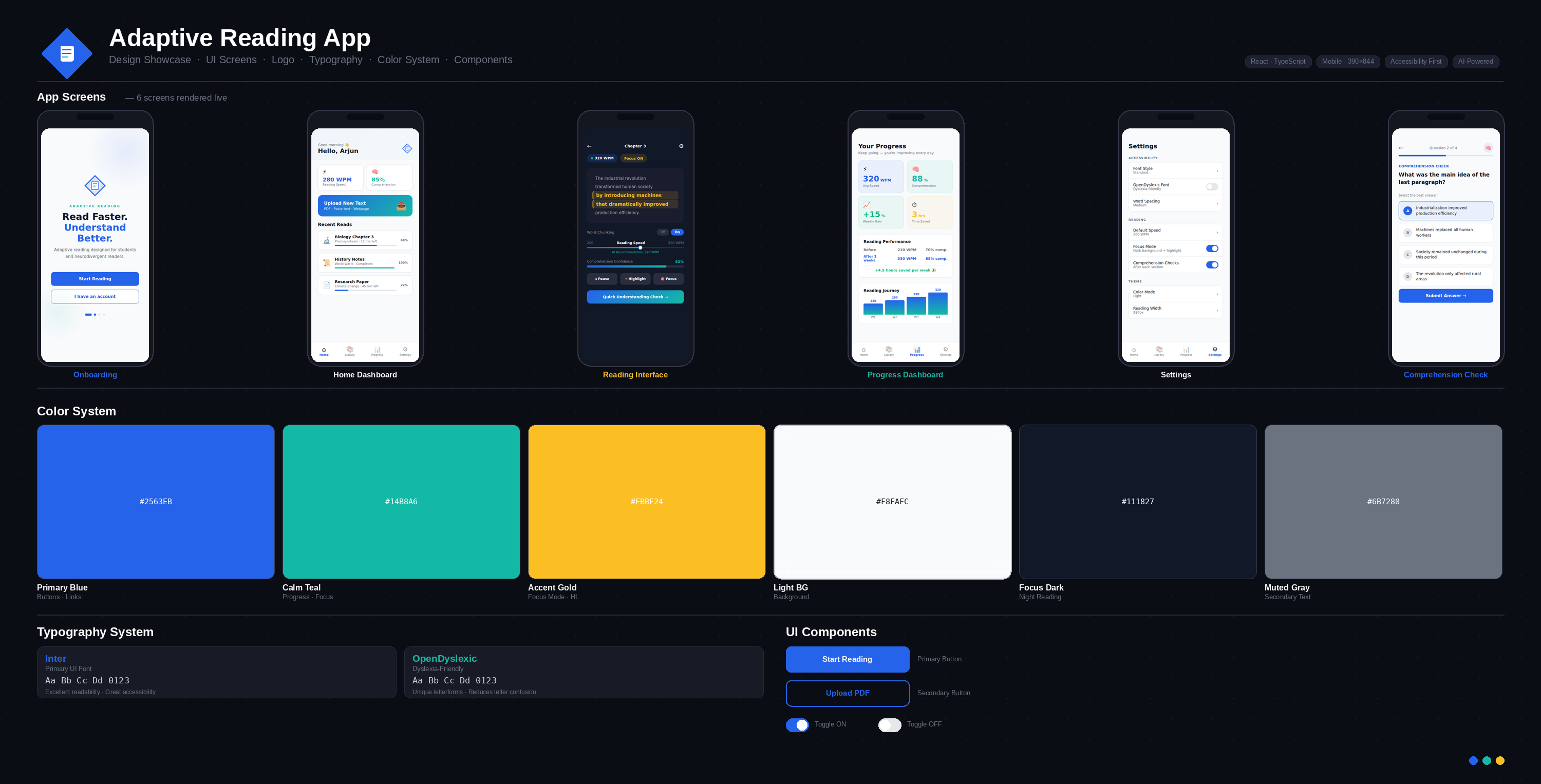
I designed a minimal and distraction-free reading interface where users can easily switch between reading modes.
Key design priorities were:
- clarity
- accessibility
- low cognitive friction
3. Feature Design
The core experience revolves around adaptive reading modes that support different learning styles.
Each mode targets a specific reading challenge such as attention drift, text complexity, or reading fatigue.
4. Prototyping
Using Figma prototyping, I connected the screens to demonstrate a realistic user journey from onboarding to reading and switching between modes.
Challenges I Faced
One of the biggest challenges was balancing feature richness and simplicity.
Reading tools can easily become overwhelming if too many features are introduced at once. I had to carefully decide which features genuinely improve comprehension and which ones would add unnecessary complexity.
Another challenge was visual hierarchy. Since reading interfaces contain large amounts of text, the design must guide attention without distracting the reader.
Designing the logo was also an iterative process. I experimented with multiple geometric concepts before creating a symbol that represents information flowing into understanding, aligning with the idea of going beyond reading.
What I Learned
Working on READ-B taught me that good design is not about adding more features but about understanding human behavior.
Through this project, I learned how:
- visual structure affects comprehension
- cognitive load influences reading performance
- small interface changes can significantly improve focus
Most importantly, I learned that technology should adapt to people, not the other way around.
Looking Ahead
READ-B is only the beginning of exploring adaptive reading systems.
In the future, the platform could include:
- AI-driven text difficulty detection
- personalized reading recommendations
- adaptive learning analytics
- enhanced accessibility for neurodivergent readers
The vision is to create a system where every reader can find their own path to understanding.
Conclusion
READ-B is built on a simple belief:
Reading is not just about words on a page — it is about unlocking understanding.
By designing tools that help readers move beyond reading, this project explores how thoughtful design and adaptive interfaces can transform the way people interact with knowledge.
Built With
- claude
- figma
- figmamake
- veo


Log in or sign up for Devpost to join the conversation.