-
-
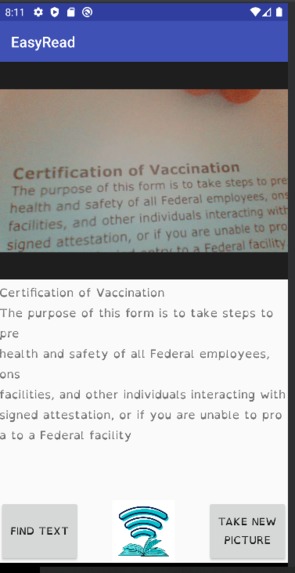
A Testing picture
-
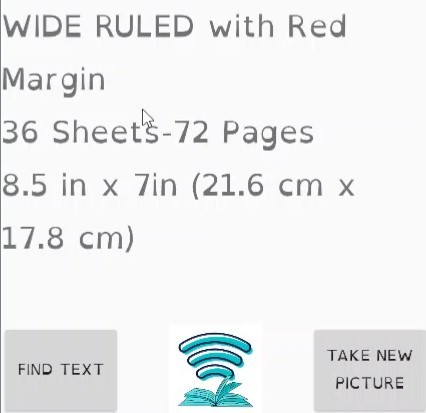
Dyslexia friendly font
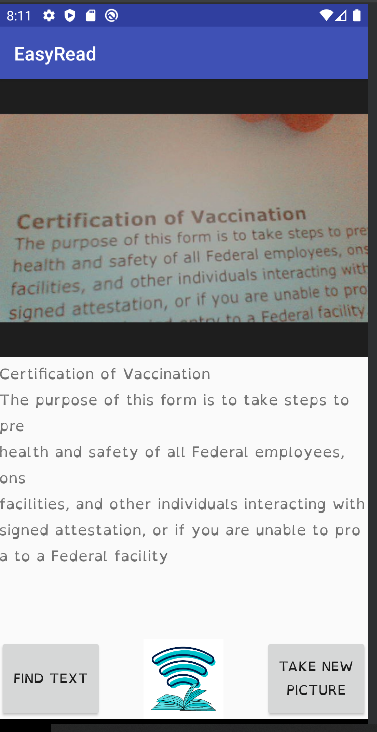
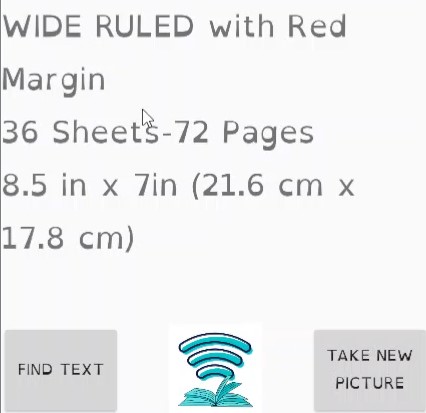
High school track
Inspiration
Our first glimpse of dyslexia was in the popular fantasy series, Percy Jackson and the Olympians, which told the story of the titular character, who suffered from dyslexia. We did some further research about dyslexia explored this site, link, that simulates what someone with dyslexia sees. We were shocked at how little mobile-based software seemed to exist for such a widespread learning disability. So, we were inspired to combine the common educational app idea of taking a picture to digitize text with features targeted towards those with dyslexia.
What it does
This is an app for Android devices. It allows students to take a picture of anything, including their homework, the whiteboard, or just a sign on a street. Then, the app will use OCR to read the text from the image, and display it in the OpenDyslexia font, for easy reading. The whole app is designed to be dyslexia friendly, with strong colors, easy-to-read text and a clear user interface.
How we built it
We used Android Studio with Java to develop the UI and camera interface. We used Google's ML-kit integration with Android Studio for detecting the text in the given image. We split up the roles, with Aditya and Nikhil being responsible for the Java side, and making the integration work well, and Reva being responsible for the UI and logos.
Challenges we ran into
This was our first time working with Android Studio, which led to a whole host of challenges. Android (and Android Studio) have many different versions, and finding consistent documentation between them was more time-consuming than we would have liked. For example, there were many permissions-based errors that took time to debug, since different versions of Android Studio require different things to access the phone's file structure, etc.
Accomplishments that we're proud of
We are proud of being able to develop a product with real-world impacts. We are also proud of how much we have learned in a timeframe of this hackathon.
What we learned
Learning a new way of developing apps in an extremely short amount of time was rewarding. Reva was previously not very familiar with Java, and Aditya had not used it in a long time, so this project was a good way for both of them to pick it back up. All of us learned Android Studio, which can be significant for personal projects and is a good way of making robust apps.
What's next for EasyRead
We'd like to add new features to EasyRead, including a Text-To-Speech Engine that will allow students to hear the text they took a picture of, if that would be easier or more convenient for them. Also, since this is an app focused towards education, we'd like to add teacher or parent interaction into the app, so that the student could directly send the pictures they take to their teacher, and the teacher would also be able to give feedback to the student about their work.
Built With
- android-studio
- google-mlkit
- java

Log in or sign up for Devpost to join the conversation.