Inspiration
Every comment section has someone who's sure "everyone agrees" with them. Usually they're wrong, and nobody ever finds out by how much. I wanted a daily game where that gap is the whole point. You don't win by being right about a rule. You win by knowing your community.
Rules are a good fit for that. Everybody has an opinion on the TSA liquids bag, Amtrak's quiet car, or keeping 25 yards from a bison, and those opinions split in ways that are hard to predict. They're also real. Every prompt comes from an official page, so the argument starts from the actual rule, not a made-up one.
What it does
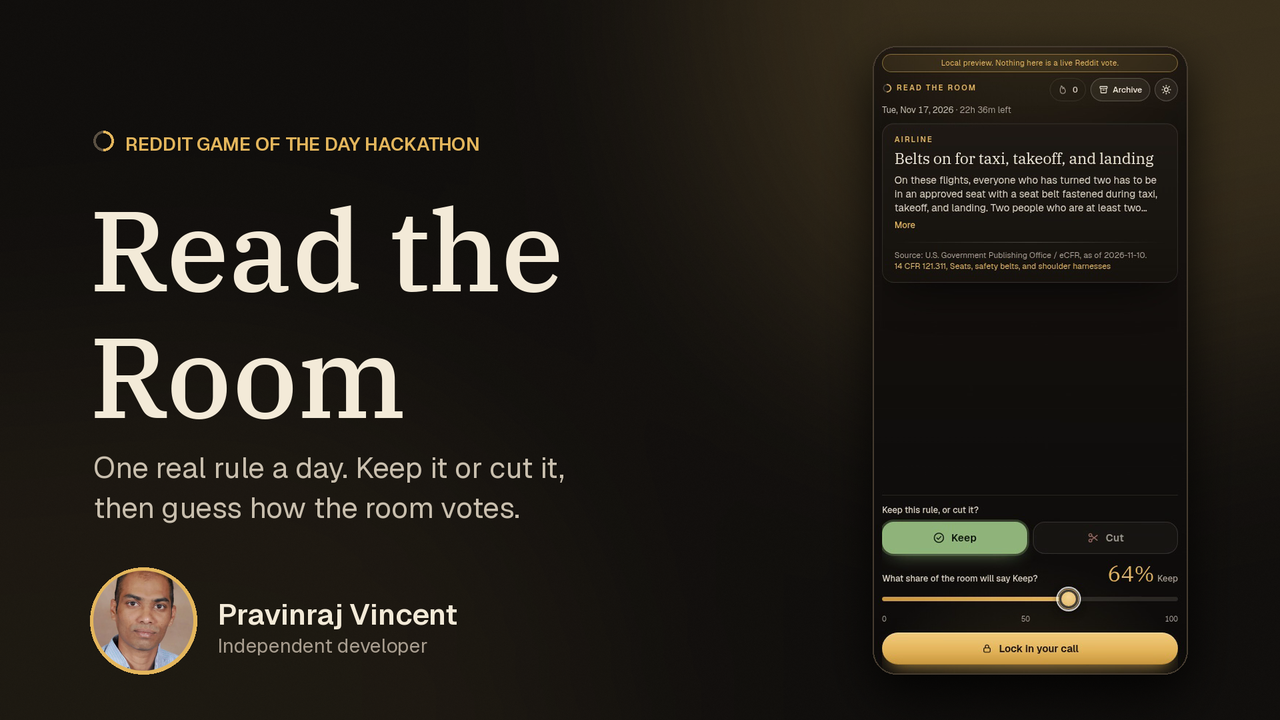
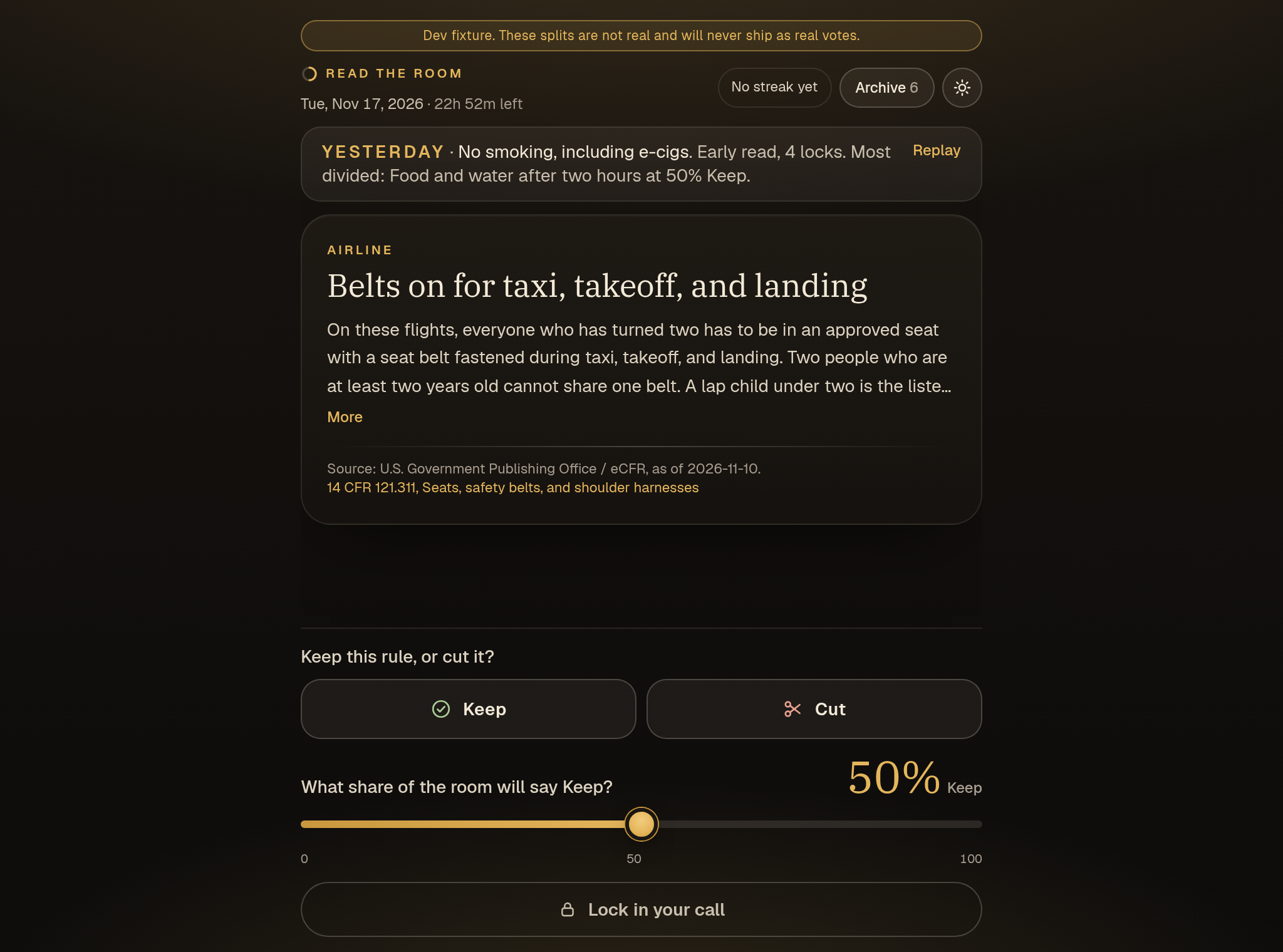
Each Eastern day, Read the Room posts one rule from an official source: an airline regulation, a TSA policy, a national park rule, a museum guideline, a store return policy. The source is linked right on the card.
You make two calls and lock them together:
- Keep or Cut. Would you keep this rule?
- Read the room. What share of this subreddit will say Keep?
While the day's open, you can see how many people have locked in, but not the split. At midnight ET the day closes. If at least 10 people played, the split becomes official and everyone's scored: 100 minus how many points your guess was off. Under 10 locks it's an Early read. The real count still shows, but there's no split and no score, because three votes aren't a room.
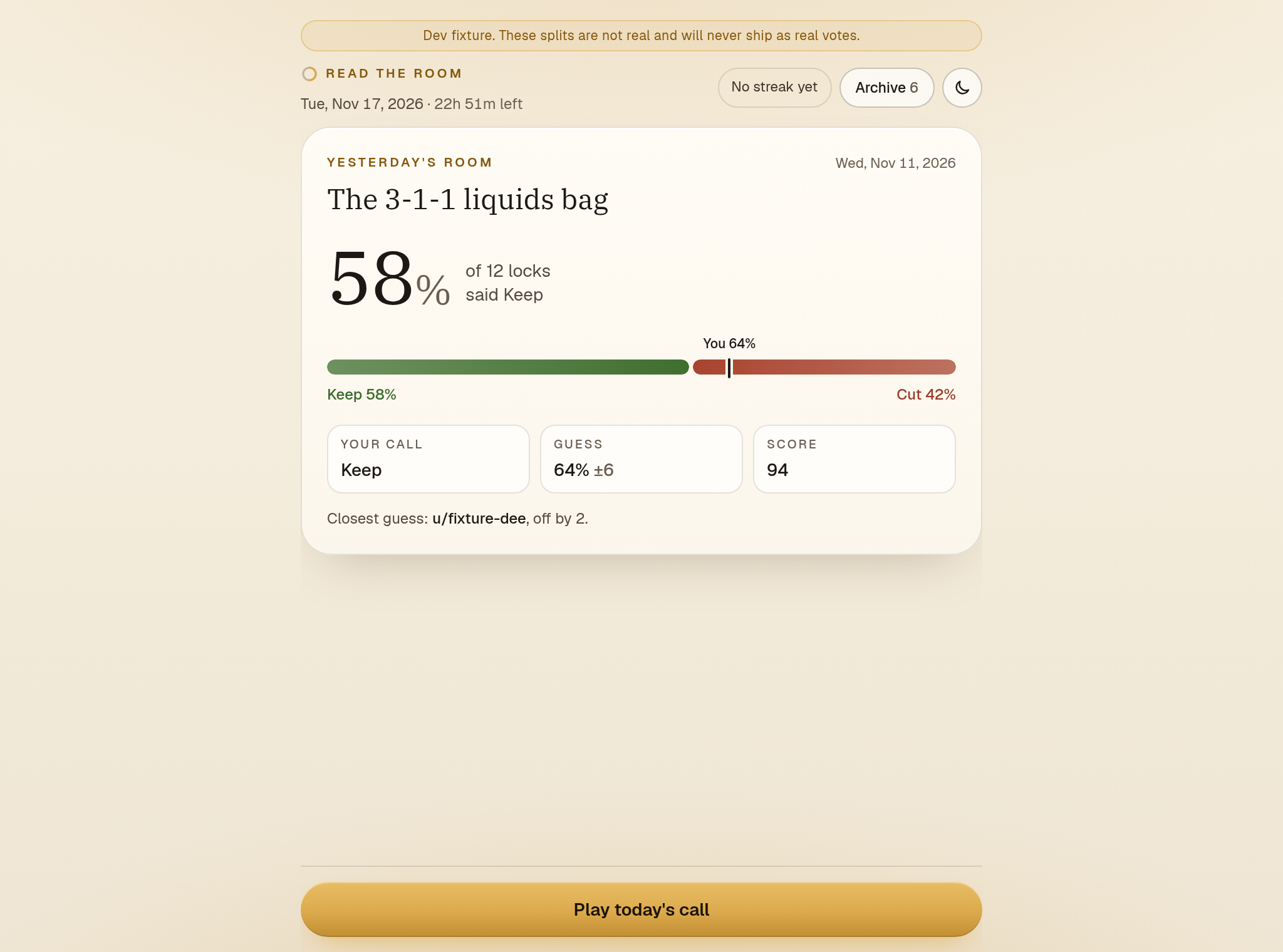
The next day opens with a Yesterday's room card. The real Keep share counts up, a split bar fills to it with a marker where your guess landed, and it shows the lock count, your call, how far off you were, your score, and the closest guesser by name. One tap folds it into a one-line recap that also names the most-divided call so far. There's a streak for playing consecutive days, and an archive where you can replay any revealed day against its frozen real split. Archive plays never change the official result, and they don't count toward your streak.
The look is a warm dark room with cream type and gold light, plus a full light theme. The game follows your Reddit or device theme, and a sun or moon button overrides it. Both themes pass WCAG AA contrast, the reveal animations respect reduced motion, and the layout holds from 320px wide up through Reddit's expanded modal.
Prompts stay away from money, fees, crypto, and gambling. The app never calls an LLM or fetches outside pages while it runs.
How we built it
- Devvit Web, starting from Reddit's official React template: React 19, Tailwind CSS 4, and Vite for the post, with an inline splash card in the feed and an expanded game view.
- Hono routes on Devvit's serverless Node runtime for state, locking, and archive play, plus a mod menu item that posts today's game.
- Devvit Redis holds one record per Eastern day. A lock is written inside a watched transaction, so a double tap or a second device can't vote twice.
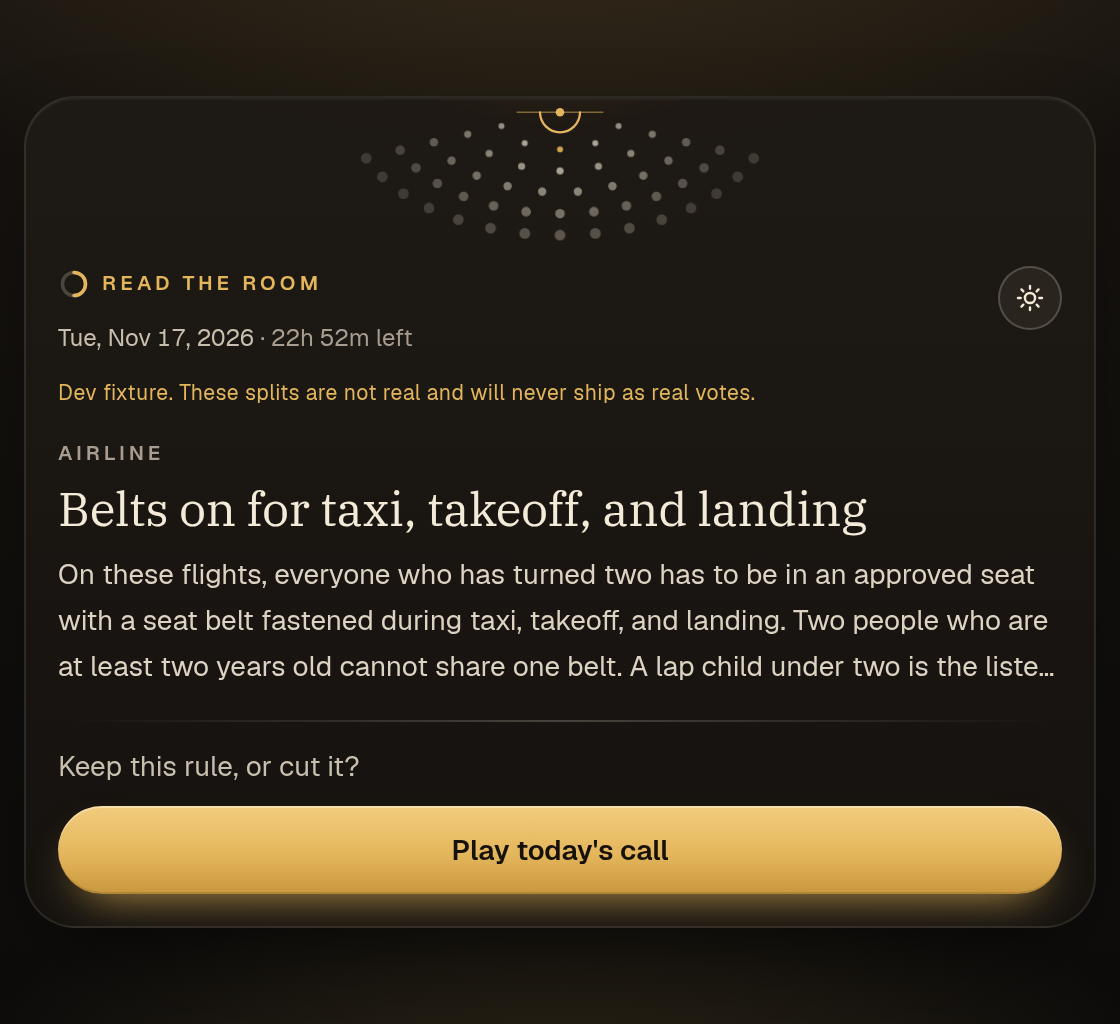
- Hand-drawn SVG and CSS for the feed card art (a lit stage with the room in rows), the split bars and the lock seal. There are no image files beyond the fonts, and theming is CSS variables keyed to
prefers-color-schemewith a saved override. - Devvit scheduler runs an hourly day-close job. Every read also runs the same close first, so a missed job never leaves yesterday open.
- Pure TypeScript game logic in a shared folder (ET calendar and DST, scoring, the 10-lock threshold, closest guesser, most-divided call, streaks, archive scoring), covered by 45 unit tests. The server talks to storage through an interface, so tests and a local preview run on an in-memory store with no Reddit login.
- 30 hand-written prompts, each with a source URL, publisher, and as-of date. I read every source on November 13, 2026 and checked that each card says only what the source says.
Challenges we ran into
- What a "day" means. Reddit is global, but a daily game needs one shared clock. I settled on US Eastern midnight, with tests around the 2026 DST changes so no day is 23 or 25 hours by mistake.
- Small rooms. A brand-new subreddit might get three players. Showing "67% said Keep" from three votes would be fake precision, so a day needs 10 locks before it's official. Under that, the game says so plainly.
- Not faking it. It'd be easy to seed votes so the archive and reveal look busy for the demo. I didn't. The production archive starts empty and only fills with real closed days. Fake splits exist only in a local preview fixture that's labeled on screen and never shipped.
- Testing a reveal without a crowd. To prove the midnight reveal works on Reddit, I ran a private test build with the threshold at 1 lock for one day, watched it close and show up in the next day's recap and archive, then set it back to 10. Then I made the server enforce the rule whenever a day is read too, so that test day now shows as an Early read, 1 lock, like any other day under 10.
- Uploads failing mid-build. For two days, larger uploads to Reddit's developer site kept dropping. I added fetch logging to the CLI run to show it was the network cutting off big requests, not the app, and the uploads went through once that cleared.
- Duplicate posts. An early build posted automatically on install, and a mod posting by hand made a second post for the same day. Now only mods post, and the post action reuses today's post if one already exists.
- Titles that go stale. A post always shows the live day's prompt, so a dated title was wrong by the next morning. New posts get an evergreen title, "Read the Room: one real rule a day. Keep it or cut it?", and the duplicate check only matches posts made that same Eastern day.
Accomplishments that we're proud of
- The whole daily loop runs on Reddit: post, lock, hidden split, midnight close, recap, archive, streak.
- Every number in the game is real. No seeded votes and no invented splits.
- Every prompt traces back to an official source a player can tap.
- The game rules are small, pure functions with tests, so the scoring and day close can be checked without trusting the UI.
What we learned
- On a daily game, the clock is the hardest part. Day boundaries, DST, and late scheduler runs all need to be handled on purpose.
- An honest empty state ("Early read, 4 locks") reads better than a fake full one.
- Predicting other people's votes is a different and more interesting question than voting. Locking both together keeps people from changing their vote after they think about the crowd.
What's next
- Live user flair for streaks and scores, if Reddit allows it for this kind of app.
- Community-submitted rules, with the same source and as-of checks.
- More categories beyond travel, parks, museums, and stores.
Built during the submission period
All of Read the Room was built between November 13 and November 17, 2026, inside the submission period (November 11 to December 8, 2026). None of it existed before. That covers the idea, the game logic, the 30 sourced prompts, the UI, the Reddit app upload, and every test.
Built With
- devvit
- devvit-web
- hono
- node.js
- react
- redis
- tailwindcss
- typescript
- vite
