-
-
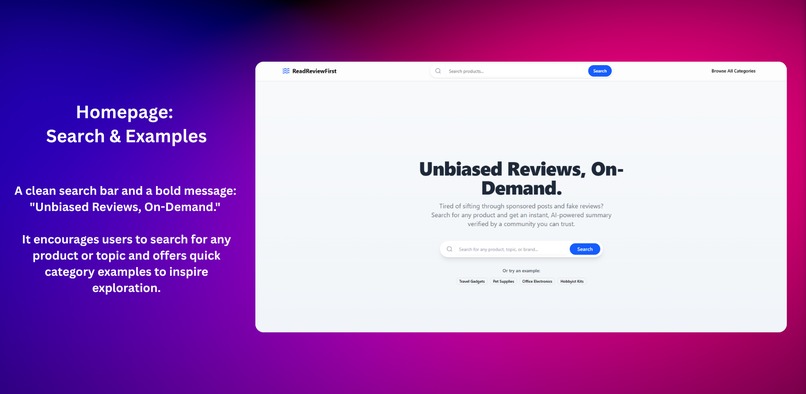
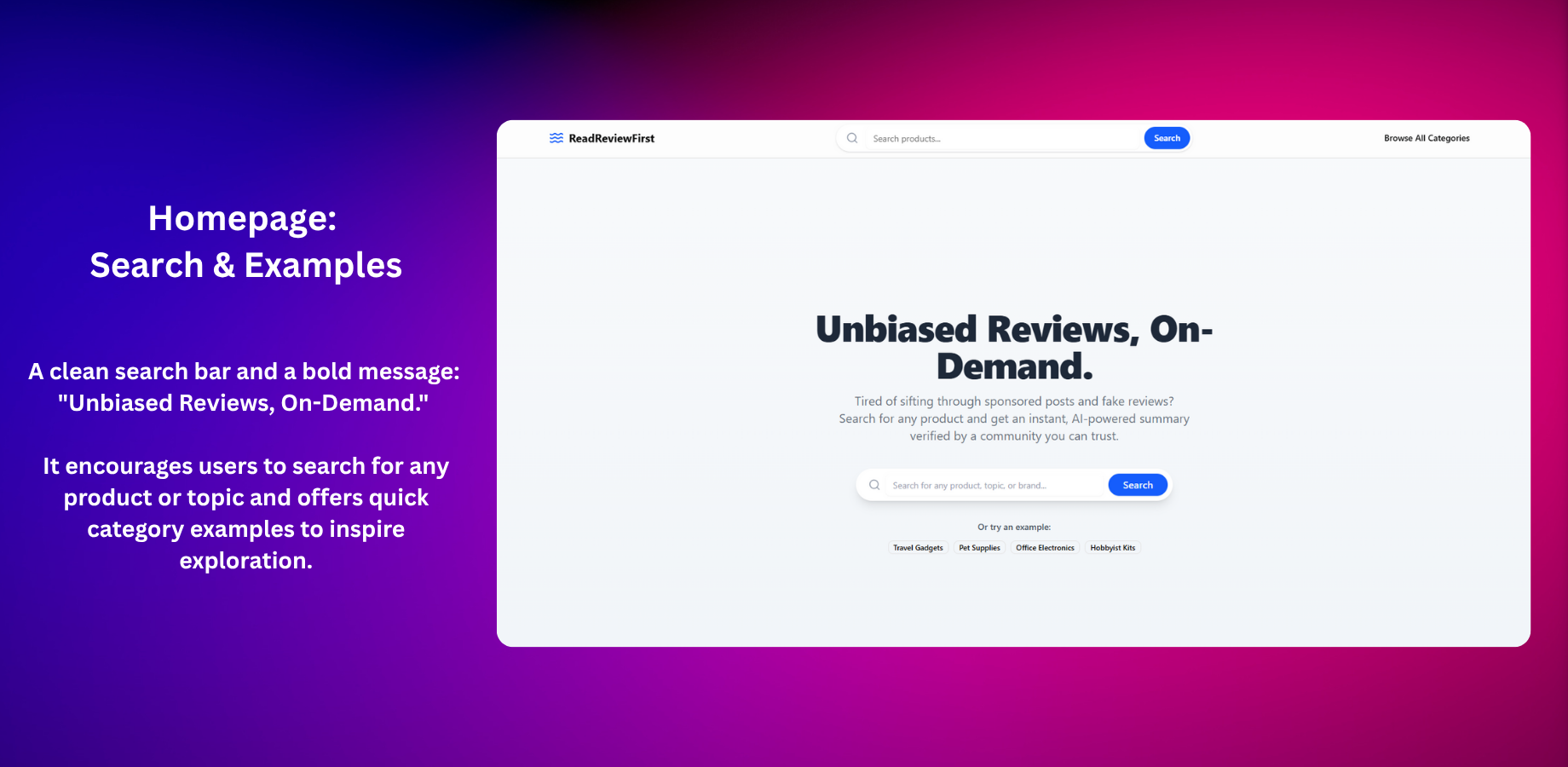
Search
-
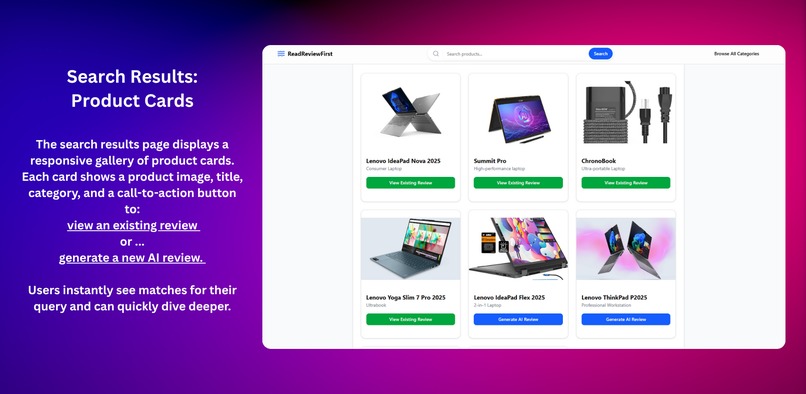
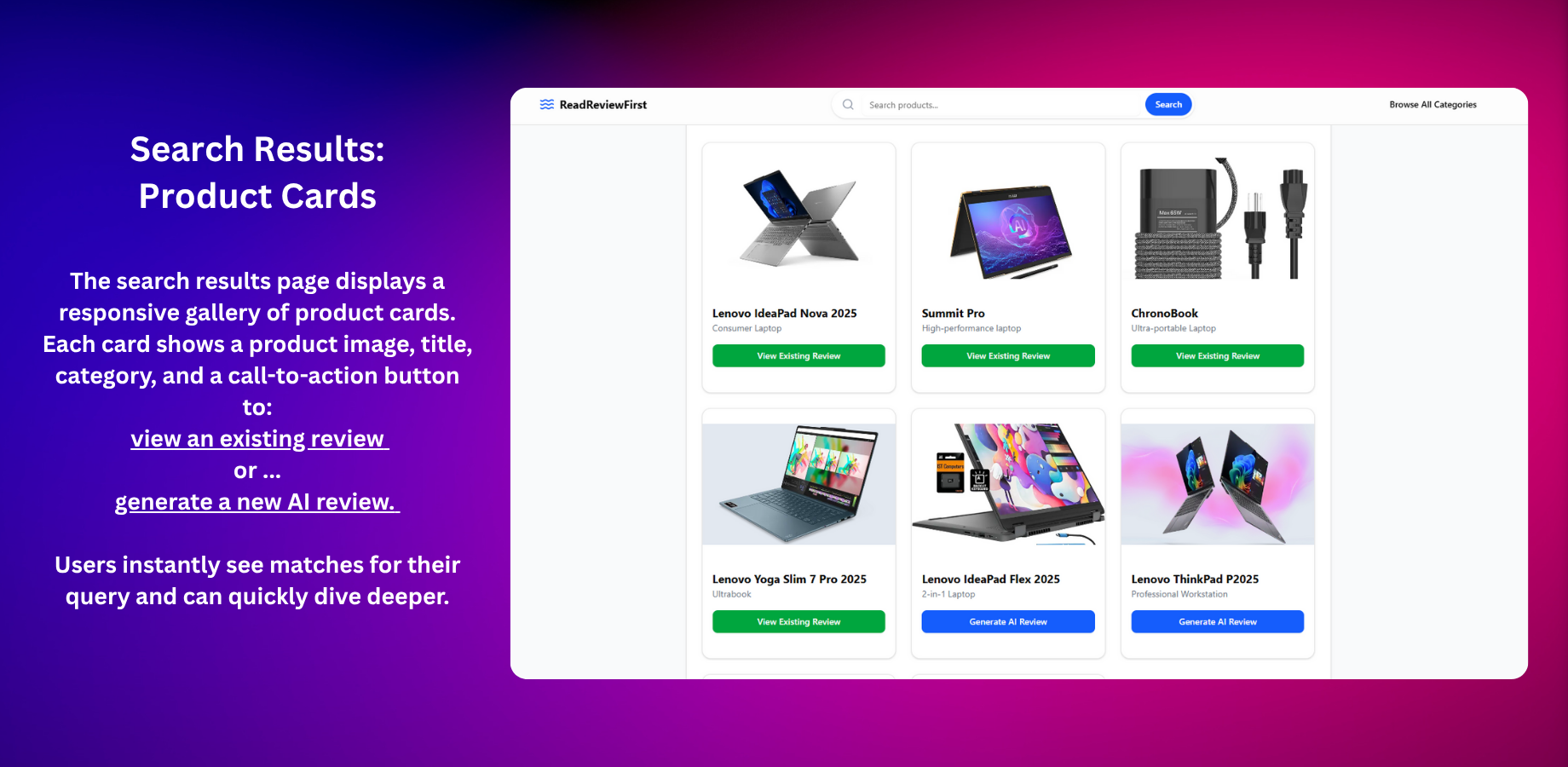
Get existing results or generate review
-
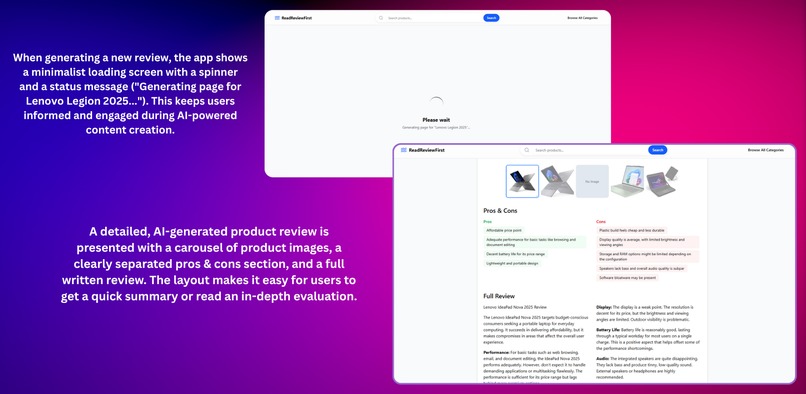
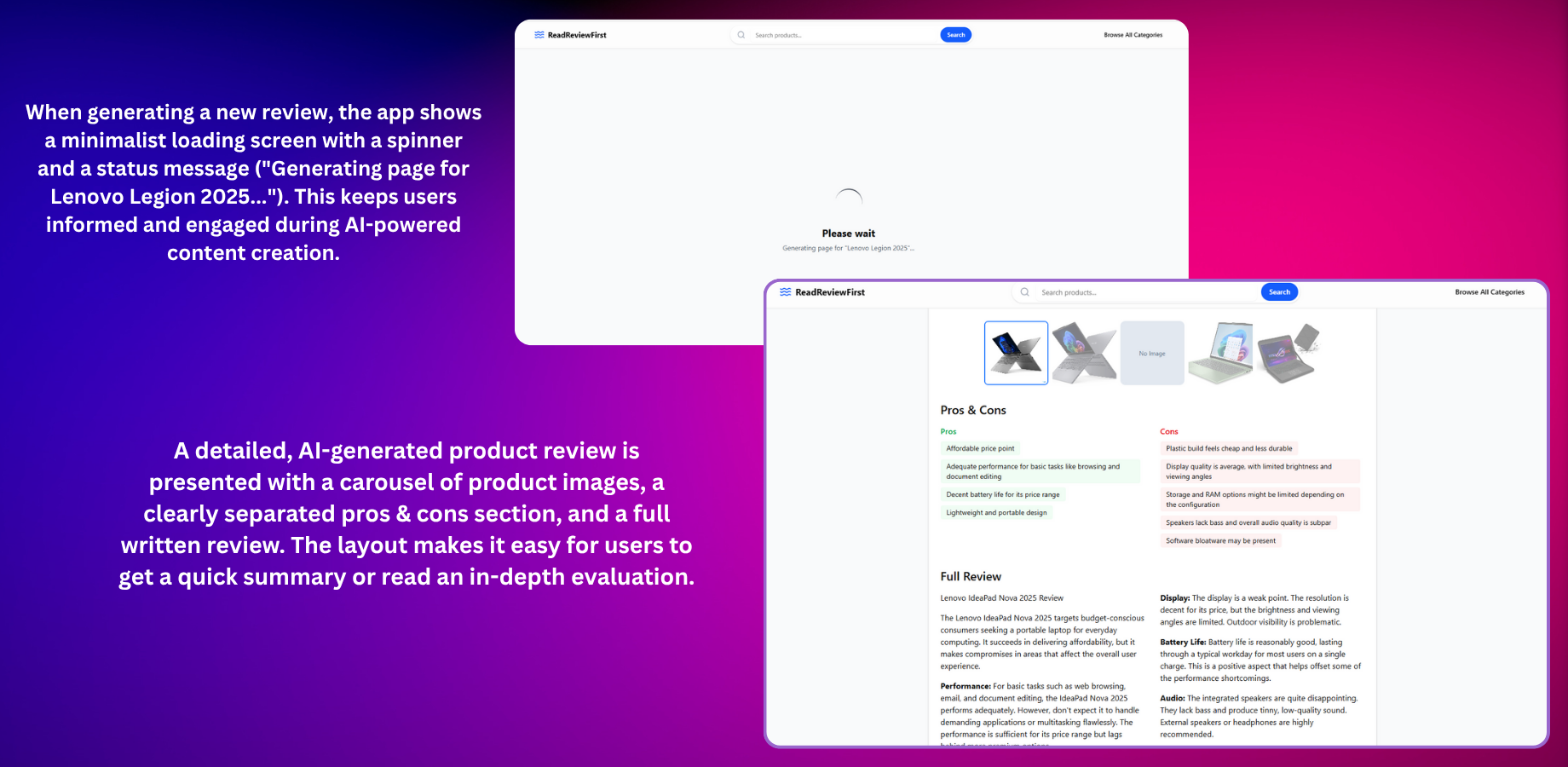
Generate and read review
-
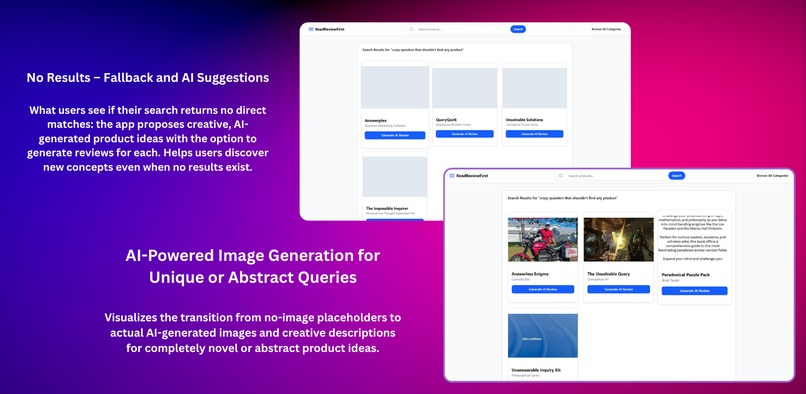
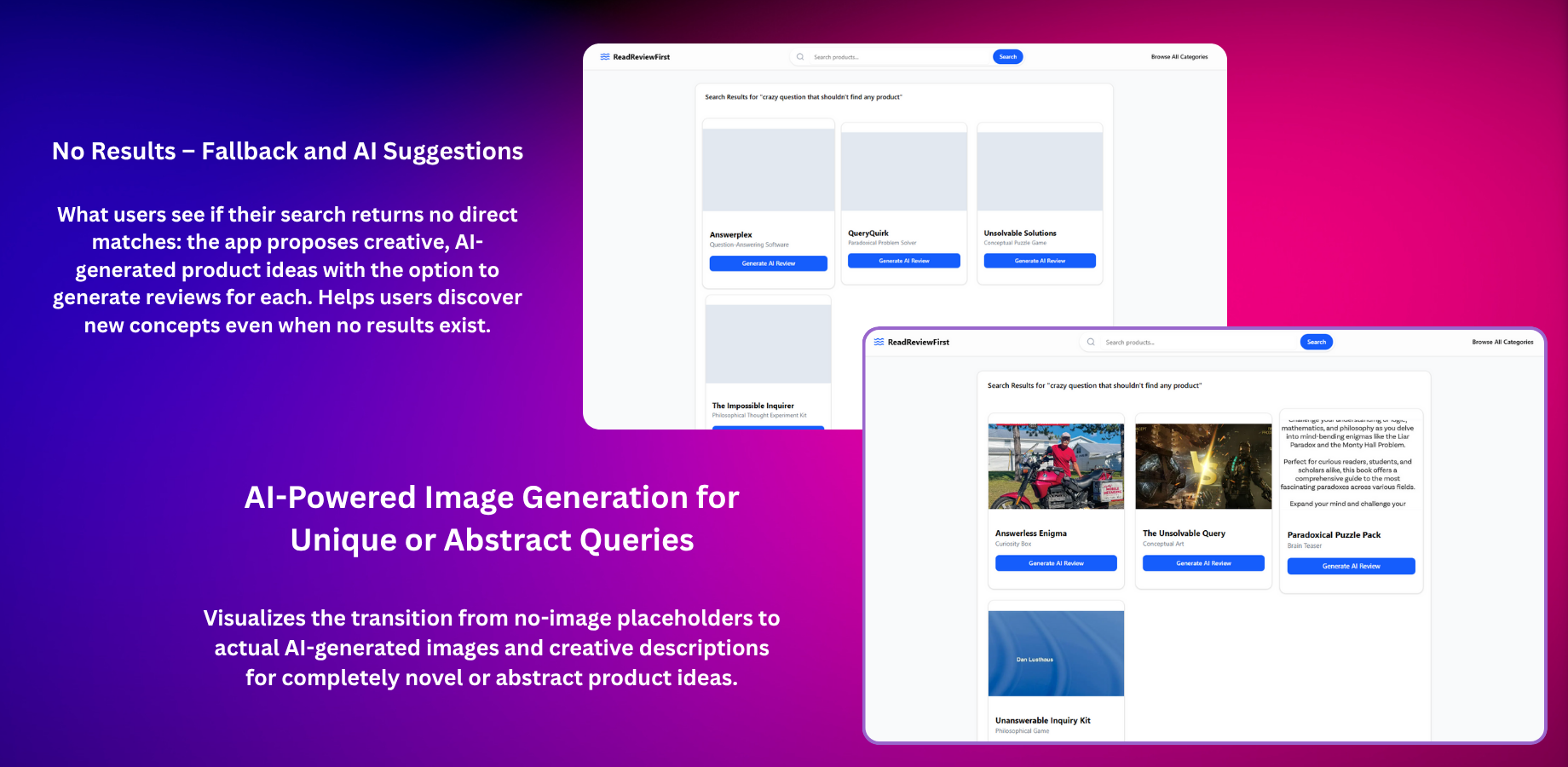
Find products for crazy ideas
ReadReviewFirst: Unbiased Reviews, On‑Demand
Inspiration
In a world saturated with sponsored content and fake reviews, finding trustworthy product information is a challenge. "ReadReviewFirst" was born from a simple need: to get unbiased, comprehensive product analysis on demand. We were inspired to create a platform that doesn't just present static reviews but generates new, objective insights the moment a user expresses curiosity, transforming the "no results found" page from a dead end into an exciting starting point for discovery.
What it Does
"ReadReviewFirst" is a dynamic, AI-powered product discovery and review engine.
Intelligent Hybrid Search: It transforms any user search query (e.g., "quiet keyboard" or "Bose QC35") into a rich set of suggestions. The backend concurrently performs a MongoDB Atlas Vector Search for semantically similar products in our database while tasking Google's Gemini AI to brainstorm new, relevant product ideas.
On-Demand Content Generation: For products not yet in our database, a single click on "Generate AI Review" triggers a robust backend process. This serverless function calls the Gemini model to generate a full, markdown-formatted review with "Pros" and "Cons," determines an optimal query for finding images, fetches those images via the Google Custom Search API, and creates a vector embedding for the product name—all before saving the complete document to MongoDB.
User-Driven Verification: The platform is not just a passive display. Users can upvote ("Looks Accurate") or downvote ("Seems Wrong") any AI-generated review. This feedback directly and atomically updates a
`verification_score`in the database, creating a community-powered system for surfacing the most reliable and helpful AI-generated content.
How We Built It
We chose a modern, scalable, and AI-centric tech stack to bring this vision to life:
Frontend: Next.js 15 (App Router) and React 19 provide a fast, interactive user experience. All UI is built with Tailwind CSS and the excellent shadcn/ui component library.
Database: MongoDB Atlas is the core of our data layer. We leverage its advanced features, including:
- Atlas Vector Search to power our semantic "similar product" search.
- Hybrid Search combining a
textindex with ourvectorindex for highly relevant, filtered results. - Atomic Operators (
$inc) to instantly and reliably update verification scores from user feedback. - TTL (Time-To-Live) Indexes on our image cache to automatically clear stale data.
Artificial Intelligence: The Google AI Platform is the engine of our content creation:
- Gemini 1.5 Flash: Used for all generative tasks, from brainstorming product suggestions to writing full, structured JSON for reviews.
- Gecko
text-embedding-004: Used to create the 768-dimension vectors that power our semantic search. - Google Custom Search API: Provides the real-world images that ground our AI-generated content.
Accomplishments We're Proud Of
Throughout this hackathon, we navigated several real-world engineering challenges to build a truly robust application.
Building a Resilient, Production-Ready API: We encountered frequent
429(Too Many Requests) and503(Service Unavailable) errors from external APIs. Instead of crashing, we engineered a resilient system by implementing:- A
withRetryhelper function that automatically retries failed API calls with an exponential backoff delay. - Graceful Degradation, where if the AI brainstorming fails after all retries, the app seamlessly falls back to showing only database results instead of showing an error.
- Sequential, Rate-Limited Processing for fetching multiple images, preventing API rate limit violations.
- A
Developing a True Hybrid Search Engine: We successfully combined three different search methodologies into a single, unified user experience. The system's ability to blend keyword-based filtering, meaning-based vector search, and creative AI brainstorming makes our search results uniquely relevant and comprehensive.
User-Assisted Content Improvement: The interactive image gallery, which allows users to refine a failed image search query, is a feature we're particularly proud of. It turns a potential dead-end into a collaborative experience, using the user's own knowledge to enrich our platform's data for all future visitors.
What We Learned
The Power of Hybrid Search: Combining MongoDB's full-text search with
$vectorSearchis not just possible but incredibly powerful. Pre-filtering candidates with a text search before applying the vector search was the key to solving our "Logitech problem" and ensuring true semantic relevance.APIs Are Not Infallible: Building for the real world means assuming external services will fail. Defensive coding with retries, timeouts, and graceful fallbacks is not optional—it's a requirement for a good user experience.
Frontend Orchestration vs. Backend Processing: We learned firsthand that for tasks involving multiple, slow network requests (like fetching images), moving the orchestration logic to the frontend to load content progressively results in a dramatically faster and better perceived performance than waiting for the backend to do everything.
What's Next for Read Review First
Our MVP has laid a powerful foundation. The next steps are focused on building out the community and monetization layers:
- Building Trust with Community Verification: Develop a "Trust Score" algorithm based on the upvote/downvote ratio and the number of votes. Highlight and promote products with the highest community-verified scores.
- Affiliate Integration & User Monetization: Allow trusted users to add their own reviews alongside the AI's and include affiliate links, sharing a portion of the revenue with the content creators.
- Multi-Modal AI: Explore using generative image models like Imagen or DALL-E as the ultimate fallback, ensuring that even the most obscure product suggestion has a unique, AI-generated placeholder image.
Built With
- gemini
- mongodb
- next.js
- react
- tailwindcss
- typescript

Log in or sign up for Devpost to join the conversation.