Inspiration
Debu has always been interested in clean energy, and at Berkeley he decided to focus on how machine learning can be applied to nuclear energy. MinSeong lives in South Korea, which has a strong nuclear program, and Anish is interested in using ML for social good. Rather than the usual consumer hackathon product, we wanted to build a tool that scientists and engineers could use to solve real-world problems. So we built ReactorTwin to tackle one of the biggest bottlenecks in reactor design, arguably the biggest outside of NRC regulation: how long it takes to simulate each core design.
What it does
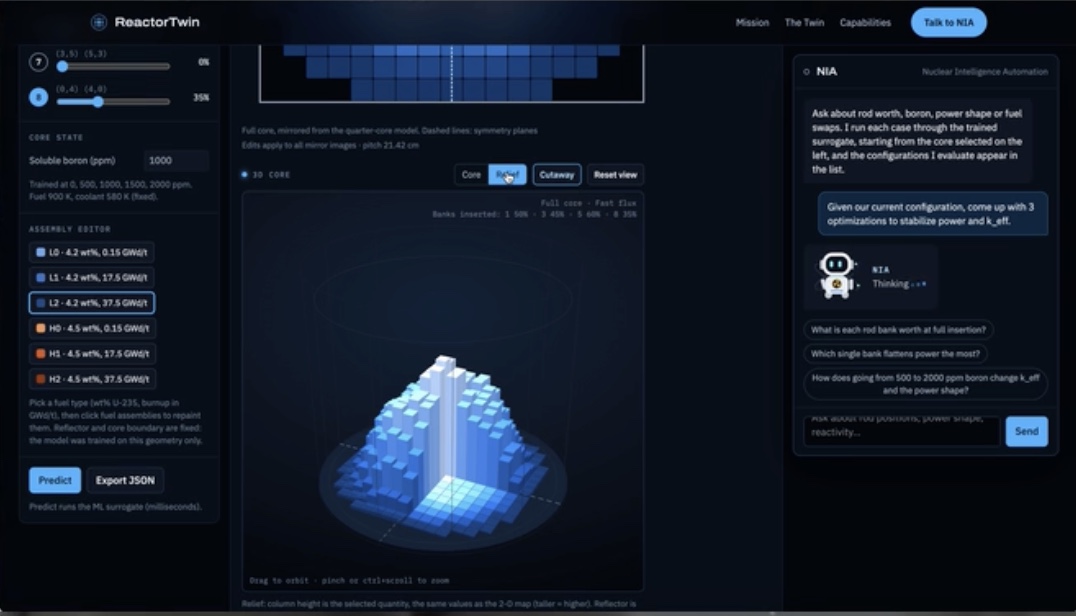
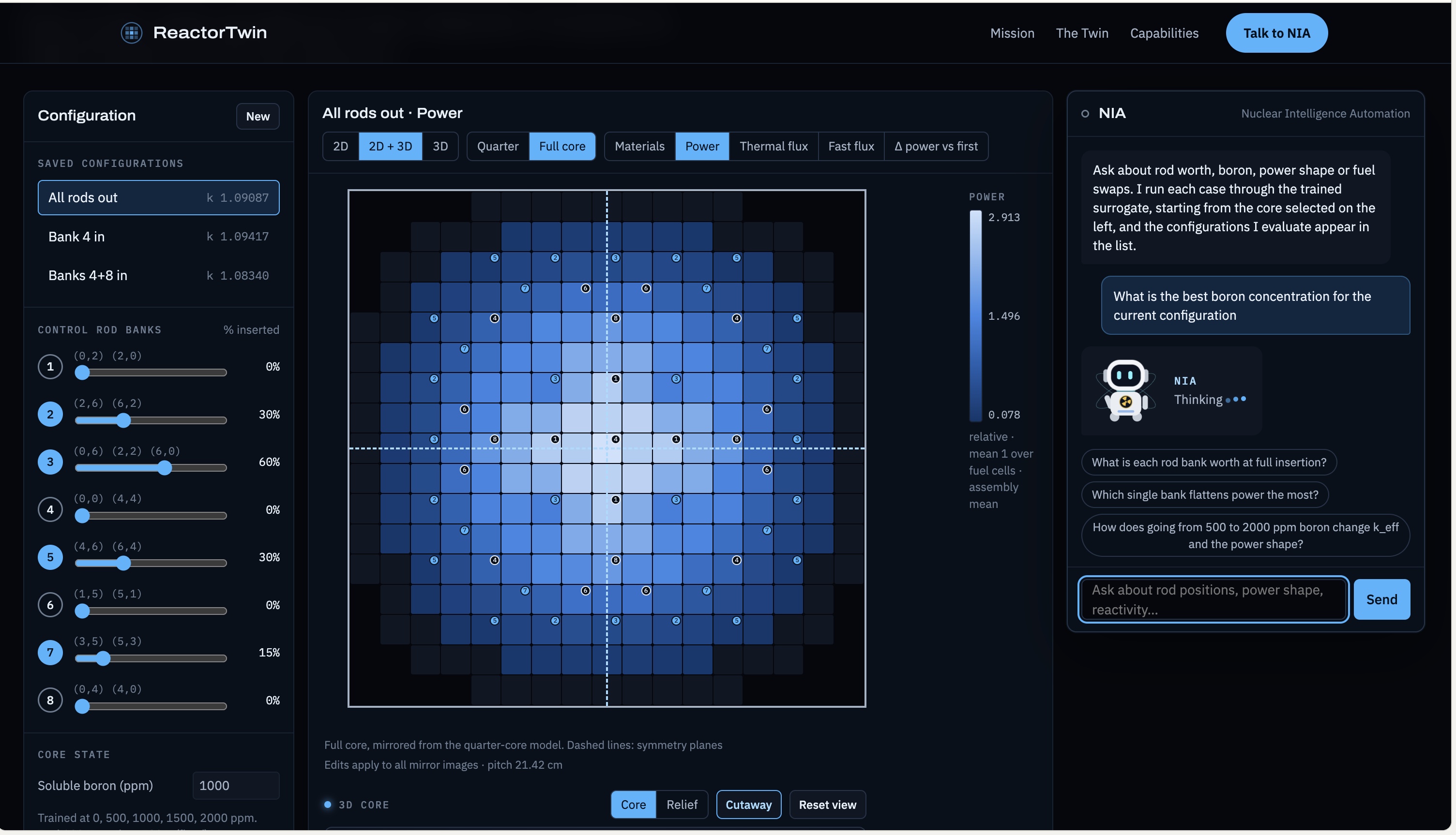
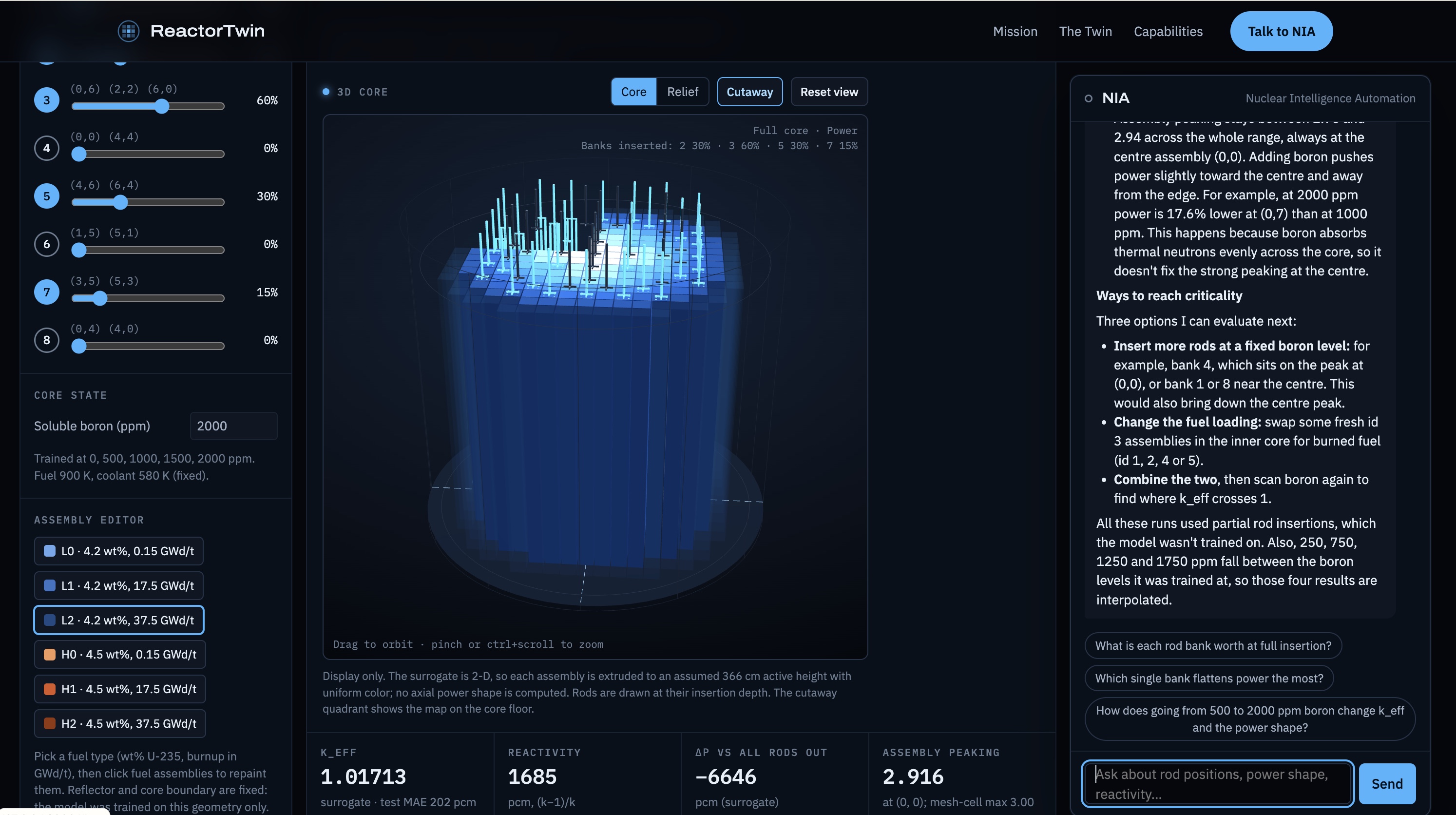
ReactorTwin includes NIA (Nuclear Intelligence Automation), an agent that works as your research and development assistant. You can ask NIA to test different control rod insertion depths, fuel layouts, boron concentrations and more, and it searches for the configurations that best stabilize the reactor. You can also work with the model directly: place materials in the reactor core yourself and adjust how far each control rod bank is inserted.
How we built it
Using NeutronDiffusion, an open-source 2-D neutron diffusion solver, we generated 5,000 samples by solving the two-group neutron diffusion equation. Each solution gives the neutron flux, the intensity of neutrons throughout the core, along with k-eff. We trained a Fourier neural operator (FNO) on these samples and connected it to NIA, so the agent can evaluate a configuration in milliseconds instead of running a full simulation.
Challenges we ran into
Generating the data was the hardest part. We needed enough features to predict flux accurately, but not so many that we couldn't generate enough data to train the model. Data generation took about seven hours, largely because of mistakes we had to fix along the way, such as missing material cross sections and not checking values while the data was being produced.
Accomplishments that we're proud of
We're proud of how technical our project is. It draws on machine learning, AI engineering, nuclear physics and computational methods. On 512 held-out cores the model never saw during training, it predicts k-eff within about 200 pcm of the reference solver on average, and its power maps are within about 7% (relative L2 error). Each prediction takes about 1.6 ms, roughly 10,000 to 1,000,000 times faster than a full-core OpenMC Monte Carlo run, which takes anywhere from minutes to hours. Using our domain knowledge to address a genuine problem in the field is something we're proud of, and it's work we may continue as research.
What we learned
Data generation can be the real bottleneck. Models are extremely capable, and Claude can build a nice website, but making sure your data is physically correct takes time, attention and domain-specific knowledge.
What's next for ReactorTwin
With more time and compute, we can generate more realistic synthetic data with fewer simplifications and add more reactor presets. Right now we only support pressurized water reactors. With new data for other designs, such as boiling water reactors or molten-salt fast reactors, ReactorTwin could become a tool that engineers and researchers actually use, pending regulatory approval.

Log in or sign up for Devpost to join the conversation.