-
-
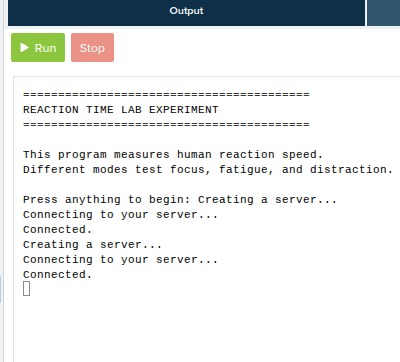
Starting Screen
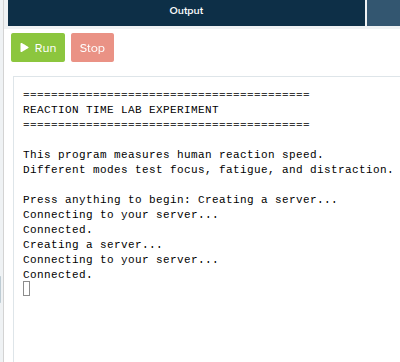
Inspiration
I built the Reaction Time Lab because I’ve always been curious about how fast the human brain can really react and how things like focus, fatigue, and distractions affect performance. I was inspired by real neuroscience experiments that measure reflexes and decision-making speed, and I wanted to recreate something similar in a simple interactive program.
What it does
This project simulates a reaction time experiment where users respond to random stimuli like “GO” or “NOW.” It records multiple trials, calculates averages, finds the fastest and slowest responses, and even compares two players. It also analyzes trends over time and visualizes performance using a text-based graph.
How we built it
I built it using C++ on CodeHS, relying on loops, arrays, functions, and timing with the clock function. I also used structured input functions from the CodeHS utility library to make the program more user-friendly.
Challenges I ran into
The hardest part was making the timing accurate across multiple players, because even small delays or input issues caused inconsistent results like premature “too early response” errors.
Accomplishments that I'm proud of
One accomplishment I’m proud of is successfully creating a full experiment system that doesn’t just take input, but actually analyzes human performance like a real lab. I also like that the program feels interactive and competitive with the two-player mode.
What I learned
From this project, I learned how sensitive timing systems can be in programming and how small design choices can affect accuracy. I also improved my skills in debugging, especially when dealing with logic that depends on real-time input.
What's next for Reaction Time Lab Experiment
Next, I want to improve the Reaction Time Lab by adding more realistic neuroscience features like standard deviation, difficulty scaling, and possibly a visual interface instead of text graphs, making it feel even closer to a real cognitive science experiment.
Built With
- cpp

Log in or sign up for Devpost to join the conversation.