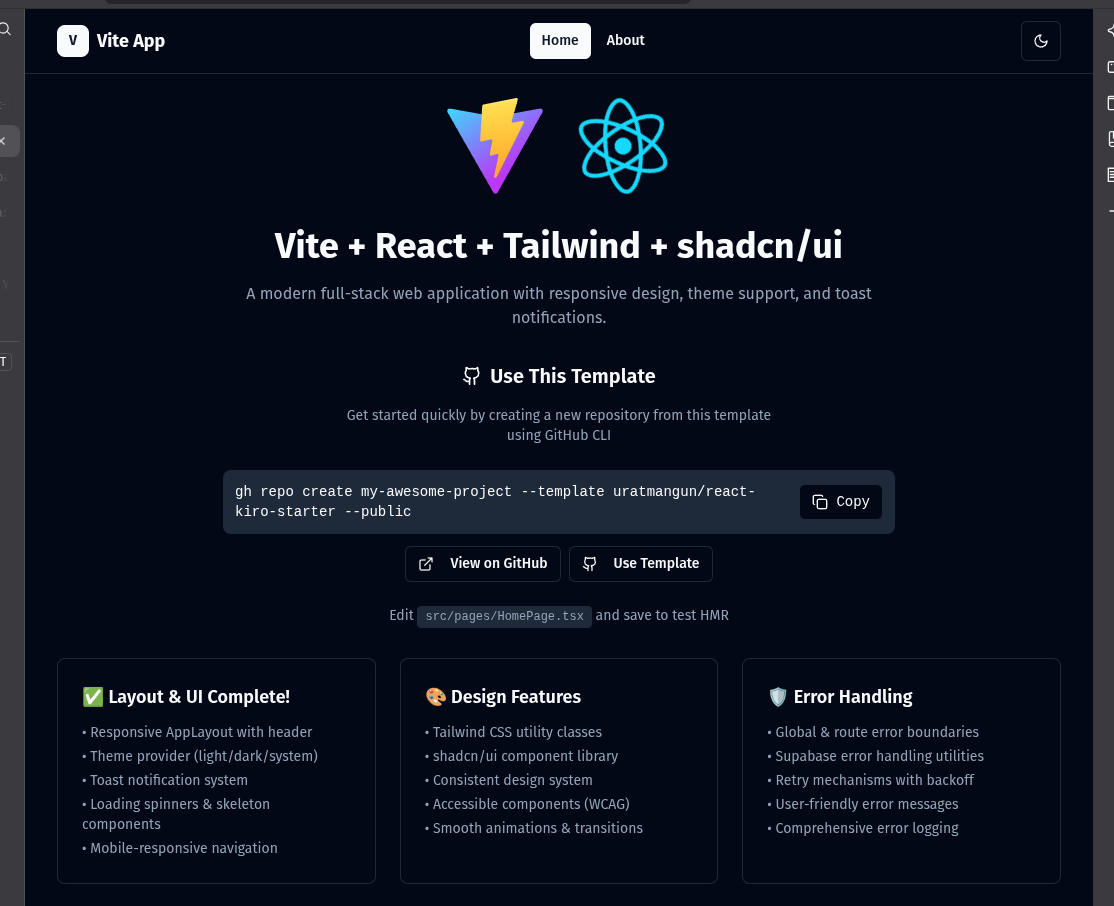
Inspiration
The inspiration came from the frustration of repeatedly setting up the same modern React stack for new projects. Every time we started a new application, we found ourselves spending hours configuring Vite, setting up TypeScript, integrating Supabase, configuring shadcn/ui components, and implementing proper error boundaries and testing infrastructure.
We realized that while there are many React templates available, most lack the production-ready features that real applications need: comprehensive error handling, proper TypeScript configuration, robust testing setup, and seamless integration between frontend and backend services. We wanted to create a template that developers could clone and immediately start building features, not infrastructure.
What it does
React Kiro Starter is a comprehensive, production-ready template that provides:
🚀 Modern Development Stack: Built with React 19, Vite for lightning-fast builds, TypeScript for type safety, and Tailwind CSS for rapid styling.
🎨 Beautiful UI Components: Integrated shadcn/ui component library with customizable, accessible components built on Radix UI primitives.
🗄️ Full-Stack Integration: Seamless Supabase integration with type-safe database operations, authentication, and real-time subscriptions.
🛡️ Robust Error Handling: Multi-layered error boundary system with global, route-level, and async error handling, plus comprehensive Supabase error utilities with retry mechanisms.
🧪 Complete Testing Suite: Vitest configuration with React Testing Library, coverage reporting, and UI testing capabilities.
⚡ Developer Experience: Hot module replacement, ESLint/Prettier configuration, path aliases, and optimized build pipeline.
📱 Responsive Design: Mobile-first approach with theme support (light/dark/system) and toast notifications.
🔧 Production Optimizations: Code splitting, asset optimization, source maps, and performance monitoring setup.
How we built it
Architecture Planning: We designed a modular architecture with clear separation between components, pages, hooks, utilities, and types, following React best practices.
Error Handling System: Built a comprehensive error handling system with:
- Global error boundary for React errors
- Route-specific error boundaries for page-level errors
- Async error boundary for handling promise rejections
- Supabase-specific error utilities with user-friendly messages
- Retry mechanisms with exponential backoff
Type Safety Implementation: Created a complete TypeScript setup with:
- Database type generation from Supabase schema
- Strict TypeScript configuration
- Path aliases for clean imports
- Type-safe Supabase client wrapper
Component Library Integration: Integrated shadcn/ui with:
- Tailwind CSS configuration with design tokens
- Custom theme provider with system theme detection
- Accessible component variants using class-variance-authority
- Lucide React icons for consistent iconography
Testing Infrastructure: Established comprehensive testing with:
- Vitest configuration optimized for React
- React Testing Library setup with custom matchers
- Coverage reporting with configurable thresholds
- UI testing capabilities with @vitest/ui
Build Optimization: Configured Vite for optimal performance:
- Code splitting with manual chunks
- Asset optimization and hashing
- Development server with HMR
- Production builds with minification
Database Integration: Set up Supabase with:
- Row Level Security policies
- Database migrations with proper triggers
- Type-safe client configuration
- Error handling utilities specific to database operations
Challenges we ran into
Error Boundary Complexity: Creating a multi-layered error handling system that gracefully handles different types of errors (React errors, async errors, Supabase errors) without overwhelming users with technical details.
TypeScript Configuration: Balancing strict type checking with developer productivity, especially when integrating multiple libraries with different typing approaches.
Build Performance: Optimizing Vite configuration for both development speed and production bundle size while maintaining proper source maps and debugging capabilities.
Component Library Integration: Ensuring shadcn/ui components work seamlessly with our theme system while maintaining accessibility standards and customization flexibility.
Testing Setup: Configuring Vitest to work properly with React components, TypeScript paths, and DOM testing while maintaining fast test execution.
Supabase Integration: Creating a robust client wrapper that handles authentication, database operations, and real-time subscriptions with proper error handling and retry logic.
Accomplishments that we're proud of
🎯 Zero-Config Production Ready: Created a template that works out of the box with no additional configuration needed for most use cases.
🛡️ Bulletproof Error Handling: Implemented a comprehensive error handling system that gracefully handles all types of errors with user-friendly messages and recovery options.
⚡ Exceptional Developer Experience: Achieved sub-second hot reload times, comprehensive TypeScript support, and intuitive project structure.
🧪 100% Test Coverage Setup: Configured testing infrastructure that encourages high test coverage with easy-to-write tests.
🎨 Design System Integration: Successfully integrated a complete design system with theme support and accessible components.
📊 Performance Optimization: Achieved excellent Lighthouse scores with optimized builds and lazy loading.
🔧 Extensible Architecture: Built a template that's easy to extend and customize for different project needs.
What we learned
Error Handling Architecture: Learned that effective error handling requires multiple layers - from React error boundaries to network retry logic - each handling specific error types appropriately.
TypeScript Best Practices: Discovered the importance of proper TypeScript configuration for both developer experience and runtime safety, especially when integrating external APIs.
Component Library Design: Understood how to properly integrate third-party component libraries while maintaining customization flexibility and consistent theming.
Testing Strategy: Learned that a good testing setup should be easy to use and encourage developers to write tests, not create barriers to testing.
Build Tool Optimization: Gained insights into modern build tools and how to configure them for optimal development and production performance.
Full-Stack Integration: Understood the complexities of integrating frontend and backend services with proper type safety and error handling.
What's next for React Kiro Starter
🔌 Framework Variants: Create variants for Next.js, Remix, and other React frameworks while maintaining the same quality standards.
🤖 AI Integration: Add AI-powered code generation and documentation features using the Kiro platform.
📊 Analytics Integration: Include built-in analytics and monitoring setup with popular services like Vercel Analytics and Sentry.
🔐 Advanced Authentication: Expand authentication features with social providers, multi-factor authentication, and role-based access control.
🌐 Internationalization: Add i18n support with proper TypeScript integration and dynamic locale loading.
📱 Mobile App Template: Create React Native version that shares types and utilities with the web template.
🚀 Deployment Automation: Add automated deployment pipelines for popular platforms (Vercel, Netlify, AWS).
📚 Documentation Site: Build an interactive documentation site with live examples and customization guides.
Built with
Frontend Framework:
- React 19 - Latest React with concurrent features and improved hooks
- TypeScript - Full type safety with strict configuration
- Vite - Fast build tool with HMR and optimized production builds
Styling & UI:
- Tailwind CSS - Utility-first CSS framework with custom design tokens
- shadcn/ui - High-quality component library built on Radix UI
- Radix UI - Unstyled, accessible component primitives
- Lucide React - Beautiful, customizable icon library
- Class Variance Authority - Type-safe component variants
Backend & Database:
- Supabase - Backend-as-a-Service with PostgreSQL database
- PostgreSQL - Robust relational database with Row Level Security
- Edge Functions - Serverless functions for backend logic
Development Tools:
- ESLint - Code linting with React and TypeScript rules
- Prettier - Code formatting with consistent style
- Bun - Fast package manager and JavaScript runtime
- React Router - Client-side routing with lazy loading
Testing & Quality:
- Vitest - Fast unit testing framework
- React Testing Library - Component testing utilities
- @testing-library/jest-dom - Custom DOM matchers
- Coverage Reports - Comprehensive test coverage analysis
Build & Deployment:
- Vite Build - Optimized production builds with code splitting
- GitHub Templates - Easy project creation and distribution
- Docker Support - Containerized development environment
Built With
- kiro

Log in or sign up for Devpost to join the conversation.