-
-
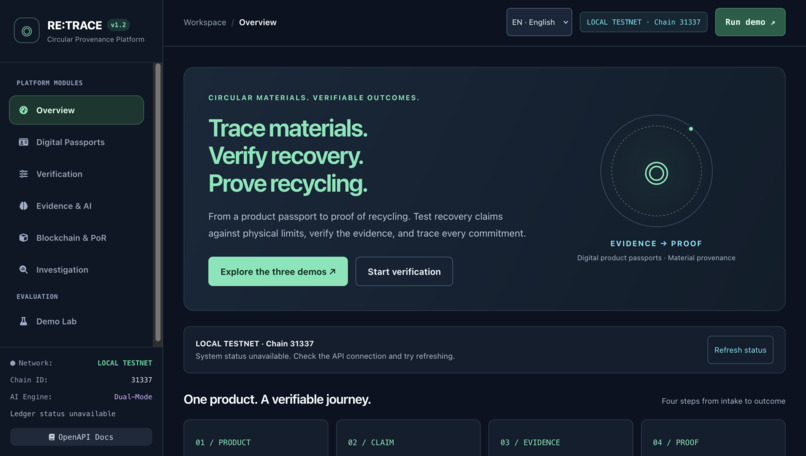
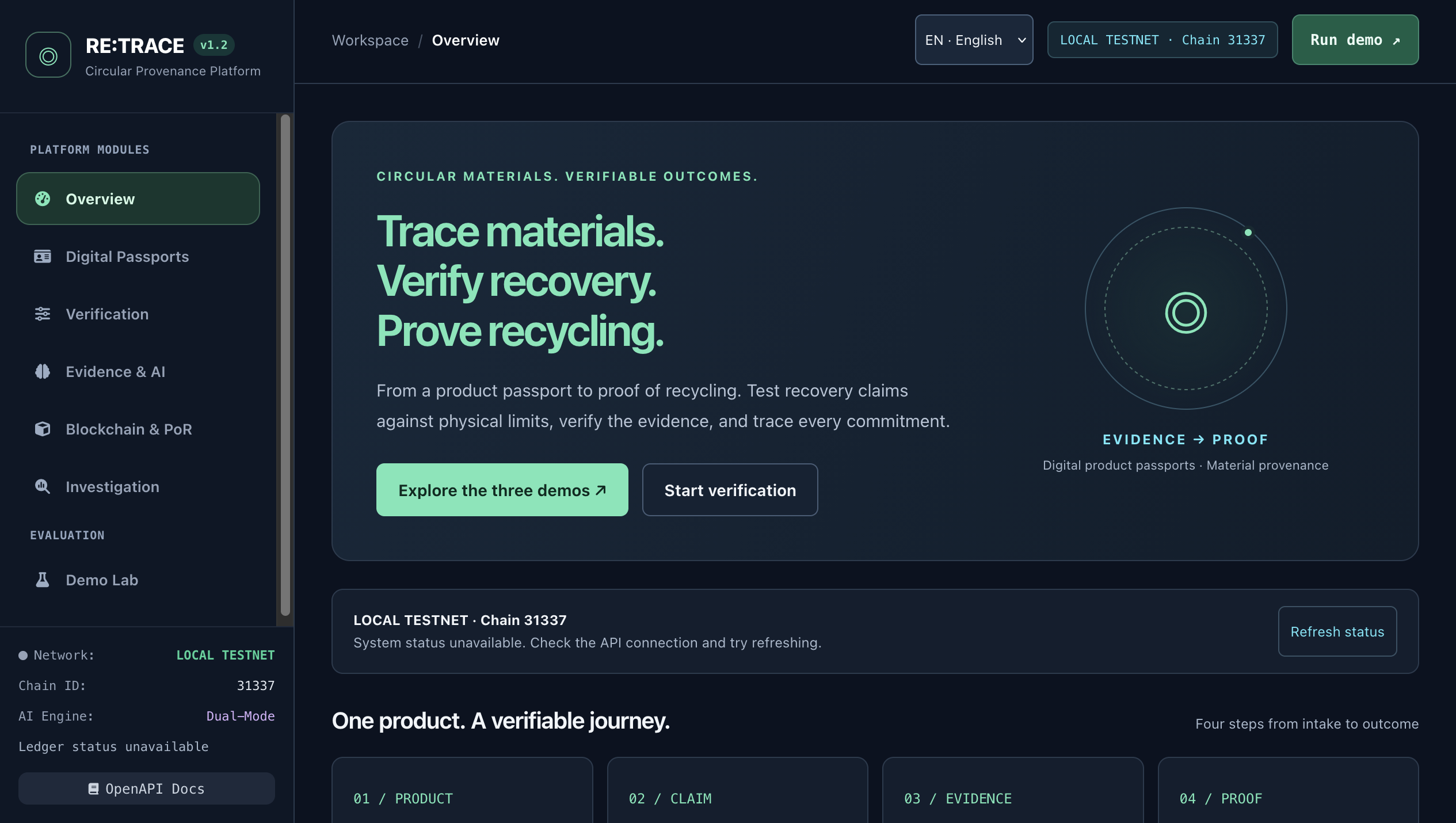
Overview: RE-TRACE's unified dashboard connects material traceability, recycling verification, and evidence-backed sustainability claims.
-
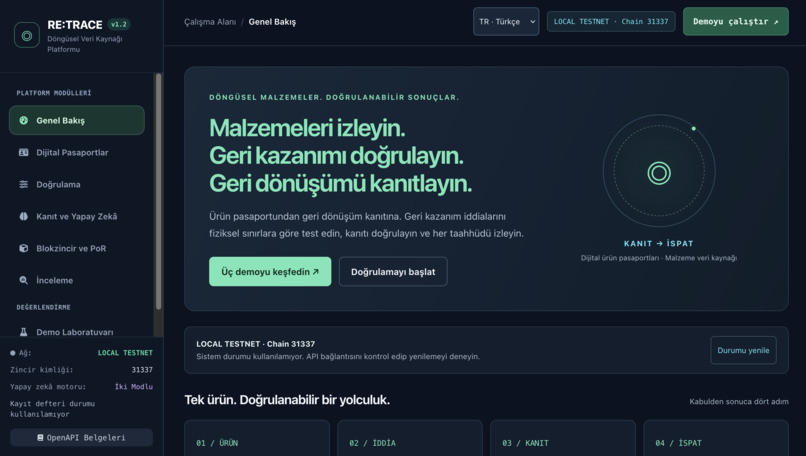
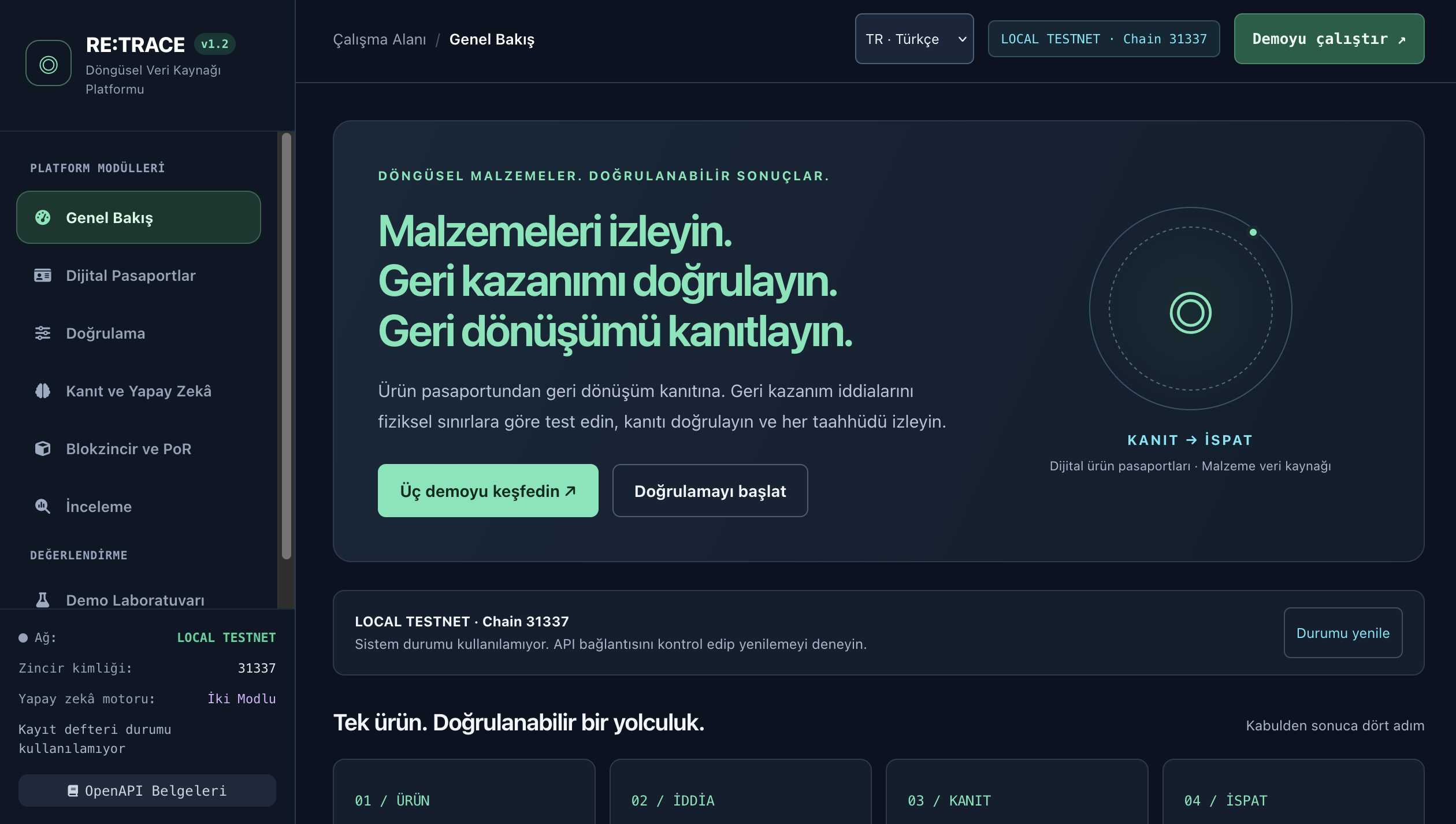
Native Turkish Support: RE-TRACE offers a localized Turkish interface for seamless recycling verification and material traceability.
-
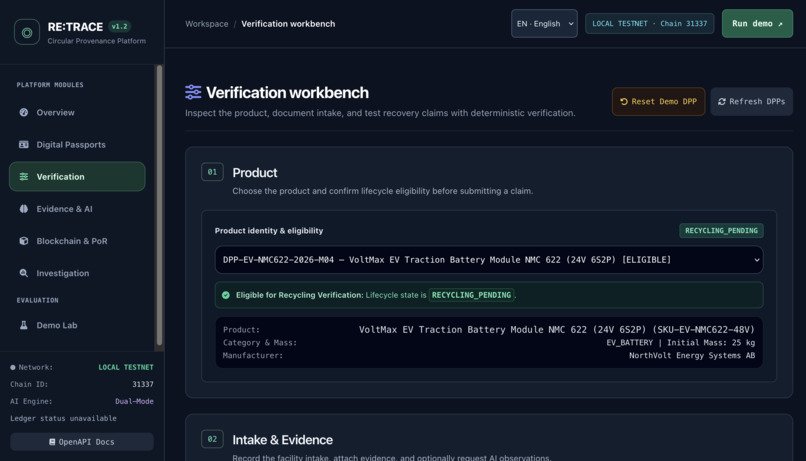
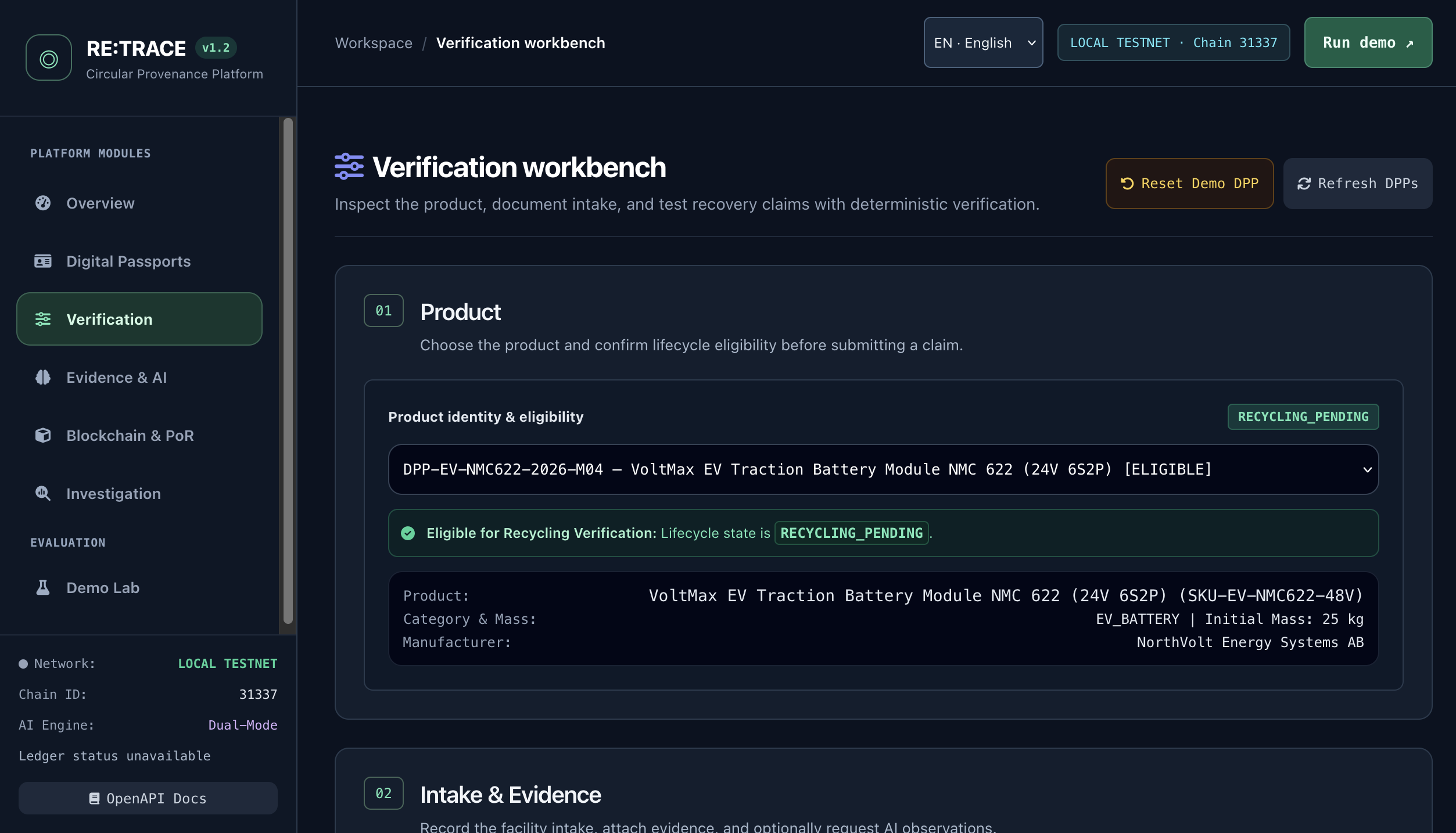
Verification Workbench: Validate recycling claims through product eligibility checks, evidence intake, and deterministic mass-balance .
-
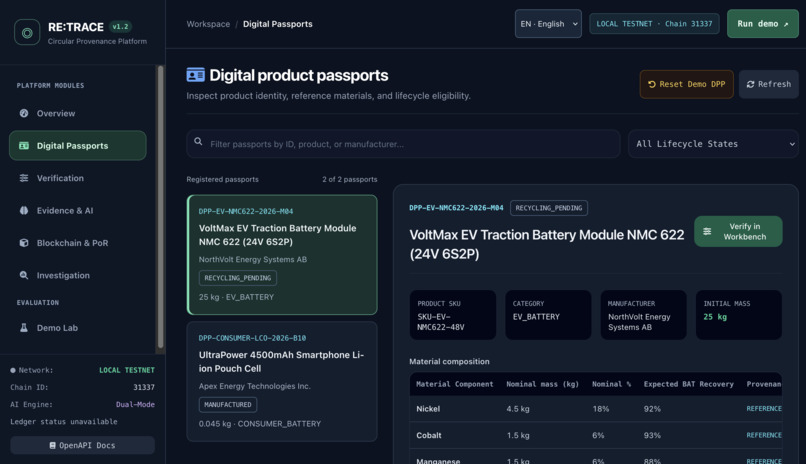
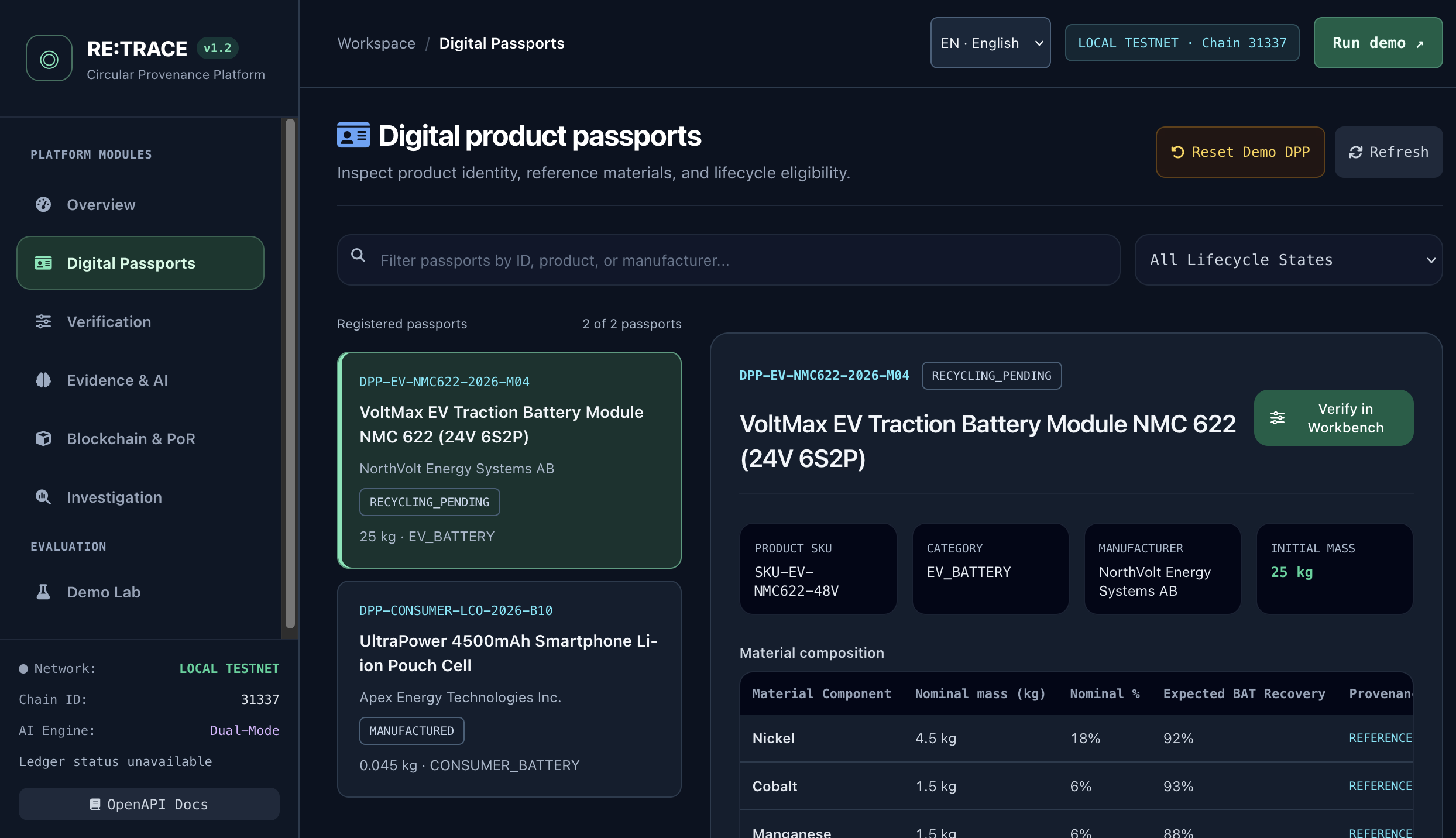
Digital Product Passports: Explore product identities, material composition, lifecycle status, and recycling eligibility in one place.
-
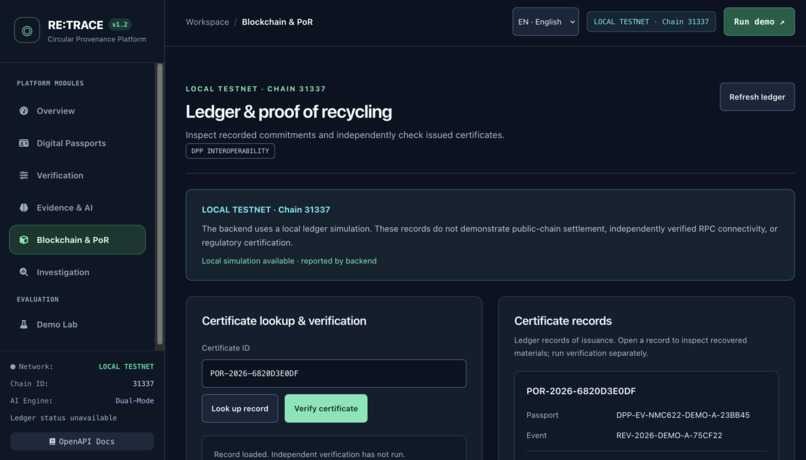
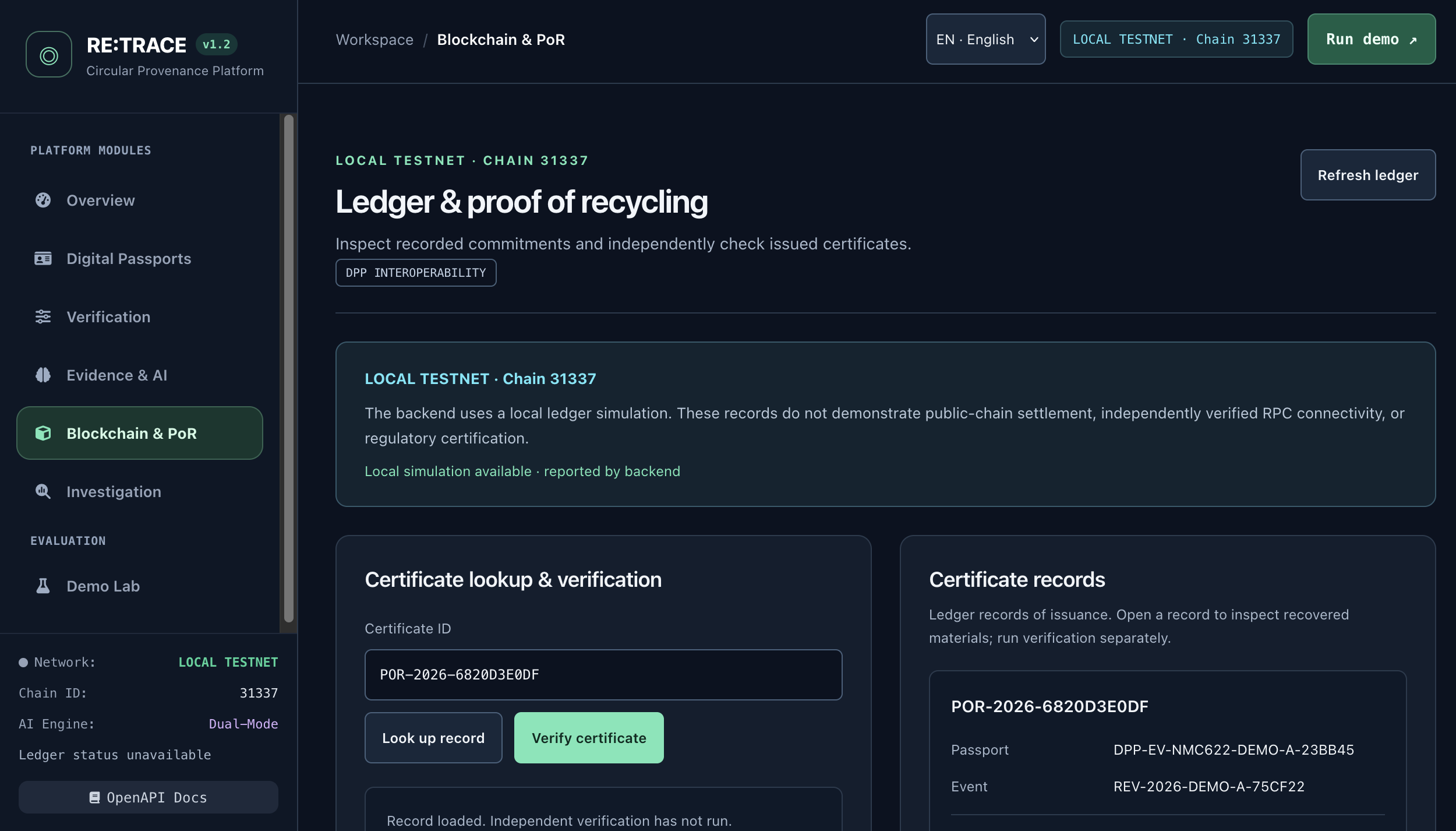
Blockchain & Proof of Recycling: Explore local testnet records, trace recycling commitments, and independently verify issued certificates.
-
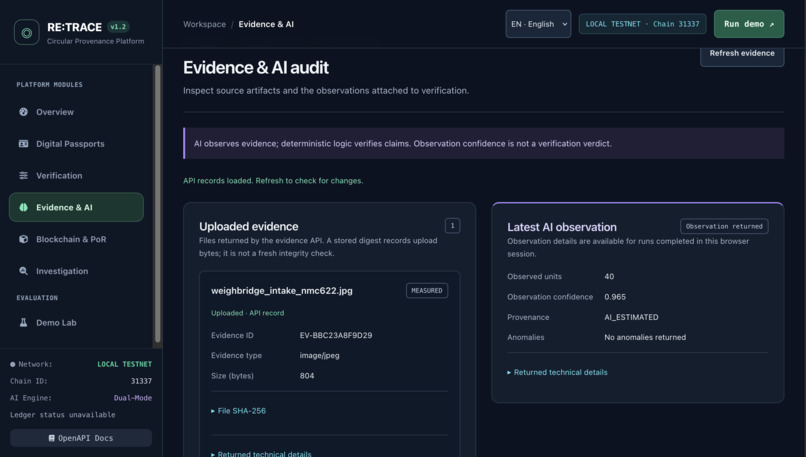
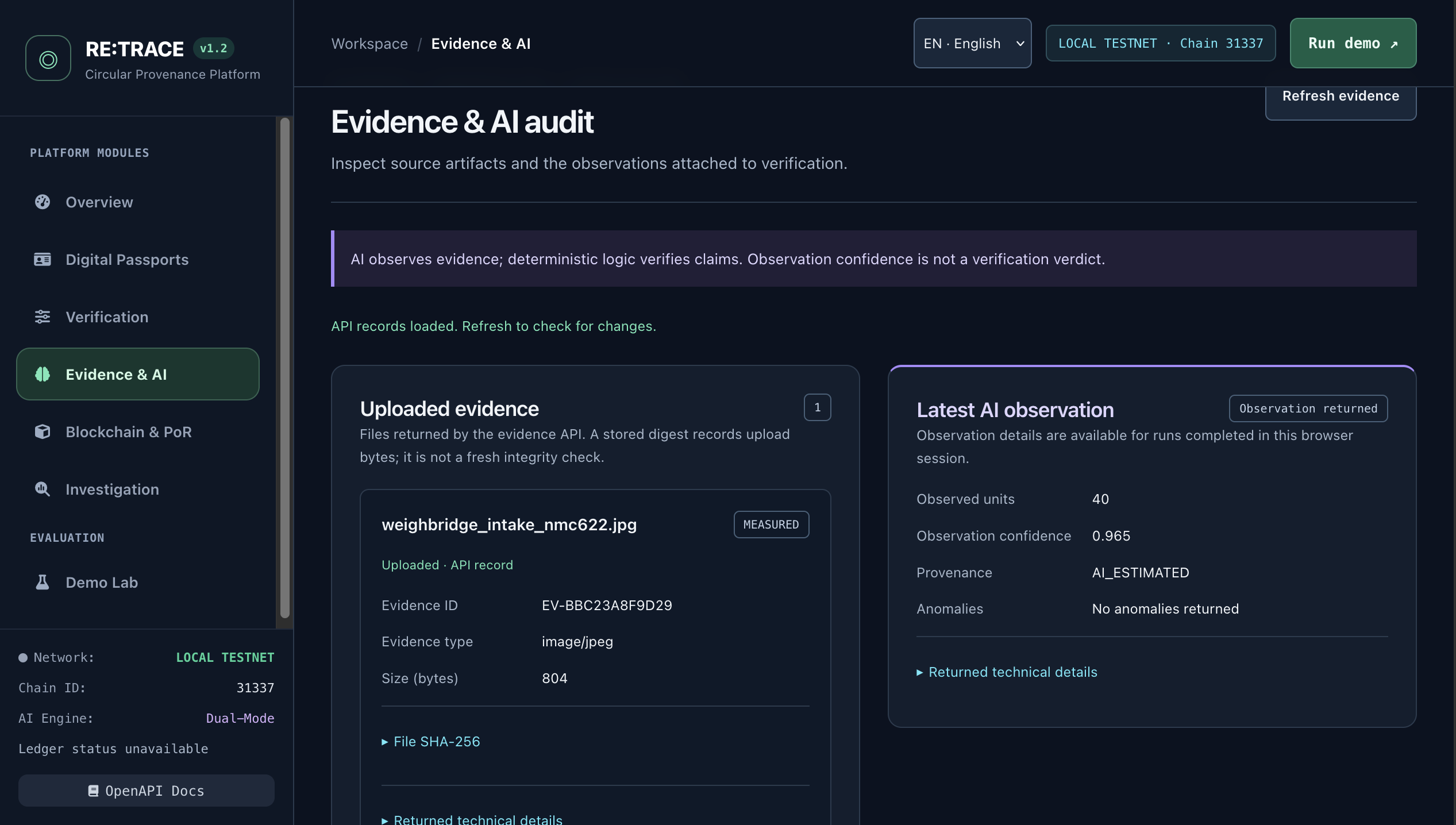
Evidence & AI Audit: Review uploaded evidence, AI-generated observations, confidence scores, and supporting verification records.
Inspiration 🌍
Every year, millions of tons of recyclable materials travel through complex supply chains. Yet one fundamental question remains: How do we know that something claimed to be recycled was actually recycled?
Sustainability labels and environmental promises are everywhere, but fragmented records, limited transparency, and greenwashing make these claims difficult to verify.
We imagined a world where every material could tell its own story — where it came from, how it was processed, and where it ended up.
That's why we created RE-TRACE, built around one simple belief:
Sustainability shouldn't just be claimed. It should be proven.
Our goal was to combine artificial intelligence, computer vision, blockchain-oriented traceability, and physical material accounting to make recycling more transparent and accountable.
What it does ♻️
RE-TRACE is an AI-powered recycling traceability platform that transforms fragmented recycling records into transparent, verifiable material journeys.
It brings together several technologies to make circular supply chains more trustworthy:
- Digital Product Passports (DPPs): Give materials unique digital identities, connecting their origins, recycling activities, and lifecycle records.
- OpenCV 5 Agentic Vision: Inspects uploaded recycling evidence, detects QR codes, evaluates image quality, and identifies potential inconsistencies.
- AI-Assisted Verification: Uses a multi-stage inspection workflow to analyze evidence, improve inspection conditions, and flag suspicious submissions.
- Mass-Balance Accounting: Tracks material inputs, outputs, and losses using deterministic calculations to identify inconsistencies in recycling claims.
- Blockchain-Oriented Traceability: Maintains auditable lifecycle records and supports blockchain anchoring for stronger verification.
- Intelligent Verification Gates: Quarantines suspicious evidence, requests human review when necessary, and blocks certificate issuance when critical conditions remain unresolved.
- Recycling Certificates: Generates certificates linked to documented recycling activity and verification outcomes.
- Interactive Dashboard: Provides an intuitive interface for exploring material journeys, managing passports, inspecting evidence, and reviewing verification results.
Together, these capabilities help transform sustainability claims into evidence-supported, traceable records.
How we built it 🛠️
We developed RE-TRACE using Python, FastAPI, OpenCV 5, and a web-based dashboard, combining computer vision with deterministic verification and digital traceability.
Our modular backend manages product passports, recycling lifecycle events, evidence uploads, mass-balance calculations, certificate generation, and ledger records.
For visual evidence inspection, we integrated OpenCV 5 into a four-stage agentic workflow:
- Perception: Analyze uploaded images and detect relevant visual information.
- Adjustment: Improve inspection conditions using techniques such as CLAHE-based image enhancement.
- Inspection: Evaluate QR-code identity, image sharpness, exposure, and evidence consistency.
- Decision: Produce explainable inspection results and determine whether evidence passes, requires review, or must be quarantined.
We used OpenCV techniques such as QR-code detection, Laplacian variance analysis, and luminance assessment to make evidence inspection more reliable.
Importantly, we kept AI-assisted visual inspection separate from deterministic mass-balance accounting, ensuring that image analysis cannot override physical material inconsistencies.
Finally, we brought these systems together through a redesigned dashboard that makes complex recycling workflows accessible and understandable.
Challenges we ran into 🧩
Connecting digital records with physical reality was one of our biggest challenges. Recording recycling transactions is relatively straightforward, but ensuring that reported material quantities remain consistent requires reliable accounting and validation.
Another major challenge was preventing false confidence in AI-generated verification. A photograph can provide supporting evidence, but it cannot independently prove that recycling occurred. We addressed this by combining OpenCV inspections with deterministic calculations and human-review safeguards.
Integrating our OpenCV Agentic Vision system into the redesigned RE-TRACE interface also required careful coordination between backend verification logic and frontend components.
We needed to ensure that inspection results, quarantine decisions, and certificate restrictions worked correctly without compromising existing functionality or the new user experience.
Finally, we focused on making the system practical and accessible while minimizing dependence on expensive infrastructure.
Accomplishments that we're proud of 🏆
We're proud to have transformed RE-TRACE from an ambitious climate-tech idea into a functional, interconnected prototype.
Our biggest accomplishments include:
- End-to-End Material Traceability: Connected Digital Product Passports, recycling activities, supporting evidence, and verification records.
- OpenCV 5 Agentic Vision: Integrated a multi-stage computer vision system that inspects evidence, evaluates quality, and detects QR-code identity mismatches.
- Deterministic Mass-Balance Verification: Implemented mathematical checks to identify inconsistent material quantities.
- Responsible Verification: Introduced quarantine flags, human-review decisions, and certificate issuance safeguards.
- Auditable Material Histories: Established a ledger-based architecture for recording recycling events and verification outcomes.
- Redesigned User Experience: Built a cohesive dashboard that makes sophisticated verification technology approachable.
- Automated Testing: Developed extensive tests covering normal recycling workflows, malformed evidence, visual mismatches, and verification safeguards.
Our proudest achievement is that RE-TRACE doesn't simply record recycling claims — it actively examines the evidence supporting them.
What we learned 📚
Building RE-TRACE taught us that traceability and trust are not the same thing.
A digital record can document an event, but establishing confidence in that event requires supporting evidence, transparent validation, and consistent material accounting.
We learned that AI is most valuable when its limitations are recognized. Computer vision can identify suspicious evidence, but it cannot replace physical verification or human judgment.
We also discovered that blockchain-oriented auditability is only meaningful when the underlying information is trustworthy.
Technically, we gained experience integrating computer vision, modular backend services, deterministic verification, and responsive frontend design into one unified application.
Most importantly, we learned that meaningful climate technology must balance innovation, accountability, and real-world practicality.
What's next for RE-TRACE 🚀
Our next goal is to take RE-TRACE beyond a hackathon prototype and move toward real-world recycling operations.
We plan to:
- Pilot with recycling organizations to evaluate RE-TRACE using real material movements and operational evidence.
- Enhance Agentic Vision with more advanced material identification, anomaly detection, and evidence analysis.
- Expand blockchain integration to support externally verifiable records and stronger audit trails.
- Improve interoperability with supply-chain platforms, recycling systems, and Digital Product Passport standards.
- Introduce automated sustainability reporting based on verified lifecycle records and material accounting.
- Improve scalability and accessibility so organizations of different sizes can adopt transparent recycling practices.
Our long-term vision is to make RE-TRACE a foundation for a circular economy where every material has a transparent history and every sustainability claim can be meaningfully examined.
Track: Sustainable Supply Chains
RE-TRACE addresses greenwashing and transparency gaps in circular supply chains through Digital Product Passports, OpenCV 5-powered evidence inspection, deterministic mass-balance verification, and blockchain-oriented auditability. It helps make recycling claims traceable, accountable, and evidence-backed.
Native Turkish Language Support
RE-TRACE now also includes native Turkish language support, making the platform more accessible to Turkish-speaking users and recycling organizations. Through the built-in language selector, users can switch between English and Turkish to navigate the dashboard, explore Digital Product Passports, review verification results, and interact with recycling workflows. This multilingual approach helps make transparent, evidence-based recycling more inclusive and accessible across borders.
Because every material has a journey. And every journey deserves proof. 🌱
Built With
- agentic-ai
- blockchain
- computer-vision
- css
- digital-product-passports
- fastapi
- html
- mass-balance-accounting
- opencv-5
- python
- qr-code-detection
- rest-apis

