RESET — Your Next Few Minutes Matter
💡 Inspiration
It started with a pretty ordinary moment. One of us was mid-deadline, completely overwhelmed, and did the thing everyone does — opened a new tab and typed "how to deal with stress." The top result said: "Take a break. Go for a walk."
That was it. No walk to where. No walk for how long. No walk for what. Just... advice, with none of the parts that actually make advice usable.
We started asking each other: when was the last time that kind of tip actually got you off the chair? Mostly, never. It's not that the advice is wrong — it's that it stops exactly at the point where a person needs the most help: turning "you should" into "here's what to actually do, right now, with the ten minutes you have."
That gap is where RESET came from. Not another app that tells you to be well. One that hands you something to do about it, on the spot, shaped around how you're actually feeling in that moment.
🧠 What We Built
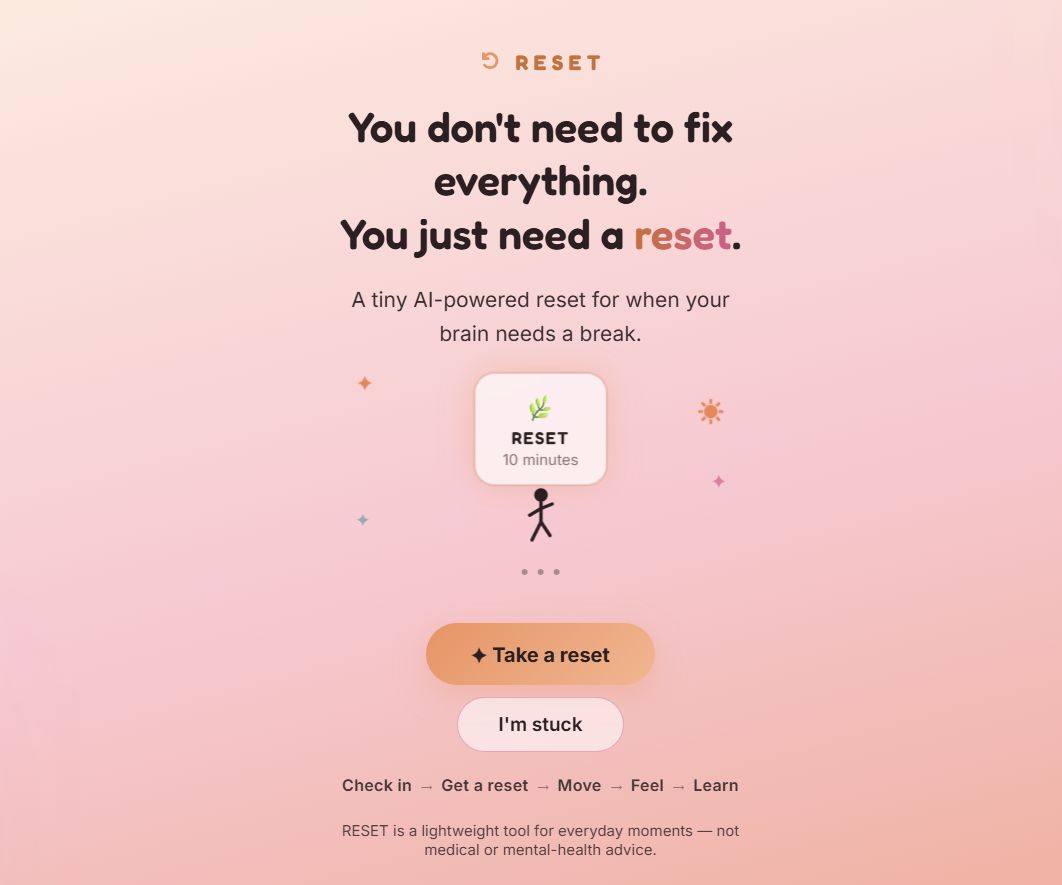
RESET is a lightweight check-in paired with an AI-powered mission engine.
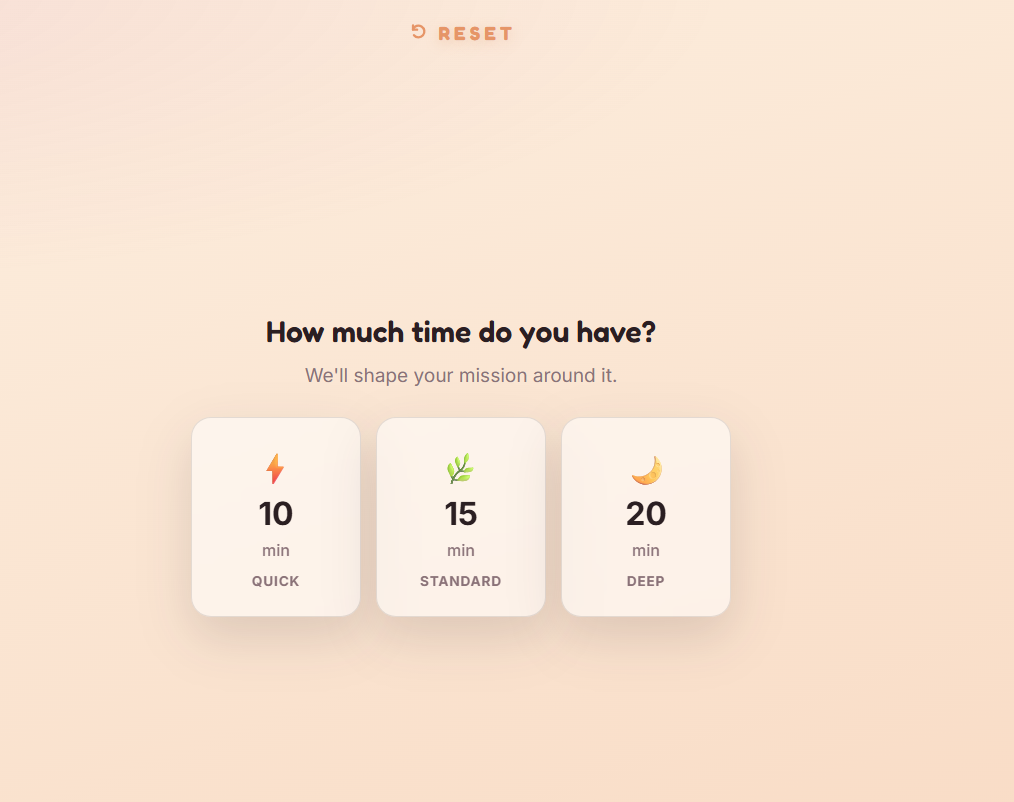
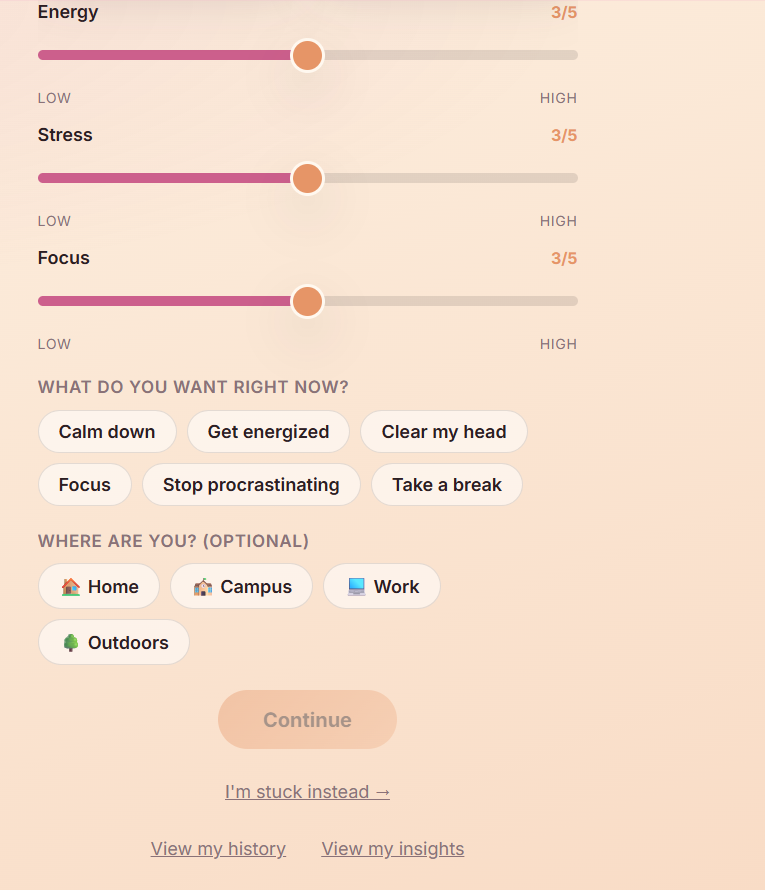
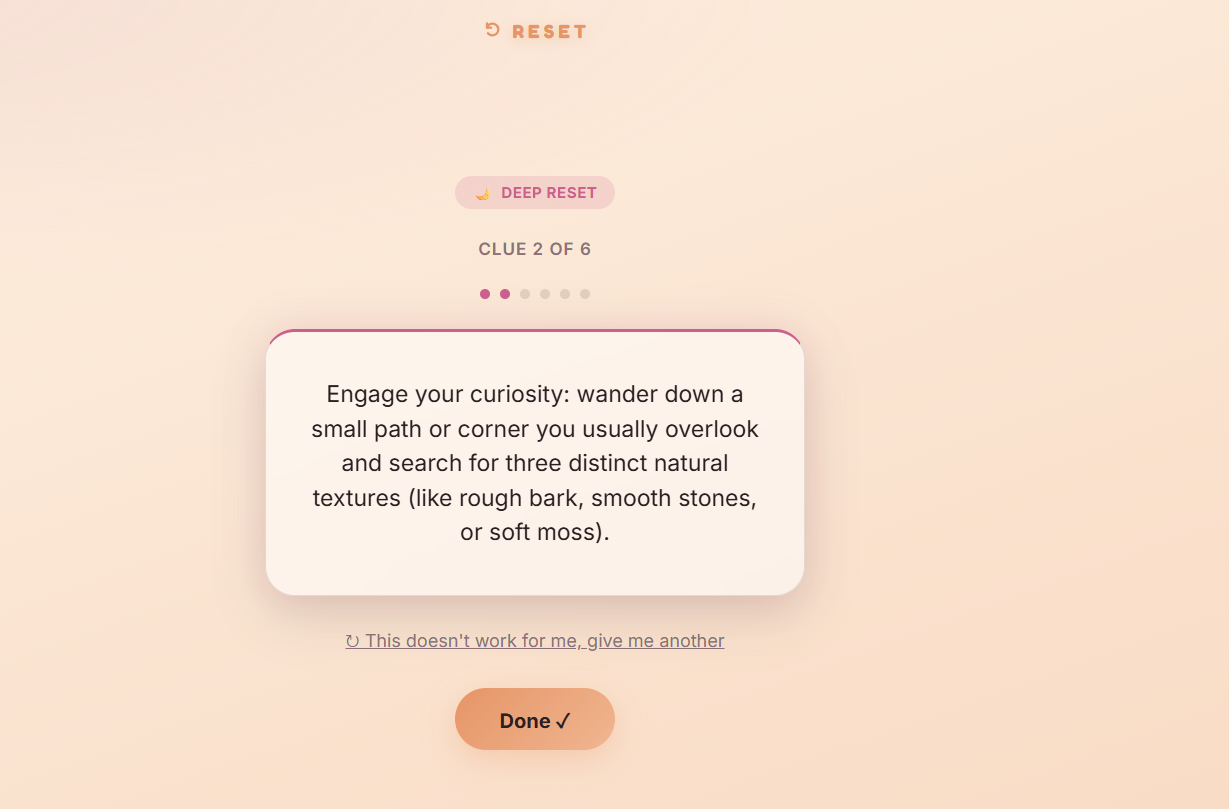
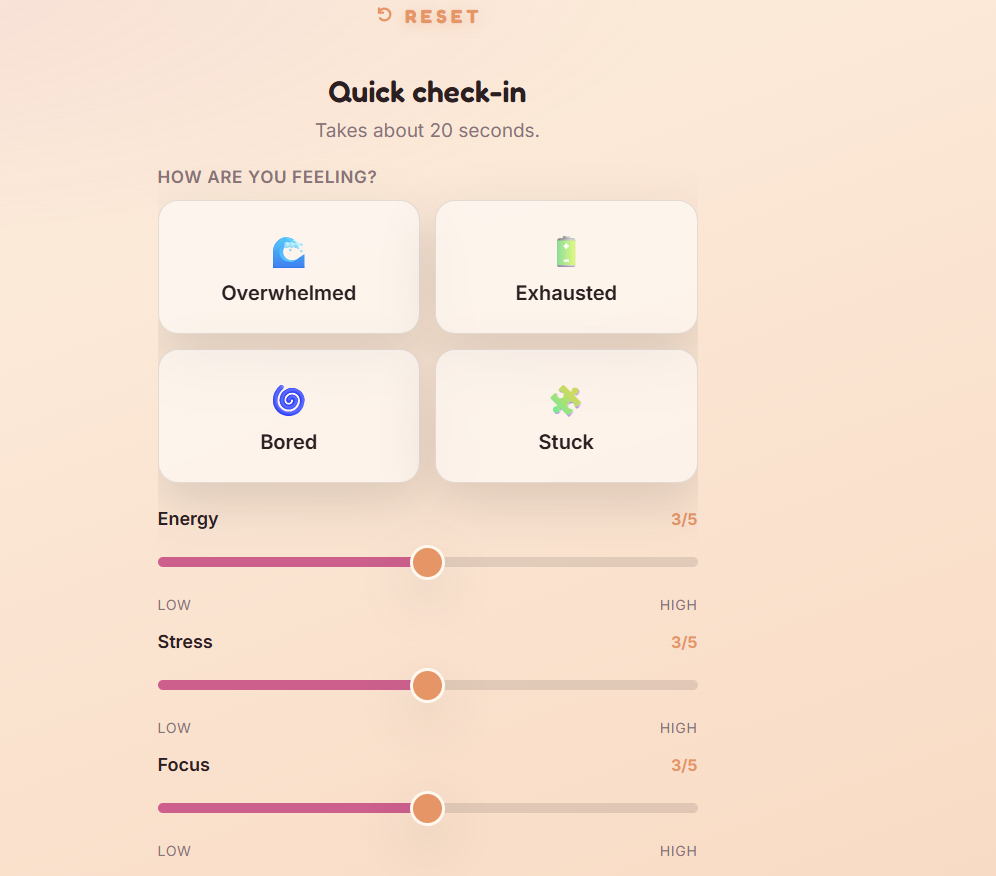
You tell it your mood, your energy, and how much time you've got — and Gemini turns that into a short, structured, real-world mission: a handful of small, physical steps designed for that specific state, not a generic "go walk for 20 minutes."
The experience follows a simple loop:
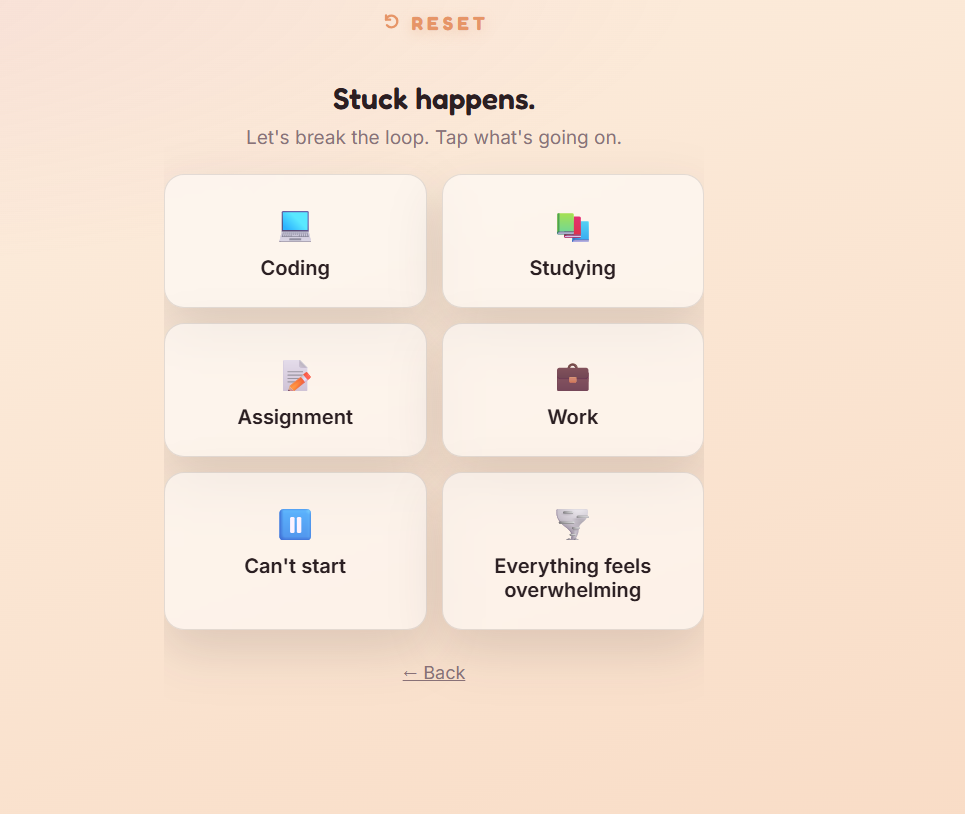
Check in → Get a reset → Move → Reflect → Learn
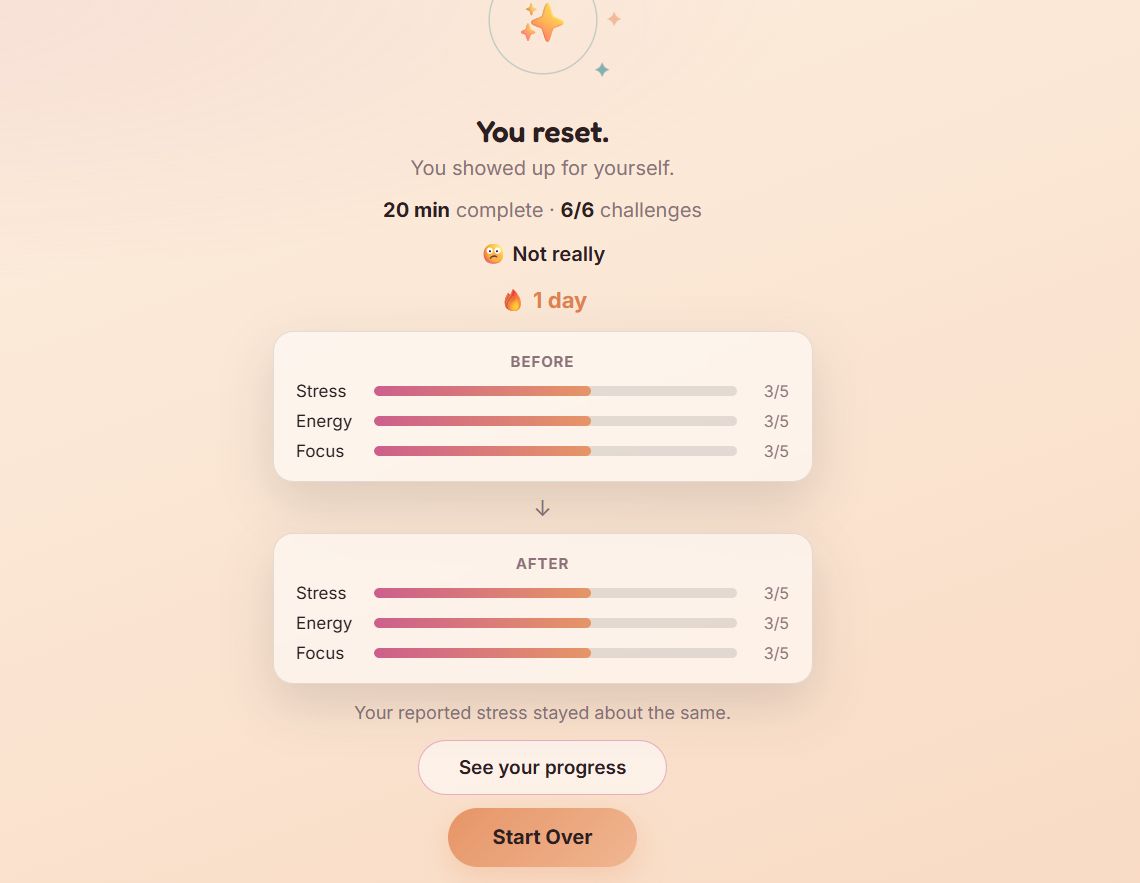
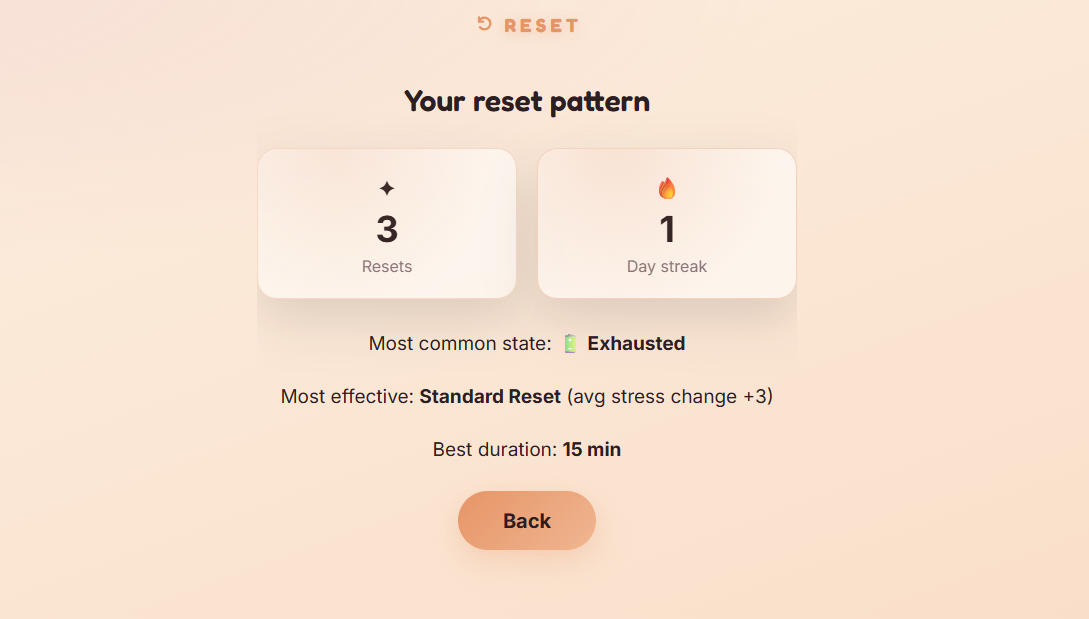
After completing a reset, you report how you feel afterward. RESET keeps that before/after signal and, over time, surfaces which reset types and durations actually seem to work for you personally.
We built this as a wellbeing tool, deliberately — not a medical or diagnostic app. It doesn't try to know what's wrong with you. It just tries to be useful in the next few minutes.
🛠️ How We Built It
Backend: FastAPI + Python, with Gemini powering mission generation, and SQLAlchemy + SQLite handling users, mission history, streaks, and feedback.
Frontend: React + Vite + plain CSS, kept deliberately simple — a screen-based state machine instead of a routing framework we didn't need.
The generation pipeline:
User State
    ↓
Reset Type Selection
    ↓
Gemini Generation
    ↓
Response Validation
    ↓
Mission
    ↓
User Feedback
    ↓
History & Insights
The engineering decision we're proudest of: Gemini is not a single point of failure. If a request times out or comes back malformed, RESET retries once, and if that fails too, falls back to a predefined mission for that mood and duration. The app never dead-ends — an AI hiccup never becomes a broken experience for the person using it.
Beyond the core loop, we added clue rerolling (if a step doesn't fit someone's environment), streak tracking, mission history, a full responsive design pass, and persistent accounts so the personalization actually has something to build on over time.
📚 What We Learned
The biggest lesson: using AI well is mostly not about the API call. It's everything around it.
We spent more time on structured output validation, retries, timeouts, and fallback design than on the prompt itself — and that's the part that actually made RESET feel reliable instead of fragile.
We also learned to stop thinking of the AI as the product. The interesting part of RESET was never "Gemini writes a mission." It's the loop underneath:
User State → Intervention → Outcome → Personalization
That loop — not the generation step alone — is what lets RESET get more useful the more someone uses it.
🚧 Challenges
We hit our Gemini free-tier quota mid-development. At first that felt like a wall. Then we realized it was actually the best stress test we could ask for — a real, unscripted failure condition to validate our fallback path against, instead of simulating one.
We also had to resist scope. It would have been easy to turn RESET into a long intake questionnaire or a mini mental-health platform. We kept asking: does this piece of information earn its place? If it didn't directly shape the mission, it didn't make the cut.
The other real challenge was tone. A lot of AI-generated wellness content reads like a wall of text with good intentions. We wanted RESET to feel physical and immediate instead — something you do, not something you read.
🌱 What's Next
RESET is intentionally small right now, but the foundation has room to grow: deeper personalization from feedback history, an installable PWA experience, and eventually light contextual awareness (like weather or time of day) — always with privacy and user control front and center.
The goal was never to help people optimize every minute of their day.
It's simpler than that: you don't need to fix everything. You just need a reset.

Log in or sign up for Devpost to join the conversation.