💡 Inspiration
As university students, we noticed a consistent and concerning pattern among our peers and ourselves: burnout rarely happens overnight. It builds quietly over days of skipped sleep, creeping screen time, escalating academic pressure, and missed meals. By the time a student actually seeks help or recognizes the collapse, they are already facing failed exams, physical exhaustion, or acute distress.
Most existing mental health applications either serve as passive journals that place the burden of logging on an already exhausted user, or they try to act like clinical therapists without proper medical safeguards. We wanted to build something fundamentally different: RE:SET — an Early Wellness Intervention System that catches subtle behavioral deterioration within 3 to 7 days and delivers actionable micro-recovery routines before a student reaches acute burnout.
⚙️ What Does It Do?
RE:SET acts as a daily preventative wellness companion designed around low friction and proactive intervention:
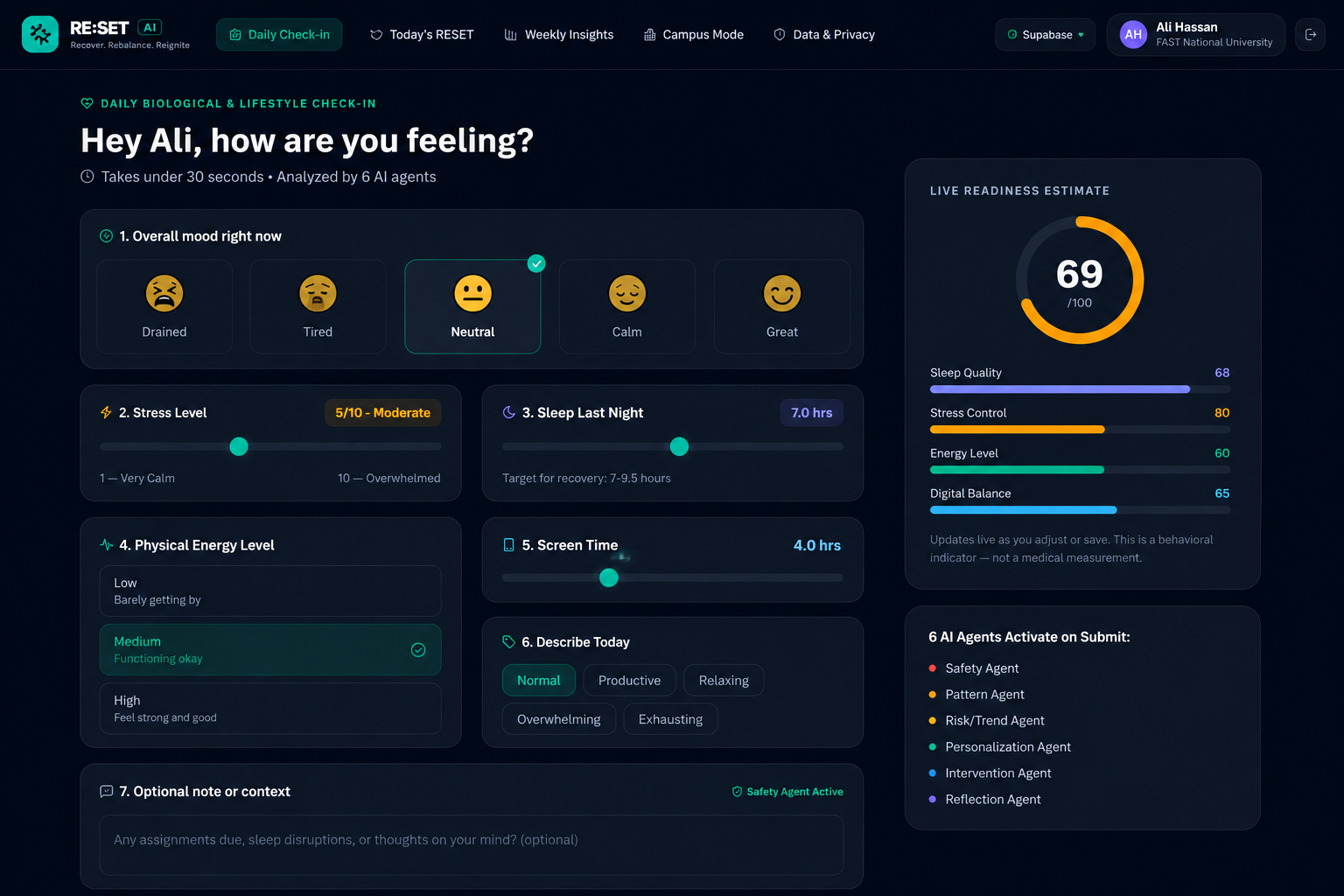
- 30-Second Micro Check-In: Students log 5 quick lifestyle sliders (mood, stress, sleep, energy, screen time) + 1 context tag.
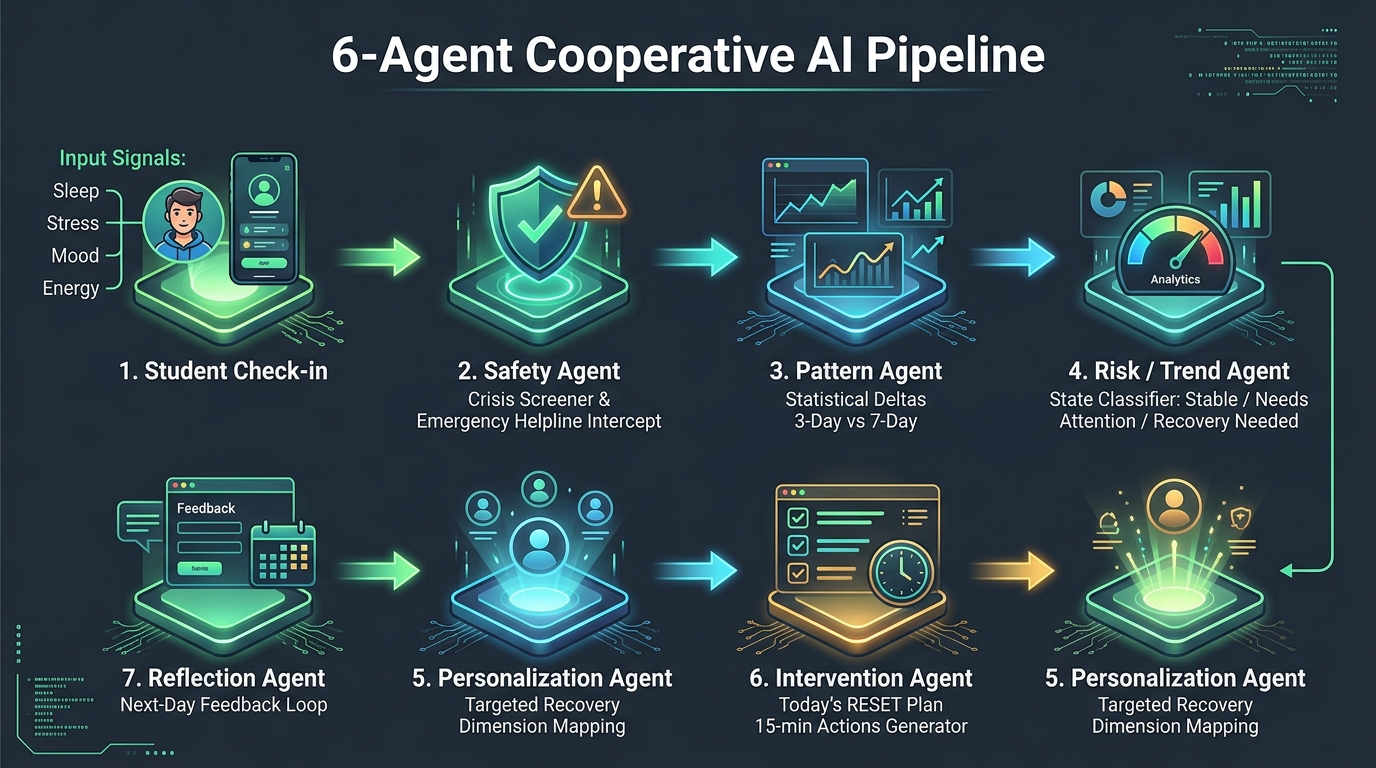
- 6-Agent Cooperative AI Pipeline: Instead of a generic single-prompt chatbot, an orchestrated multi-agent network analyzes 3-day and 7-day rolling trends to detect deterioration patterns.
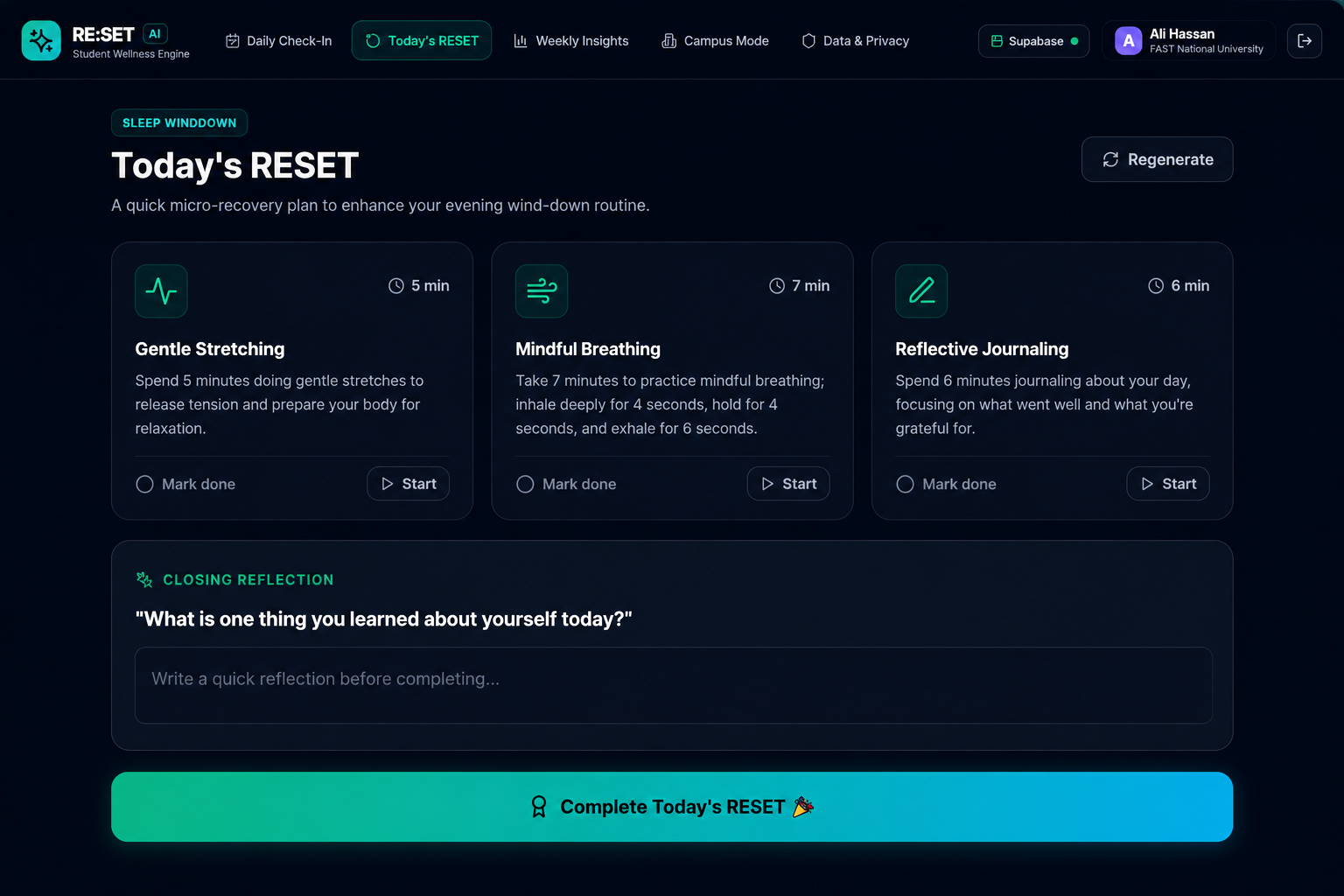
- Today's RESET Plan: Automatically generates 3 personalized micro-recovery actions (5–15 minutes total, covering Somatic, Cognitive, Sensory, or Circadian recovery) with built-in countdown timers.
- Safety-First Crisis Interception: An independent Safety Agent screens notes in real-time. If critical distress or self-harm language is detected, it completely halts all AI generation and immediately routes the user to accredited 24/7 human emergency helplines.
- "Why Do I Feel Different?" Diagnostic: Pinpoints the exact lifestyle variable (e.g., sleep deficit vs. elevated screen time) that contributed most to a student's current fatigue.
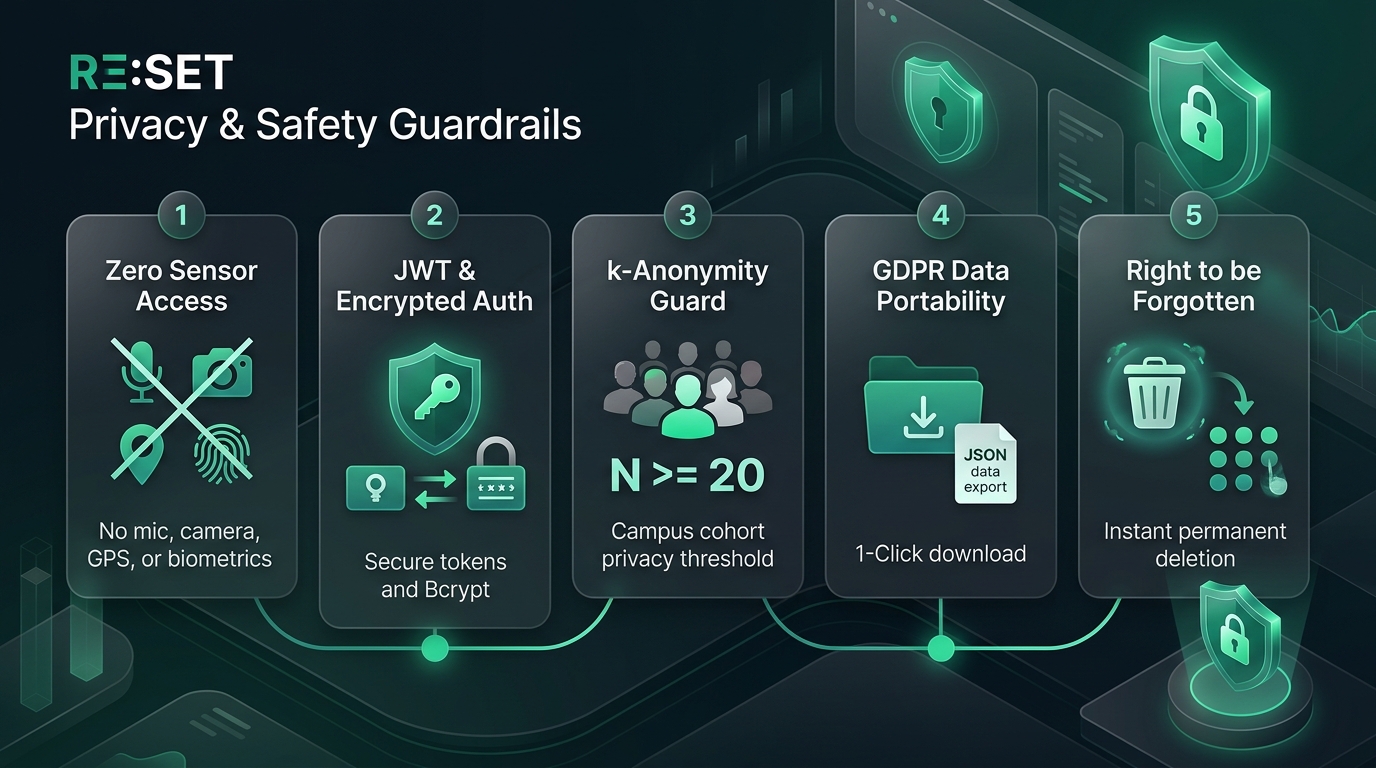
- Campus Mode (Institutional Intelligence): Aggregates university-wide wellbeing trends with strict $k$-anonymity ($N \ge 20$) so administration can schedule decompression days during peak stress weeks without compromising individual privacy.
🛠️ How We Built It & Tech Stack
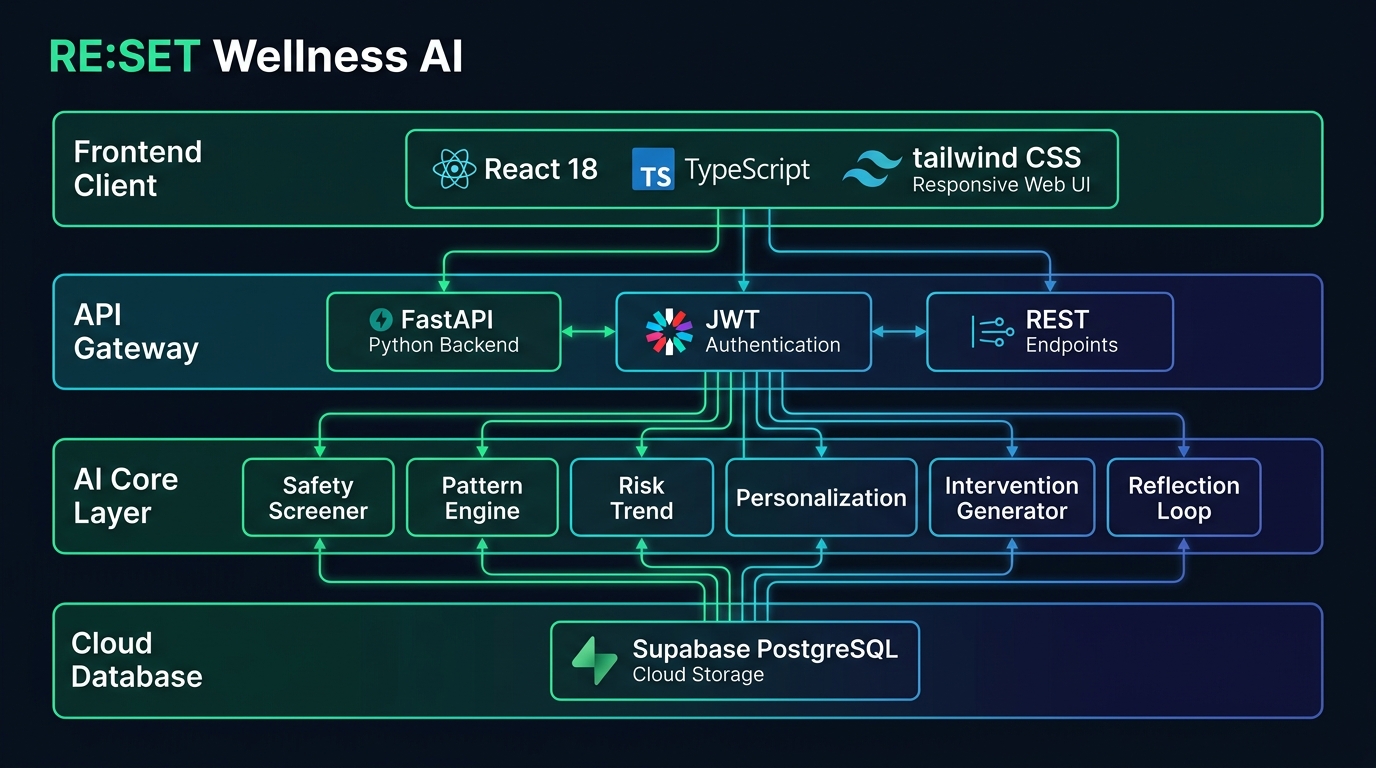
We engineered RE:SET as a fully decoupled, production-grade web platform:
- Frontend: Built with React 18, TypeScript, and Vite, styled using modern dark-mode glassmorphic CSS tokens and Lucide React icons. Includes an interactive SVG circular countdown timer and dynamic sparkline charts.
- Backend API: Engineered using FastAPI (Python 3.11) with asynchronous endpoints, strict Pydantic schemas, and structured error handling.
- Database & Storage: PostgreSQL hosted on Supabase, utilizing SQLAlchemy 2.0 ORM for relational modeling across users, daily check-ins, signals, patterns, and aggregate campus data.
- Authentication: Secure JWT Bearer tokens paired with salted Bcrypt password hashing.
- Deployment: Live frontend deployed on Vercel, backend ASGI server deployed on Render.
🤖 AI Models & Usage Details
- AI Engine: We integrated the AIML API utilizing the
gpt-4o-minimodel (API tier). - Architecture: We implemented a 6-Agent Cooperative Pipeline:
Safety Agent(Crisis keyword & sentiment filter)Pattern Agent(Statistical rolling delta computation)Risk / Trend Agent(State classification: STABLE, NEEDS_ATTENTION, RECOVERY_NEEDED)Personalization Agent(Recovery domain mapping)Intervention Agent(Timed micro-step generation)Reflection Agent($T$ vs $T+1$ biological adaptation analysis)
🚧 Challenges We Ran Into
- Multi-Agent Orchestration & Latency: Running multiple LLM calls sequentially could cause slow response times. We optimized the pipeline by using deterministic algorithmic math for statistical rolling deltas and reserved LLM inference for contextual synthesis and structured JSON generation, keeping total pipeline latency under 3 seconds.
- Safety & Crisis Guardrails: Ensuring non-diagnostic ethical boundaries. We had to make sure the AI never attempts clinical medical diagnoses, and that crisis triggers immediately short-circuit the pipeline without calling the recommendation agents.
- Student Privacy in Campus Analytics: Implementing strict mathematical $k$-anonymity so institutional administrators can see macro campus stress trends without ever being able to trace data back to an individual student.
🏆 Accomplishments That We're Proud Of
- Built a complete, end-to-end working system with zero reliance on mock placeholders — from authentication to live AI intervention generation.
- Designed a cohesive, accessible glassmorphic UI that feels calming, intuitive, and takes less than 30 seconds to complete daily.
- Implemented real-time interactive tools like the active step timer with audio chime feedback and personalized recovery reflections.
📚 What We Learned
- How to structure multi-agent cooperative workflows where each agent has strict inputs, deterministic roles, and validated JSON schemas.
- The importance of building proactive, preventative tools in digital health rather than reactive, heavy-input applications.
- Handling end-to-end production deployment across separated cloud infrastructure (Render + Vercel + Supabase) with secure CORS and environment management.
🔮 What's Next for RE:SET
- Wearable Integration: Syncing passive health data (Apple HealthKit / Google Health Connect) for automatic sleep and resting heart rate variability (HRV) tracking.
- Offline PWA Support: Progressive Web App capabilities for offline check-ins with automated background syncing.
- Multi-University Expansion: Expanding Campus Mode dashboards to student counseling departments across universities nationwide.
🎯 Track Submissions
- Primary Track: Health (Advanced Track)
- Bonus Track: Best Use of AI (Multi-agent structured reasoning, real-time safety guardrails, and automated recovery synthesis)
Built With
- bcrypt
- css3
- fastapi
- gpt-4o-mini
- html5
- jwt
- numpy
- openai
- pandas
- postgresql
- python
- react
- render
- rest-api
- sqlalchemy
- supabase
- tailwind
- typescript
- uvicorn
- vercel
- vite

Log in or sign up for Devpost to join the conversation.