-
-
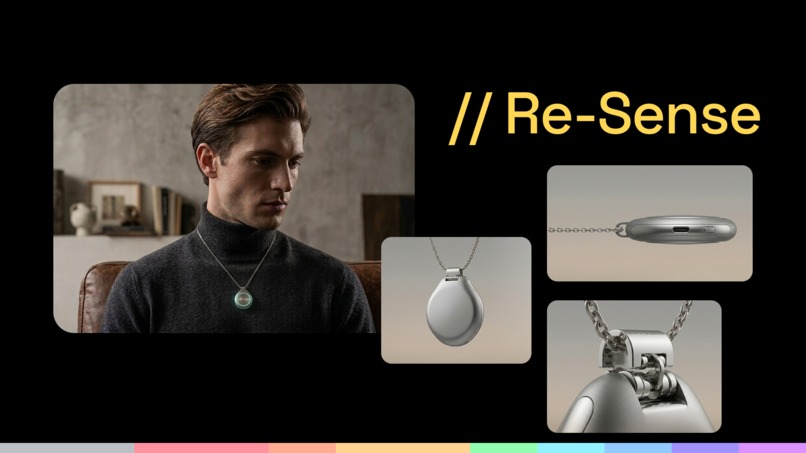
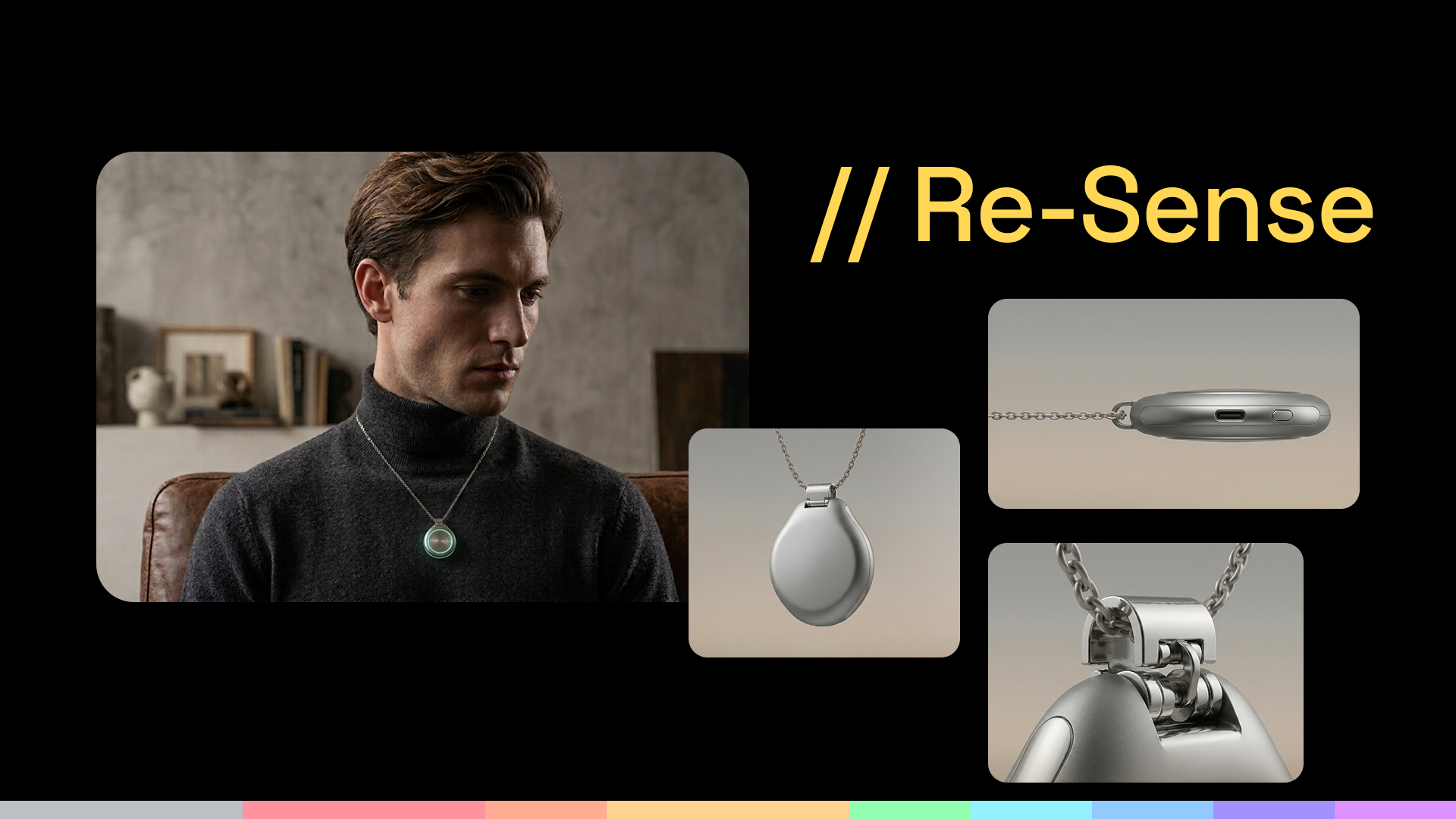
Re-Sense : Feel What you stop noticing
Inspiration
In today’s digitally immersed world, people spend long hours interacting with screens and virtual environments. While technology tracks many aspects of our activity, we are increasingly disconnected from the subtle signals our bodies constantly send, such as changes in breathing, muscle tension, or emotional stress. These signals are part of interoception, the internal sense that helps us understand our body’s physical and emotional state. We were inspired to explore how technology could help people reconnect with these signals, not by replacing human awareness, but by training people to recognize and interpret their own body cues again.
What it does
Re-Sense is a speculative sensory training system that detects subtle internal body signals and translates them into meaningful insights. A wearable sensor strip captures signals such as breathing rhythm, heart variability, and muscle tension. These signals are analyzed by an interpretation engine and communicated through a conversational interface that explains what the body might be experiencing and suggests simple actions. Instead of presenting raw numbers like typical wearables, Re-Sense focuses on helping users understand what these signals mean. Over time, it trains users to recognize these cues independently, gradually reducing reliance on the system.
How we built it
We designed Re-Sense as a conceptual product ecosystem consisting of three key components: a wearable sensing strip, an interpretation layer, and an interactive interface. We mapped the system architecture starting from body signal detection, to data interpretation, to human-readable insights displayed on a screen interface. The experience was designed through a storytelling framework using the ABT structure (And, But, Therefore) to clearly communicate the problem and solution. Interface concepts, system flows, and visualizations were developed to show how the product would guide users through awareness, interpretation, and training.
Challenges we ran into
One of the biggest challenges was designing a system that interprets internal body signals in a meaningful way without reducing them to complex medical data or abstract metrics. Another challenge was balancing speculative thinking with realistic product design. We also needed to ensure that the system did not create long-term dependency on technology, but instead empowered users to rebuild their natural body awareness.
Accomplishments that we're proud of
We are proud of creating a concept that reframes wearable technology as a training tool rather than a tracking device. The project presents a clear system architecture that connects human body signals, sensing technology, and an intuitive guidance interface. We also developed a narrative that highlights an often overlooked human sense—interoception—and demonstrates how design can help restore it.
What we learned
Through this project, we learned how subtle sensory experiences can be translated into meaningful design opportunities. We explored how storytelling frameworks like ABT can strengthen the communication of complex ideas. We also gained insight into designing systems that prioritize human awareness and well-being rather than simply collecting more data.
What's next for Re-Sense
The next step for Re-Sense would be exploring more advanced sensing technologies and refining how internal signals could be interpreted and visualized in real time. Future iterations could include adaptive learning systems that personalize guidance based on individual patterns. We would also like to prototype interactive experiences that demonstrate how users gradually learn to recognize and respond to their own body signals without relying on the device.
Built With
- chatgpt
- claude
- figma
- figmamake
- gemini
- nanobanana


Log in or sign up for Devpost to join the conversation.