-
-
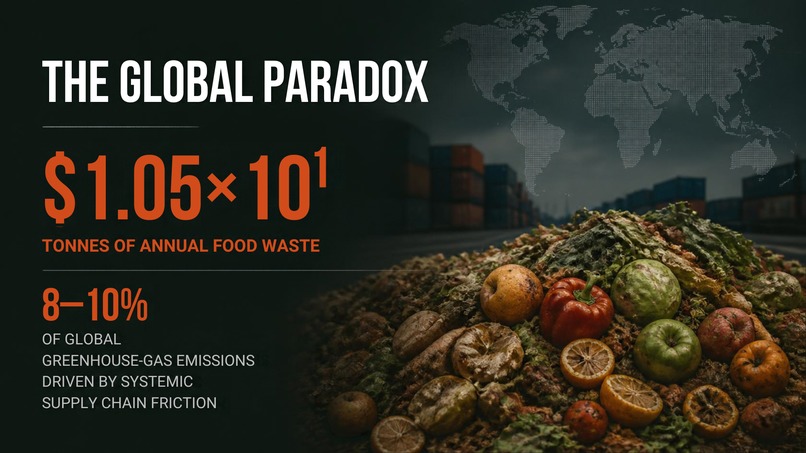
Slide 1: The Global Paradox - Highlighting global food waste scale and supply chain friction.
-
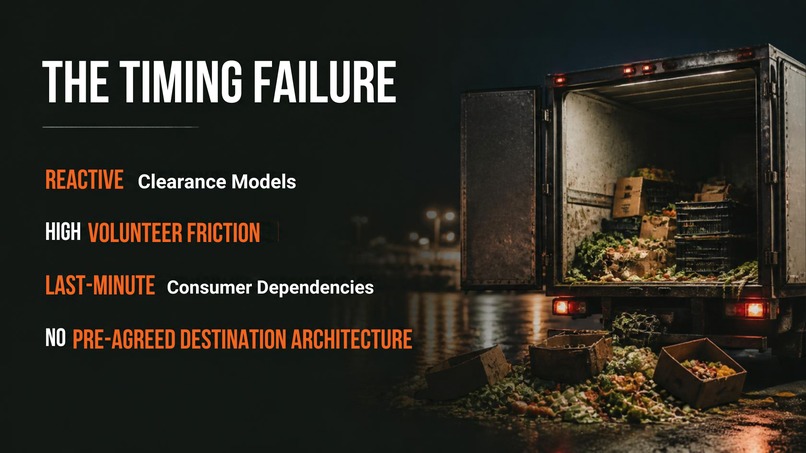
Slide 2: The Timing Failure - Analyzing reactive clearance models and last-minute dependencies.
-
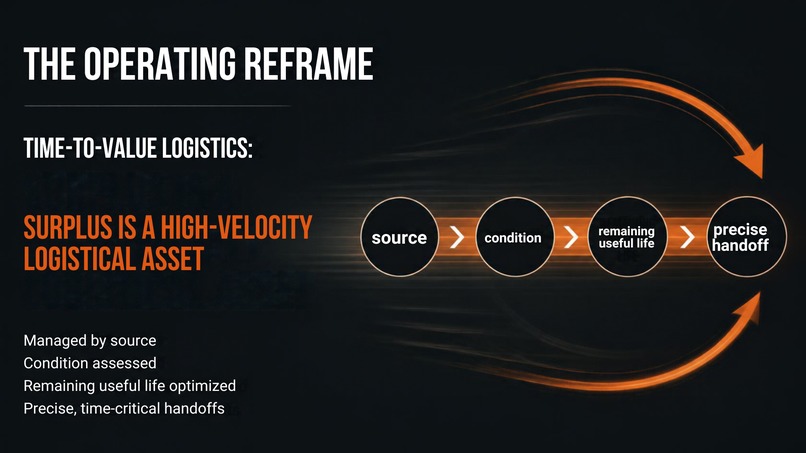
Slide 3: The Operating Reframe - Shifting surplus into a high-velocity logistical asset.
-
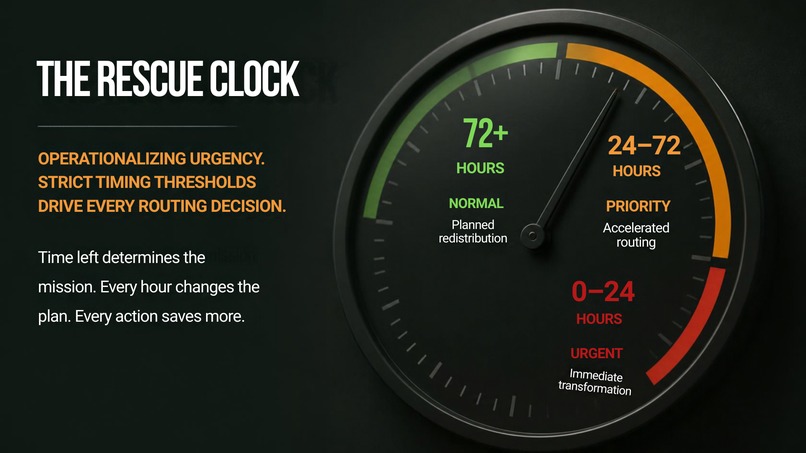
Slide 4: The Rescue Clock - Establishing precise time-sensitive milestones for surplus management.
-
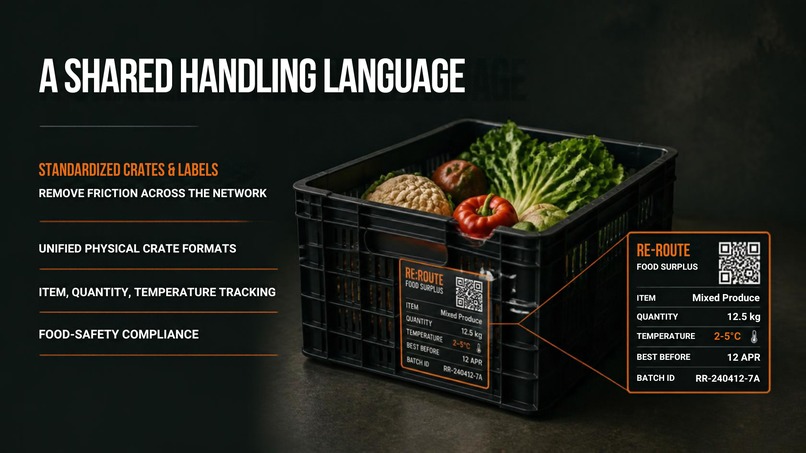
Slide 5: The Crate Standard - Standardized packaging and labeling for efficient logistics.
-
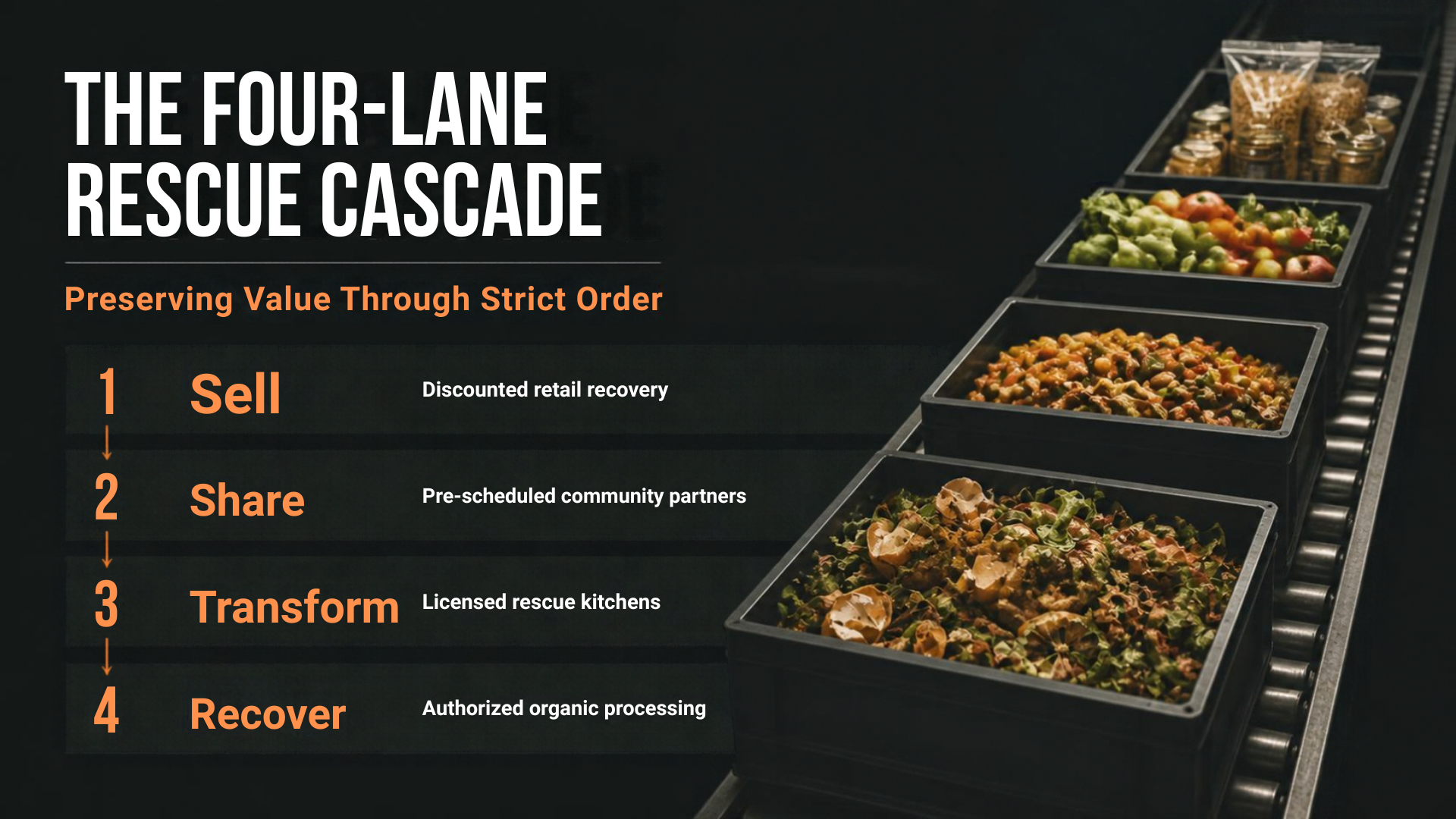
Slide 6: The Four Channels - Routing surplus through Sell, Share, Transform, and Recover pathways.
-
Slide 7: Neighborhood Hubs - Decentralized collection and redistribution architecture.
-
Slide 8: Pilot Deployment - Real-world testing strategy and initial operational metrics.
-
Slide 9: Impact & Value - Environmental and economic outcomes of the logistics network.
-
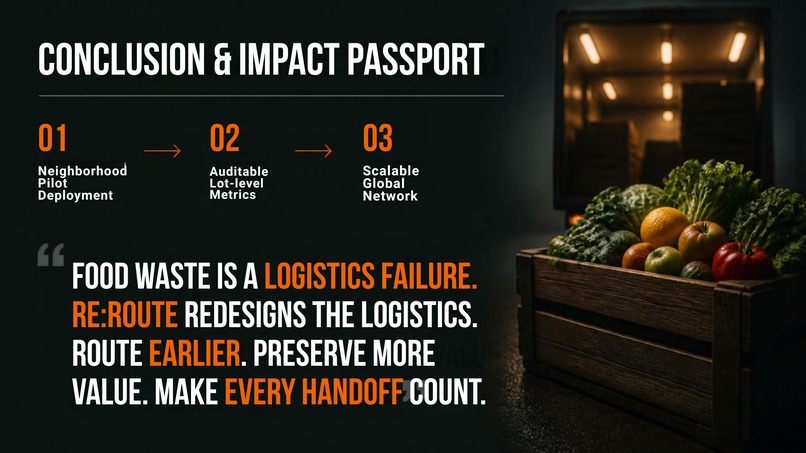
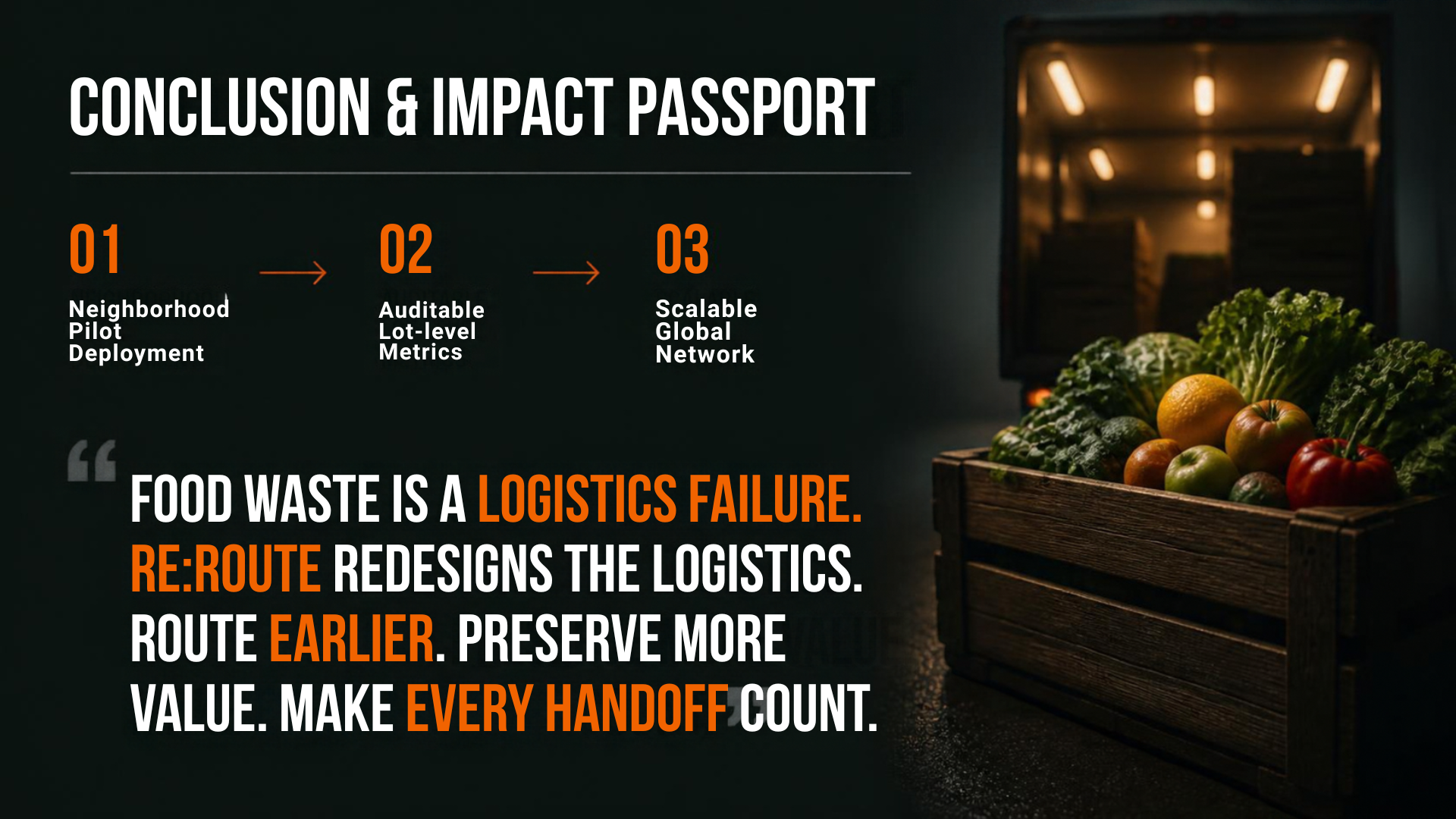
Slide 10: Conclusion & Next Steps - Scaling the RE:ROUTE ecosystem for broader adoption.
RE:ROUTE — Project Story
1. Inspiration
RE:ROUTE was born from a paradox that should not exist: the world has an enormous food surplus at the same time that millions of people struggle to access sufficient food.
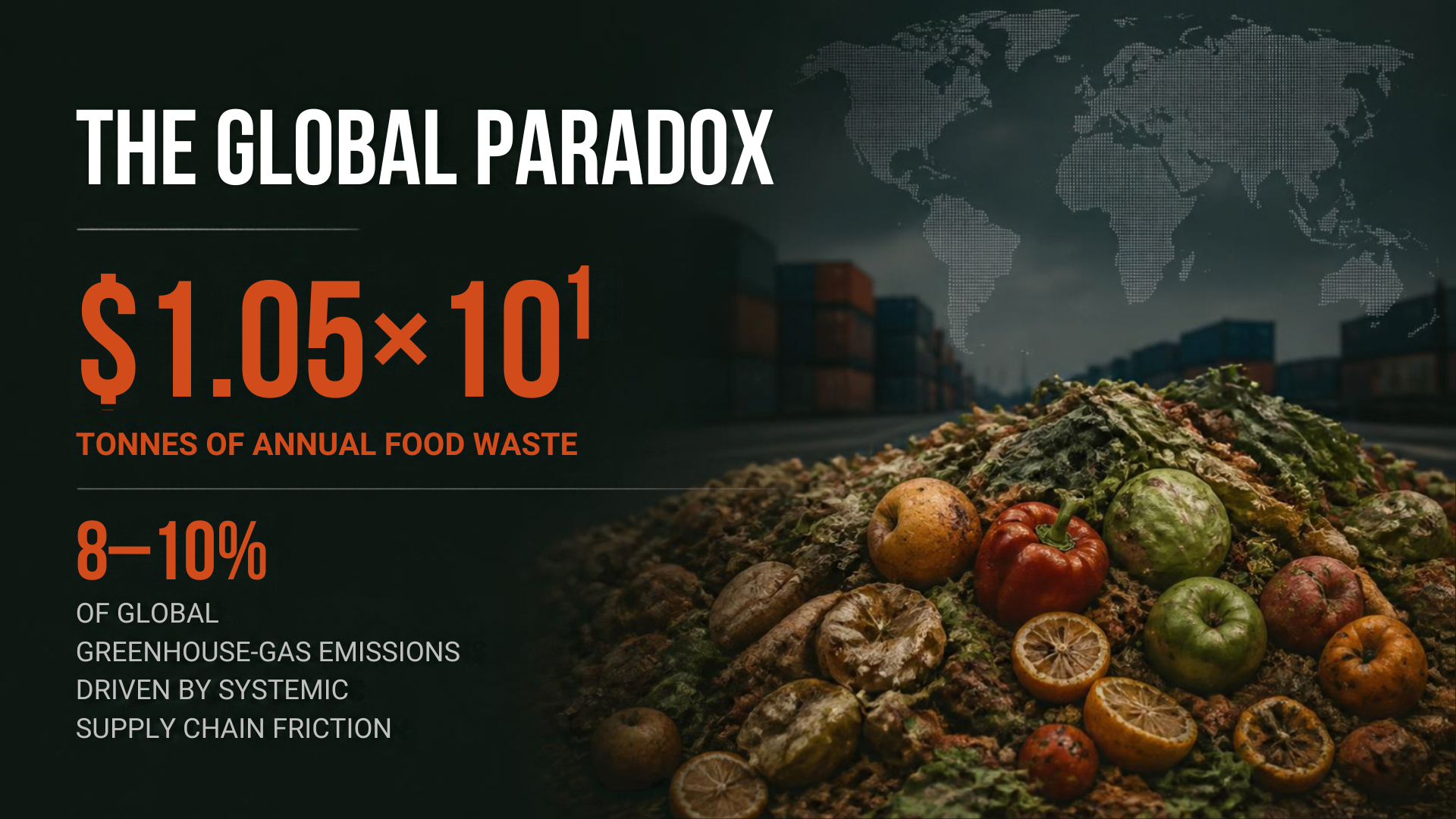
In 2022 alone, an estimated $1.05 \times 10^9$ tonnes of food were wasted at the retail, food-service, and household levels. Food loss and waste is also associated with approximately $8\text{–}10\%$ of global greenhouse-gas emissions.
But the deeper problem we identified was not simply food waste.
It was a logistics failure.
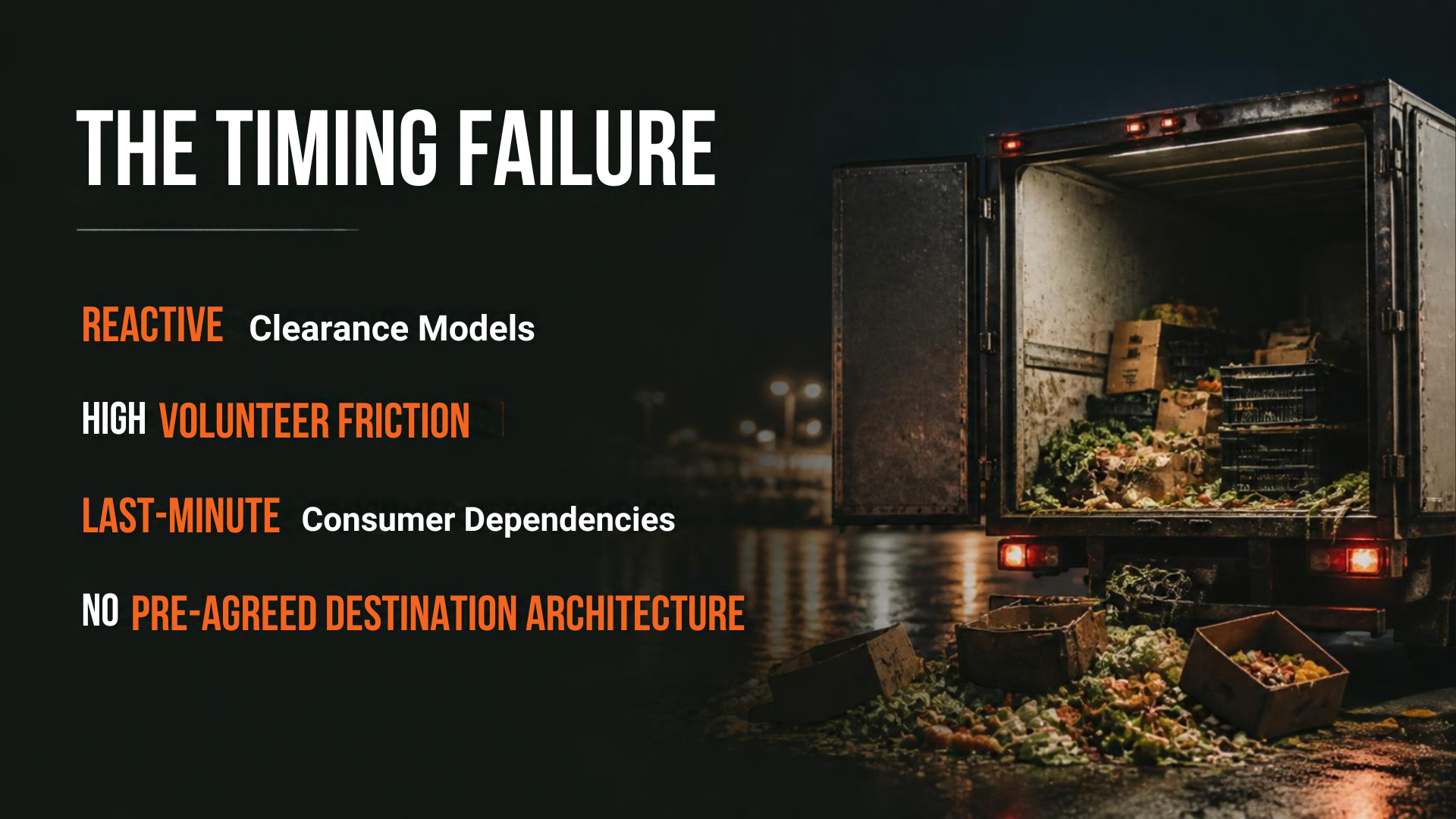
A supermarket can have perfectly usable food today but no suitable destination tomorrow. A restaurant can produce surplus at 8 PM while a community organization discovers its need at 9 AM the following day. A charity may be willing to receive food but lack the transportation, storage capacity, or information required to collect it in time.
The existing model is therefore often reactive:
Food becomes surplus → someone searches for a recipient → transportation is arranged → the clock runs out.
RE:ROUTE asks a fundamentally different question:
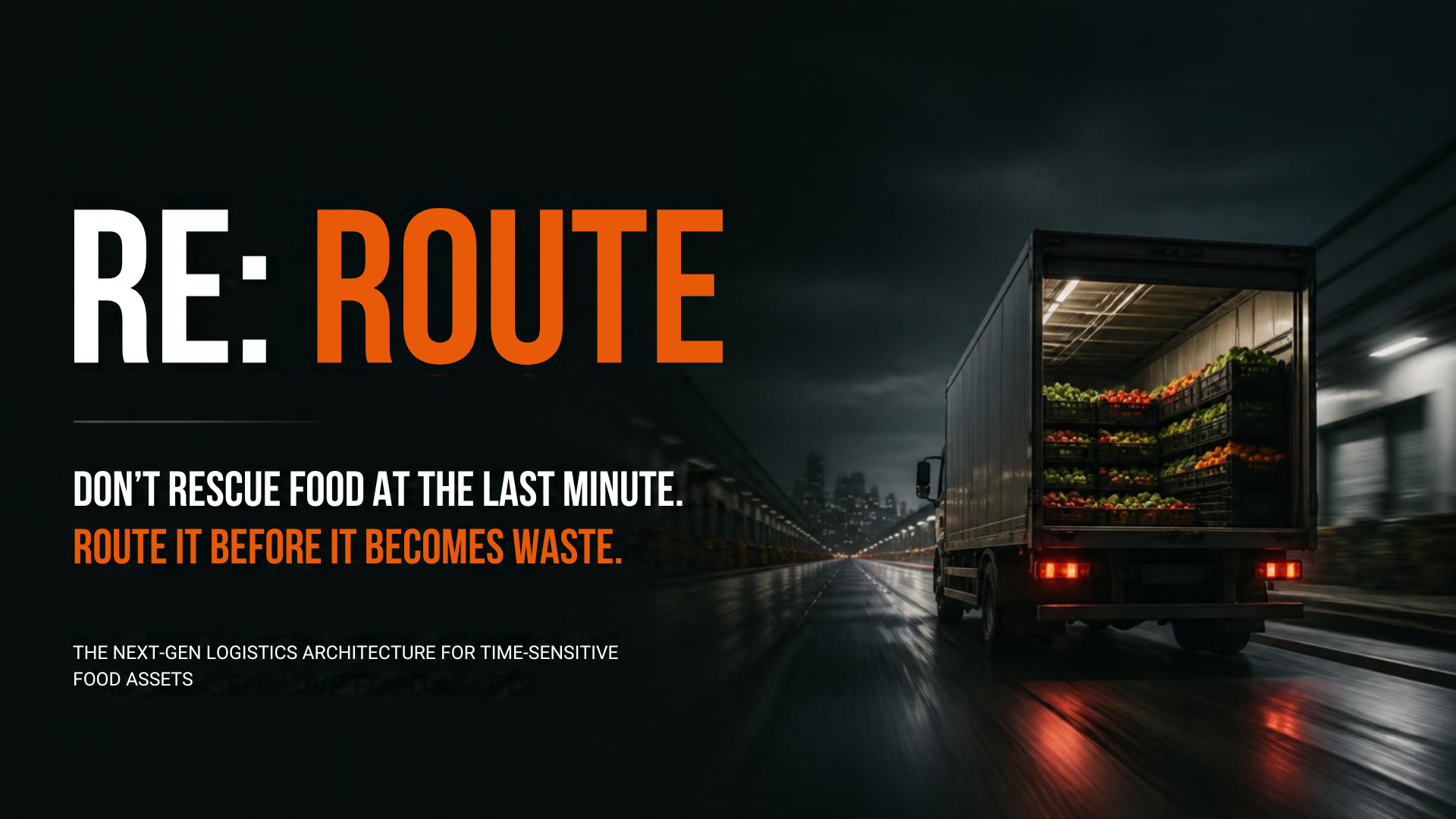
What if surplus food never had to enter an emergency rescue phase in the first place?
That question led us to shift the concept from last-minute charity toward planned circular logistics.
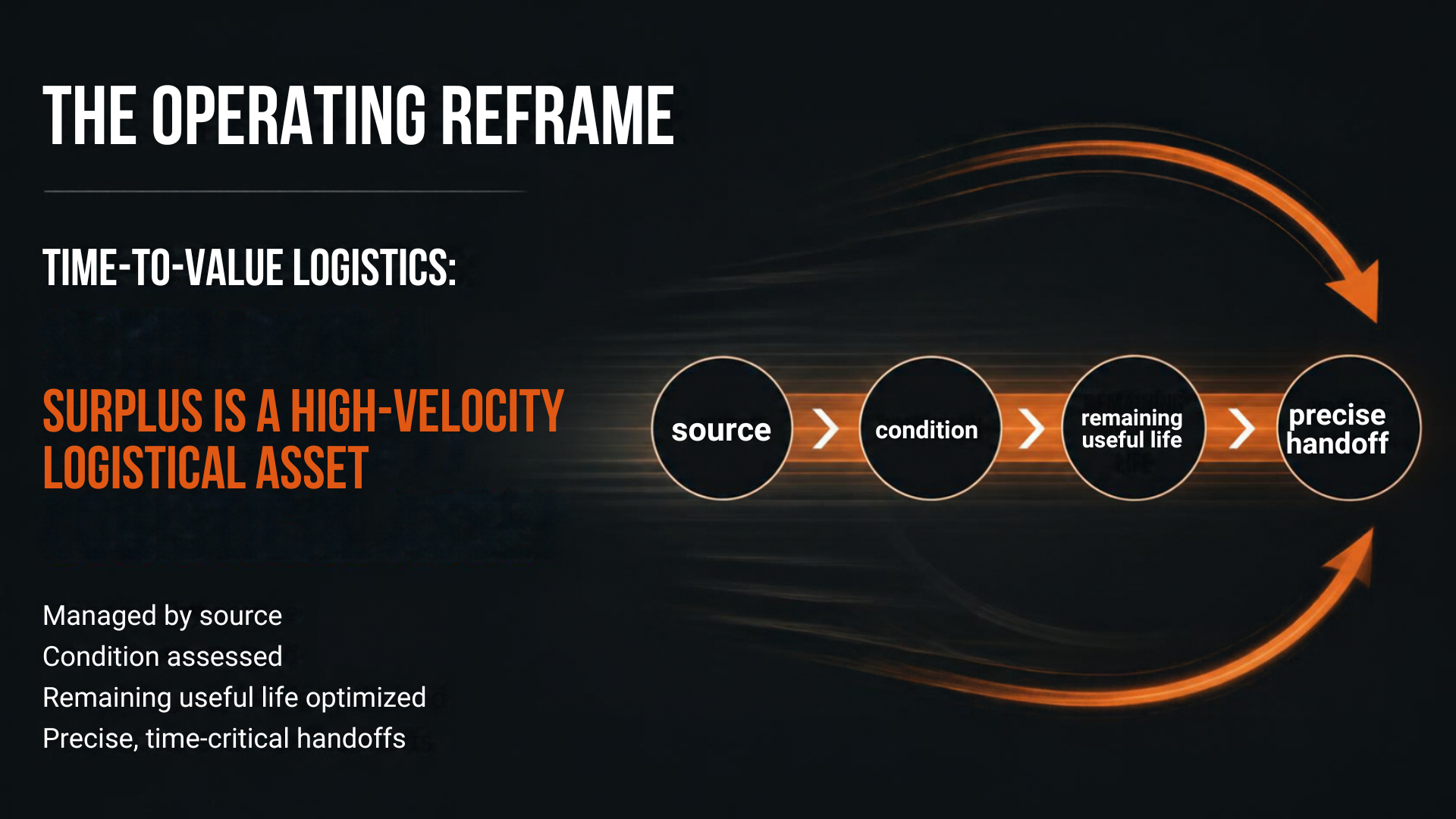
Instead of treating surplus as an unpredictable problem that appears at the end of a business day, we treat it as a time-sensitive resource that should already have a destination pathway before it becomes waste.
The vision is simple:
Every surplus food item should have a next destination before its useful life expires.
That destination could be a buyer, a community organization, a transformation kitchen, or an appropriate recovery pathway.
RE:ROUTE was created to turn food rescue from an emergency operation into an organized circulation system.
2. How We Built It
We deliberately designed RE:ROUTE as a non-code, technology-optional logistics architecture.
The innovation is not dependent on building another app. It is embedded in the way the physical and organizational system works.
We structured the concept around three interconnected mechanisms.
The Rescue Clock
Our first principle was that time is the most important variable in surplus-food logistics.
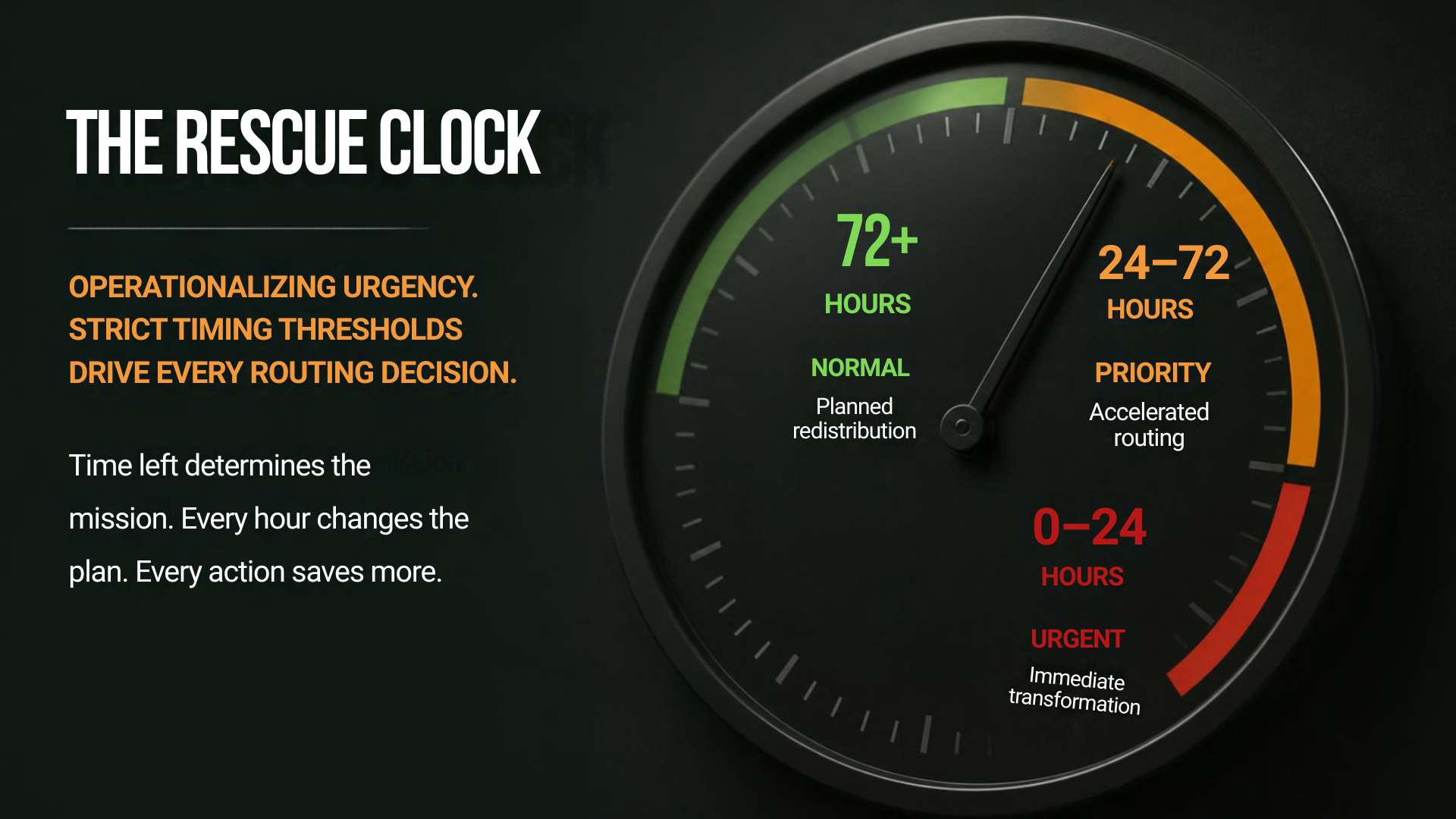
We therefore created the Rescue Clock: a simple operational system that categorizes surplus according to its remaining useful life.
- 72+ HOURS — NORMAL: suitable for planned redistribution or discounted sale.
- 24–72 HOURS — PRIORITY: requires accelerated routing.
- 0–24 HOURS — URGENT: should immediately enter the highest-priority available pathway.
This changes the question from:
“What do we do with this food?”
to:
“How much useful time does this food have left, and where can that value go next?”
Time is no longer an afterthought. It becomes the central logistics signal.
Standardized Crates
The second problem was fragmentation.
Different businesses package surplus differently, record different information, and communicate with recipients in different ways. That creates friction at exactly the moment when speed matters most.
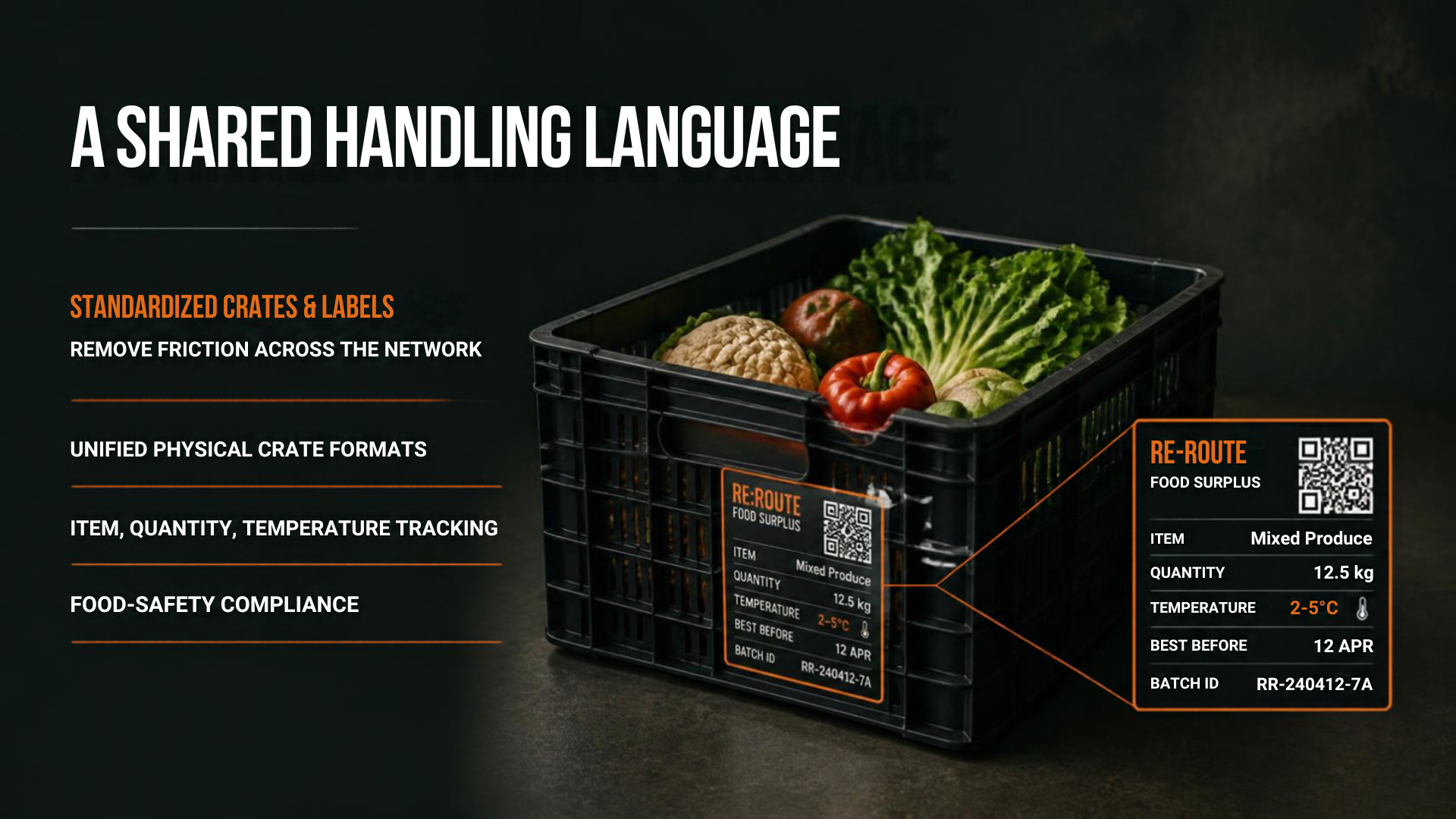
We designed RE:ROUTE Standardized Crates as a universal physical interface for surplus food.
Each crate carries a simple information structure:
Food category
Quantity
Collection time
Use-by / best-before information
Temperature requirements
Allergen information
Rescue Clock status
Priority destination
The objective is not technological complexity.
It is operational clarity.
A recipient should be able to understand a crate's status almost instantly without calling the sender, searching through messages, or reconstructing missing information.
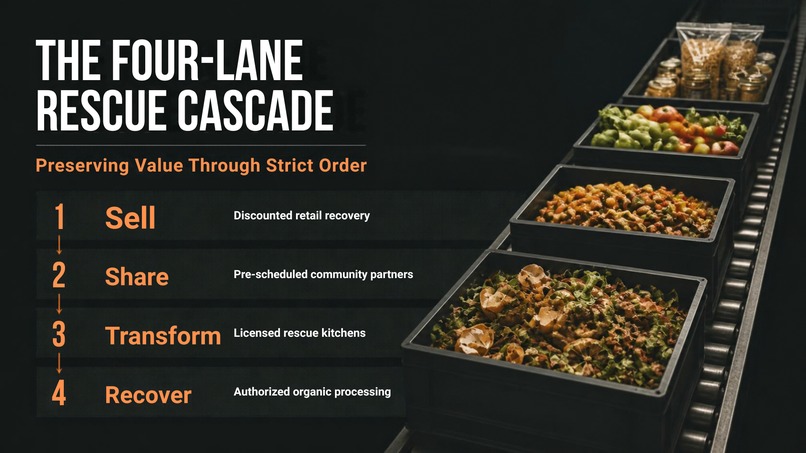
The Four-Lane Rescue Cascade
The final architectural layer is the Four-Lane Rescue Cascade.
We rejected the traditional binary model of:
Sell → Donate → Throw Away
and replaced it with a cascading value-preservation system:
1. SELL
Food with sufficient remaining life can be discounted and sold.
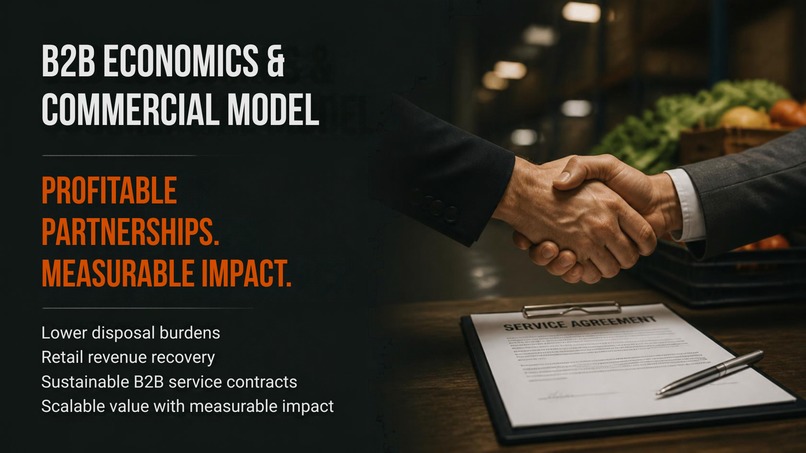
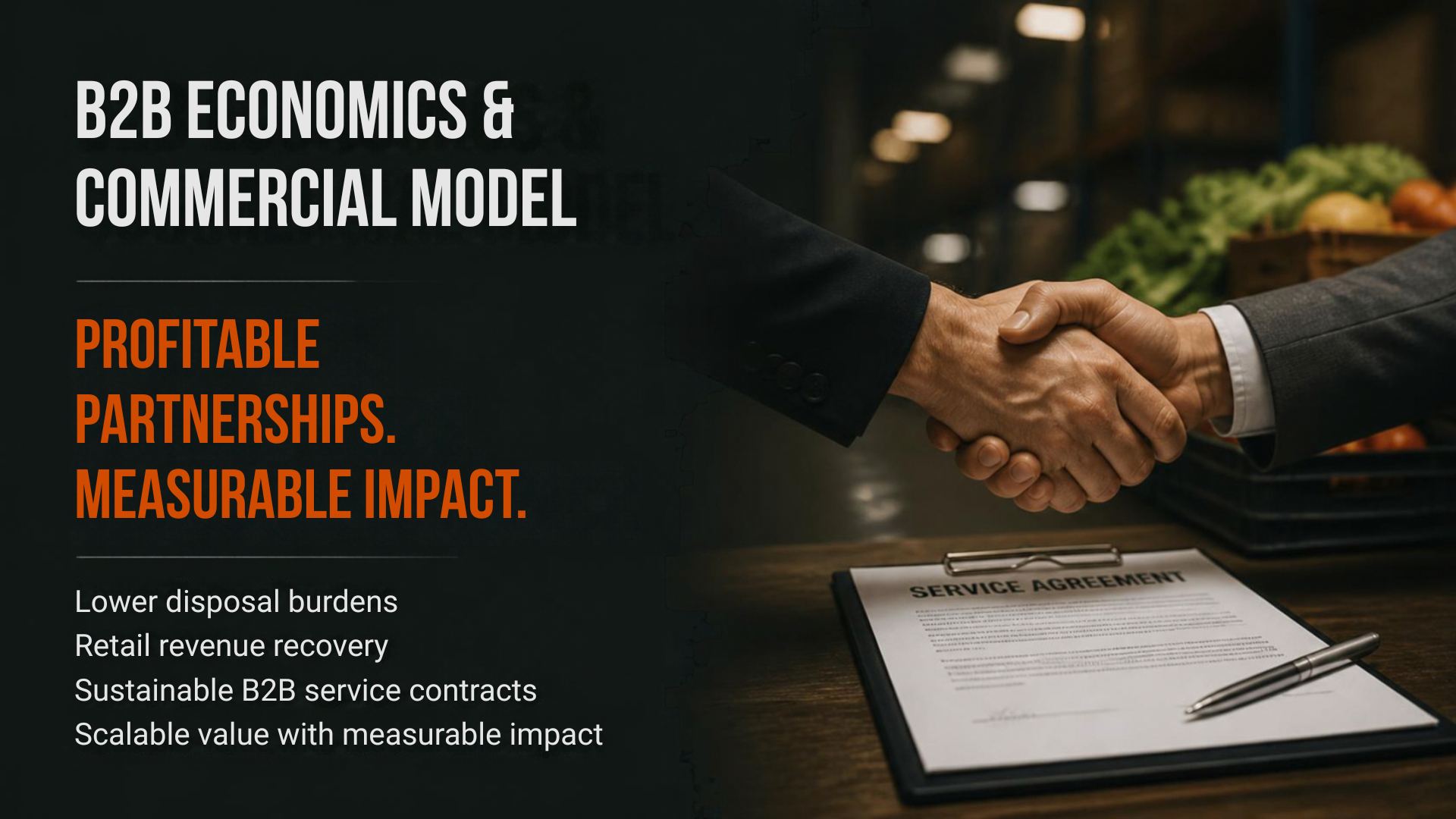
This allows businesses to recover part of their investment instead of treating every surplus item as a donation.
2. SHARE
Food unlikely to sell but still suitable for redistribution moves to approved community partners, food organizations, shelters, or other appropriate recipients.
3. TRANSFORM
Food that remains safe but has limited retail appeal can become an ingredient rather than a product.
Depending on food type and applicable regulations:
surplus vegetables → prepared meals
fruit surplus → processed ingredients
bread surplus → transformed food products
This creates an additional opportunity to preserve value before food exits the human food chain.
4. RECOVER
Only when human consumption and higher-value pathways are no longer appropriate does the material move toward an authorized recovery pathway, such as animal feed or organic recovery, where legally permitted and safe.
The principle behind the cascade is:
Do not ask whether food can be rescued. Ask what is the highest-value use it can still reach in time.
The Complete RE:ROUTE Architecture
The three mechanisms work together:
Surplus appears
↓
Rescue Clock determines urgency
↓
Standardized Crate captures the essential information
↓
Four-Lane Cascade identifies the highest-value destination
↓
Predefined route transports it
↓
Destination records the outcome
↓
Impact is measured
This turns fragmented surplus into a predictable, measurable flow of resources.
3. Challenges We Faced
The first challenge was conceptual.
The obvious solution was to build another platform connecting businesses with people who wanted excess food.
We deliberately moved beyond that approach.
The difficult question was not:
“How can we connect two people?”
It was:
“How can an entire local food network continue functioning when surplus appears unpredictably and its value decreases with time?”
That forced us to think like logistics designers rather than marketplace designers.
A second challenge was the dependency on last-minute coordination.
If a rescue system needs someone to discover a surplus, decide whether they want it, arrange transportation, and complete collection after the food has already become available, the system is inherently fragile.
Our response was to create predefined pathways and recurring routes.
Instead of repeatedly asking:
“Who wants this today?”
RE:ROUTE is designed around:
“Who is responsible for this category of surplus when it reaches this stage of its Rescue Clock?”
A third challenge was technological dependence.
It is tempting to solve a modern problem by immediately creating an app.
But technology can become a barrier when the operational system itself has not been designed correctly.
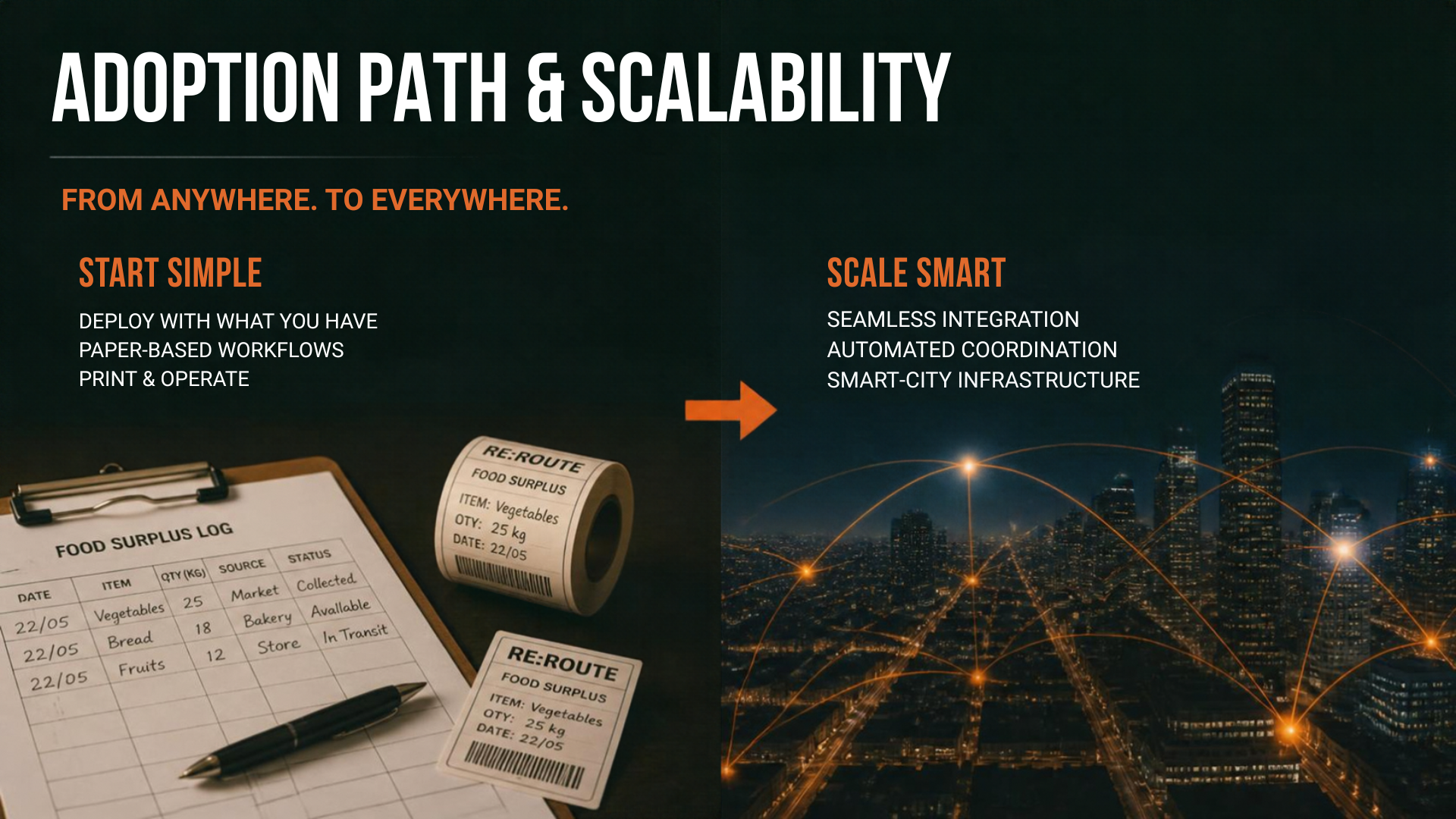
We therefore made RE:ROUTE technology-optional by design.
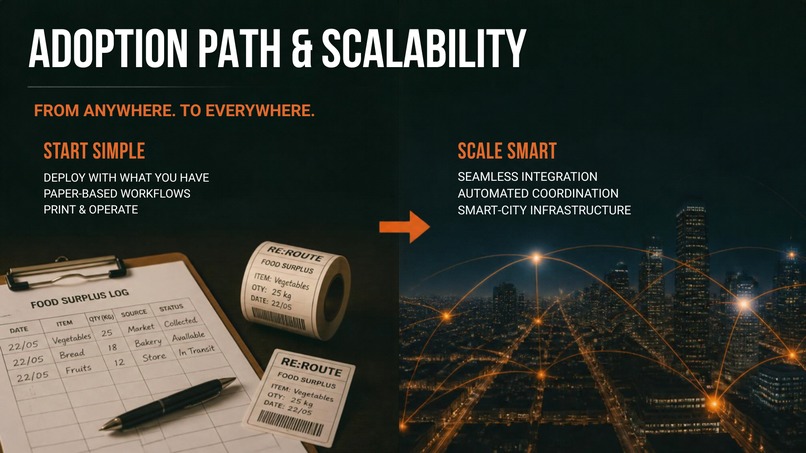
The first deployment can operate using:
printed labels + standardized crates + partner agreements + route schedules + spreadsheets + existing communication tools
Technology can later improve forecasting, matching, analytics, and automation—but the system remains functional even without a sophisticated digital platform.
That became one of our most important design principles:
Technology should accelerate a good system, not disguise a broken one.
4. What We Learned
1. Supply-chain optimization is often about coordination, not invention.
The resources already exist.
The supermarkets already have food.
The restaurants already have kitchens.
The charities already have beneficiaries.
The transportation network already exists.
The missing element is often synchronization.
RE:ROUTE taught us that innovation can come from redesigning the relationships between existing resources rather than inventing entirely new ones.
2. Time-to-Value is a critical logistics metric.
Traditional logistics often asks:
Where is the product?
RE:ROUTE adds another question:
How much useful time remains before the product loses its value?
This led us to the concept of Time-to-Value Logistics.
For perishable resources, distance alone does not determine whether a route succeeds.
A destination five kilometers away but available tomorrow may be less useful than a destination fifteen kilometers away that can receive the product immediately.
The objective is therefore not simply to minimize distance.
It is to maximize:
[ \text{Recovered Value} = f(\text{Remaining Life},\ \text{Destination},\ \text{Transport Time},\ \text{Capacity}) ]
That perspective changes how surplus networks should be designed.
3. Circular systems need cascading destinations.
A resilient system should not collapse when its first option fails.
If a product cannot be sold, there should be another pathway.
If it cannot be distributed directly, it should potentially be transformed.
If it can no longer serve human consumption, an appropriate recovery route should exist.
The Sell → Share → Transform → Recover cascade therefore makes RE:ROUTE more resilient than a single-purpose rescue channel.
4. The most scalable systems are modular.
RE:ROUTE was designed as a collection of repeatable components:
Rescue Clock
Standardized Crates
Four-Lane Cascade
Scheduled Routes
Partner Network
Impact Measurement
A neighborhood can deploy the model with a handful of businesses.
A city can replicate it across districts.
A different country can adapt the same architecture to its own regulations, food systems, and infrastructure.
That modularity is what transforms RE:ROUTE from a one-time project into a potentially scalable operating model.
5. The biggest lesson: waste is often a design problem.
We began by asking:
“How do we save wasted food?”
We ended by asking a much larger question:
“Why does food become waste before a system has decided what its next useful destination should be?”
That shift changed the entire project.
RE:ROUTE is not designed merely to rescue food after the system fails.
It is designed to prevent the failure from occurring in the first place.
Our vision
We imagine a future in which cities do not treat surplus food as unpredictable waste, but as a time-sensitive resource moving through a coordinated circular network.
A future where a food business does not ask:
“Who can take this?”
It already knows:
“Where this goes next.”
That is RE:ROUTE.
Built With
- ai-tools
- business-model
- canva
- design-thinking
- environmental-impact
- food-rescue
- food-waste-reduction
- hackathon
- innovation
- last-mile-logistics
- non-code
- notion
- operations-management
- process-optimization
- python
- resource-optimization
- reverse-logistics
- social-impact
- spreadsheets
- supply-chain
- sustainable-development
- systems-thinking
- waste-management
- web-app
- web-development

Log in or sign up for Devpost to join the conversation.