## Inspiration
Everyone has woken a moment too early — pulled out of a dream just as it turned luminous, then spent the morning aching to climb back in, knowing the door has already closed. That ache is not trivial. Dream recall collapses within minutes of waking; we lose the overwhelming majority of our dreams before we can hold them, precisely because the brain state that produces a dream is not the one that stores it.
Yet dreams are far from noise. In neuroscience, REM sleep and dreaming are implicated in memory consolidation and emotional regulation — the sleeping brain rehearsing, sorting, and integrating experience. And dream content itself may carry signal about the body: longitudinal research has linked frequent distressing dreams in older adults to higher risk of cognitive decline and Parkinson's disease (Otaiku, eClinicalMedicine, 2022), while REM sleep behavior disorder — physically acting out dreams — is among the strongest early predictors of synucleinopathies such as Parkinson's, and recurrent nightmares are a core feature of PTSD. In other words, the dreams we are quickest to forget may be some of the most worth keeping.
RE-DREAM began with the small, human version of that idea: give people back the dream they woke from. But it is also a bet — if dreams matter this much, to memory, to emotion, and to health, they deserve an interface that lets us re-enter, finish, and preserve them, instead of letting them evaporate.
## What it does
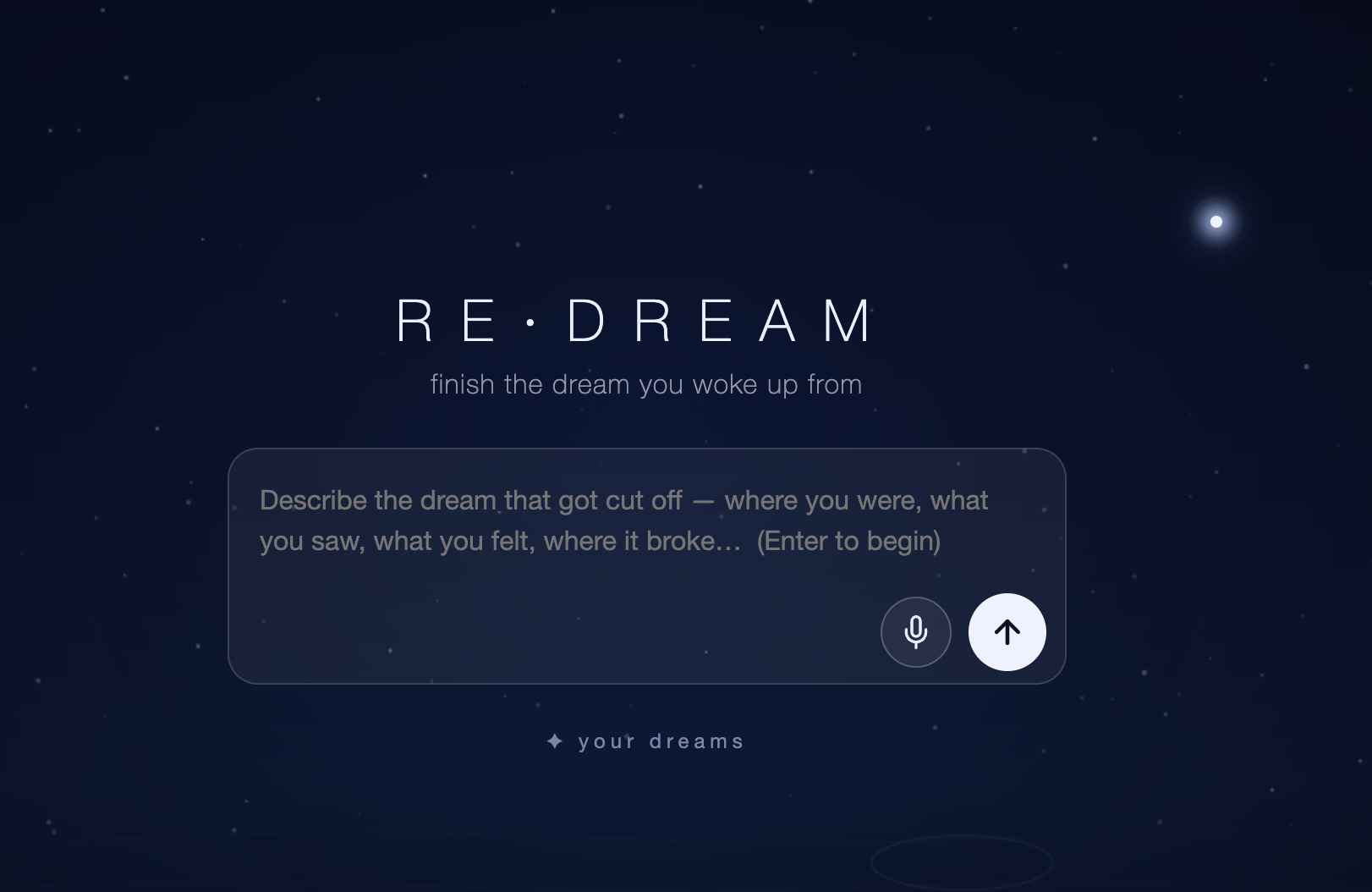
- You describe the dream that got cut off — by typing or speaking it.
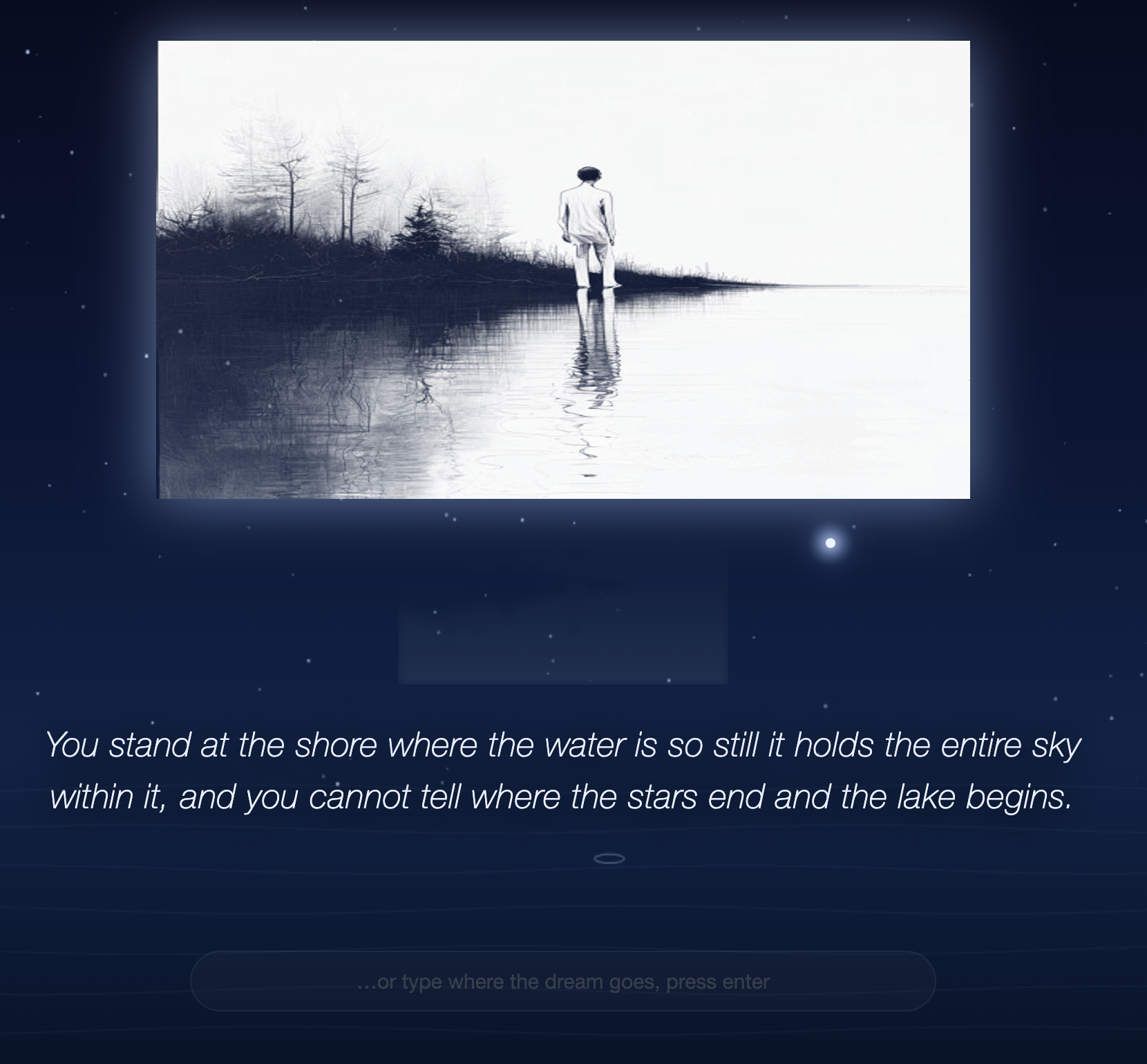
- You re-enter a quiet dreamscape: a white line-art figure drawn over a blue starlit sky and rippling water, narrated aloud by a calm British voice, the words fading in and out like a memory.
- There are no menus. You hold the spacebar and simply say where the dream should go — "I step onto the water and walk toward the voice" — and the dream continues in that direction, in real time.
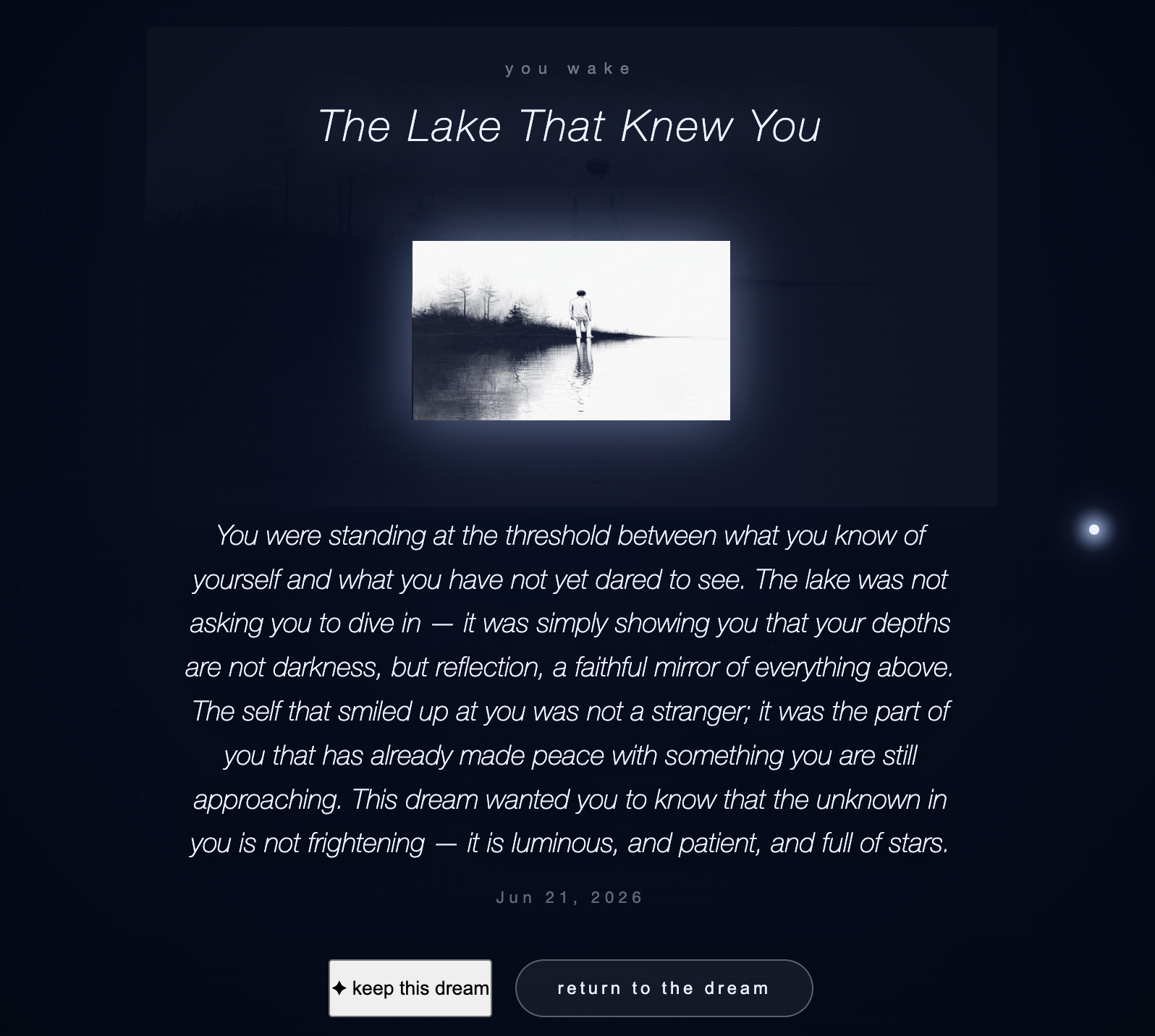
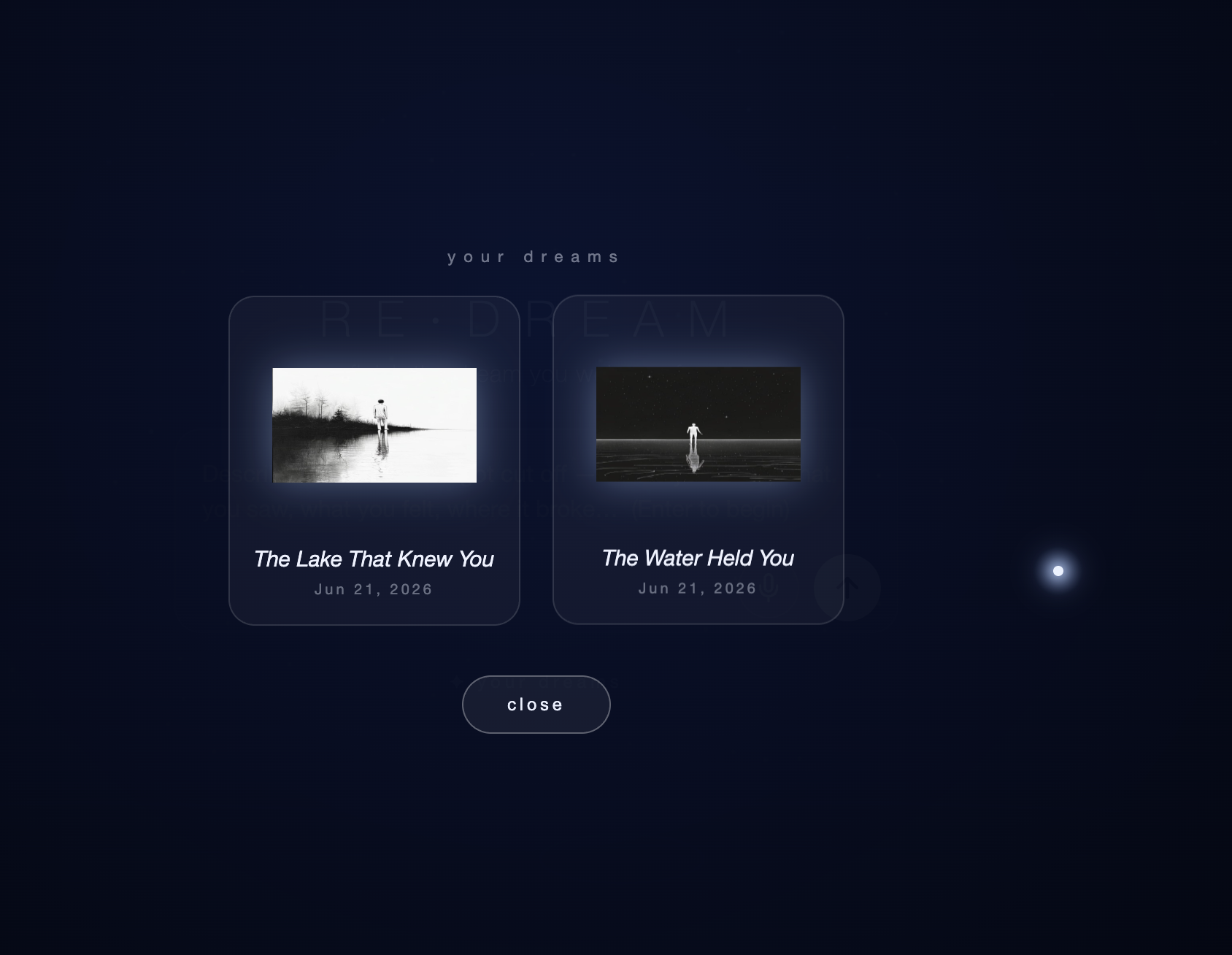
- When you are ready, you wake, and the dream gives you a Dream Card: a title, the image of your dream, and a tender interpretation of what your subconscious seemed to be working through — read aloud.
- Keep your dreams in a soft, floating Dream Gallery and revisit them any time.
## How we built it
- Anthropic (Claude) is the dream engine: it continues the narrative in the direction you speak, art-directs the figure to draw, and — on waking — names the dream and interprets it. One model carries story, art direction, and meaning.
- Deepgram gives the dream ears and a voice: Aura text-to-speech narrates every beat in a British voice; Nova speech-to-text lets you steer the dream by talking to it. Voice is the entire interface.
- Visuals are generated white line-art, composited over a hand-built canvas starfield and water-ripple world with screen blending, so each figure floats as light. A Flask backend orchestrates Claude, Deepgram, image generation (behind a caching proxy), and the saved-dream gallery.
## Challenges we ran into
Making it feel like a dream and not a menu: the entire experience is steered by voice in real time, so the narrative must bend to whatever the dreamer says. The craft was making an AI unlearn coherence just enough to feel oneiric while still honoring the dreamer's direction. The premium white line-art aesthetic meant generating art on black and screen-blending it over a generated starscape, and keeping live image generation reliable under load pushed us to build a caching image proxy.
## What's next
Closing the loop with the sleeping body. Dream reconstruction from overnight signals — movement, heart rate, and sleep-talk — would let someone wake and immediately re-enter the dream they were just having. At scale, durable, searchable dream journals could turn fleeting subjective experience into longitudinal data — the very kind of record that the research linking dream content to neurological health currently has to collect by hand.
Built With
- anthropic
- claude
- deepgram
- flask
- flux
- html5
- javascript
- python
- web-audio-api


Log in or sign up for Devpost to join the conversation.