-
-
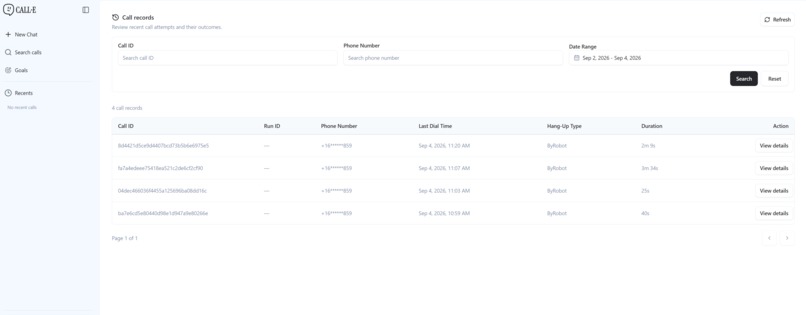
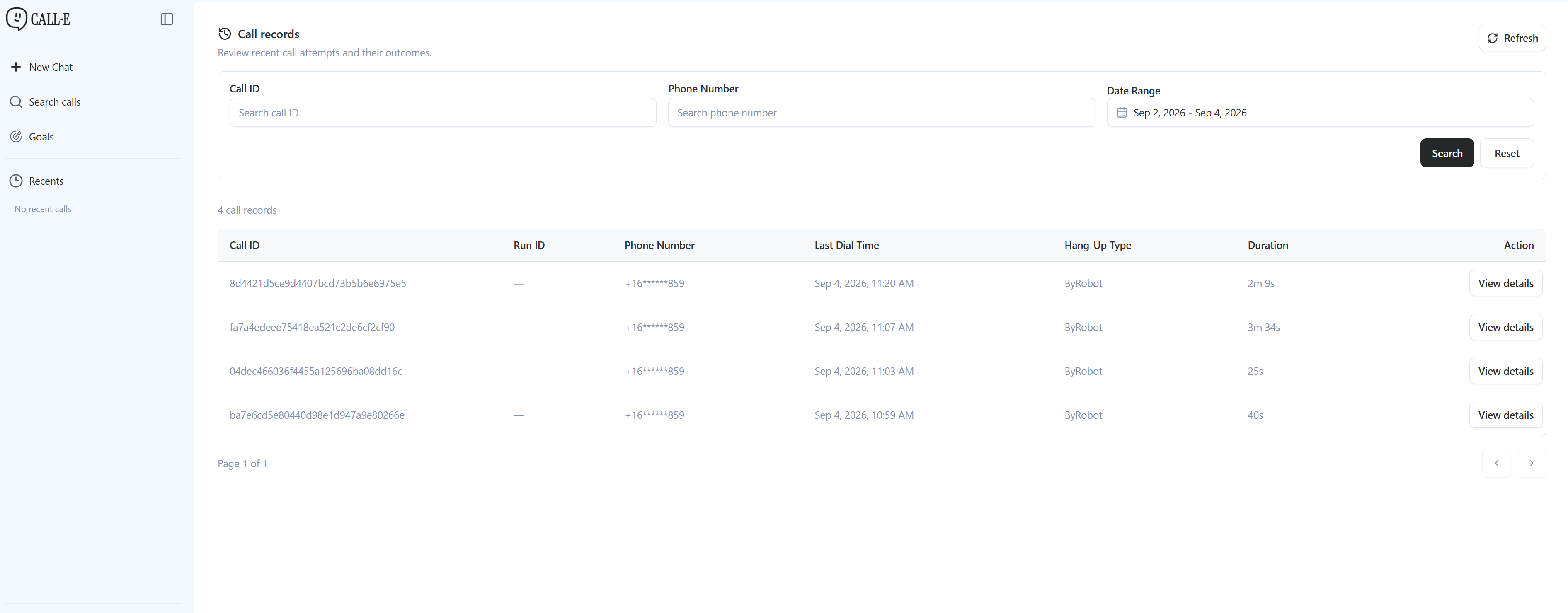
Call e dashboard
Inspiration
Healthcare often begins with a phone conversation. For nutrition support, patients may need to provide basic information before an RDN can determine the appropriate next step. I wanted to explore whether an AI phone agent could make this initial intake more consistent while keeping the human RDN at the center of care.
This led me to build the RDN Intake & Referral Agent: a CALL-E-powered phone workflow that collects consent-based intake information and transforms the conversation into a structured, referral-ready summary.
What I Built
The agent makes an outbound phone call and conducts a natural conversation with the patient. It:
- Discloses that it is an AI assistant.
- Requests consent before continuing.
- Collects the patient's name and nutrition-support needs.
- Asks about healthcare referral status, nutrition goals, dietary preferences, restrictions, and allergies.
- Collects general location and optional insurance information.
- Collects preferred appointment times for an RDN.
- Reads the collected information back to the patient for confirmation.
- Produces a structured JSON result for human/RDN review.
The agent is intentionally not a medical advisor. It does not diagnose conditions, prescribe treatment, interpret medical information, or provide individualized medical or nutrition advice.
How I Built It
I implemented the project as a reusable CALL-E Agent Skill.
CALL-E handles the phone interaction, while the skill defines the intake workflow, safety boundaries, structured result format, confirmation process, and human-review behavior.
The workflow is:
RDN/Care Team → CALL-E AI Phone Agent → Patient Consent → Structured Intake → Patient Confirmation → RDN-Ready Summary
I also added fail-closed behavior for situations such as unclear consent, requests to stop, an incorrect recipient, emergencies, or unreliable information.
Testing
After CALL-E service availability was restored, I performed live phone testing.
The successful test demonstrated AI disclosure, consent, information collection, patient confirmation, safety-boundary handling, and structured JSON result generation.
The final demonstration test completed successfully with a 0.95 completion confidence.
What I Learned
The biggest lesson was that voice agents require more than simply asking a sequence of questions. I needed to design the agent to handle ambiguity, confirm important information, respect the recipient's choices, and maintain clear boundaries when a conversation moves outside its intended purpose.
I also learned the importance of converting an unstructured conversation into reliable structured output that can support a downstream human workflow.
Challenges
One of my biggest challenges was designing the conversation so that the agent could collect structured information without making the interaction feel like a rigid form.
I also encountered a temporary CALL-E-side 503 provider_unavailable issue during early testing. After the service was restored, I successfully completed live phone calls and validated the workflow end-to-end.
Healthcare safety was another important challenge. I deliberately separated information collection and referral coordination from clinical decision-making so that the RDN remains responsible for professional care.
Impact
I built this project to demonstrate how real phone-based AI can reduce repetitive intake work while preserving a human-centered healthcare workflow.
Rather than replacing an RDN, the agent is designed to help the RDN start with organized, patient-confirmed information.
The result is a reusable foundation for building safer AI-powered phone workflows for healthcare intake and care coordination.
Future Development
This prototype focuses on the intake and referral stage. A future production version could connect the structured intake output to an RDN scheduling and care-management system.
In that version, the RDN or care team could review the patient-confirmed information, coordinate an available appointment, and follow up with the patient to confirm the appointment.
The AI would remain focused on communication, intake, and workflow coordination, while clinical decisions and appointment confirmation remain under appropriate human or authorized system control.
Built With
- agent
- agents
- automation
- call-e
- conversational
- healthcare
- json
- language
- llm
- natural
- phone
- processing
- python
- skills
- voice

Log in or sign up for Devpost to join the conversation.