RC-Rehab
Rehab that kids actually want to do. Muscle sensors and a phone camera turn cerebral palsy exercises into a racing game, and a real RC car drives every rep.
Inspiration
A nine-year-old boy with cerebral palsy couldn't open his right hand, and his therapy was opening and closing it thousands of times at home. Researchers turned it into video games: in six weeks he played 43 hours and held a lightsaber for the first time. Then the study ended, the games went back to the lab, and most of his gains were gone four weeks later (Fu et al. 2020).
That's the real problem. The same reps at home get discouraging, and 34–79% of families of children with CP don't keep up with home exercise programs (Niyonsenga et al. 2024). Games change that: the boy made ~1,000 hand movements an hour in games vs ~70 in regular practice, and across 19 randomized trials, game-based therapy had a large effect on motor function in children with CP (Fu 2020, Chen 2018).
So we built a toy kids want to play with: drive a real RC car with your own muscles, inside a Duolingo-style game that brings you back every day.
What it does
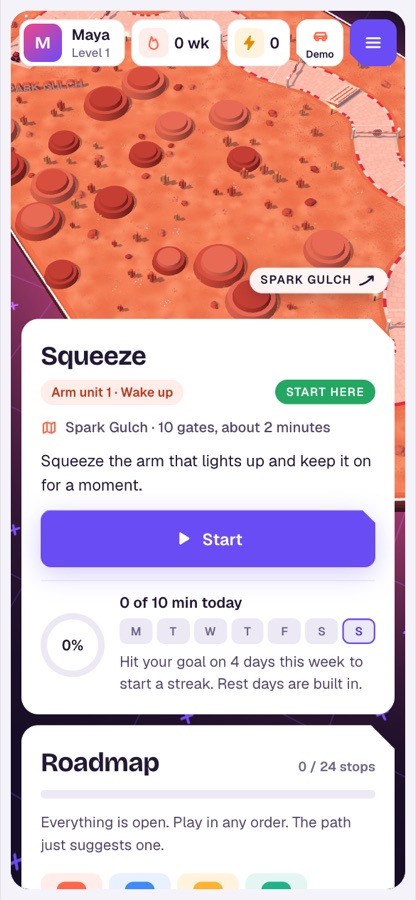
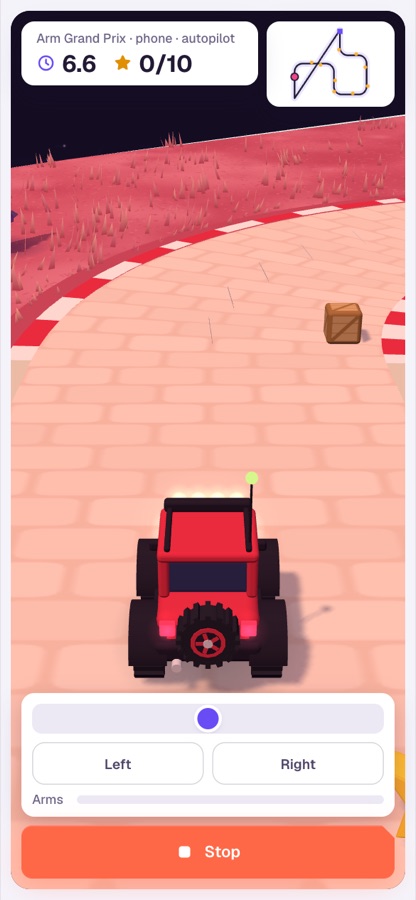
- Arm mode (/arms): an EMG sensor on each bicep drives a real RC car. Flex left, right or both to steer, and the game car on screen moves with it.
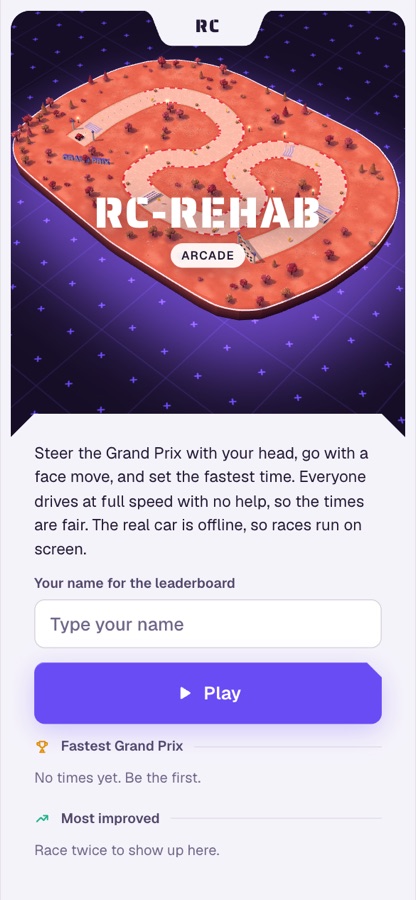
- Camera mode (/path): no sensors needed. Your head steers and face moves (open mouth, raised eyebrows, smile) are the gas pedal.
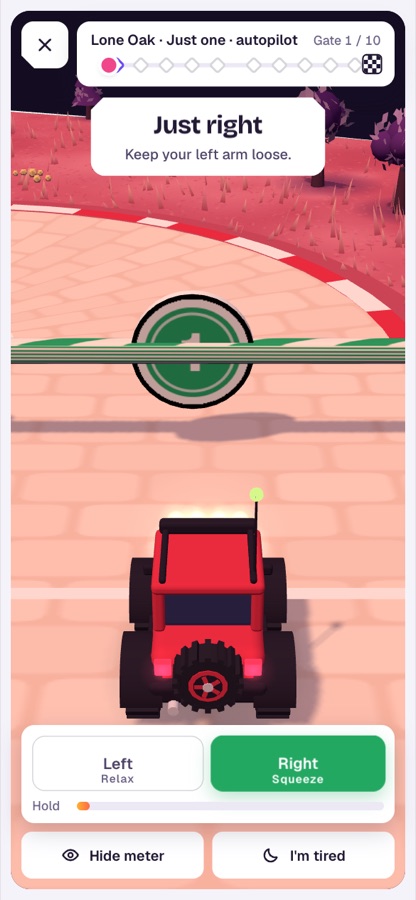
- A daily path, like Duolingo: every lesson is a race track with 10 gates, and each gate opens with one rep. It adapts to how you're doing, tells you when to rest, and logs every rep for the therapist.
- Arcade (rc-rehab.vercel.app): race the Grand Prix for a spot on the live leaderboard.
To the kid, it's a race. To the therapist, it's hundreds of reps that wouldn't have happened otherwise.
Built on real research
Every exercise rule comes from 19 published papers and reviews (PubMed, PubMed Central, peer-reviewed journals):
- Relaxing counts as much as squeezing. In CP the biceps are often over-active, so letting go on cue is a skill (EMG + VR study). The game never says "squeeze harder".
- Feedback fades. Motor learning works best when feedback fades, so the meter hides itself every third rep once you're doing well (MacIntosh 2019, JSLHR 2023).
- Reps and rest follow CP strength guidelines: about 10 easy reps, rest between sets, every other day (Verschuren 2016, Scholtes 2008).
- Honest where evidence is weak. Mouth exercises are framed as control practice, never as speech treatment (Arvedson 2010).
How to try it
- Open rc-rehab.vercel.app on a phone or a laptop with a webcam.
- Type a name, press Play and allow the camera. Video never leaves your device.
- Do the 10-second setup (relax, steer left, steer right, show your GO move), then race.
| Link | What you get |
|---|---|
| rc-rehab.vercel.app | Arcade: race with your head and face |
| /path | Camera mode: the head and face lesson path |
| /arms | Arm mode. No sensors? Hold A / D or the on-screen buttons |
| /path?autopilot | Watch it play itself |
| /screen | Big screen: live race and leaderboard |
No camera? Tap Use touch controls instead. The real car only joins when it's with us, so online races run on screen. Connecting the Bluetooth car needs Chrome or Edge.
How we built it
- Muscle signal: MyoWare 2.0 EMG sensors feed an ESP32-S3, which streams both arms over Bluetooth Low Energy straight into the browser with Web Bluetooth. A 6-second calibration (relax, squeeze left, squeeze right) learns each person's own range and sets hysteresis thresholds, so it works with whatever strength that arm has. Our Arm Lab test bench adds a classifier over 1.2-second windows (mean, RMS, 90th percentile, spread) that refuses to guess when the signal is unclear.
- Computer vision: Google MediaPipe Face Landmarker runs on the phone's GPU, tracking 478 face points and 52 expressions. We compute head turn, tilt and nod, and calibration picks whichever movement and gesture the player does most clearly.
- Game: Three.js with 20+ hand-built courses and arcade physics, all in the browser.
- Real car: the RC remote only has on/off buttons, so the ESP32 presses them for it, pulsing each side's wheels to copy the game car's speed and turns.
- Live backend: Node.js WebSockets on Vercel functions, with Upstash Redis relaying messages between servers. A leader lock and saved snapshots keep races alive through dropped connections and server handovers.
Challenges we ran into
- The signal is tiny. A muscle signal is a few thousandths of a volt buried in noise. Move the sensor a centimetre and it disappears, and every arm reads differently. Per-person calibration fixed it.
- The car's remote was never built to be taken over. We wired an ESP32 to fake button presses and pulse them for partial speed.
- At 3 a.m., with 24 hours left, we almost scrapped it. Then someone pointed out that the boy did that movement thousands of times with a hand that wouldn't listen, and we were quitting after a few tries with hands that work fine. We plugged it back in, and now it drives.
Accomplishments we're proud of
- A real car driven by muscle signals, mirrored live in a 3D game.
- Two complete therapy paths that adapt to each player's own range.
- It runs from a link in any browser, with no install, no account, and no video uploaded.
- 100 automated checks drive every lesson and course to the finish.
What we learned
- In CP the hard part is often switching a muscle off, not on.
- Kids don't need more exercises. They need a reason to do the ones they have.
What's next
- Test with kids with CP and their physiotherapists, and tune the sensors on real arms.
- A therapist dashboard to set goals and track progress week by week.
- More sensors (forearm, legs) so more kids can play.
Built With
- bluetooth
- esp32-s3
- javascript
- myoware
- node.js
- three.js
- vercel
- websock


