-
-
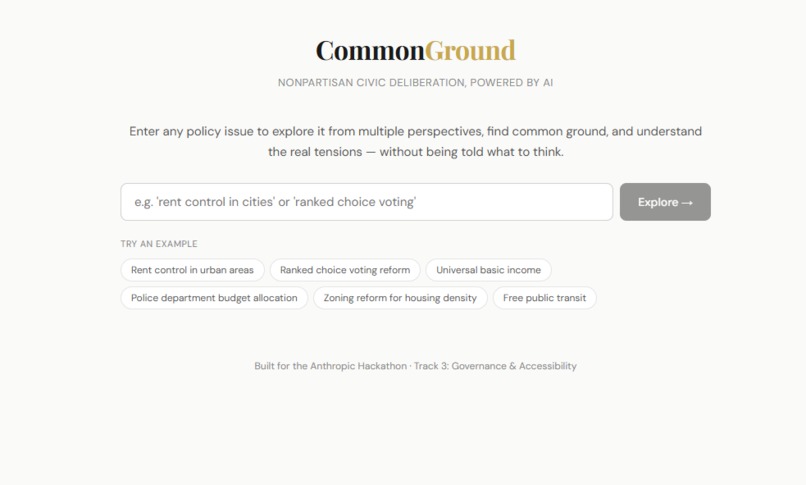
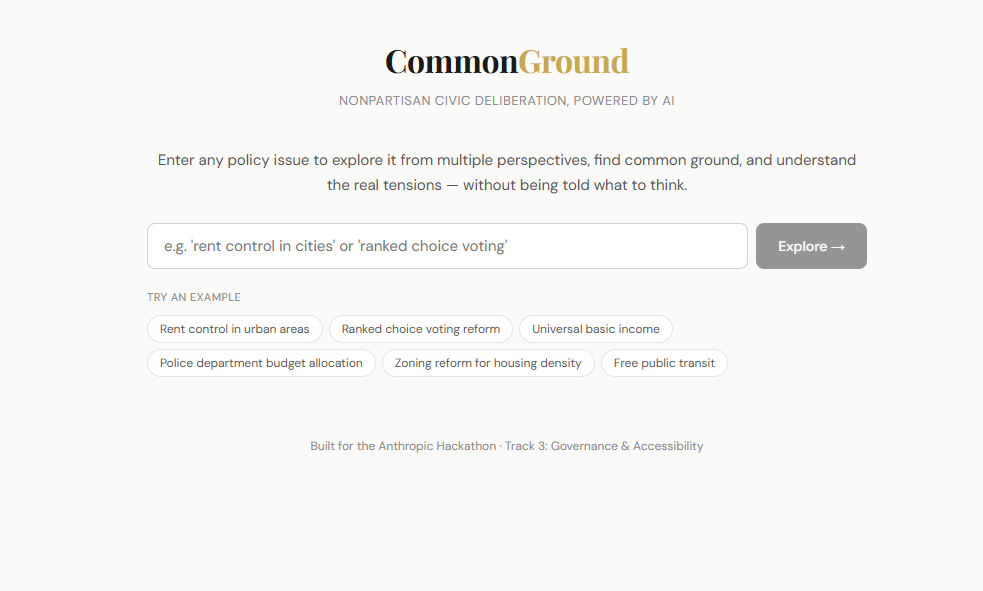
CommonGround’s landing page invites users to enter any policy issue and begin a guided, nonpartisan exploration.
-
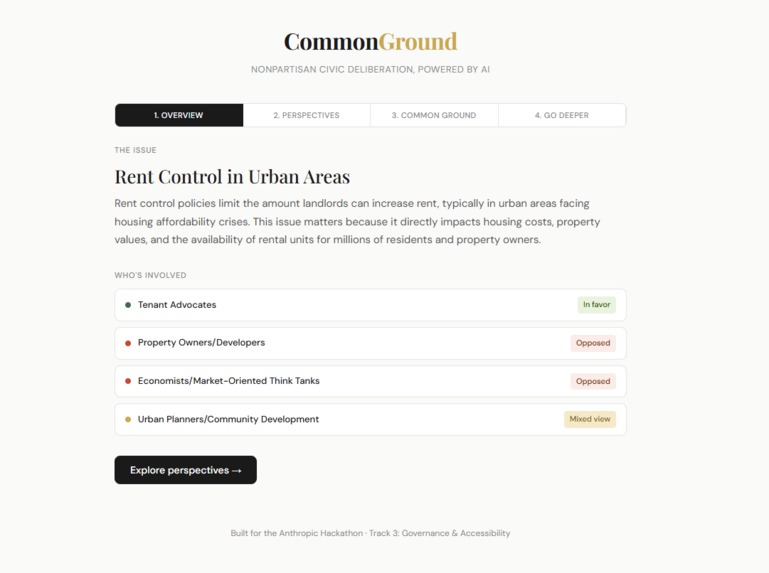
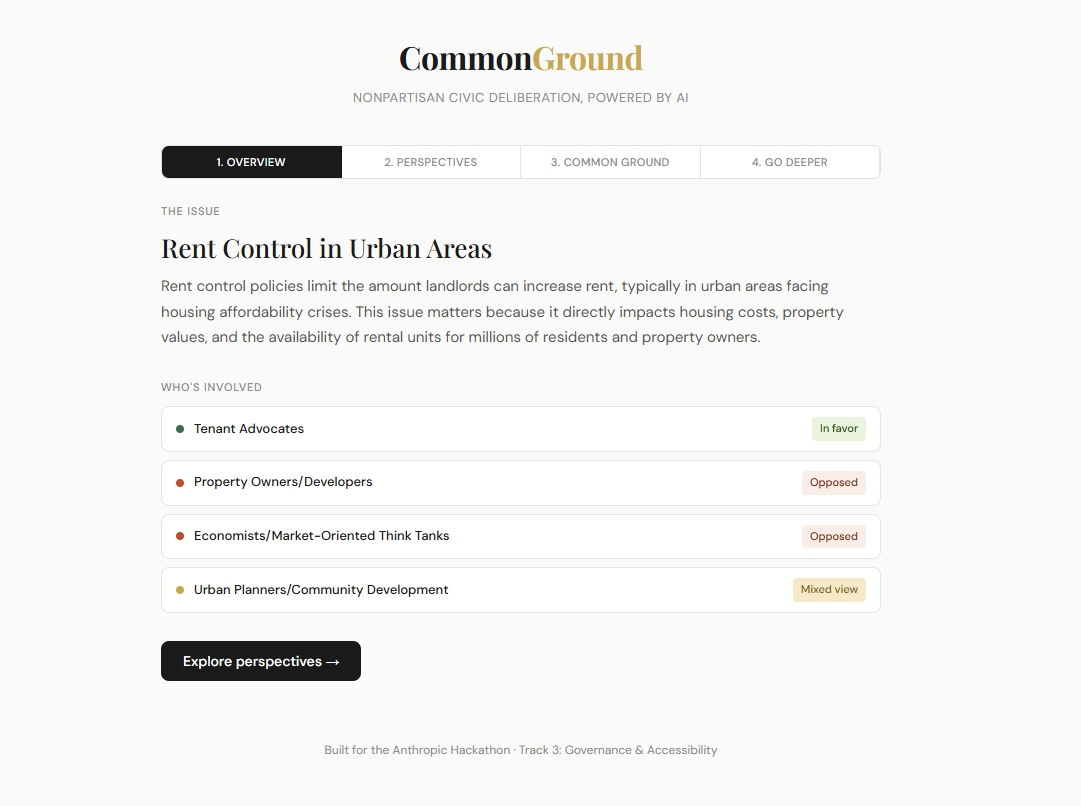
The overview screen introduces the issue with a neutral summary and maps the key groups involved before the user dives deeper.
-
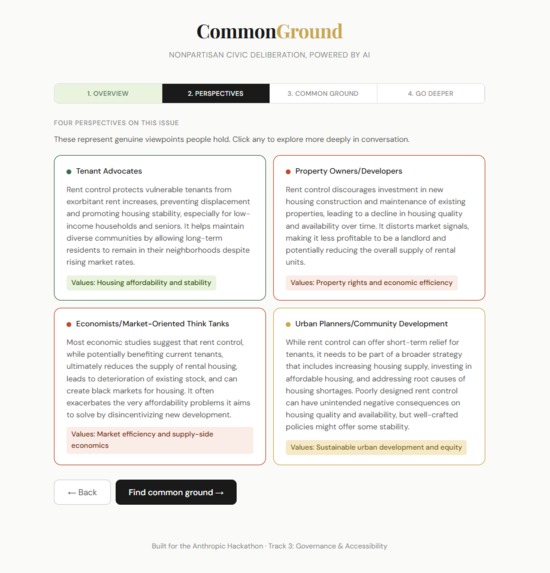
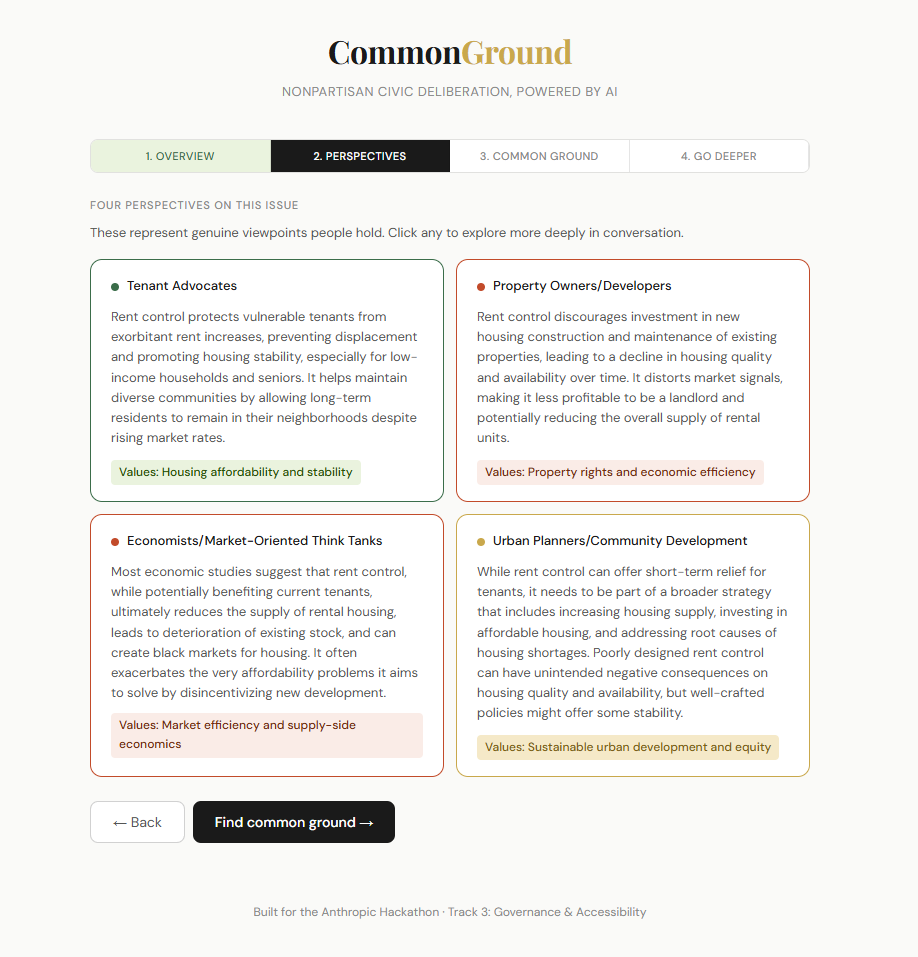
The perspectives view presents four genuine stakeholder viewpoints, highlighting each group’s reasoning and core values side by side.
-
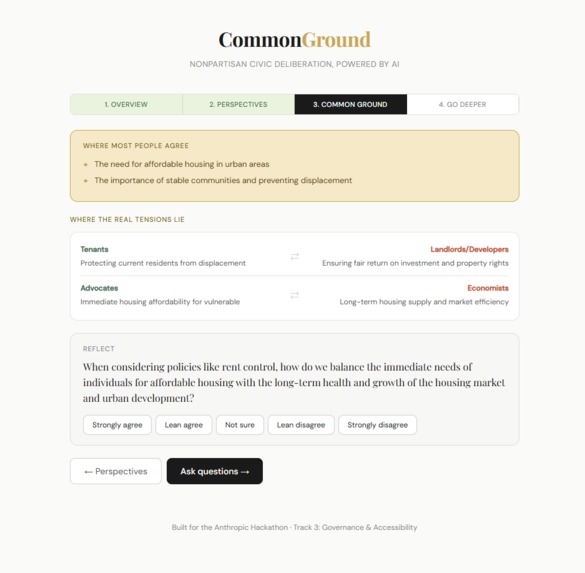
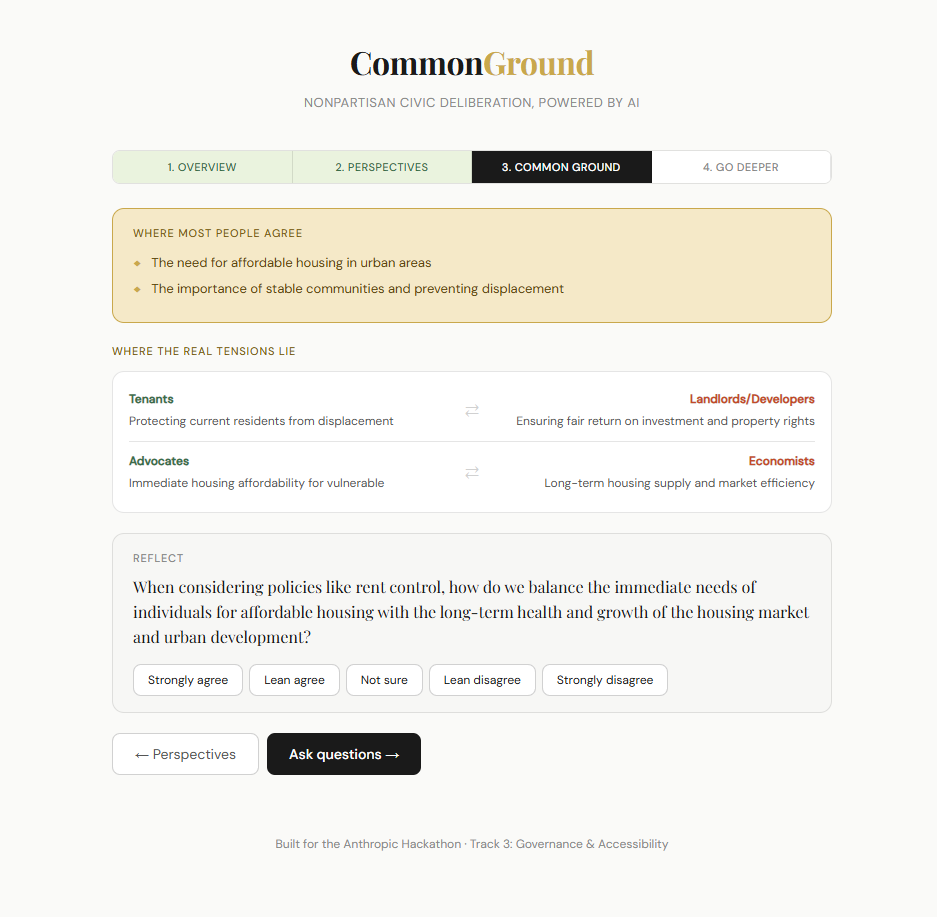
The common ground stage surfaces shared concerns, core tensions, and a reflection prompt to help users think through the tradeoffs.
-
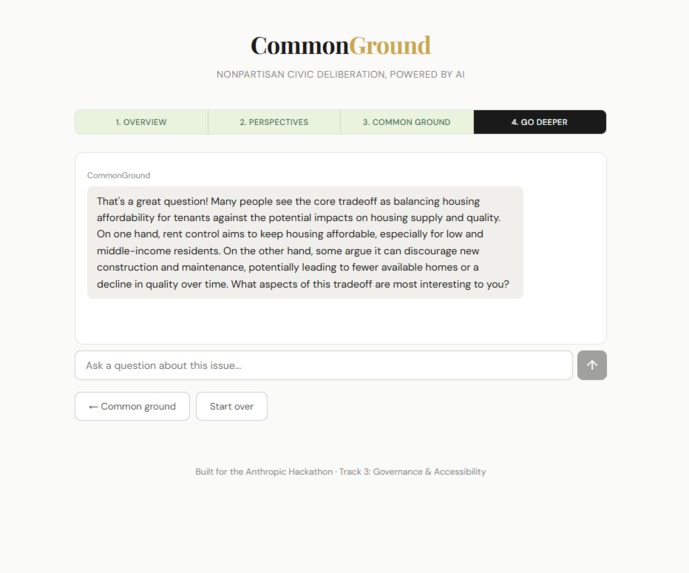
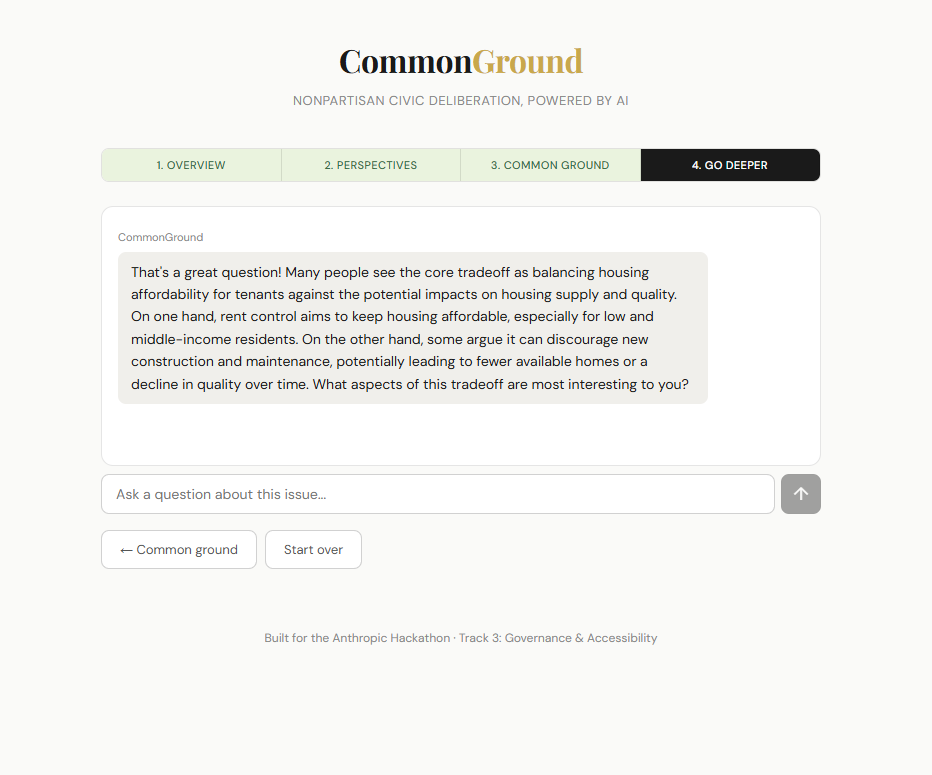
The chat experience lets users ask follow-up questions and explore the issue in a more conversational, interactive way.
Inspiration
CommonGround came from a simple frustration: most people encounter public-policy debates as heat before light. It is easy to find the loudest opinion in a room and much harder to understand why reasonable people disagree in the first place. We wanted to build something that slows that process down and helps users explore competing values, tradeoffs, and shared concerns before they lock into a side.
We were especially interested in civic issues where disagreement is real, emotions run high, and the consequences affect everyday life. Instead of building another debate app optimized for winning arguments, we wanted to build a civic learning tool optimized for understanding.
What it does
CommonGround is an AI-powered civic deliberation platform. A user enters a policy issue, and the app guides them through a structured, nonpartisan exploration of that topic.
It first generates a neutral overview of the issue, then surfaces multiple stakeholder perspectives with their core values and arguments. From there, it highlights areas of common ground and the real tensions between positions. Finally, it opens a conversational chat experience where users can ask follow-up questions and explore a specific viewpoint in more depth without being pushed toward a particular conclusion.
The goal is not to tell people what to think. The goal is to help them think more clearly.
How we built it
We built CommonGround as a full-stack web app with a React frontend and a Node/Express backend. The frontend handles the multi-phase user flow, moving from issue input to overview, perspectives, common ground, and chat. The backend manages validation, rate limiting, logging, error handling, and the AI orchestration layer.
For the AI layer, we designed prompts that ask the model to behave like a nonpartisan civic educator rather than a debate partner. We structured the output so the app can present issues consistently across different topics, and we added a chat mode that uses conversation history plus optional perspective context to support deeper exploration.
We also put real attention into the surrounding product behavior, not just the model calls: cleaner error handling, environment-based configuration, and a frontend flow that keeps the experience readable and approachable rather than overwhelming.
Challenges we ran into
One of the biggest challenges was getting reliable structured output from the model. It is easy to ask for balanced analysis in natural language; it is much harder to get predictable, parseable output every time, especially when the response is long and highly structured.
We also had to balance nuance with usability. Civic issues are messy, and oversimplifying them makes the tool less trustworthy, but overloading users with complexity makes the product hard to use. Finding the right level of structure, tone, and brevity was a recurring design problem.
Another challenge was preserving neutrality. It is not enough for the model to sound balanced once; the whole experience has to consistently avoid nudging users toward one viewpoint while still being informative and concrete.
Accomplishments that we're proud of
We are proud that CommonGround feels like a real product, not just a prompt wrapped in a UI. The experience has a clear flow, a coherent civic purpose, and an interaction model that supports reflection rather than outrage.
We are also proud of the tone the system maintains. It does not flatten disagreement into false equivalence, but it does try to surface the underlying values behind each position. That matters for trust. The common-ground and tension framing also helps users see that disagreement is often about competing priorities, not just ignorance or bad faith.
On the technical side, we are proud that we built an end-to-end app with frontend, backend, validation, health checks, structured responses, and conversational follow-up in a relatively small footprint.
What we learned
We learned that prompt design is product design. The wording of system instructions, the structure of outputs, and the constraints on tone all have visible effects on user trust and usability.
We also learned that building civic AI tools requires more than factual correctness. Framing, neutrality, and emotional temperature are part of the product. A response can be technically correct and still be unhelpful if it makes the user feel pushed, flattened, or unheard.
Finally, we learned that structured AI features need strong guardrails. When you rely on generated content to drive a UI, resilience matters: response formatting, fallback behavior, and error handling are not polish, they are core functionality.
What's next for CommonGround
Next, we want to make CommonGround more interactive and more trustworthy. That includes adding source-backed issue summaries, better transparency around how perspectives are generated, and stronger safeguards for factual grounding.
We also want to personalize the learning flow without turning it into an echo chamber. That could mean helping users compare their own values against different policy tradeoffs, save explorations across issues, or revisit topics from multiple lenses over time.
Longer term, we see CommonGround growing into a broader civic reasoning tool: something useful not just for individual reflection, but also for classrooms, community groups, and public-interest organizations trying to have better conversations about hard issues.

Log in or sign up for Devpost to join the conversation.