-
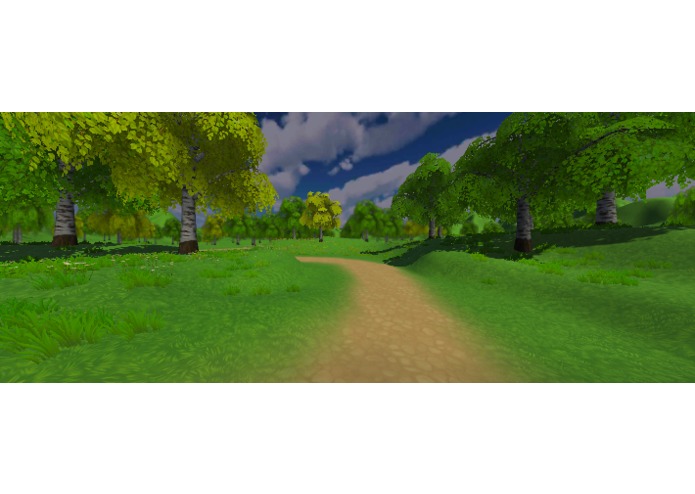
Environment without Rain or Snow
-
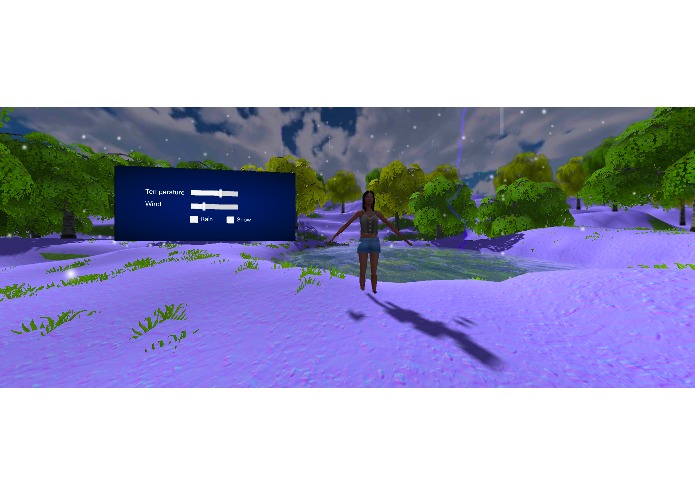
Testing Rayne Bow
Inspiration
While the project initially was inspired by the desire to know how to dress for specific weather based on your location, Rayne Bow took off once we realized we wanted to use the program to help others understand the consequences of climate change. Driven by our own concerns and fears for the environment, we see a need to convey to others that climate change is something to worried about, especially before the effects of climate change become completely irreversible. By using VR's ability to place people right in the heart of a storm, we hoped that Rayne Bow could be a tool for teaching others about the seriousness and urgency of climate change.
What it does
Rayne Bow allows a user to manipulate the weather conditions in a simulated environment in virtual reality. Someone can change windspeed, temperature, and precipitation and then see the effects on Rayne Bow, our virtual aspiring meteorologist, and her surroundings. The user can then navigate the space to further understand the effects of severe weather—especially of severe weather a user might not experience where they live—and can begin to understand why climate change can lead to problematic weather for all.
How we built it
We built this using Unity 3D and an Oculus Go.
Challenges we ran into
Since we were relatively new to Unity and completely new to developing for an Oculus Go, we ran into many software and hardware issues. From programs not uploading to the Oculus Go to not being able to find shaders and materials that we needed, Rayne Bow had challenges we weren't prepared for and we were often forced to design more components from scratch and master new software and development tools to fix each problem.
Accomplishments that we're proud of
We are incredibly proud of how the project turned out overall. Especially considering where we started, getting a project that has so many components and effects off the ground was incredibly exciting. The precipitation effects (snow and rain) were custom designed by our group and Rayne Bow and her clothes were customized and transformed from online resources into assets we could use in Unity. So much of this project represents our hard work, and we cannot help but feel proud of it.
What we learned
We learned so much about designing assets for Unity, controlling effects (especially particle effects) in Unity, and manipulating components for different objects in Unity. Additionally, we learned a lot about how navigation works in VR for the Oculus Go.
What's next for Rayne Bow
More options for weather and more accurate/realistic weather shown! By offering more realistic and accurate weather, we can better show the consequence of high temperatures and heavier/more destructive storms. Additionally, if we let users manipulate time in Rayne Bow, we could use the program to not only model extreme weather happening at the moment but also the effect of overall changes in climate, which would help others better understand climate change.

Log in or sign up for Devpost to join the conversation.