Inspiration
The results of research studies are typically published in academic journals or presented at conferences, which can be challenging for healthcare workers and clinicians to access and understand, especially if they are not experts in the field. This can result in delays in the adoption of new treatments and therapies or missed opportunities for improving patient outcomes.
What it does
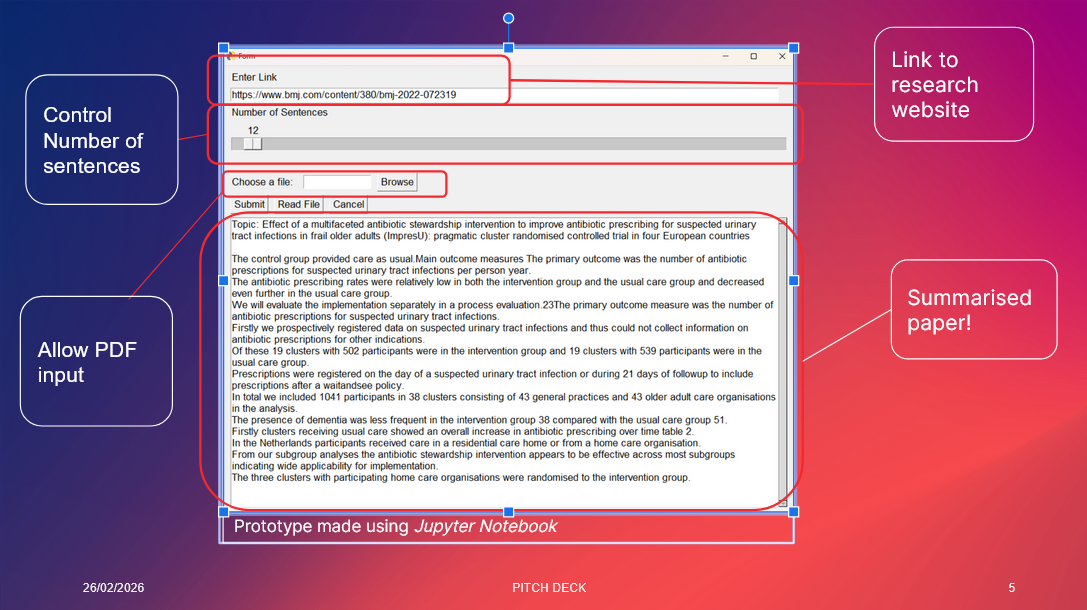
The creation of a program that aims to assist in medical research and healthcare by streamlining the process of understanding and digesting lengthy research papers.
How we built it
The program was built using Jupyter Notebook, which suggests that the program is written in Python, a popular programming language for data science and machine learning. Python has a rich ecosystem of libraries and tools that make it easy to process and analyze natural language text, such as the research papers that the program aims to streamline.
The Natural Language Toolkit (NLTK) is a library for Python that provides tools and resources for processing and analyzing human language data. NLTK includes a variety of modules and functions for tasks such as tokenization, stemming, tagging, parsing, and sentiment analysis. In this case, NLTK was used to rank the sentences in research papers, which suggests that the program uses some form of text summarization or extraction algorithm.
Overall, the use of Jupyter Notebook and NLTK highlights the importance of open-source tools and libraries in enabling innovation and collaboration in data science and research. By leveraging these tools, even individuals with minimal programming knowledge can build powerful programs and applications that can have a significant impact on medical research and healthcare.
Challenges we ran into
As project creators, we faced several challenges during the development of our program, including a lack of knowledge of Python libraries and difficulties implementing Pysimplegui.
As individuals with limited programming experience, we had to invest time and effort into learning the relevant Python libraries and tools needed to develop our program effectively. We found this to be a significant challenge, as Python has a vast ecosystem of libraries and tools, and learning to use them effectively requires a considerable investment of time and effort.
In addition to this, we also faced challenges with implementing Pysimplegui, a library for creating GUI interfaces for Python programs. Designing and implementing GUIs can be challenging, particularly for individuals with limited programming experience, and we found that Pysimplegui was not easy to implement. As a result, we had to invest additional time and effort into creating a user-friendly interface for our program.
Despite these challenges, we remained committed to our goal of developing a program that could help improve lives and make a positive impact on society. We persevered through these challenges and ultimately developed a program that we are proud of, but we recognize that there is always room for improvement. By continuing to learn and develop our skills, we hope to overcome these challenges and create even more effective and user-friendly programs in the future.
Accomplishments that we're proud of
Participating in the hackathon was a memorable and rewarding experience that challenged us to develop new skills and make a positive impact on society. As a team with a shared passion for technology and innovation, we were excited to work together on a real-world problem.
Throughout the hackathon, we learned valuable skills such as problem-solving, critical thinking, communication, and collaboration. Working on a tight deadline required us to be creative and efficient, and we were impressed by the innovative solutions that we developed. We enjoyed working collaboratively with our team members, and we were able to combine our different perspectives and skill sets to create a more robust solution.
One of the most rewarding aspects of the hackathon was the opportunity to make a positive impact on society. Our project focused on solving a healthcare issue, and we were passionate about developing a solution that could improve people's lives. It was inspiring to see the creativity and dedication of all the participants, and we left the event feeling proud of our accomplishments
What we learned
Participating in a hackathon can be a valuable learning experience that teaches us important skills such as collaboration, time management, problem-solving, flexibility, and perseverance. Working collaboratively with team members allows us to learn from others and combine different perspectives to develop more robust solutions. Hackathons often have tight deadlines, providing an opportunity to hone time management and prioritization skills. Developing a program from scratch can be a challenging task that requires creative problem-solving skills while pivoting and changing approaches can teach us the importance of flexibility and adaptability. Finally, hackathons can be mentally and physically exhausting, providing a lesson in perseverance and determination. Overall, hackathons provide a unique opportunity to learn new skills, collaborate with others, and develop innovative solutions to real-world problems.
What's next for Rawdy Summarizer
Their future goals include developing new tools and applications that can streamline processes, improve communication and collaboration among team members, automate repetitive tasks, and provide real-time insights and analytics. They also aim to make their programs accessible and user-friendly for workers from all backgrounds and skill levels, thereby democratizing access to technology and empowering workers to be more productive and effective in their work.
Built With
- jupyter-notebook
- python

Log in or sign up for Devpost to join the conversation.