-
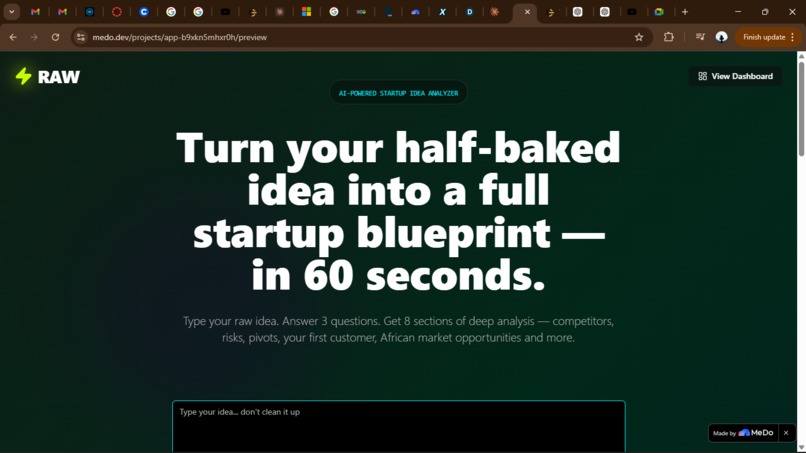
Raw
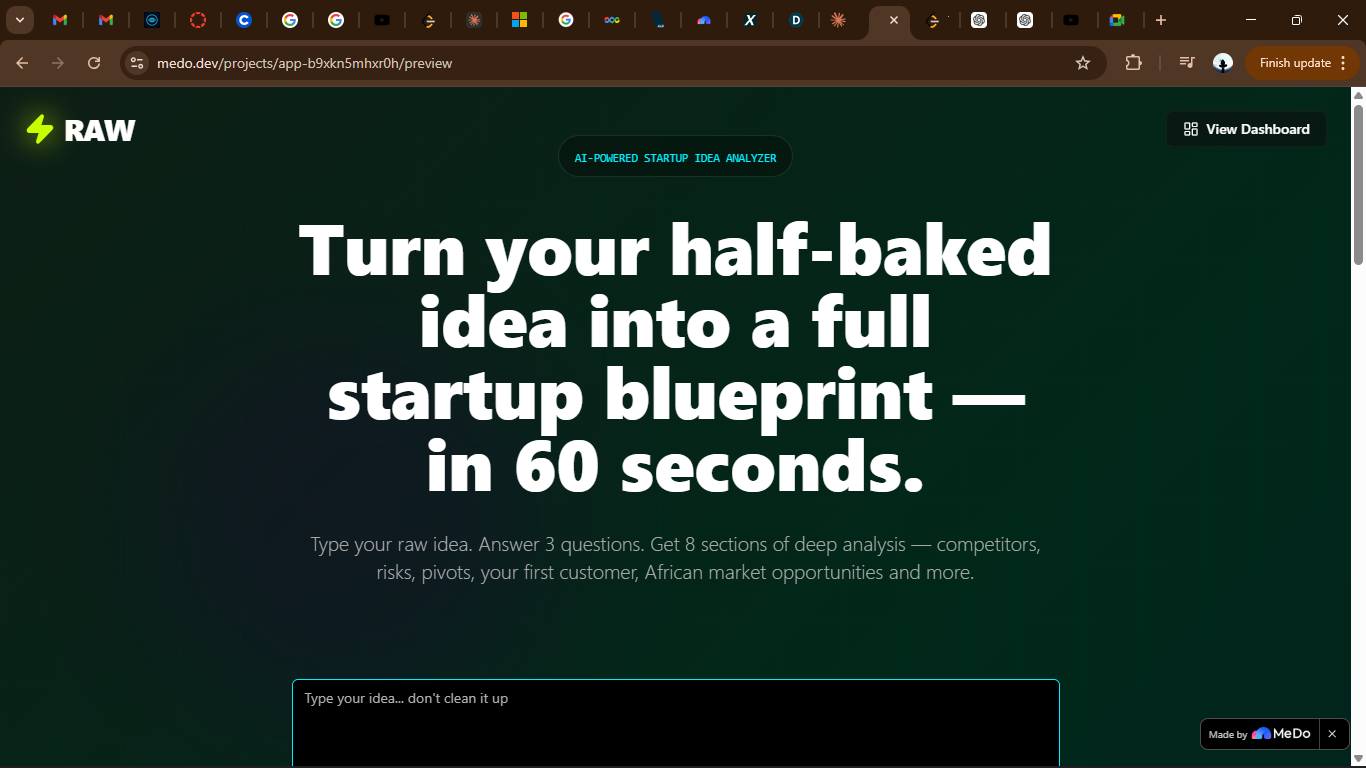
Inspiration
I kept watching people around me — students, young Africans, first-time entrepreneurs — sit on genuinely great ideas that never went anywhere. Not because the ideas were bad. Because they had no starting point.
No way to know if someone was already doing it. No way to understand who their first customer actually was. No way to stress-test the weak spots before pitching. Just a gut feeling and a lot of doubt.
I also noticed that every "idea validation" tool out there was built for polished founders in Silicon Valley — not for someone in Kigali, Lagos, or Nairobi with a rough thought and no business background.
That gap frustrated me. So I built RAW.
The name says it all — come as you are, idea and all, no polish needed. RAW meets you exactly where you are and hands you back a blueprint.
What it does
RAW is an AI-powered startup idea analyzer built for unpolished thinkers.
You type your raw idea — messy, half-formed, one sentence, whatever you have. RAW then interviews you with 3 smart follow-up questions to understand your market, your customer, and your context. Then it generates a full Idea Blueprint across 8 powerful sections:
- Idea DNA — strips and sharpens your idea into a clear, focused summary
- Competitor Map — identifies who's already out there and exactly where your opening is
- Kill Shot — the 3 most likely reasons your idea fails, with a fix for each
- 5 Pivots — smarter and wilder variations of your original idea, ranked by potential
- Who Pays First — a vivid portrait of your exact first customer, not vague demographics
- Timing Pulse — a scored analysis of whether the world is ready for your idea right now
- African Angle — dedicated analysis of your idea in African markets, the opportunities Western competitors are ignoring, and which cities to start in
- Steal the Playbook — finds an unrelated industry that already solved your problem and shows you what to borrow
The whole thing takes 60 seconds. No sign up. No fluff. Just clarity.
How we built it
RAW was built entirely using MeDo — no traditional coding required.
The entire application — from the landing page to the AI-generated blueprint — was constructed through natural language conversation with MeDo. Every screen, every interaction, every animation, and every AI logic flow was described in detail through prompts, and MeDo translated it into a fully functional, deployed web application.
The build process looked like this:
- Concept & Flow — Defined the core user journey: idea input → 3-question interview → loading screen → 8-section blueprint
- Screen by Screen — Prompted MeDo to build each screen individually with precise layout, content, and interaction instructions
- Design System — Specified the full visual language: dark aurora background, electric lime, cyan and magenta accents, glassmorphism cards, animated glowing borders
- AI Logic — Instructed MeDo to make the blueprint fully dynamic — every section generated based on the user's specific idea and interview answers
- Iteration — Refined through multiple follow-up prompts: restructuring the landing page hierarchy, replacing emojis with proper icons, adding live animations, fixing the content order so value is communicated instantly
- Deployment — Published directly from MeDo to a live public URL with one click
The most powerful moment was realizing that the quality of the final product was entirely determined by how precisely and creatively I could describe what I wanted. MeDo handled the execution — my job was the vision.
Challenges we ran into
1. Getting MeDo to hold a consistent design vision The biggest challenge was maintaining a coherent aesthetic across all screens. Early builds defaulted to generic navy-and-teal templates. It took multiple rounds of very specific, detailed prompting to push MeDo toward the bold dark aurora aesthetic with lime, cyan and magenta accents we actually wanted.
2. Landing page hierarchy The first version buried the value proposition. Users would land and see a cool headline — "Your idea is messy. Good." — but have no immediate idea what RAW actually did. Restructuring the page so the description and scope came first, before the headline, required several iterations to get right.
3. Keeping "Good." on screen A small but frustrating problem — MeDo kept animating the teal "Good." as a one-time entrance that would play and then vanish. Getting it to stay permanently visible with only a subtle continuous glow took more back-and-forth than expected.
4. Making the blueprint feel personal, not generic The risk with AI-generated analysis is that it feels templated and vague. Crafting the prompts so that each of the 8 blueprint sections felt genuinely tailored to the specific idea entered — especially the African Angle and Who Pays First sections — required careful instruction design.
5. Communicating a no-code build as a serious product Building without writing a single line of code can feel like it needs justification. The real challenge was making RAW feel polished and intentional enough that the technology behind it became irrelevant — what matters is whether it solves the problem. We believe it does.
Accomplishments that we're proud of
- Built and deployed a fully functional AI-powered web application with zero lines of code written manually
- Designed a product with a genuinely unique angle — the African Angle section is something no other idea validation tool in the world offers
- Created a user experience that communicates value in the first 3 seconds — before the user even scrolls
- The 8-section blueprint covers more ground than most paid validation tools, delivered in 60 seconds for free
- Built something we would actually use ourselves ## What we learned
- Prompting is a skill. The quality of what MeDo built was entirely determined by how precisely and creatively we described what we wanted. Vague prompts produce vague results. Specific, detailed, opinionated prompts produce something real.
- UI hierarchy beats aesthetics. A beautiful page that doesn't immediately communicate what it does will lose users in 3 seconds. We learned this the hard way and restructured the landing page twice.
- Context is a competitive advantage. Building specifically for African entrepreneurs — not as an afterthought but as a core feature — instantly differentiated RAW from every similar tool that exists.
- No-code is not a limitation. MeDo proved that the bottleneck in building is rarely technical. It's clarity of vision and quality of thinking.
What's next for RAW
- Save & revisit — let users create accounts to save and return to their blueprints over time
- Regenerate sections — allow users to regenerate individual blueprint sections they want to explore differently
- Collaborate — share your blueprint with a co-founder or mentor and let them add comments
- African city-specific analysis — deeper market data for Kigali, Lagos, Nairobi, Accra, Cairo and more
- Voice input — speak your idea instead of typing it, for users who think better out loud
- Blueprint export — download as a polished PDF ready to share with investors or accelerator programs
- Community — a feed where builders share their blueprints publicly and get feedback from other RAW users

Log in or sign up for Devpost to join the conversation.