-
-
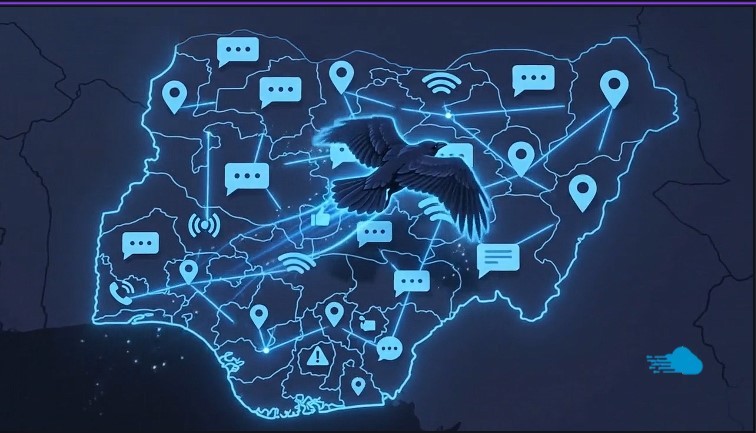
Ravencry-nodes
-
you-are-not-alone
-
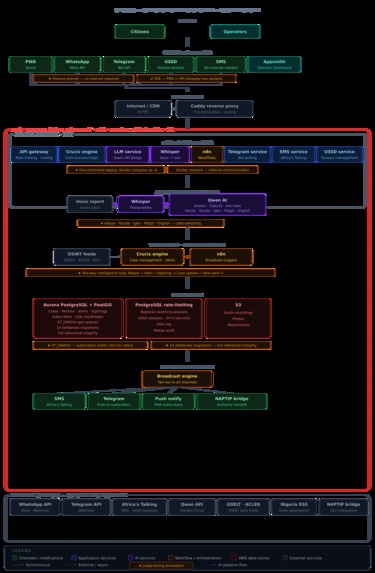
Architecture
Inspiration
In Nigeria, when a child goes missing or a commuter is abducted on the Abuja-Kaduna highway, the first hours matter more than anything else. Nigeria has one of the highest kidnapping rates in Africa. Thousands of cases. No rapid alert system.
Three constraints shaped every decision we made:
1. Any device. Any network. A worried mother in rural Zamfara has a feature phone with no internet, only USSD shortcodes. An urban family in Lagos reports via WhatsApp. A community volunteer uses Telegram. These are not edge cases, they are the audience. Five channels, one pipeline.
2. Five languages, not one. Nigeria speaks Hausa, Yoruba, Igbo, Pidgin, and English, and people code-switch mid-sentence. A system that only works in English fails 80% of the population. We chose Qwen because it handles Nigerian languages better than any other model we tested.
3. It has to ship. This is a working system on cloud infrastructure with Docker Compose, one-command deploys, and a deliberate 15-migration database schema. If it doesn't run, it doesn't help anyone.
The name: ravens are watchful, intelligent, and communicate danger to their flock. That's what this system does.
What it does
RAVENCRY: Real-time AI for Vigilance, Event Notification, and Crisis Response Yielding, is a Nigeria-native, multi-channel, AI-powered anti-kidnapping and missing persons rapid alert platform.
Five citizen reporting channels
| Channel | Technology | Who it serves |
|---|---|---|
| Meta Cloud API (v25.0) | Urban smartphone users | |
| USSD | *384*72836# via Africa's Talking |
Rural feature phones, zero internet |
| Telegram Bot | @ravencry_alert_bot |
Community volunteers, coordinators |
| SMS | Africa's Talking sandbox | Any phone with signal |
| PWA | Next.js 14 on Vercel | Smartphone users, offline-capable |
AI triage in five Nigerian languages
The Qwen-powered LLM service processes reports in Hausa, Yoruba, Igbo, Pidgin, and English, including code-switching:
| Endpoint | Function | Example |
|---|---|---|
| QW-01 Extract | Structured field extraction | "An sace ɗana Ibrahim yana da shekara 9 a Kano" → {name: "Ibrahim", age: 9, location: "Kano"} |
| QW-02 Classify | Severity tiering | Child + high-risk zone → FLASH. Adult + Lagos → ROUTINE |
| QW-03 OSINT | News article analysis | Punch headline → actionable: true, creates draft case |
| QW-04 Anti-fake | Misinformation detection | Trust-by-default, 3+ red flags to hold for review |
OSINT sweep engine (Crucix)
Forked Crucix with 5 Nigeria-specific source modules + 29 global sources running parallel sweeps every 5 minutes: GDELT Nigeria, ACLED conflict data, NAPTIP RSS (10 feeds), Nigerian News RSS (5 feeds), Citizen Reports from Aurora.
Four-channel alert delivery
When a FLASH case is approved, n8n orchestrates parallel broadcast:
- Telegram alert channel, formatted message with photo, case ID, location
- SMS: geofenced batch delivery to subscribers within 160km via PostGIS
ST_DWithin - Web Push: PWA users receive live notifications
- NAPTIP bridge (Mock): CAP-JSON formatted webhook to government coordination
Tier system
- FLASH: Child ≤17, high-risk zone, or weapons involved. Auto-approve in demo mode.
- PRIORITY: Active abduction, adult victim, moderate risk area
- ROUTINE: Lower-risk missing persons, information-gathering
How we built it
Architecture
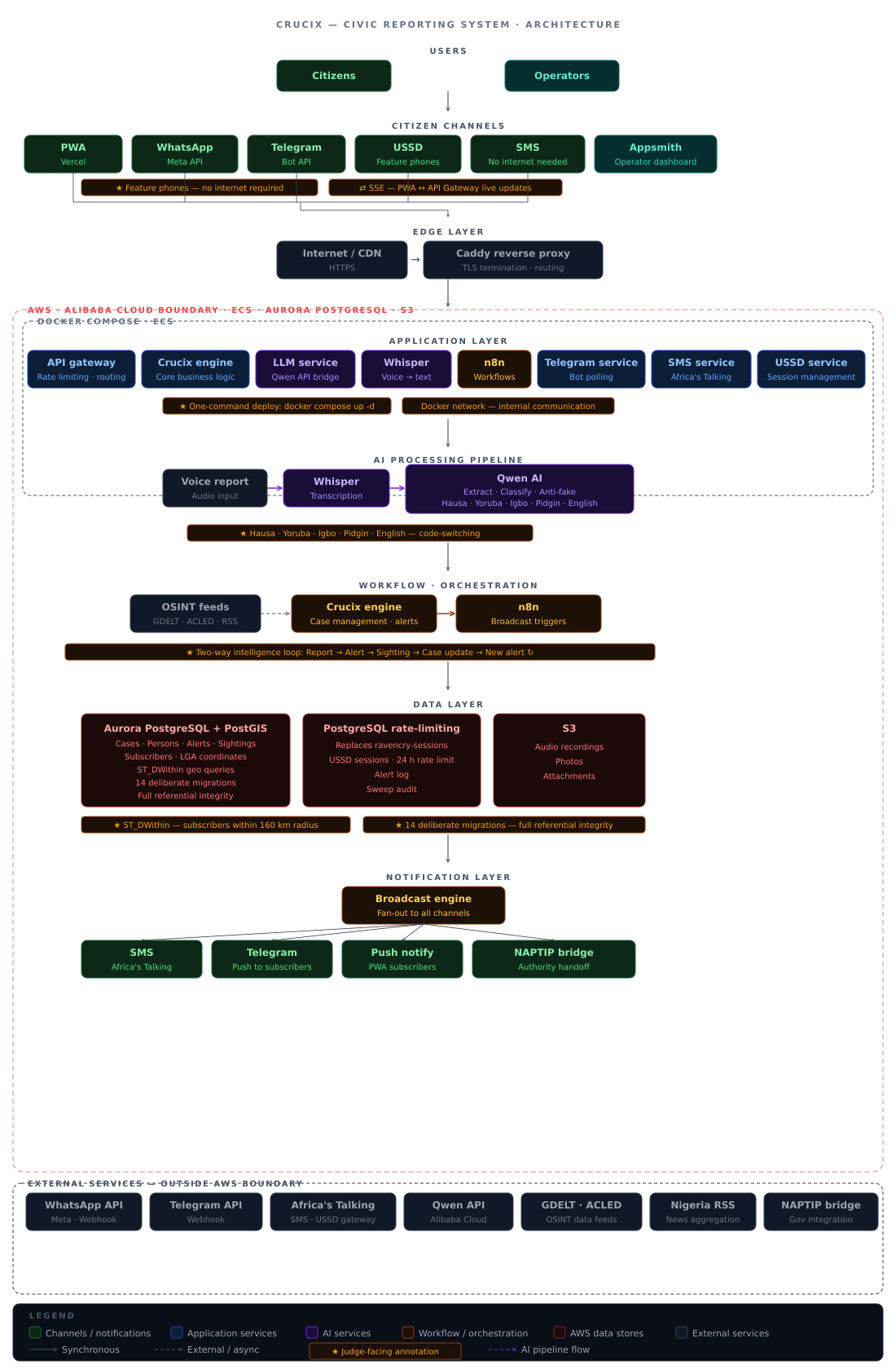
11 Docker containers on Alibaba Cloud ECS, orchestrated via Docker Compose. Caddy reverse proxy with auto-TLS. Aurora PostgreSQL with PostGIS as source of truth. Vercel for the PWA frontend.
Public → Caddy (80/443) → API Gateway (3003) → LLM Triage (3002)
                         → Crucix HUD (3001)
                         → Telegram Bot (3005)
                         → SMS Service (3006)
                         → USSD Handler (3007)
                         → n8n Workflows (5678)
                         → Whisper (8000)
                         → NAPTIP Mock (3008)
         Data Layer: Aurora PostgreSQL · S3
Tech stack
| Layer | Technology |
|---|---|
| AI/LLM | Qwen (qwen-plus, qwen-turbo) via DashScope · Whisper (faster-whisper int8) |
| Backend | Express 4 + TypeScript · 14 API endpoints · Consistent error format |
| OSINT | Crucix (forked) · 34 parallel sources · Delta engine |
| Orchestration | n8n (self-hosted) · 3 workflows (WhatsApp intake, FLASH broadcast, OSINT ingestion) |
| Frontend | Next.js 14 PWA · Tailwind · Leaflet maps · SSE live feed · Offline IndexedDB |
| Database | Aurora PostgreSQL + PostGIS + pg_trgm · 15 migrations · 9 tables |
| Infrastructure | Terraform (IaC) · Docker Compose (11 services) · Caddy (auto-TLS) |
| Integrations | Meta WhatsApp Cloud API · Africa's Talking (SMS/USSD) · Telegram Bot API · GDELT · ACLED |
Data model
15 hand-written SQL migrations. 9 tables: persons, cases, sightings, alerts, subscribers, push_subscriptions, operators, sources, lga_coords. Full referential integrity with foreign keys. PostGIS for geospatial queries (geofencing, LGA proximity). pg_trgm for dedup. Enum types for state machine.
Key design decisions
- LLM-agnostic from day one: provider abstraction supports Qwen, OpenAI, DeepSeek, Gemini
- Trust-by-default: anti-fake defaults to
legitimate(score 0.7). False positives harm victims more than false negatives. - Stateless USSD: completely stateless menu parsing via asterisk-delimited depth. No session storage needed.
- Race condition guard: approval endpoint uses
WHERE status = 'pending'at the database level.
Challenges we ran into
Docker: local dev ≠ production
Multi-stage Docker builds default to the dev target (tsx watch, hot reload). COPY semantics with trailing / copy contents, not the directory. node:22-alpine has no curl for health-checks. npm ci fails when lockfile is stale, had to regenerate on EC2. These all worked locally and broke on deploy.
Caddy plugin limitations
The stock caddy:2-alpine image has no rate_limit plugin. We needed rate limiting on the API gateway. The solution: removed the rate_limit directive and added DNS overrides (dns: [8.8.8.8]) because systemd-resolved is unreachable from Docker containers. Auto-TLS with Let's Encrypt worked correctly once DNS was fixed.
Cross-cloud complexity
We attempted to migrate from AWS to Alibaba Cloud using Terraform and a $40 voucher. Hit Forbidden.RiskControl anti-fraud blocks, Zone.NotOnSale for instance types, and SSH username differences (root not ubuntu). Rolled back to AWS EC2. The Terraform module is saved as a pending fix.
Nigerian language edge cases
Age extraction from Nigerian cultural references, "primary three" ≈ 8 years old, "JSS2" ≈ 13. Location extraction requires LGA-level precision, not just city names. "Child" must be defined as ≤17 per Nigerian legal context. Each of these required explicit examples in the prompts.
n8n networking in Docker
n8n containers can't reach localhost on the host, they need host.docker.internal. The WhatsApp intake workflow (WF-01) depends on 3 internal services (Whisper, Qwen LLM, API Gateway), and each connection required Docker network debugging.
Phone encryption gap
The design calls for AES-256-GCM phone encryption with KMS. decryptPhone() was never implemented, we used sandbox workarounds for testing. This is the #1 production blocker and the highest-priority security item post-hackathon.
Schema drift across four surfaces
The database schema exists in four places: TypeScript types, migration files, the running Aurora instance, and the design document. When they drift, Aurora is the authority. We learned this the hard way when clothing_desc vs clothing_description caused silent mismatches.
dotenv comment parsing
The dotenv parser treats inline comments as values. An empty LLM_MODEL= followed by # (optional) became the literal string # (optional) override default model, causing silent failures. The fix: truly empty values, nothing after the =.
Accomplishments that we're proud of
1. Five Nigerian languages, working
The AI pipeline correctly extracts structured fields and classifies severity across Hausa, Yoruba, Igbo, Pidgin, and English, including code-switching like "My pikin don disappear, a ganshi a Kasuwan." Qwen was the clear winner among all models tested (GPT-4o, DeepSeek V3, Gemini 2.5 Pro) for Nigerian language handling.
23 AI tests, 0 errors.
2. Full end-to-end pipeline verified
Test T-060: USSD report → pending_triage → Qwen FLASH classification → operator approval → n8n WF-02 → all 4 channels delivered: Telegram ✅, SMS ✅, NAPTIP ✅, Push (0 subscribers). Complete pipeline works.
Test T-061: Hausa text → WhatsApp intake → Qwen extract (language_detected: "hausa") → Qwen classify (FLASH) → Aurora (language='ha', input_channel='whatsapp') → Meta reply. Verified end-to-end.
3. Trust-by-default design
Every friction point that prevents hoaxes also prevents legitimate reports. Our anti-fake system defaults to legitimate (0.7 score). It takes 3+ red flags to hold for review. Infrastructure failure → defaults to legitimate. A citizen in Katsina with a feature phone shouldn't need to solve a CAPTCHA to report a missing child.
4. Shippable, not a prototype
- 11 Docker services, one command to deploy:
docker compose up -d - 15 deliberate SQL migrations, not a generated schema
- 14 API endpoints with consistent error format, rate limiting, and database-level race condition guard
- Monorepo with shared TypeScript types across all services
- Terraform infrastructure-as-code for reproducible deployment
- 5 live subdomains: api, crucix, n8n, ops, and the main PWA
5. USSD for the unconnected
A completely stateless USSD handler using asterisk-delimited menu depth parsing. No session storage needed. Fail-open rate limiting (3 reports/phone/24h). Four branches: report missing person, report sighting, check alerts, subscribe/unsubscribe. This serves rural communities where smartphones aren't common and internet is unreliable. 38 USSD tests, all passing.
6. 97 tests across 7 services
| Service | Tests |
|---|---|
| LLM Triage | 23 tests (5 languages, classification, OSINT, anti-fake) |
| USSD Handler | 38 tests (handler + menu rendering) |
| Telegram Bot | 21 tests (templates, commands, broadcast) |
| SMS Service | 15 tests (templates, length constraints) |
| Total | 97 tests |
7. LLM-agnostic architecture
A 30-minute abstraction that paid off for the entire project. One llm service with provider abstraction supporting Qwen, OpenAI, DeepSeek, and Gemini. Swap one env var to change providers.
What we learned
1. Docker hides bugs from local dev
Multi-stage build targets, COPY trailing-slash semantics, missing curl in Alpine, stale lockfiles, dotenv comment parsing, these all worked on localhost and failed on EC2. The pattern: local dev is not production, and Docker is a compiler with its own rules.
2. LLM-agnostic from day one was the right call
A 30-minute abstraction gave us vendor flexibility for the entire project. When we needed OpenAI for comparison testing, it was one env var. When Qwen proved superior for Nigerian languages, we switched back.
3. Teaching machines Nigerian languages requires explicit patterns
Five pattern discoveries: (1) tell the model what languages to expect explicitly, (2) protect proper nouns, don't normalize Nigerian place names, (3) null is better than hallucination, use temperature: 0.1, (4) Pidgin is not broken English, needs its own glossary, (5) list transliteration variants ("an sace", "an yi garkuwa", "an kama").
4. Schema authority must be singular
When the schema exists in TypeScript types, migration files, running Aurora, and design docs, drift is inevitable. The rule: the database is the authority. All types derive from what's in Aurora.
5. n8n is both a superpower and a constraint
Visual workflows are "demo gold", proving complex orchestration without writing orchestration code. But n8n-in-Docker networking (host.docker.internal), webhook authentication (shared secret), and workflow export/import are all friction points. For production, n8n's webhook-based orchestration would need circuit breakers and retry logic that the visual editor doesn't expose.
6. Infrastructure-as-code doesn't prevent cloud-specific failures
Terraform correctly modeled the Alibaba Cloud deployment. But Forbidden.RiskControl anti-fraud throttling, Zone.NotOnSale instance availability, and SSH username differences (root not ubuntu) are runtime failures that Terraform can't predict. IaC gives reproducibility, not immunity from cloud provider quirks.
7. Trust-by-default is a design philosophy, not just a feature
False positives cost trust. False negatives cost lives. Every design decision, anti-fake defaults, rate limiting that fails open, anonymous reporting, unauthenticated alert feed, flows from this. Security and safety in conflict zones are not the same as security in Silicon Valley.
8. PostGIS in the database beats geofencing in application code
Subscriber geofencing is a one-line SQL query: ST_DWithin(subscribers.coords, cases.coords, 160000). Doing this in application code would require loading all subscribers and computing Haversine distances. PostGIS does it at the database level, indexed, in milliseconds.
What's next for Ravencry
Immediate (Week 1: production blockers)
- Implement
decryptPhone()with AWS KMS, the #1 security gap preventing real SMS delivery - IP whitelist crucix, n8n, and ops subdomains in Caddyfile
- JWT authentication on operator endpoints: replace
api_keyheader - Circuit breaker on Africa's Talking SMS: 3 consecutive failures → skip SMS, alert ops channel
- Complete n8n workflows: build and export WF-01 and WF-02 from n8n editor
- Deploy PWA to Vercel with live API URL
Short-term (Weeks 2–8 | V2 core)
- Facial recognition: InsightFace embeddings on sighting photos for cross-referencing
- License plate recognition: toll gate and traffic camera feeds
- Radio/TV broadcast integration: NTA, Channels TV API
- Case deduplication algorithm: pg_trgm fuzzy matching across reports
- Full Yoruba + Igbo UI translation: English and Hausa already done in PWA
Medium-term (Months 3–6 | V2 complete)
- Predictive hotspot modeling: historical incident heatmaps for proactive alerts
- Offline solar edge nodes: Raspberry Pi + Node-RED for rural connectivity
- CCTV camera network federation: opt-in private camera feeds (filling stations, banks)
- Cross-report correlation: linking related cases by location, timing, and descriptions
- Reporter credibility tracking: trust scoring for anonymous vs verified reports
- Anti-fake reverse image search: Google Vision / TinEye integration
Long-term (Months 7–24+ | V3 vision)
- Highway monitoring: Abuja-Kaduna corridor as the pilot
- Telecom CDR movement anomaly detection: with carrier partnerships
- Satellite imagery for forest camp detection in vulnerable corridors
- Drone aerial feeds: thermal imaging for search missions
- Cross-border ECOWAS expansion: harmonized alert protocols across West Africa
- Banking app alert partnerships: GTBank pilot, push alerts through banking apps
- Community vigilante integration: Amotekun, Civilian JTF Telegram channels
- Public safety API (B2B): insurance data layer, commercial integrations
- Automated drone deployment from self-deploying satellite-linked ground stations for 24/7 search missions over Nigeria's vulnerable corridors
Partnerships needed
- Mobile Network Operators: zero-rate USSD shortcodes (MTN, Glo, Airtel, 9mobile)
- Government: NAPTIP (official bridge, not mock), Nigeria Police Force, NDPC (data protection compliance under NDP Act 2023)
- Media: Channels TV, NTA, Punch, Vanguard for broadcast integration
- Community organizations: Amotekun, Civilian JTF, local vigilante groups
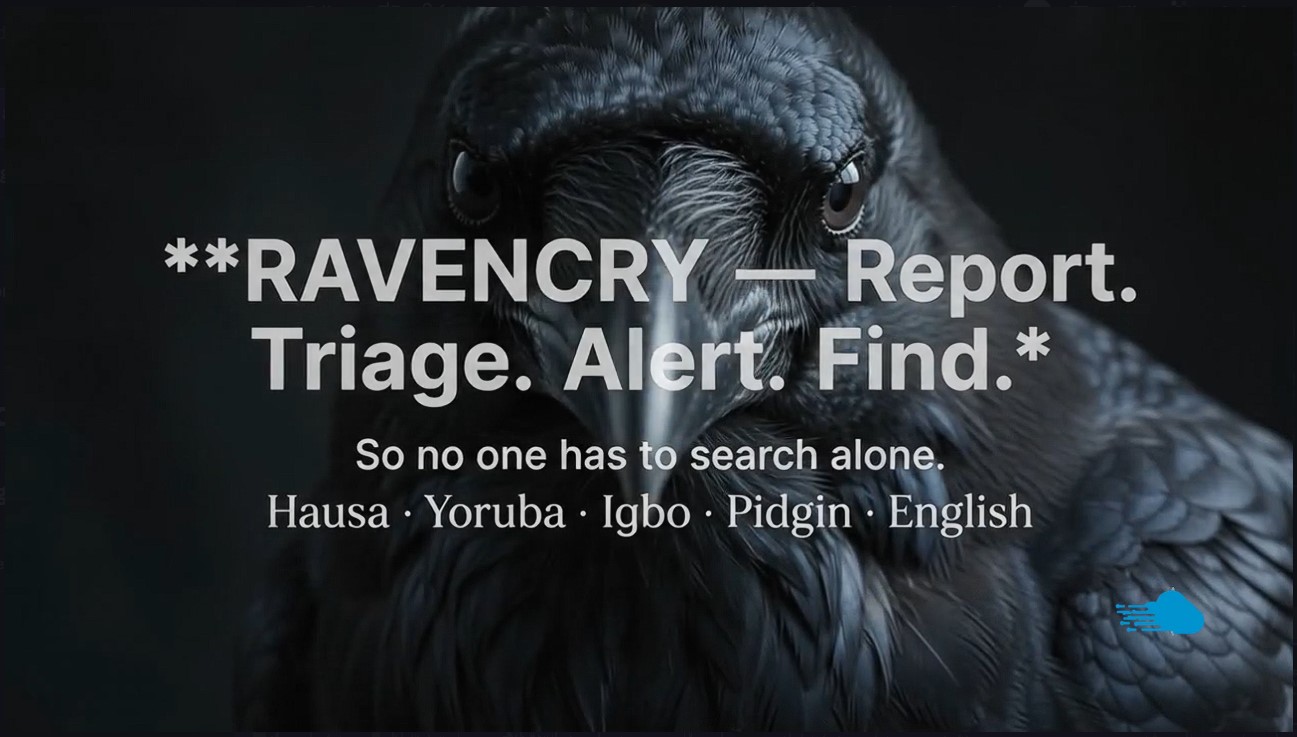
RAVENCRY: Report. Triage. Alert. Find. So no one has to search alone.
Hausa · Yoruba · Igbo · Pidgin · English
Built With
- africastalking
- alibaba-cloud
- amazon-web-services
- caddy
- docker
- docker-compose
- express.js
- n8n
- next.js
- node.js
- openai-api
- openai-whisper
- postgis
- postgresql
- progressive-web-app
- python
- qwen
- react
- tailwindcss
- telegram-bot
- terraform
- typescript
- vercel


Log in or sign up for Devpost to join the conversation.