Inspiration
More than 15% of America's war heroes come home with PTSD every year. Recovering is a long and difficult journey with one of the biggest challenges being monitoring. Moreover our work on Raven was inspired by a study showing that algorithms could be used to detect dementia in the writings of dead authors without ever needing to step foot into a doctors office (ftp://ftp.cs.toronto.edu/pub/gh/Lancashire+Hirst-extabs-2009.pdf). There have also been other tractable attempts at leverage similar alternative data sources for diagnostics such as the android app built for a research study at University of Michigan that uses speech data to highlight onsets of manic episodes in bipolar patients (http://techcrunch.com/2014/07/24/your-smartphone-will-soon-know-if-you-have-bipolar-disorder). Using Facebook as our language corpus we developed an integrated diagnosis cloud to help doctors visualize, understand, and leverage this underutilized form of mental health data. Our ultimate goal is to expand Raven to use data from the human genome and microbiome.
What it does
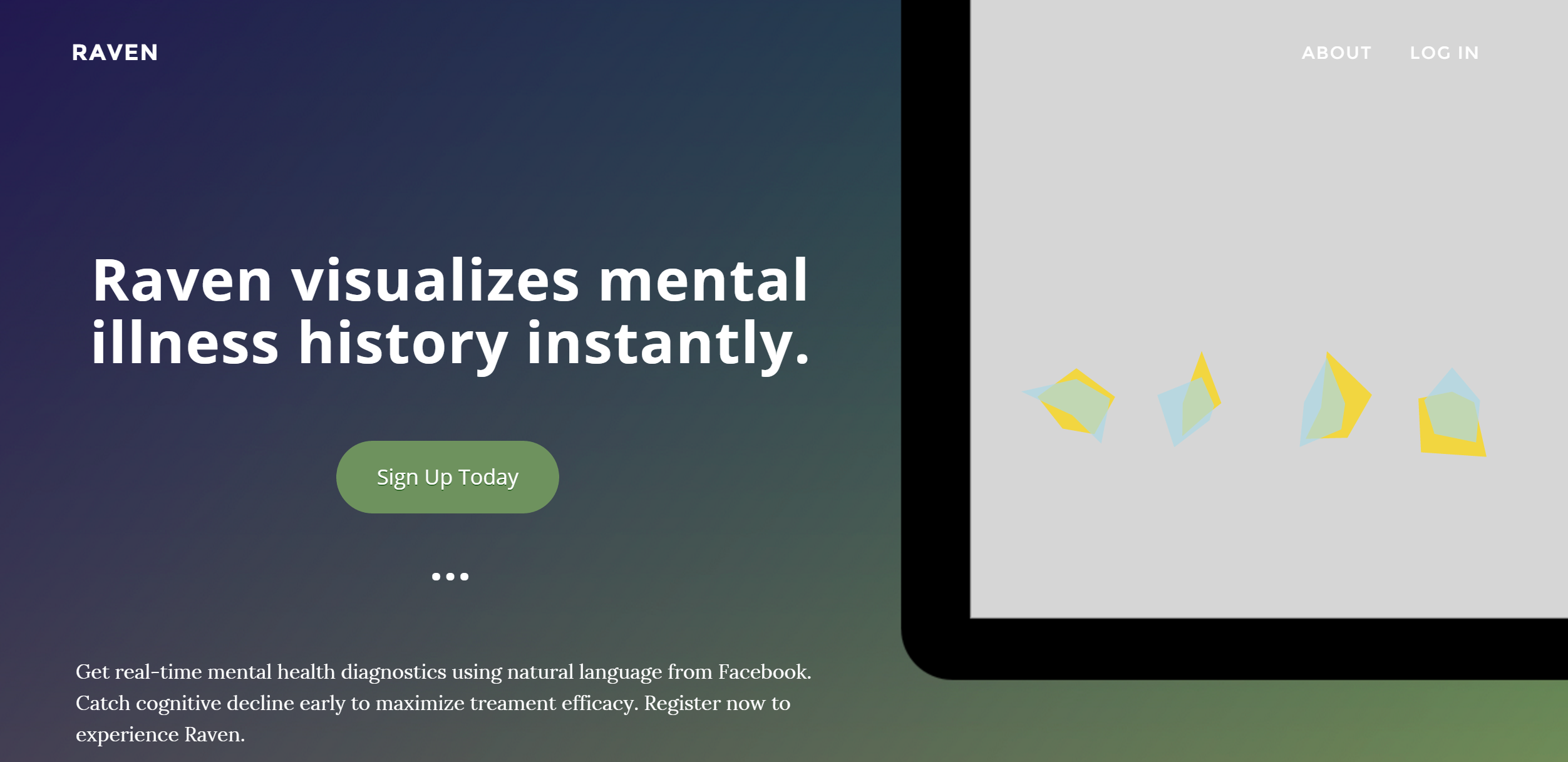
Raven assesses and monitors mental health by analyzing the syntax, lexical choices, and user behavior of patients. Using pre-trained sentiment and topic models our radically simple interface maps out an interface directly from the raw text written in real-time by the patient. 24/7 access and ADA-compliant accessibility ensures that Raven is always there when you need it.
How we built it
We built Raven using the Node.JS framework, Facebook API, D3, and MongoDB, and pre-trained machine learning models.
What's next for Raven
Raven will continue to learn and become more accurate as it gains access to more data. We hope to bring this app to full fruition and help millions of mental health victims. Once we have built up a corpus at critical mass we will look to make intelligent joins with genome and microbiome data to form the world’s most holistic health care product.


Log in or sign up for Devpost to join the conversation.