-
-
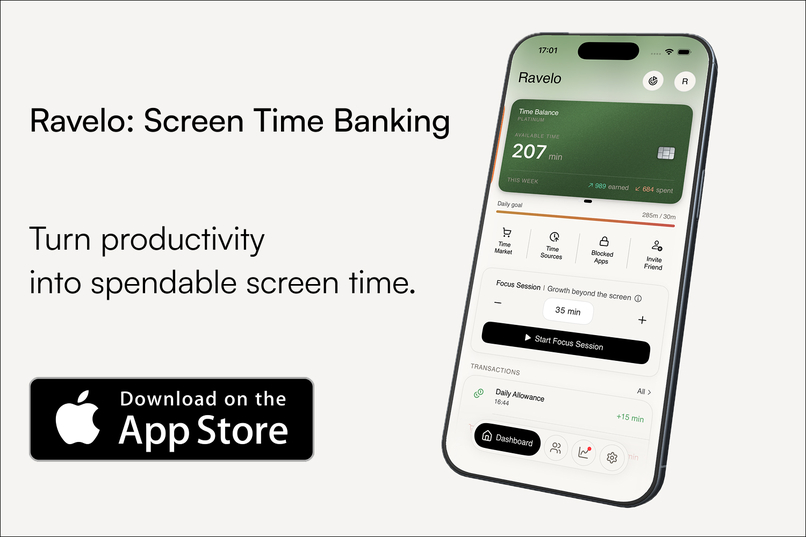
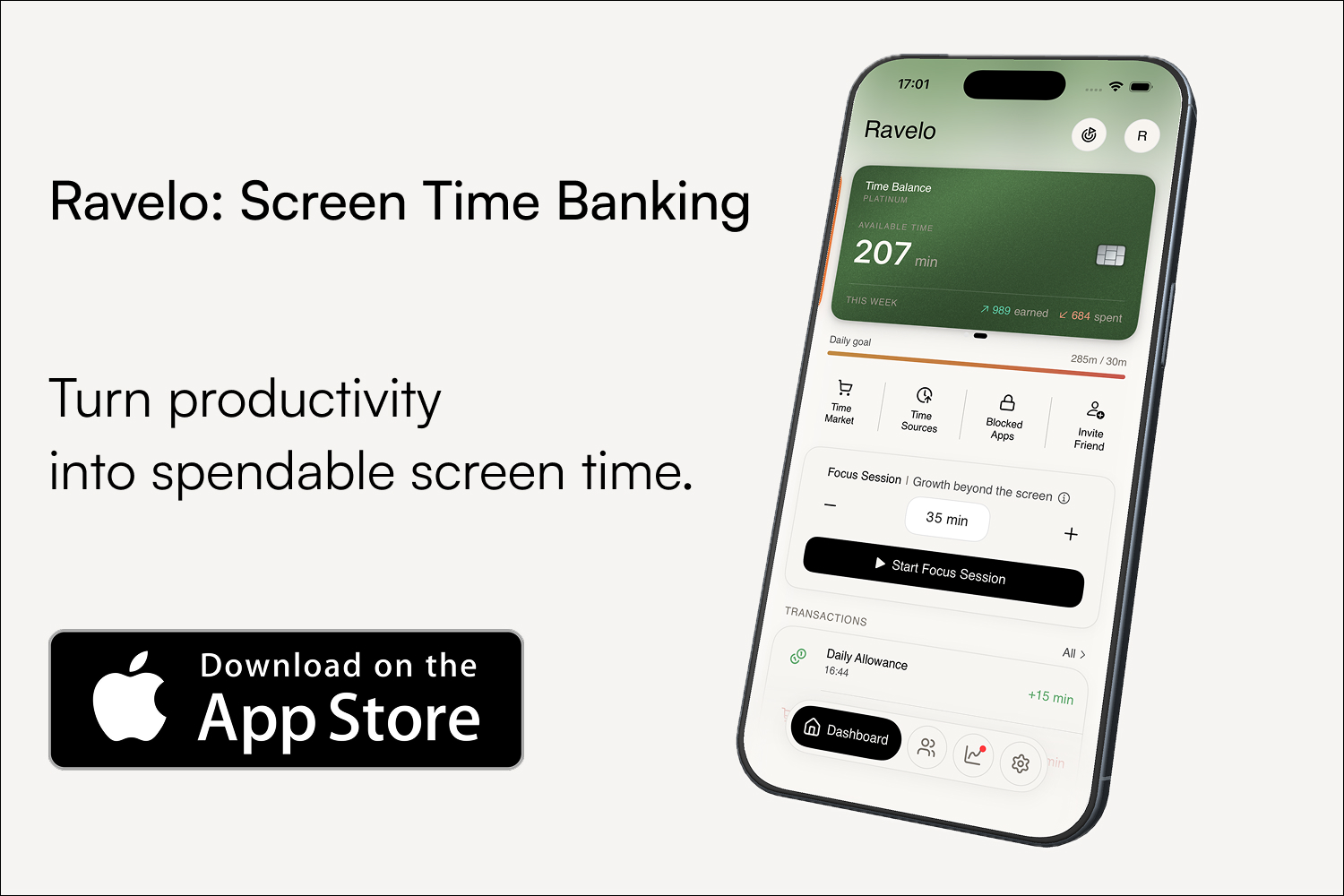
Ravelo turns productive time into a currency you can spend on the apps you enjoy.
-
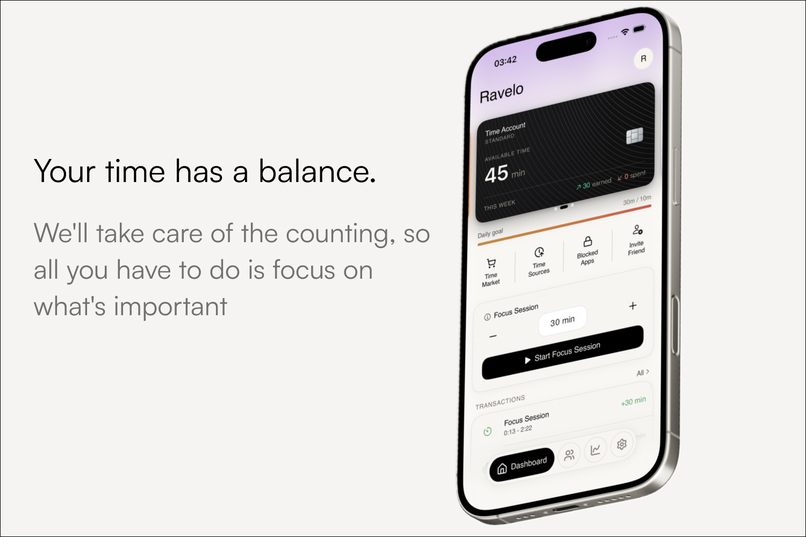
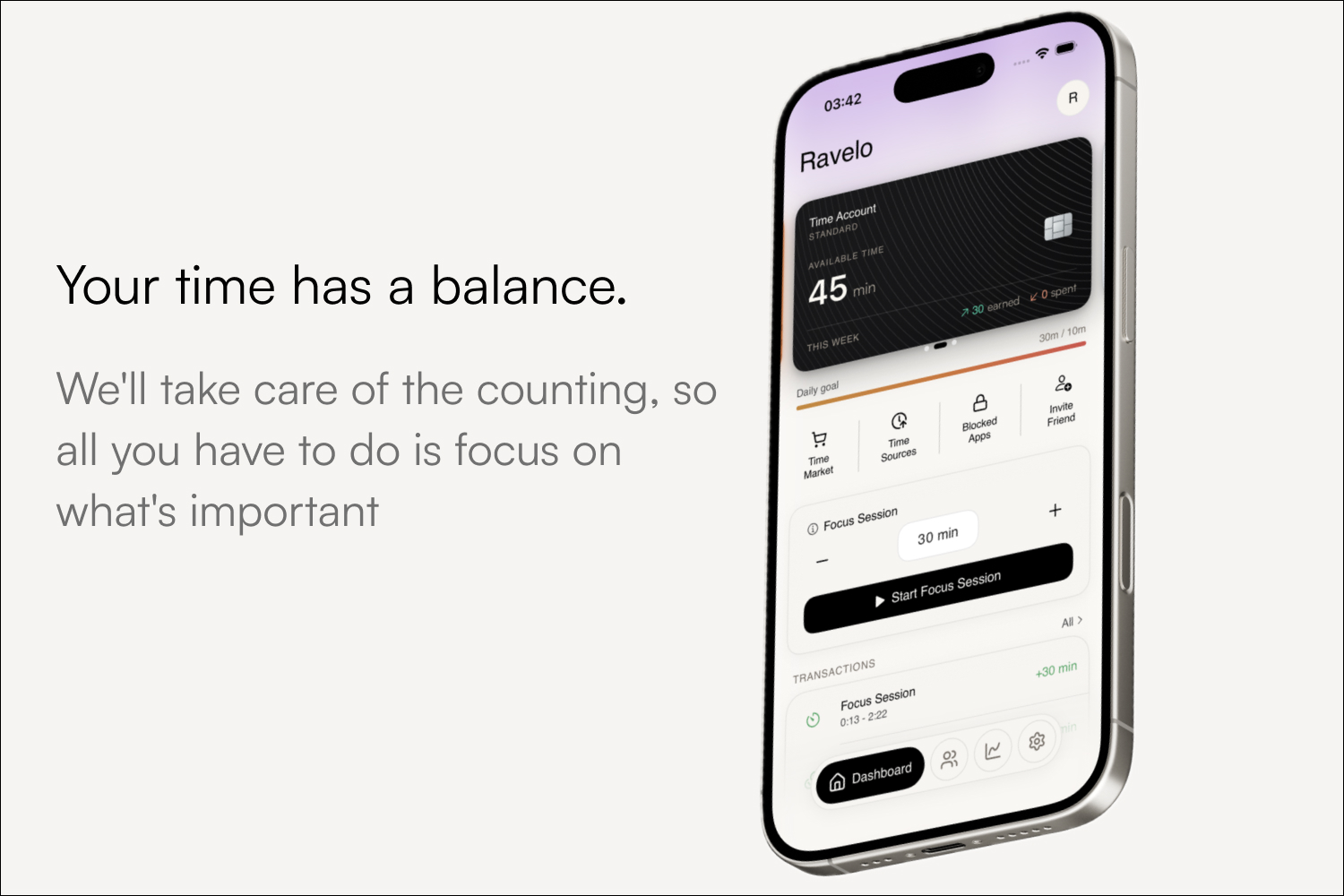
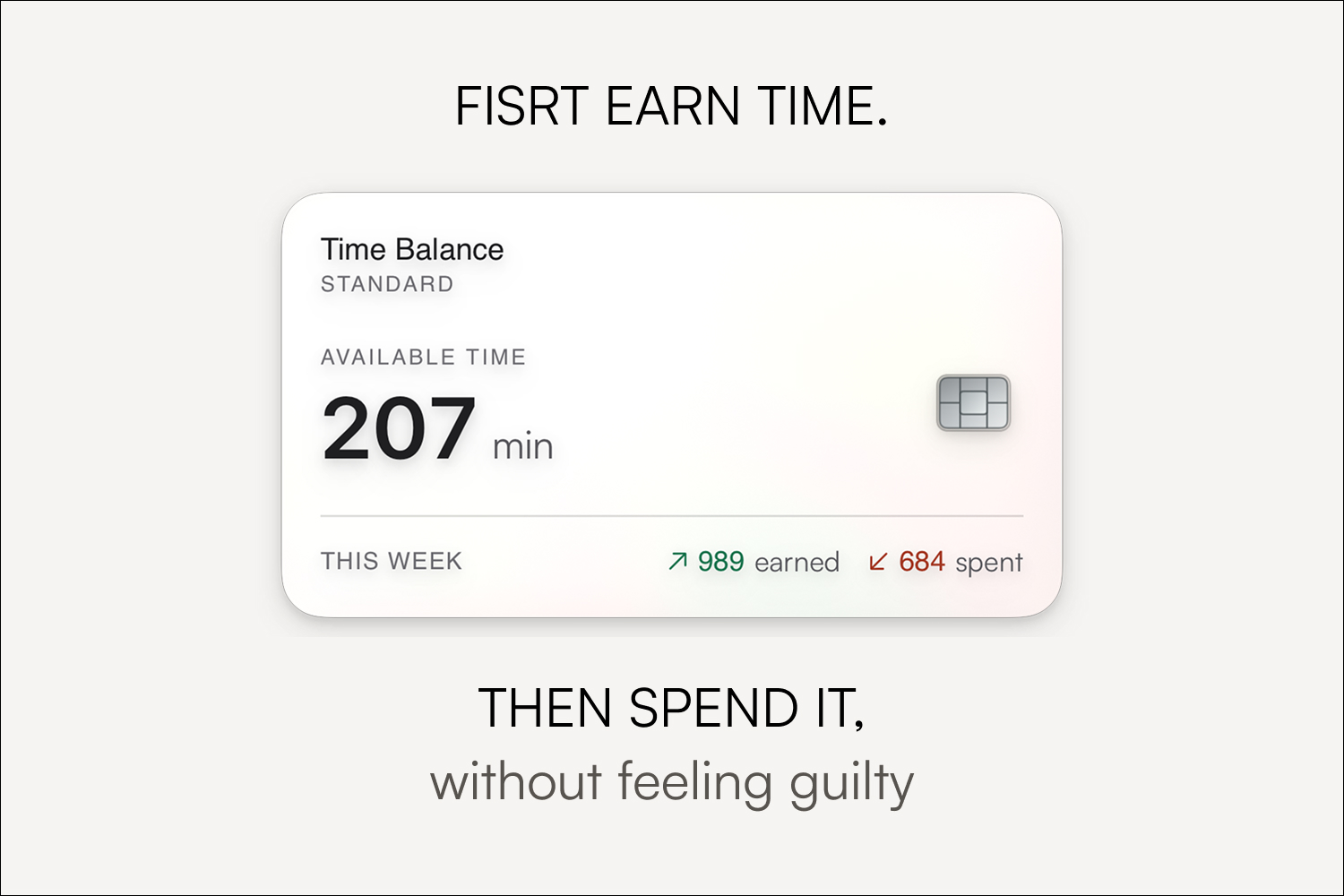
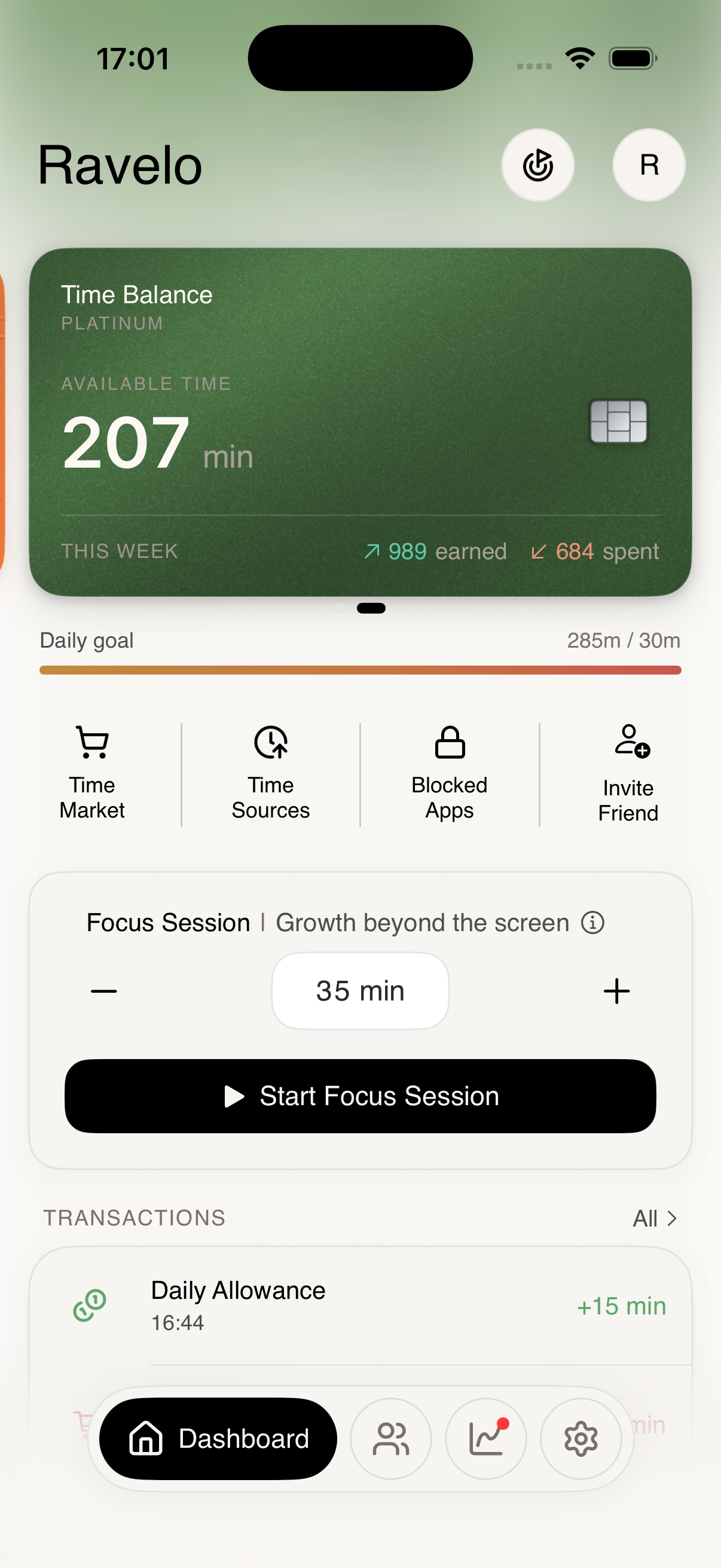
Your Time Account keeps track of every minute you earn and spend, automatically.
-
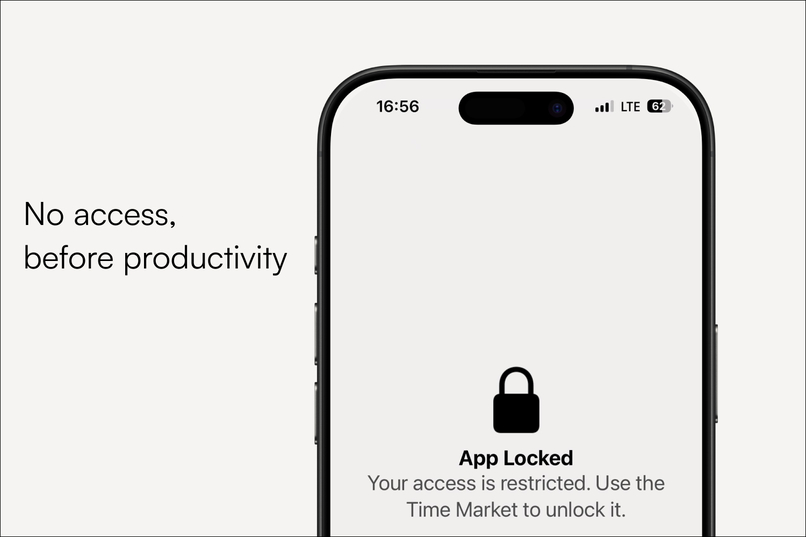
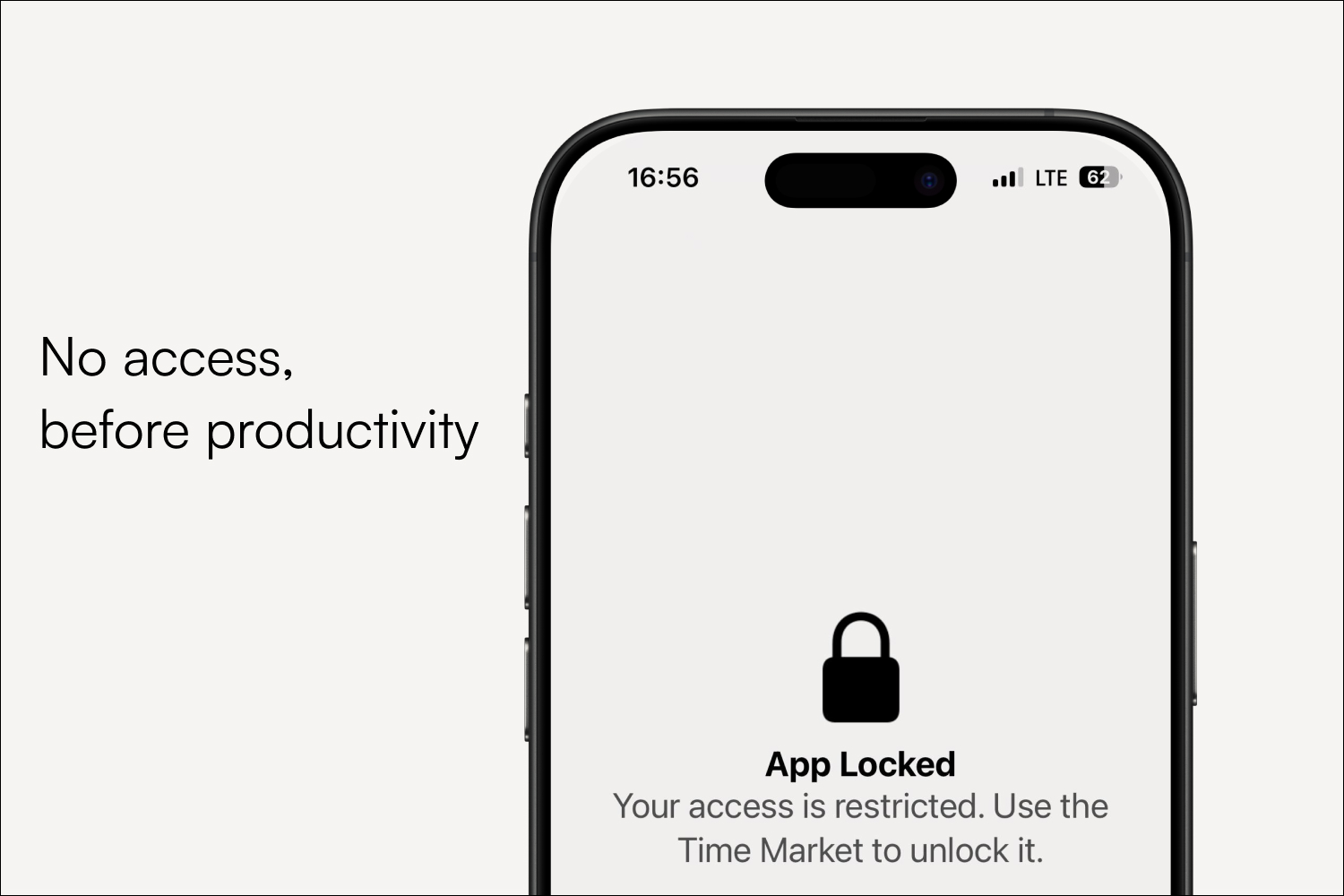
Distracting apps stay locked until you have earned enough time to unlock them.
-
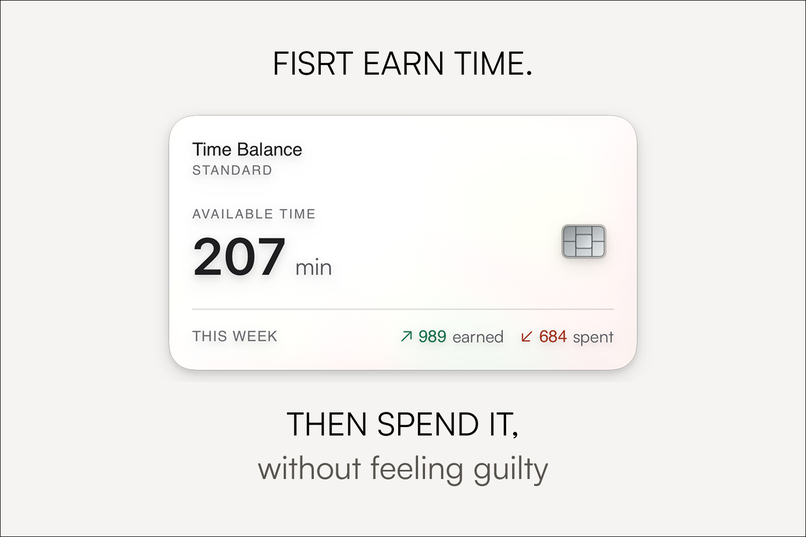
Earn time first, then spend it without guilt — your balance makes every minute intentional.
-
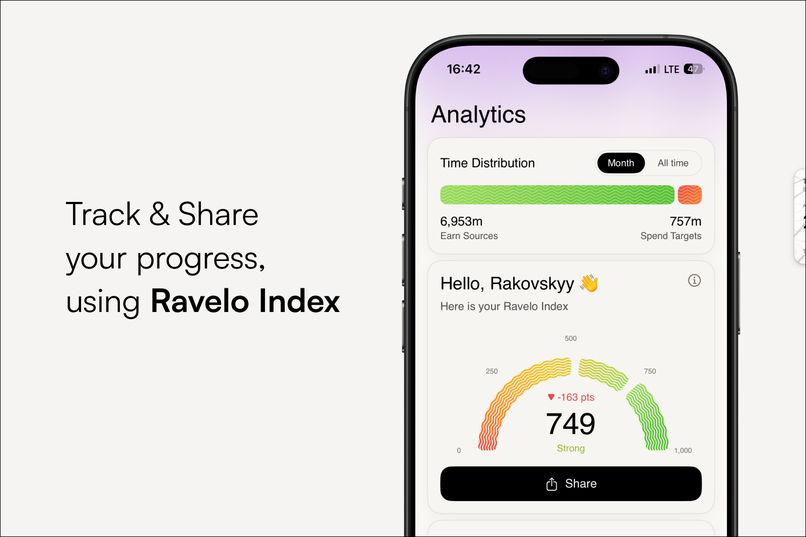
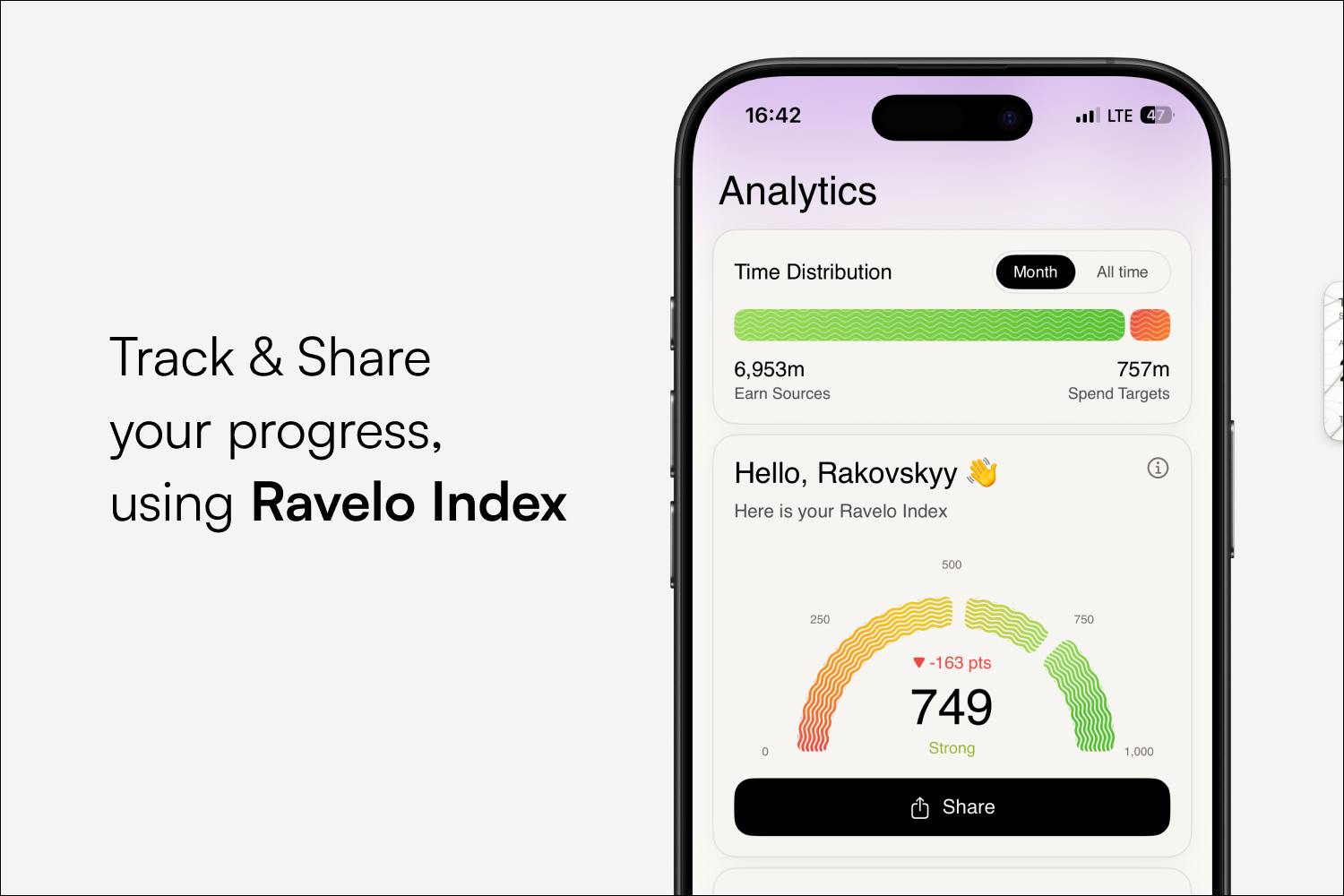
Ravelo Index helps you track how consistently you earn, spend, and protect your time.
-
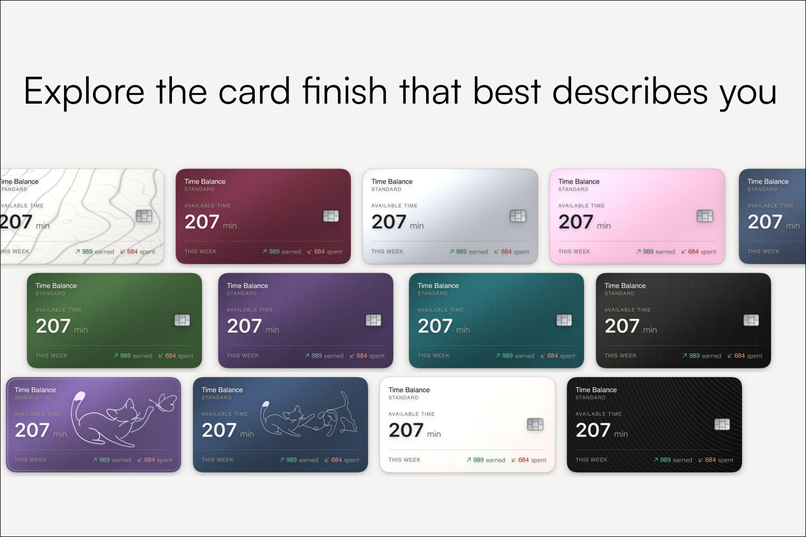
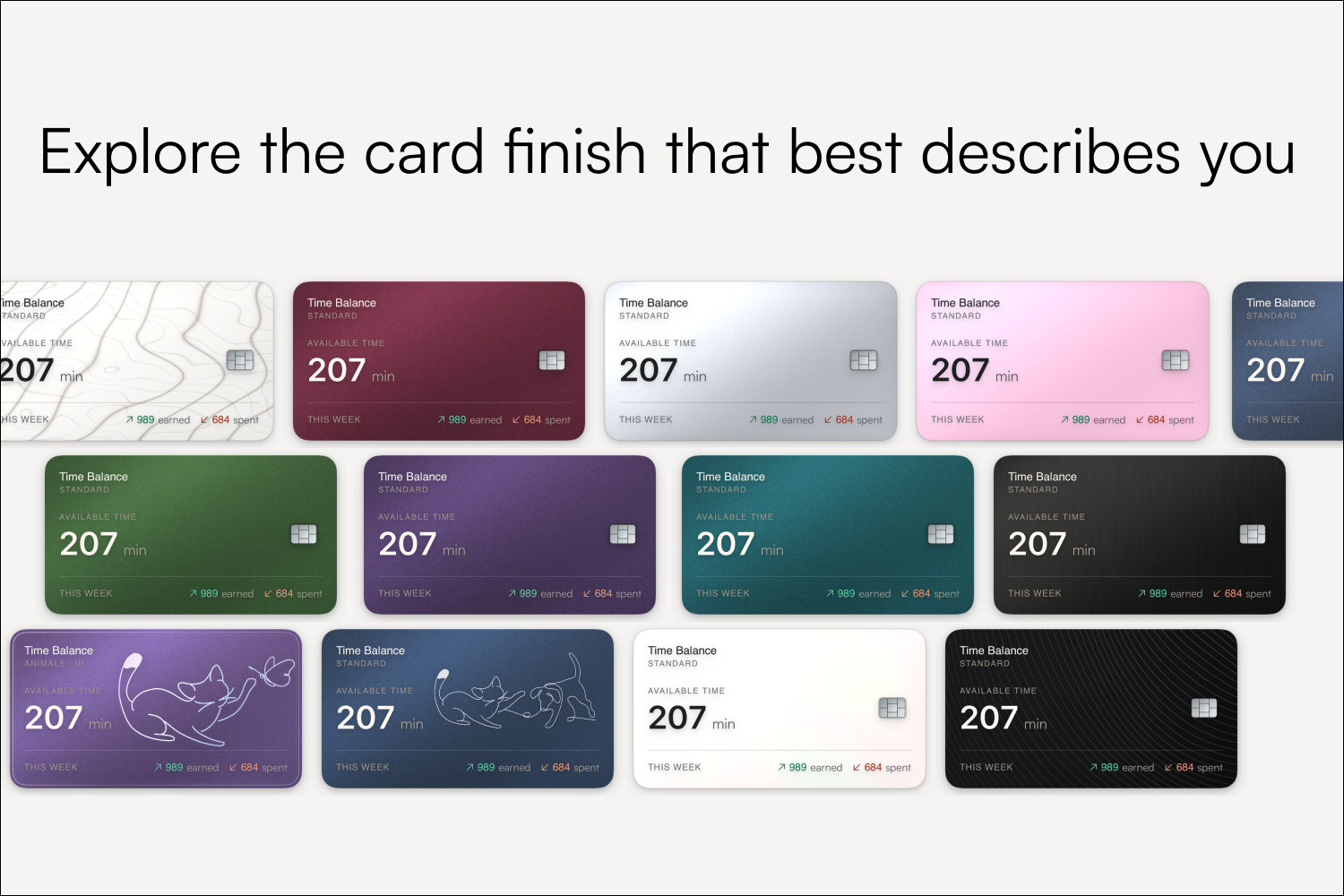
Personalize your Time Account with card finishes that make the experience feel uniquely yours.
-
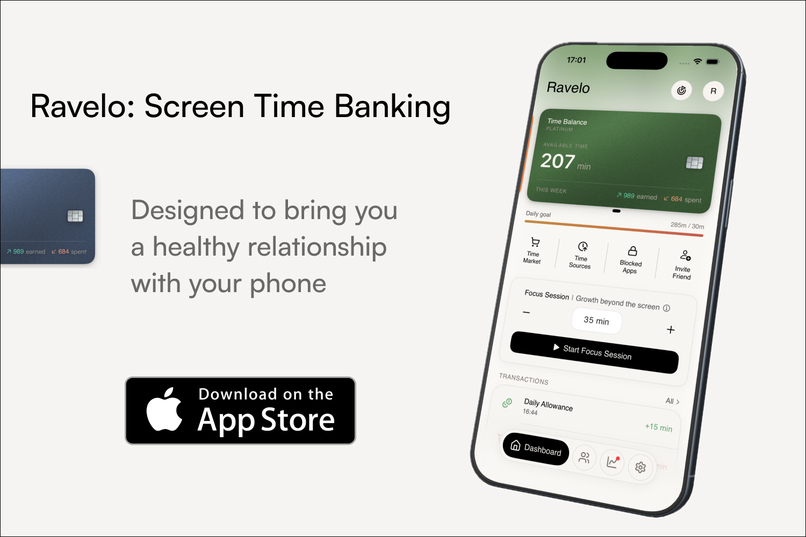
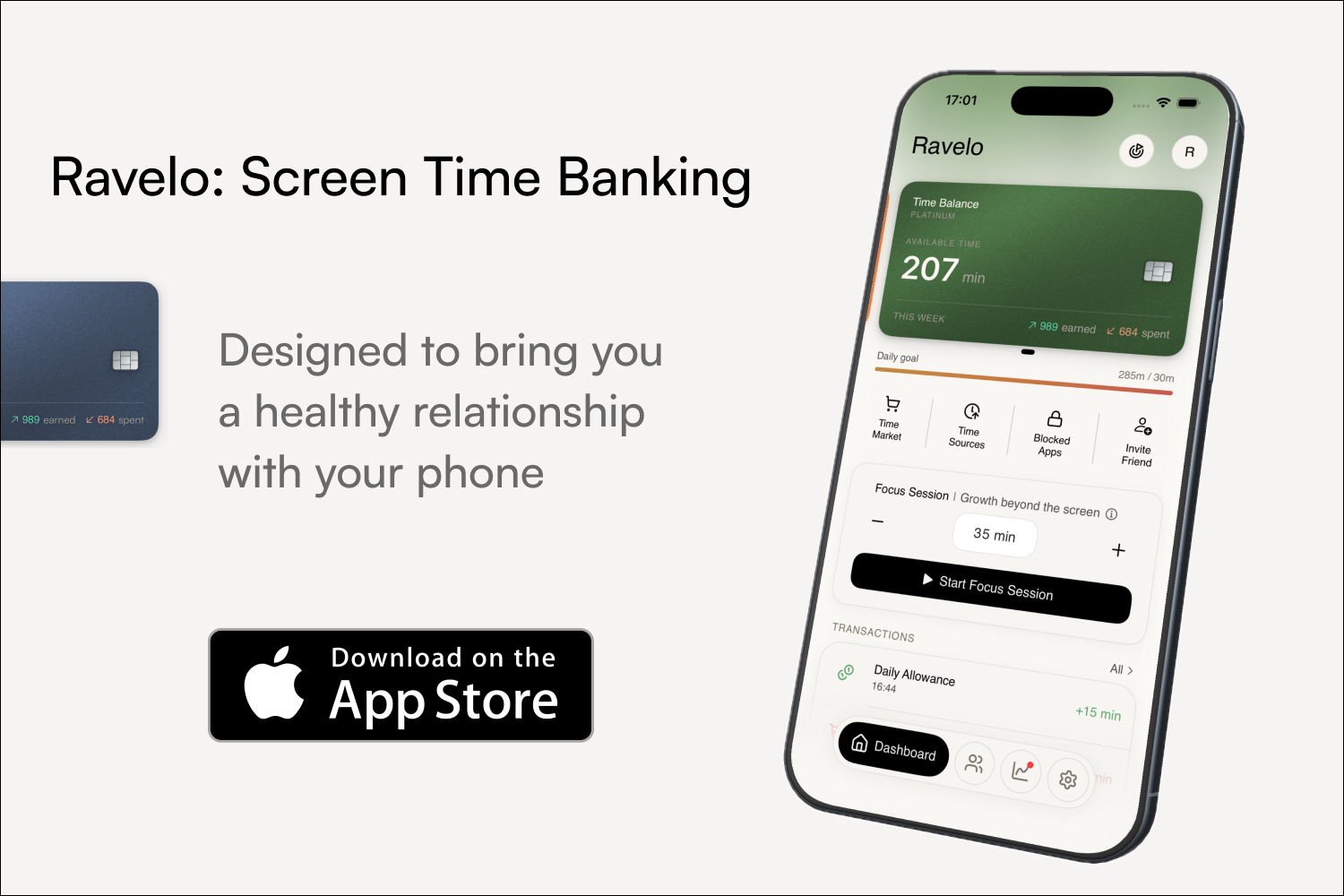
A different approach to screen time: less restriction, more intention, and a healthier relationship with your phone.
-
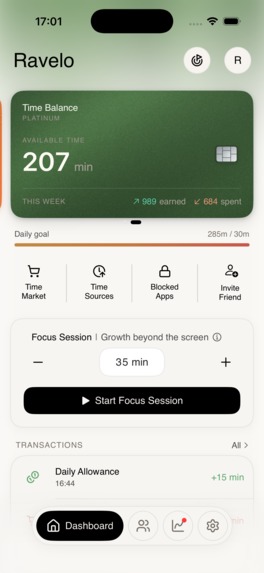
Interface without phone frames
-

App icon
Inspiration
Most screen-time tools are built around the same idea: restriction. Set a 30-minute limit. Start a focus timer. Block an app. Ignore the warning. Add five more minutes. Repeat tomorrow. The more we looked at this pattern, the more it felt like the problem wasn't that people didn't know they were spending too much time on their phones. The problem was that traditional tools kept asking them to make the same decision over and over again. We wanted to change that relationship completely. Money already has a simple mental model: you earn it, save it, and decide what is worth spending it on. We started wondering:
What if time worked the same way?
What if opening Instagram wasn't controlled by an arbitrary daily limit, but by time you had already earned? That question became Ravelo. Instead of treating screen time as something that must constantly be taken away, we wanted to make productive time feel tangible — something you could earn, bank, and intentionally spend.
What it does
Ravelo turns screen time into a small personal economy. Users choose distracting Leisure Apps such as social media, games, or entertainment. Those apps stay blocked until the user has time available to spend. Time can be earned in two main ways:
- by completing Focus Sessions for offline work, studying, reading, or other activities;
- by spending time inside selected Growth Apps that the user considers productive.
The earned minutes are deposited into a Time Account.
From there, the user decides when those minutes are worth spending. They can use their balance to unlock Leisure Apps, and when the purchased time runs out, access is automatically restricted again.
The loop is simple:
Earn - Bank - Spend - Repeat
Instead of asking "How long should I block Instagram today?", Ravelo changes the question to:
"Have I earned the time I want to spend?"
That small change is the core of the product.
How we built it
Ravelo is built natively for iPhone using Swift and SwiftUI. At the system level, we use Apple's Screen Time APIs — including FamilyControls, ManagedSettings, and DeviceActivity — to control access to selected applications while respecting the privacy constraints of iOS. The challenging part wasn't simply blocking an app. It was building an economy on top of those system capabilities. Ravelo has to keep track of earned time, spending, active unlock periods, focus sessions, productive app activity, and restrictions while different parts of the application and Screen Time extensions operate independently. A large part of the work has been making fairly complex system behavior feel simple. The user should never have to think about Screen Time APIs, extensions, background execution, or synchronization.
They should only see: I earned 30 minutes. I have 30 minutes in my account. I can decide whether they are worth spending.
Challenges we ran into
iOS intentionally places strong restrictions around Screen Time functionality, and those constraints shaped almost every part of Ravelo. Screen Time extensions run separately from the main application. Background execution is limited. Application selection is privacy-preserving. Timers cannot simply depend on the app remaining alive. That meant seemingly simple features — like subtracting exactly the right amount of time from a balance and immediately restoring a restriction when that balance reaches zero — required much more careful state management than they appear to on the surface. We also discovered that the hardest challenges weren't only technical. We were introducing a mental model users hadn't seen in a screen-time app before.
People already understand blockers, limits, and timers.
A Time Account, earning minutes, banking them, and spending them is different.
So a significant part of building Ravelo became a design challenge: how do you introduce a new behavior without making it feel complicated? We went through many iterations of the dashboard, onboarding, terminology, blocking experience, Time Account, and earning mechanics before the product started feeling like one coherent system rather than a collection of productivity features.
Accomplishments that we're proud of
The thing we're most proud of isn't an individual feature. It's that Ravelo now has its own behavioral model. We started with an uncomfortable question about why traditional screen-time limits are so easy to ignore and turned it into a working system where productivity becomes income and entertainment becomes spending. The banking metaphor now runs throughout the entire product — from earning minutes to the Time Account to spending that balance on leisure.
We're also proud that this isn't only a concept or prototype. Ravelo has gone through hundreds of development iterations and is now a real product available to iPhone users. Building it meant combining native iOS technologies, Screen Time APIs, subscriptions, multiple extensions, persistent state, and a completely new interaction model into something that should feel almost obvious when you use it. That simplicity took a lot of complexity underneath.
What we learned
The biggest lesson was that changing behavior isn't necessarily about making restrictions stronger. Sometimes it is about changing the value system around the behavior. A traditional blocker says:
"You can't use this."
Ravelo tries to say:
"You can — but decide whether it is worth what you earned."
That distinction influenced almost every product decision we made. We also learned that when you introduce a new mental model, explanation matters enormously. Features that seemed completely intuitive to us after months of development were unfamiliar to someone opening Ravelo for the first time. That pushed us to simplify language, reduce decisions, and make the core loop visible throughout the product. And technically, building deeply around Apple's Screen Time framework taught us to design around system constraints rather than constantly fighting them. The restrictions of the platform ultimately pushed Ravelo toward a more automatic experience — one where users don't need to repeatedly start blockers or manually police themselves.
What's next for Ravelo: Screen Time Banking
Ravelo started with one idea:
What if time could behave like money?
We think there is much more to explore inside that idea. The Time Account can become more than a balance. We want to continue developing systems that help users understand how they earn, protect, and spend their attention over longer periods of time. That includes richer insights into time habits, stronger long-term goals, new ways to earn time, and mechanics that reward consistency rather than short bursts of motivation. We also want Ravelo's economy to extend beyond a single device over time. But the principle will remain the same.
We don't want to build the strictest app blocker. We want to build an alternative to the traditional idea of screen-time restriction — a system where attention feels valuable because your time has to be earned before it can be spent.
Built With
- familycontrols
- posthog
- revenuecat
- swift
- swiftui
- testflight
- uikit


Log in or sign up for Devpost to join the conversation.