-
-
RationAI
Inspiration
800 million Indians depend on the Public Distribution System. Most of them cannot answer three basic questions: What am I entitled to? When will it arrive? What do I do when it doesn't?
The information exists. It lives inside government portals built for administrators — not for the woman in rural Gujarat who needs her ration card linked, or the elderly man who hasn't received his quota in three months and doesn't know where to complain.
We asked one question: what happens when you point AI at that problem?
What it does
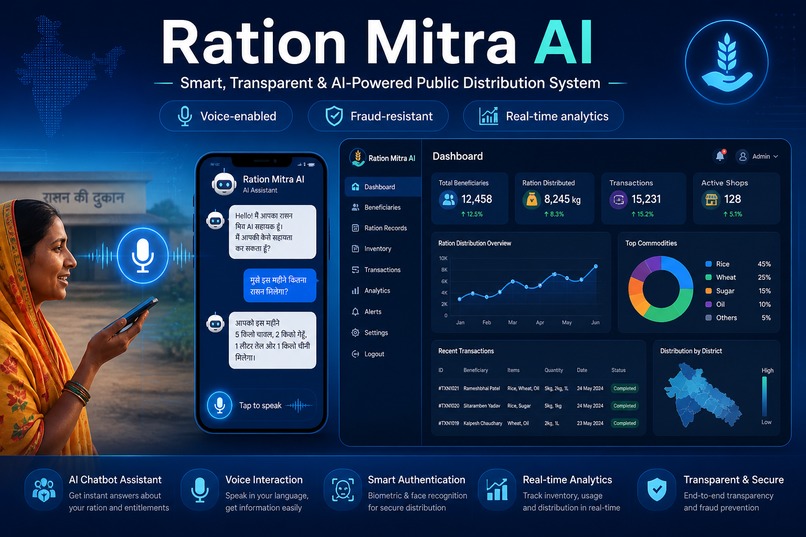
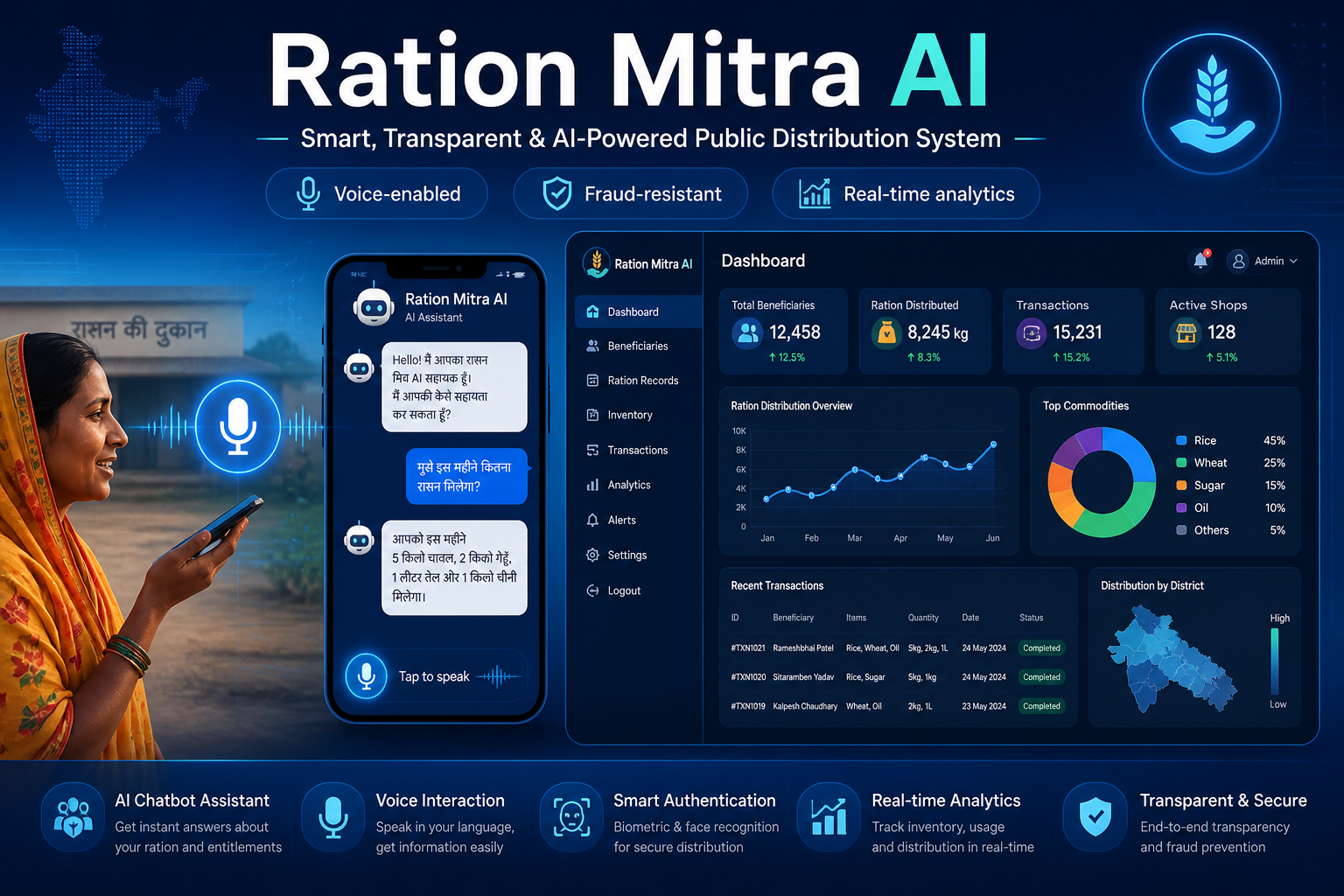
RationAI is a bilingual (Gujarati + Hindi) AI-powered navigator for India's PDS system. It does two things:
Optimise: A conversational AI guide that helps citizens:
- Check their monthly ration entitlements
- Locate their nearest fair price shop
- File complaints in plain language
- Understand their rights under NFSA
Represent: A live dashboard that makes the system legible — which districts report consistent shortfalls, complaint patterns by region, distribution gaps by commodity. The most powerful tool isn't always a fix. Sometimes it's a mirror.
How we built it
Built using Lovable (AI-powered frontend builder) with Claude AI as the conversational and research engine. We mapped the PDS data flow — central allocation → state distribution → fair price shops — and identified the 6 key friction points citizens face daily.
AI was embedded in every stage: problem research, system mapping, design decisions, content generation, and build. Not as decoration — as the actual method.
Challenges we ran into
- PDS data is fragmented across 28 state portals with no unified API
- Translating bureaucratic language into plain Gujarati accurately without losing meaning
- Representing systemic failure without misrepresenting individual fair price shops
- Building a working product in 24 hours with zero prior coding experience
Accomplishments that we're proud of
- Working bilingual AI assistant live on the internet in under 6 hours
- Zero coding experience → fully deployed web app
- Dashboard visualising real Gujarat district-level PDS patterns
- Identified the 6 most common PDS failure points citizens face
What we learned
The hardest part was not building the tool. It was understanding the system well enough to intervene usefully.
Government systems are not complex because complexity is necessary. They are complex because nobody ever designed them for the person at the end of the chain — the person who walks 4 kilometres to a fair price shop and is turned away because the system says their card is inactive.
AI made it possible to go from zero to working product in hours. But the decisions that mattered — which system to address, whose pain to centre, what "better" actually means for a rural citizen — those required human judgment.
We are humans inside the system of building. AI was the tool. Understanding was the work.
What's next for RationAI
- State-by-state PDS data integration
- Direct connection to official grievance portals (PFMS, state helplines)
- Voice input for users with low literacy
- Open dataset of PDS failure points for journalists and researchers
- Offline mode for areas with poor connectivity
Built With
- claude-ai
- html
- javascript
- lovable
- react

Log in or sign up for Devpost to join the conversation.