Inspiration
We translate City Hall's Amtsdeutsch into a participatory digital noticeboard for the average citizen.
The Rathaus publishes numerous official announcements specifying regulatory proceedings, but these documents are often written in complex legalese and PDFs buried in government sites. We sense there is an important lack of transparency and participation in local governance, and we want to change that.
What it does
Current information outlets include:
- The RatsInformationsSystem (RIS), which includes meeting schedules, agendas, proposals, voting results, official council decisions, etc.
- Amtsblatt, the official gazette announcing new regulations, bylaws, statutes, etc.
- The “Rathaus Umschau”, a weekly bulletin with summaries of council decisions, press releases from departments, etc.
- Meeting transcripts and minutes from city council sessions.
- And more.
These are numerous but unintelligible and hidden from the average citizen.
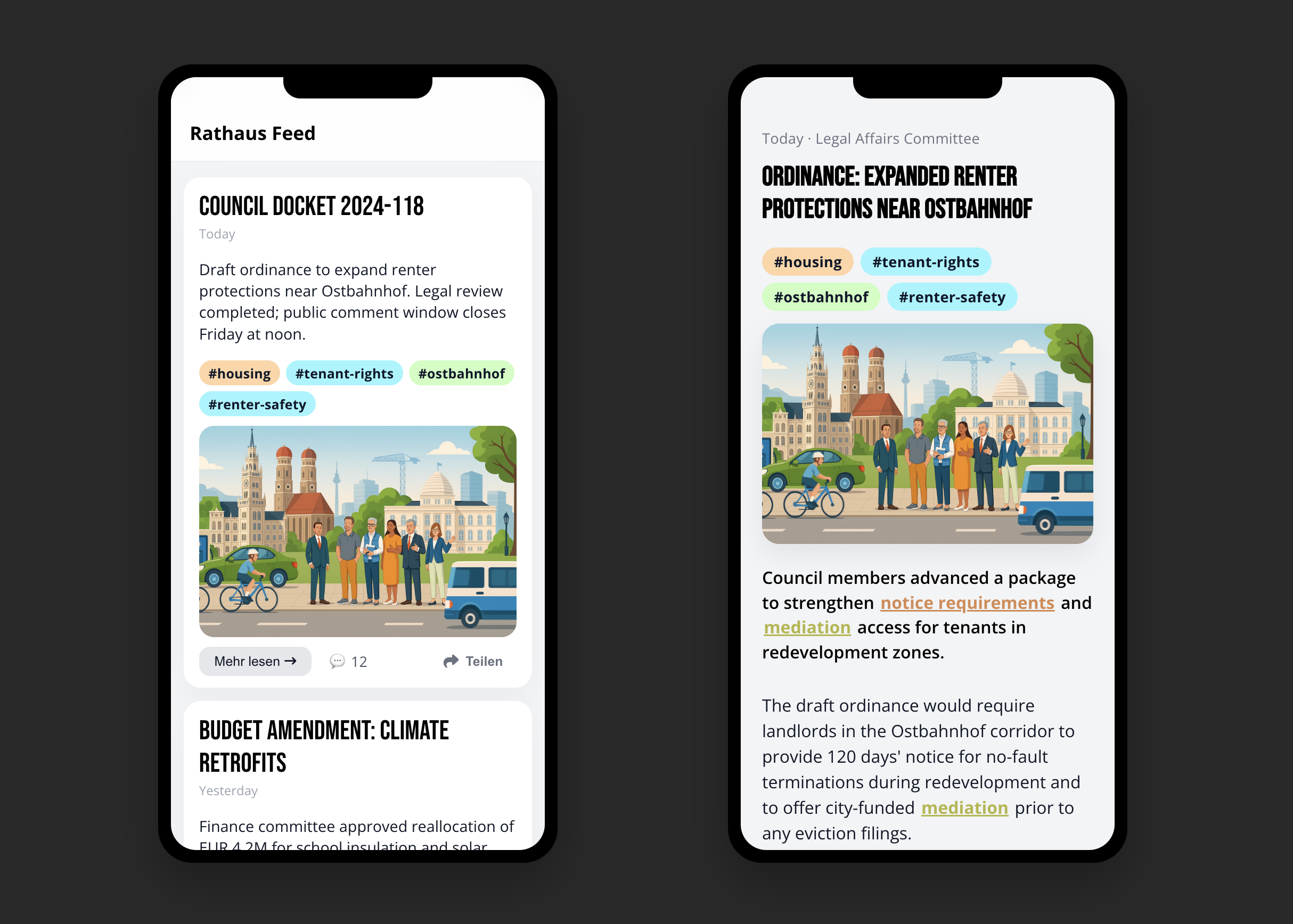
We built a full-stack application that ingests these official documents, uses AI to translate them into plain language summaries, and presents them in a user-friendly interface where citizens can easily browse, search, and discuss local government activities.
- 🧾 Summarised updates on what the city is planning, deciding, or debating
- 🏷️ Tags & filters (e.g. “mobility”, “housing”, “climate”, “kids & youth”) to find what actually matters to them
- 💬 Discussion threads to voice opinions, ask questions, and engage with fellow citizens
- 📚 A children’s view for use in schools and educational settings
- 🗳️ To-do: pointers to participation options (petitions, consultations, surveys, events) whenever there’s a way to get involved
How we built it
We split the project into three parts:
Scrapers + AI service: Python scripts gather documents from official sources and feed them into an AI summarizer. Backend API: A TypeScript/Node service stores items, tags them, and serves curated feeds. Frontend app: A React-based UI that delivers a scrollable feed and deep-dive views inside a phone-frame layout.
Challenges we ran into
Municipal data isn’t standardized, so scraping and cleaning it took lots of edge-case handling. Balancing concise summaries with factual accuracy meant iterating on prompt engineering and filters. Coordinating the data flow between the AI service and backend without blocking the UX required careful caching and retries.
Accomplishments that we're proud of
- Turning dense council documents into accessible, shareable blurbs that actually feel readable.
- Building an end-to-end pipeline—from scraper to AI to UI—in a short hackathon window.
- Designing a mobile experience that feels modern while still grounded in public-interest journalism.
What we learned
- City data projects need both technical rigor and editorial sensitivity; automating “civic clarity” is a team sport.
- Real-world PDFs and HTML sources can break at any time, so monitoring and graceful fallbacks are essential.
- Short feedback loops between AI output and human judgment dramatically improve trustworthiness.
What’s next for RathausFeed
- Expand coverage beyond Munich to other municipalities.
- Add personalization (follow topics, get alerts) and community calls-to-action.
- Partner with local media or civic groups to keep content verified and up to date.

Log in or sign up for Devpost to join the conversation.