RateDrop
Project Story
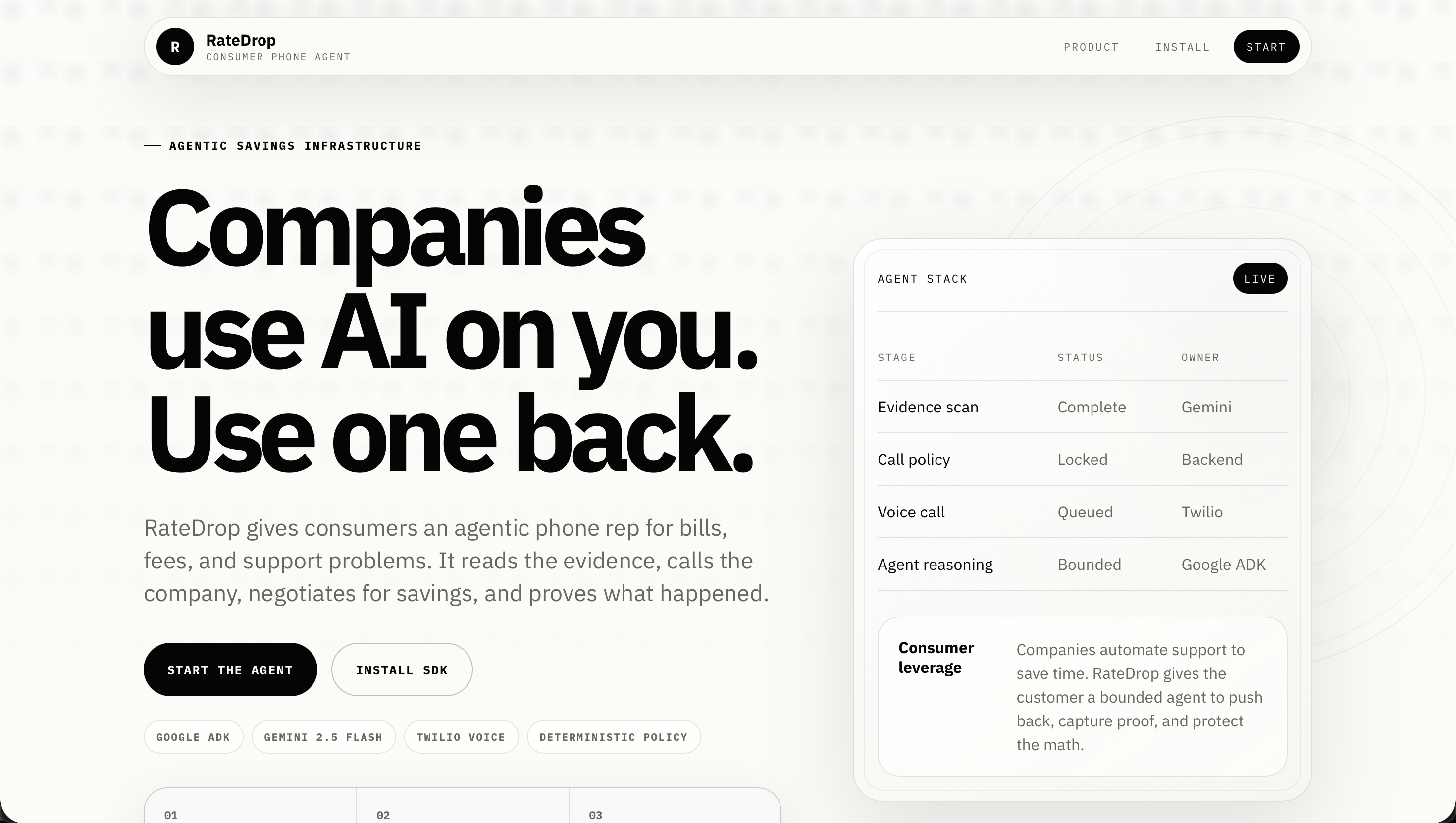
RateDrop is a consumer-facing AI phone agent that helps people lower their bills, dispute fees, and resolve support problems using the evidence they already have. Instead of asking users to explain everything from scratch, RateDrop starts with the actual bill, extracts the important facts, builds a structured support mission, and then carries the conversation through a live voice flow.
The core idea is simple: companies already use automation to reduce support costs, but consumers usually get stuck with long hold times and scripted responses. RateDrop gives the customer a bounded, bill-aware agent that can push back, ask for retention options, request credits, and keep the conversation focused on a measurable outcome.
What RateDrop Does
- A user uploads a PDF or image of a bill, or chooses a demo bill fixture.
- RateDrop extracts structured facts like provider, monthly total, plan name, line items, red flags, and negotiation angles.
- The backend turns those facts into a deterministic mission with a target outcome and completion criteria.
- A Twilio voice flow starts the call and streams the live conversation back to the app.
- When live rep utterances arrive, the backend routes them through a Google ADK-backed negotiator agent when enabled.
- The agent does not freestyle the business logic. It operates inside a bounded policy layer that decides when to push, counter, accept, or close.
- The UI shows the transcript, call state, and final result math in real time.
Why It Is Agentic
RateDrop is not a generic chatbot with a phone number attached. It is an agentic system with a narrow job, a grounded input, and deterministic guardrails.
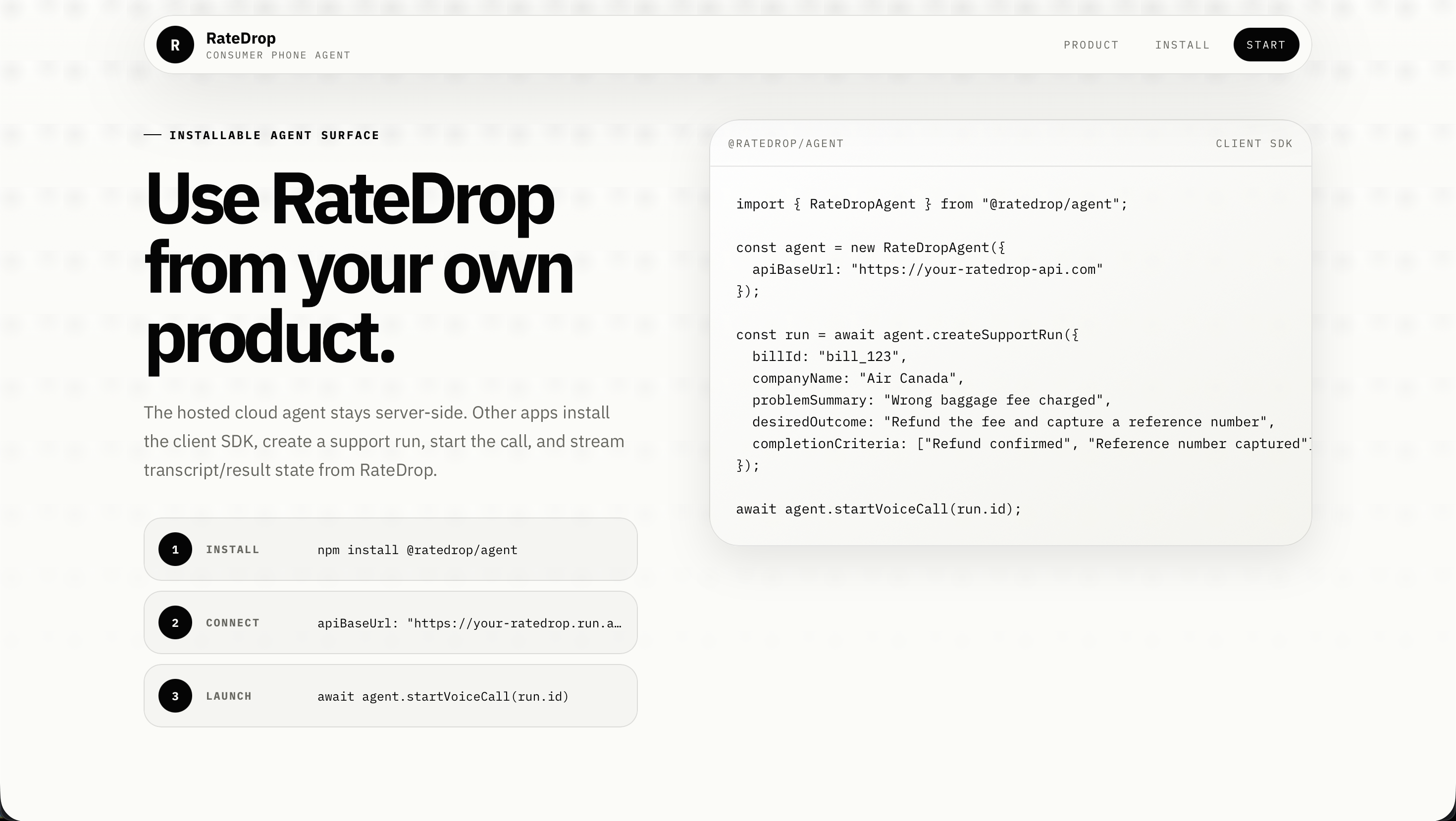
The agentic SDK, @ratedrop/agent, is the app-facing entry point for launching a support run. It lets a product create a mission, attach bill facts, and start a voice call while keeping the actual negotiation engine on the server. That separation matters: the browser never receives private model credentials, policy rules, or result-calculation logic.
Behind the SDK, the live call loop stays server-side. When ConversationRelay is active, Twilio sends the conversation into the backend WebSocket route, and the Google ADK-backed negotiator processes the rep's utterances under deterministic policy control. Gemini can phrase the response, but the math and the decision boundaries remain code-driven.
Why It Is Fully Cloud Based
RateDrop is designed as a cloud-native application from end to end.
- The frontend runs as a hosted Next.js app.
- The backend runs as a hosted FastAPI service.
- The live voice path uses Twilio Programmable Voice and ConversationRelay.
- The transcript stream is published from the backend and consumed by the UI over SSE/WebSocket updates.
- Storage can run locally for the hackathon demo or in MongoDB Atlas for cloud persistence.
- The recommended deployment path is Google Cloud Run, which gives RateDrop a public HTTPS endpoint and a public WebSocket surface for the ConversationRelay flow.
That means the demo is not dependent on a local machine once deployed. The upload, extraction, agent reasoning, call orchestration, transcript streaming, and result proof all happen in the cloud.
The Technical Story
RateDrop is built around a few design choices that keep the demo reliable:
- Structured extraction instead of freeform summarization
- Deterministic negotiation policy instead of pure model improvisation
- Server-side agent execution instead of shipping sensitive logic to the client
- Live transcript streaming so users can see the negotiation unfold
- Deterministic savings math so the final outcome is measurable and auditable
The result is a product that feels like a real consumer tool instead of a one-off demo. It has a clear input, a clear mission, a live voice interaction, and a final proof trail.
Demo Flow
The demo is intentionally short and visible:
- Upload a bill.
- Review the extracted facts and negotiation angles.
- Start the voice mission.
- Watch the transcript stream live.
- See the before/after math, credit recovery, and outcome proof.
Why We Built It
RateDrop exists because bill negotiation is a frustrating, repetitive support problem that should be automatable for consumers, not just for companies. By combining a bill-aware workflow, a cloud-hosted voice agent, and a grounded agentic SDK, RateDrop gives users a practical way to recover money and resolve support issues with less friction.
In short: upload the bill, launch the agent, negotiate in the cloud, and prove the savings.
Built With
- gcp


Log in or sign up for Devpost to join the conversation.