Inspiration
Natural disasters, infrastructure failures, and humanitarian crises often occur in environments where communication networks are unavailable, situational awareness is limited, and emergency responders face significant risks. Traditional drone systems typically operate independently, requiring constant human control and lacking the ability to collaborate intelligently.
We envisioned a platform where autonomous drones could work together as a resilient swarm—sharing knowledge, making collective decisions, adapting to changing environments, and continuing missions even when connectivity is degraded. RASIP was inspired by the need to accelerate disaster response, improve search and rescue operations, monitor critical infrastructure, and restore communications in challenging environments through the convergence of AI, edge computing, cloud intelligence, and distributed networking.
What it does
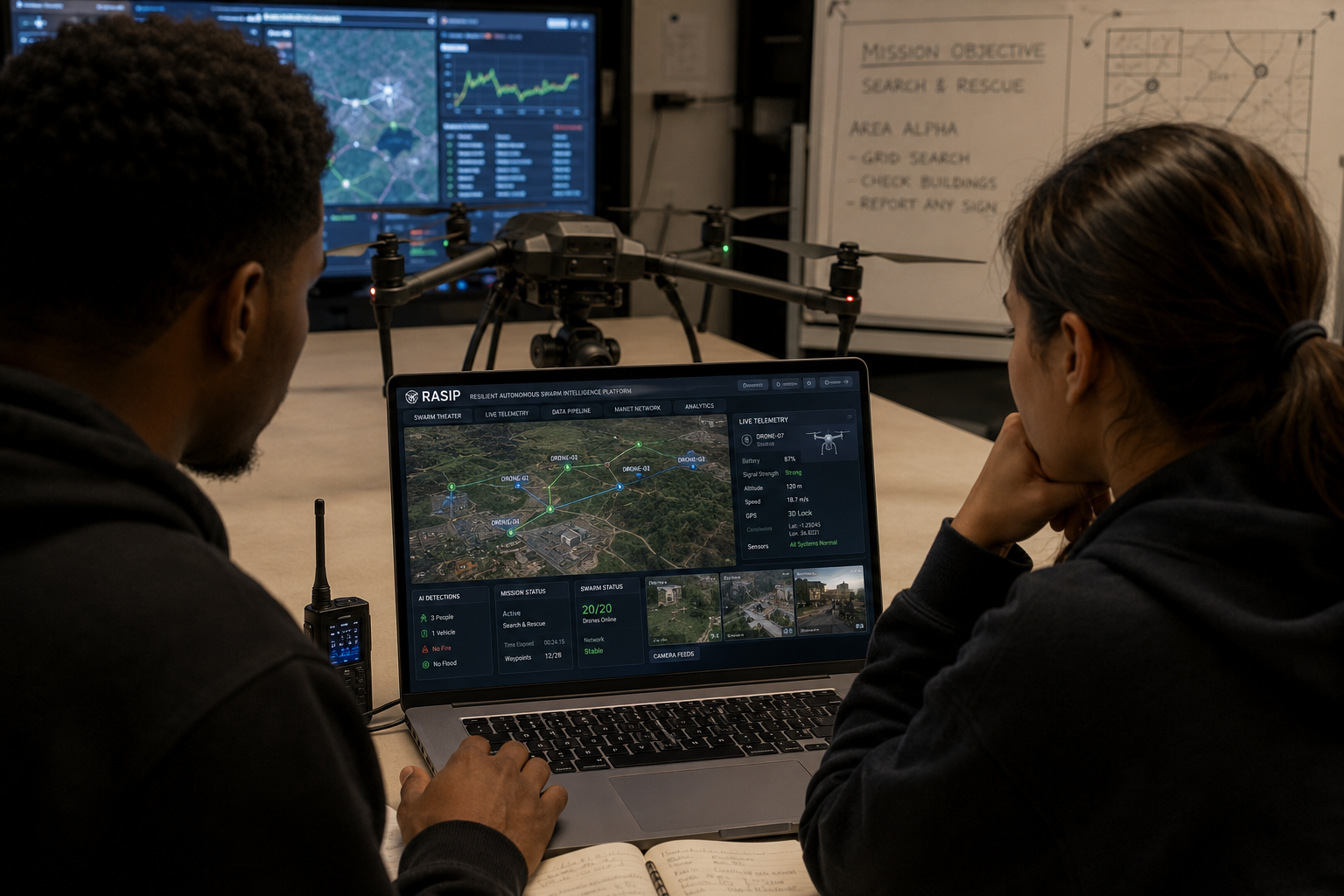
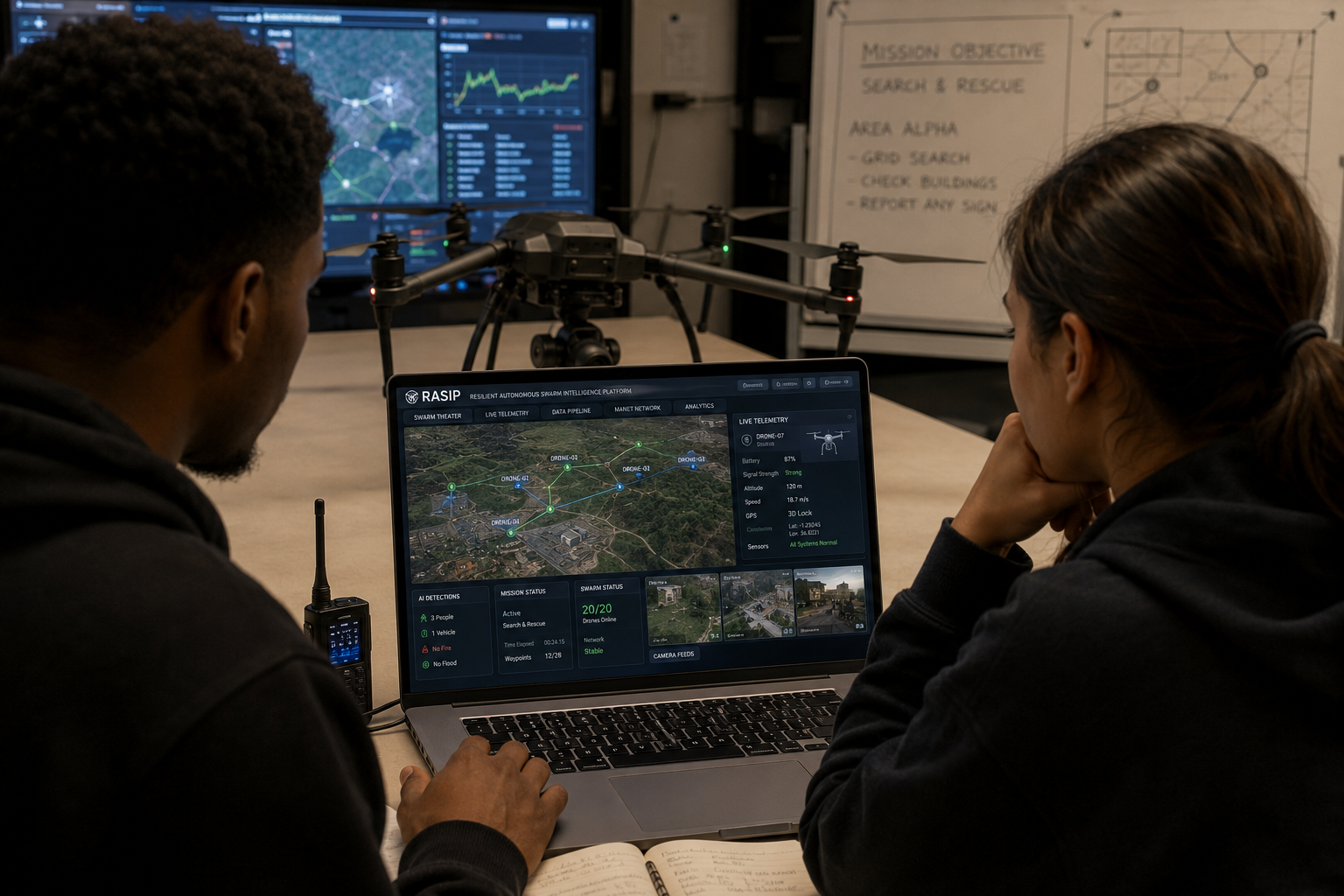
RASIP (Resilient Autonomous Swarm Intelligence Platform) is an end-to-end autonomous drone swarm ecosystem for disaster response and emergency operations.
The platform enables multiple drones to collaborate in real time using swarm intelligence, edge AI, and decentralized networking. Each drone performs on-device object detection with YOLOv8, obstacle avoidance using LiDAR and Visual SLAM, and sensor fusion powered by Kalman filtering for accurate navigation even when GPS is unreliable.
Drones communicate through a self-healing MANET mesh network using QUIC, MQTT, and ZeroMQ, allowing the swarm to remain operational even if individual nodes fail.
Mission data is securely streamed to Microsoft Fabric through Azure Event Hub, where real-time analytics, digital twins, anomaly detection, and AI insights are generated. A Retrieval-Augmented Generation (RAG) engine stores mission knowledge in a vector database, enabling intelligent contextual reasoning and natural-language mission queries.
The platform also features automated AI retraining pipelines, allowing edge models to improve continuously as new mission data becomes available.
How we built it
RASIP was developed as a modular, production-oriented architecture composed of multiple interoperable layers.
The frontend was built with Next.js 14, React, Tailwind CSS, Three.js, Mapbox GL, and Recharts to provide a real-time command center featuring swarm visualization, telemetry dashboards, digital twins, AI insights, and mission analytics.
The backend was implemented using FastAPI, Python 3.11, asyncio, PostgreSQL, and Redis to orchestrate APIs, WebSocket telemetry, mission coordination, and asynchronous event processing.
Edge intelligence was powered by YOLOv8, TinyML, OpenCV, Visual SLAM, LiDAR processing, and sensor fusion algorithms that combine GPS, IMU, and SLAM data using Kalman filters.
Distributed swarm behavior was implemented using Boids algorithms, formation control, distributed consensus, and MANET mesh networking with QUIC, MQTT, and ZeroMQ.
Mission knowledge is managed through a Retrieval-Augmented Generation pipeline using Qdrant and Sentence Transformers, enabling semantic search and contextual reasoning.
Cloud analytics were built on Microsoft Fabric, Azure Event Hub, OneLake, KQL, Power BI, Azure AI Foundry, and Copilot Studio integration to provide enterprise-grade monitoring, AI retraining, and operational intelligence.
Security was implemented using AES-256-GCM encryption, SHA-256 identity verification, digital signatures, UUID-based drone identities, and biometric authentication.
Challenges we ran into
One of the biggest challenges was integrating many advanced technologies into a single coherent platform while maintaining modularity and scalability.
Designing a realistic swarm architecture required balancing autonomous decision-making with distributed consensus to ensure reliable coordination between drones.
Another challenge involved building resilient networking capable of handling unreliable communications through mesh networking and protocol failover.
Managing real-time telemetry, AI inference, cloud analytics, and autonomous behavior simultaneously required careful asynchronous system design and efficient event processing.
Finally, integrating edge AI with cloud-based retraining and maintaining secure identity verification across distributed drones demanded significant architectural planning.
Accomplishments that we're proud of
We successfully designed a comprehensive autonomous swarm platform that combines multiple cutting-edge technologies into a unified ecosystem.
Highlights include:
- Autonomous multi-drone swarm coordination.
- Real-time edge AI using YOLOv8 and TinyML.
- Sensor fusion with Kalman filtering and Visual SLAM.
- Self-healing MANET mesh networking.
- Retrieval-Augmented Generation (RAG) for mission intelligence.
- Microsoft Fabric integration for real-time analytics.
- Digital Twin visualization.
- Automated AI retraining pipeline.
- Enterprise-grade security with encrypted communications and identity verification.
- A modern command center capable of visualizing the entire swarm in real time.
We are especially proud that RASIP demonstrates how AI, distributed systems, cloud computing, and autonomous robotics can work together to solve real-world disaster response challenges.
What we learned
Developing RASIP reinforced the importance of designing systems that are modular, resilient, and scalable from the beginning.
We gained deeper experience in distributed systems, edge AI deployment, asynchronous architectures, swarm intelligence algorithms, sensor fusion, cloud-native analytics, and AI lifecycle management.
The project also highlighted the value of combining edge computing with cloud intelligence rather than relying exclusively on either approach. By integrating Retrieval-Augmented Generation, autonomous networking, and continuous model improvement, we demonstrated how intelligent systems can become increasingly adaptive over time.
What's next for RASIP — Resilient Autonomous Swarm Intelligence Platform
Our roadmap focuses on transforming RASIP into a real-world operational platform.
Future milestones include:
- Integration with physical PX4 and ArduPilot drone fleets.
- Large-scale simulation using AirSim and Gazebo.
- Federated learning across distributed drone swarms.
- Advanced reinforcement learning for autonomous mission planning.
- 3D terrain-aware path planning and weather-aware navigation.
- Satellite communication for beyond-line-of-sight operations.
- Support for wildfire monitoring, flood response, agriculture, and infrastructure inspection.
- Deployment on Kubernetes with enterprise-grade CI/CD pipelines.
- Expanded Microsoft Fabric capabilities including predictive maintenance, advanced Digital Twins, and Copilot-powered mission planning.
- Collaboration with emergency agencies, humanitarian organizations, and smart city initiatives to validate RASIP in real-world scenarios.
Our long-term vision is to create a resilient autonomous intelligence platform where collaborative drone swarms become trusted partners in disaster response, environmental protection, infrastructure resilience, and public safety worldwide.
Built With
- aes-256-gcm-encryption
- azure-ai-foundry
- azure-event-hub
- boids-swarm-algorithms
- chart.js
- delta-lake
- docker
- docker-compose
- fastapi
- git
- github
- grafana
- graphql
- hmac
- javascript
- kalman-filter
- kubernetes
- kusto-query-language-(kql)
- manet-mesh-networking
- mapbox-gl
- microsoft-copilot-studio
- microsoft-fabric
- model-context-protocol-(mcp)
- mqtt
- next.js-14
- nginx-ingress
- onelake
- opencv
- postgresql
- power-bi
- prometheus
- python
- pytorch
- qdrant
- quic
- rag-(retrieval-augmented-generation)
- react-18
- recharts
- redis
- redux-toolkit
- rest-apis
- sentence-transformers
- sha-256
- sql
- tailwind-css
- tensorflow-lite-(tinyml)
- three.js
- typescript
- visual-slam
- vscode
- websockets
- yolov8
- zeromq


Log in or sign up for Devpost to join the conversation.