-
-
Drone Simulation
Inspiration
Natural disasters, wildfires, floods, earthquakes, and infrastructure failures often destroy communication networks and delay emergency response when every second matters. Traditional disaster-response systems rely heavily on centralized coordination and human operators, creating bottlenecks in rapidly changing environments. We envisioned a platform where autonomous drone swarms could collaborate intelligently, adapt in real time, and continue operating even when connectivity, GPS, or individual drones fail. RASIP was inspired by the need for resilient, scalable, and AI-driven disaster response capable of saving lives when conventional systems are overwhelmed.
What it does
RASIP (Resilient Autonomous Swarm Intelligence Platform) is an end-to-end autonomous drone swarm ecosystem designed for disaster response, search and rescue, environmental monitoring, infrastructure inspection, and emergency communications recovery.
The platform enables multiple drones to:
- Coordinate using swarm intelligence and distributed consensus.
- Detect survivors, hazards, vehicles, and critical assets using YOLOv8 computer vision.
- Navigate autonomously through GPS-denied environments using SLAM and sensor fusion.
- Maintain communication through self-healing MANET mesh networks.
- Share mission knowledge using RAG-powered swarm memory.
- Securely verify identities and mission data through blockchain-inspired cryptographic verification.
- Stream telemetry and operational insights to Microsoft Fabric for real-time analytics and decision support.
- Continuously improve performance through AI retraining pipelines and edge deployment.
The result is a resilient autonomous system capable of operating in complex, dynamic, and high-risk environments.
How we built it
RASIP was built as a multi-layer intelligent system combining edge AI, distributed systems, cloud analytics, and autonomous robotics.
Core Components
Swarm Intelligence Engine
- Boid-based behavioral algorithms
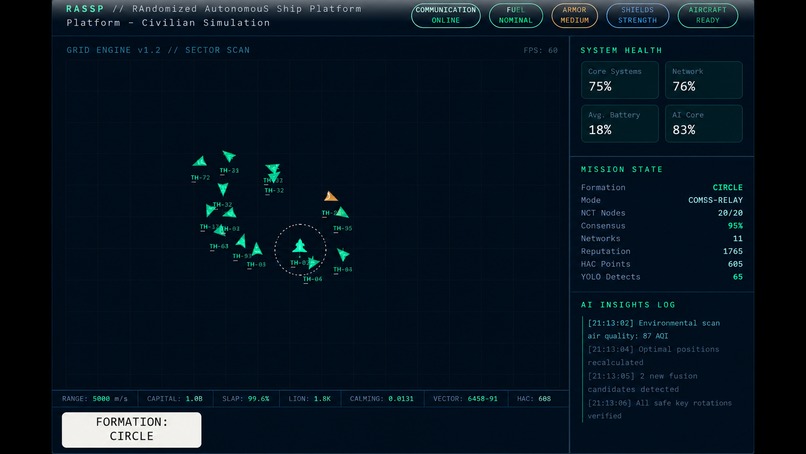
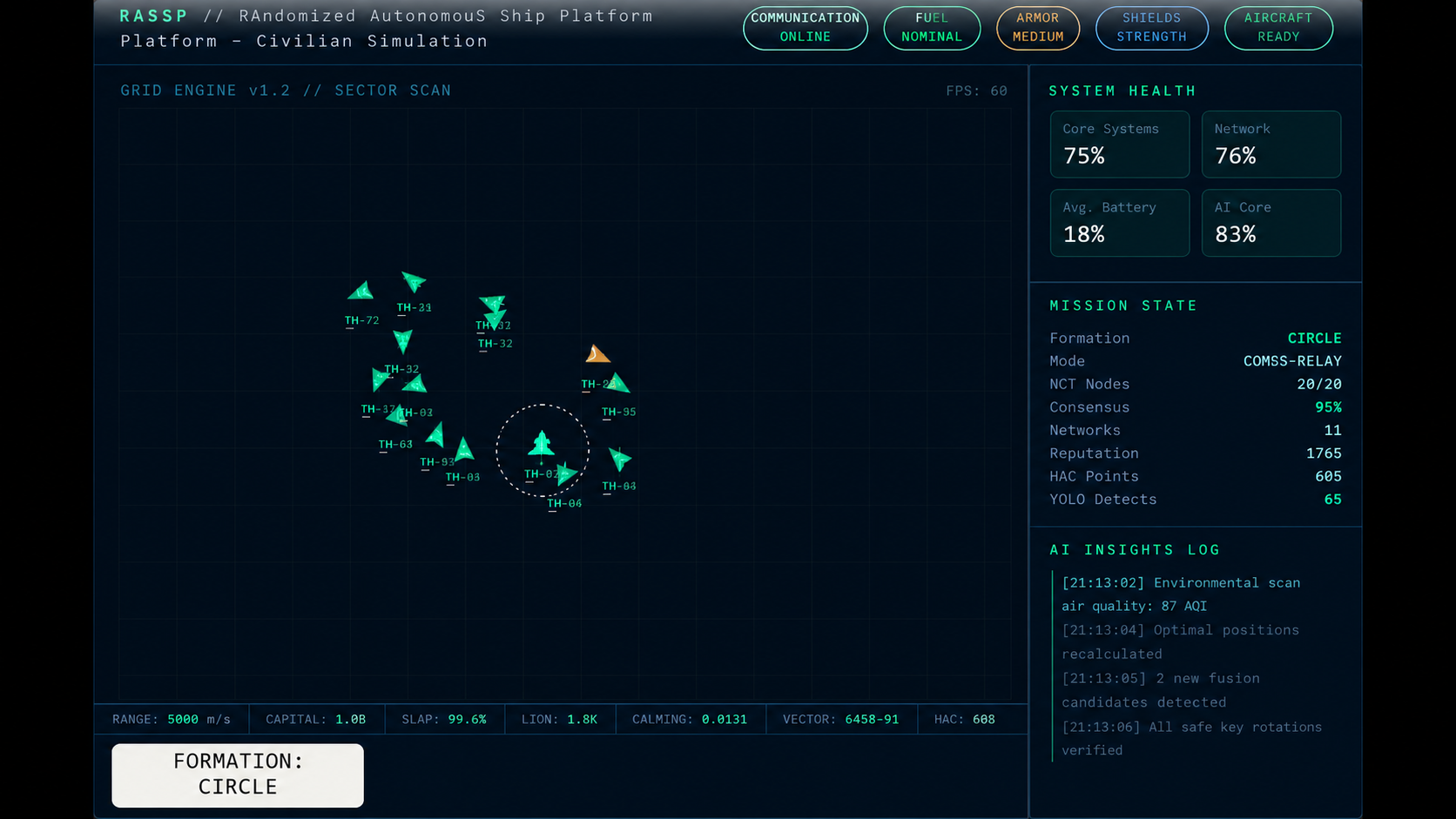
- Formation control (Grid, V-Wing, Circle, Diamond, Search Patterns)
- Distributed consensus and mission coordination
Edge AI Layer
- YOLOv8 object detection
- Visual SLAM navigation
- LiDAR obstacle avoidance
- TinyML deployment for low-latency inference
Sensor Fusion System
- GPS, IMU, LiDAR, and SLAM integration
- Kalman filtering for accurate localization
- Dynamic confidence weighting when sensors degrade
Resilient Networking
- MANET mesh architecture
- QUIC primary communications
- MQTT fallback
- ZeroMQ emergency channels
Intelligence Layer
- Retrieval-Augmented Generation (RAG)
- Qdrant vector database
- Mission memory and contextual decision-making
Security Layer
- AES-256 encryption
- SHA-256 identity verification
- Digital signatures and operator authentication
Cloud & Analytics
- FastAPI backend
- Next.js command center dashboard
- Azure Event Hub
- Microsoft Fabric OneLake
- Real-time KQL analytics and anomaly detection
Challenges we ran into
Building an autonomous swarm platform required solving several complex engineering challenges:
Real-Time Coordination
Maintaining synchronization across multiple autonomous drones while minimizing latency was difficult, especially during dynamic mission changes.
GPS-Denied Navigation
Disaster environments often contain obstacles, signal interference, and damaged infrastructure. We had to develop fallback mechanisms using SLAM and sensor fusion to ensure reliable navigation.
Network Resilience
Traditional communication methods fail when infrastructure is damaged. Designing a self-healing MANET architecture with multiple fallback protocols required significant experimentation.
AI at the Edge
Balancing model accuracy with limited onboard computing resources forced us to optimize detection models and deploy lightweight TinyML solutions.
Data Consistency
Ensuring swarm-wide consensus and shared situational awareness across distributed nodes while avoiding conflicting decisions was a major systems challenge.
Security
Disaster-response systems are high-value targets. Implementing strong encryption, identity verification, and tamper-resistant logging while maintaining performance required careful architectural decisions.
Accomplishments that we're proud of
- Developed a complete end-to-end autonomous swarm architecture rather than a standalone drone application.
- Successfully integrated swarm intelligence, edge AI, cloud analytics, and distributed networking into a unified platform.
- Built a resilient communication framework capable of operating even when traditional infrastructure is unavailable.
- Implemented explainable AI insights that allow operators to understand swarm decisions and mission outcomes.
- Created a scalable architecture supporting future expansion from small drone teams to large-scale autonomous fleets.
- Integrated Microsoft Fabric, Azure Event Hub, RAG, and Copilot-ready APIs into a single operational ecosystem.
- Designed the platform with real-world disaster-response scenarios as the primary use case rather than laboratory simulations.
What we learned
Developing RASIP reinforced several important lessons:
- AI becomes significantly more valuable when combined with autonomous decision-making and real-time data streams.
- Swarm intelligence creates resilience because system performance does not depend on a single drone or communication node.
- Edge computing is essential for mission-critical environments where cloud connectivity cannot be guaranteed.
- Reliable disaster-response systems require redundancy at every layer—navigation, networking, sensing, and intelligence.
- Explainability is just as important as accuracy when human operators must trust AI-driven decisions.
- Building production-grade autonomous systems requires integrating multiple disciplines, including robotics, AI, cybersecurity, networking, and cloud engineering.
What's next for RASIP — Resilient Autonomous Swarm Intelligence Platform
Our vision is to evolve RASIP from a simulated autonomous ecosystem into a deployable real-world disaster-response platform.
Near-Term Goals
- Deploy physical drone prototypes for field validation.
- Expand swarm sizes beyond 50 coordinated drones.
- Integrate live satellite and weather intelligence feeds.
- Enhance AI-driven mission planning and resource allocation.
Mid-Term Goals
- Implement autonomous charging and battery-swap stations.
- Add predictive disaster analytics using historical and live environmental data.
- Introduce federated learning across drone fleets for continuous improvement.
- Deploy advanced digital twins for mission rehearsal and simulation.
Long-Term Vision
- Enable nationwide disaster-response drone networks.
- Support humanitarian operations, wildfire management, and emergency communications recovery.
- Integrate quantum-safe security protocols for future resilience.
- Create a fully autonomous multi-agent emergency-response ecosystem capable of coordinating aerial, ground, and IoT assets in real time.
RASIP's ultimate mission is to transform disaster response from reactive operations into proactive, intelligent, and resilient autonomous action—helping save lives, protect infrastructure, and strengthen communities worldwide. 🚁🌍✨
Built With
- aes-256-encryption
- azure-ai-foundry
- azure-event-hub
- blockchain-inspired-identity-verification
- copilot
- docker
- fastapi
- grafana
- kubernetes
- manet-networking
- microsoft-fabric
- mqtt
- next.js
- opencv
- postgresql
- power-bi
- prometheus
- python
- pytorch
- qdrant
- quic
- rag
- react
- redis
- tailwind-css
- three.js
- tinyml
- typescript
- visual-slam
- yolov8
- zeromq


Log in or sign up for Devpost to join the conversation.