-
-
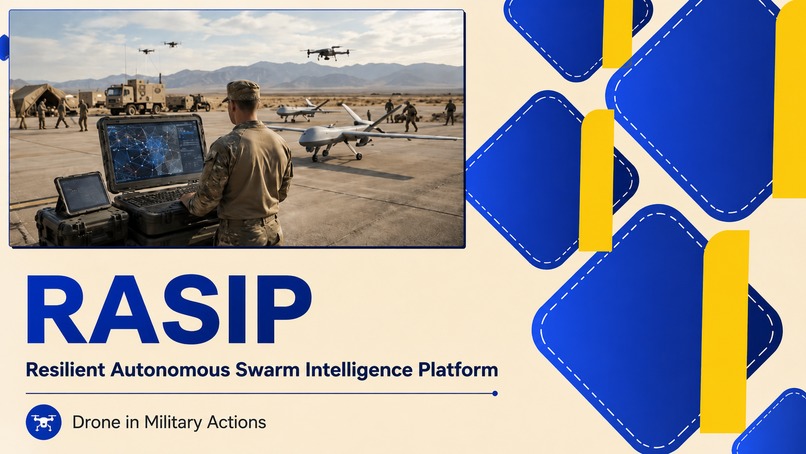
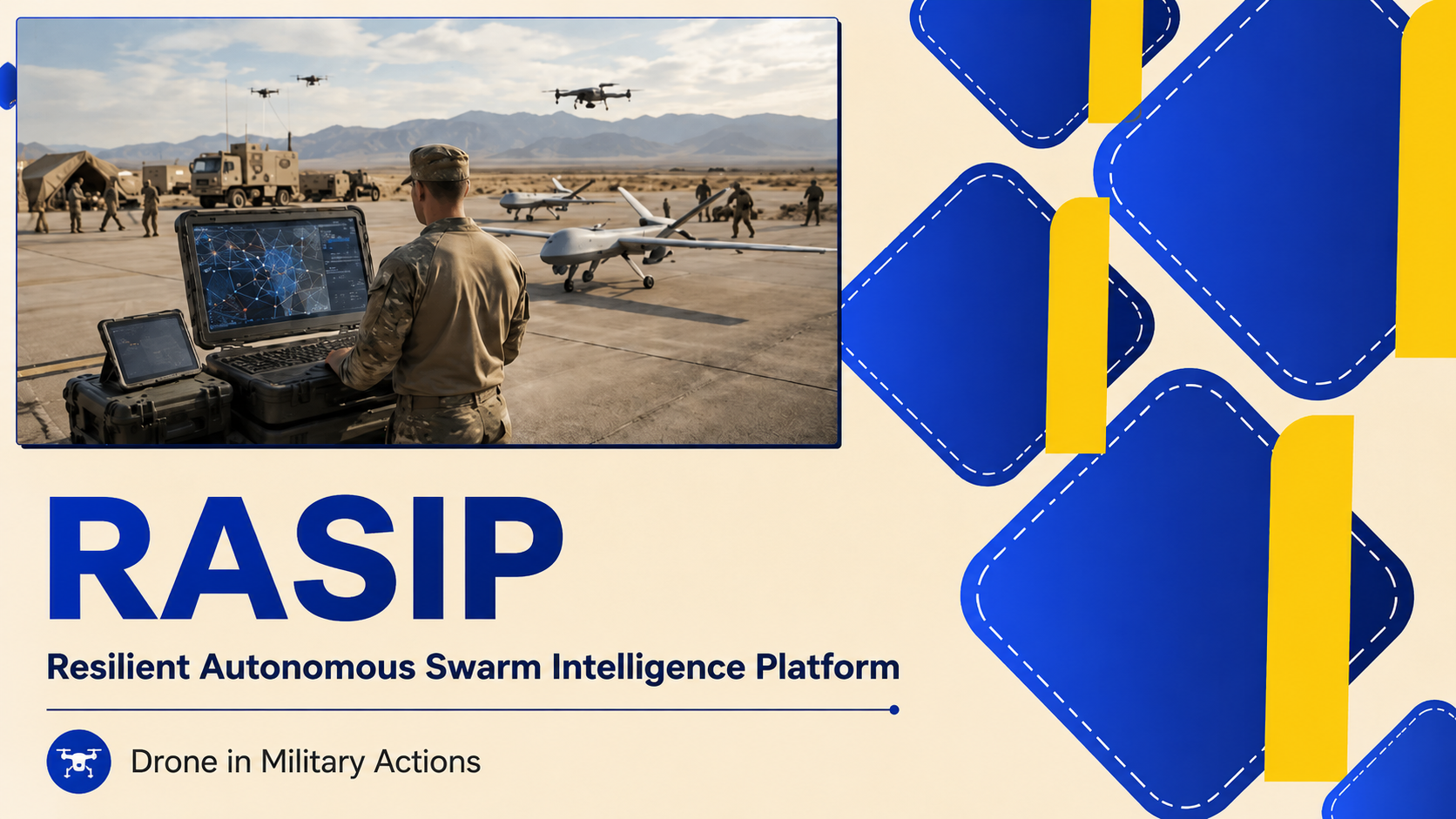
Drones in military actions
Inspiration
Natural disasters, infrastructure failures, and emergency situations often occur in environments where communication networks are degraded, situational awareness is limited, and human responders face significant risks. We were inspired by the idea of creating a resilient autonomous system capable of coordinating fleets of drones to assist in disaster response, search and rescue, environmental monitoring, and emergency communications recovery.
Our goal was to explore how swarm intelligence, edge AI, cloud analytics, and resilient networking could work together to create an autonomous ecosystem that continues operating even when individual drones, sensors, or communication links fail. We wanted to demonstrate how distributed intelligence can improve response times, increase coverage, and reduce risks to human responders.
What it does
RASIP (Resilient Autonomous Swarm Intelligence Platform) is an end-to-end autonomous drone swarm platform designed for civilian disaster response and resilient operations.
The platform enables fleets of drones to:
- Coordinate autonomously using swarm intelligence and boid-based behaviors.
- Detect people, vehicles, hazards, and objects using YOLOv8 computer vision.
- Navigate in degraded environments through GPS, IMU, LiDAR, and SLAM sensor fusion.
- Maintain communications through MANET mesh networking with QUIC, MQTT, and ZeroMQ fallback channels.
- Share mission knowledge through a distributed MCP context engine and RAG-powered memory system.
- Secure telemetry and identity data using encryption and blockchain-inspired verification.
- Stream operational data into Microsoft Fabric for real-time analytics, anomaly detection, and AI retraining.
- Provide commanders with a live command-and-control dashboard, digital twin visualization, telemetry monitoring, and AI-powered insights.
The result is a self-healing swarm ecosystem capable of adapting to changing conditions while maintaining mission continuity.
How we built it
RASIP combines multiple layers of modern AI, networking, and cloud technologies:
Swarm Intelligence
We implemented boid-based swarm algorithms using separation, alignment, and cohesion principles, enabling drones to maintain formations and coordinate collectively.
Edge AI
Each drone runs computer vision models using YOLOv8, Visual SLAM, TinyML inference, LiDAR processing, and sensor fusion pipelines to understand its environment and navigate autonomously.
Resilient Networking
To maintain communication under adverse conditions, we built a MANET mesh architecture using QUIC as the primary transport, MQTT as a fallback, and ZeroMQ as an emergency channel.
Intelligence & Memory
We integrated a Retrieval-Augmented Generation (RAG) system powered by Qdrant vector search and sentence-transformer embeddings to give the swarm persistent mission memory and contextual reasoning.
Cloud Analytics
Telemetry streams are ingested through Azure Event Hub and analyzed in Microsoft Fabric using EventStreams, OneLake, KQL analytics, and anomaly detection pipelines.
Security Layer
We implemented AES-256 encryption, digital signatures, identity verification, and immutable SHA-256 ledger-style audit records to ensure integrity and trust across the platform.
Dashboard & Digital Twin
A Next.js command center provides live telemetry, swarm visualization, network monitoring, analytics dashboards, and explainable AI insights.
Challenges we ran into
Building a platform that combines autonomous systems, distributed networking, AI, and cloud analytics introduced several challenges:
- Designing swarm coordination algorithms that remain stable under changing conditions.
- Creating resilient communication pathways that continue functioning despite node failures and packet loss.
- Integrating multiple navigation sources such as GPS, IMU, SLAM, and LiDAR into a unified sensor fusion framework.
- Balancing real-time performance with computationally intensive AI workloads.
- Building a realistic digital twin capable of representing live swarm behavior.
- Ensuring data integrity and security across distributed edge devices and cloud services.
- Managing the complexity of connecting edge intelligence, cloud analytics, and autonomous decision-making into a cohesive architecture.
Accomplishments that we're proud of
We are proud of successfully creating a complete end-to-end swarm intelligence ecosystem that brings together:
- Autonomous drone coordination and formation control.
- Real-time edge AI object detection and navigation.
- Self-healing MANET mesh networking with multiple communication fallbacks.
- RAG-powered mission memory and contextual intelligence.
- Secure identity verification and telemetry integrity mechanisms.
- Microsoft Fabric integration for real-time analytics and AI workflows.
- A live command-and-control dashboard with digital twin visualization.
Most importantly, we built a platform that demonstrates how autonomous systems can remain operational and adaptive even in highly constrained environments.
What we learned
Through developing RASIP, we learned that resilience is not achieved through a single technology but through layered redundancy across every part of the system.
Key lessons included:
- Swarm intelligence becomes significantly more robust when combined with distributed consensus mechanisms.
- Edge AI dramatically reduces response latency compared to cloud-only architectures.
- Sensor fusion provides much higher reliability than relying on any individual navigation source.
- Resilient networking requires multiple fallback pathways to handle unpredictable conditions.
- Cloud analytics platforms such as Microsoft Fabric provide powerful capabilities for large-scale telemetry processing and operational intelligence.
- Explainable AI is critical when autonomous systems are making mission-critical decisions.
What's next for RASIP
Our roadmap focuses on transitioning from simulation to real-world deployment:
- Real drone hardware integration and field testing.
- Larger-scale swarm deployments with 50+ autonomous nodes.
- Advanced digital twin environments using high-fidelity geospatial simulations.
- Federated learning for distributed model updates across drone fleets.
- Satellite communication fallback for GPS-denied and disconnected environments.
- Autonomous charging stations and battery-swap scheduling.
- Integration with emergency response agencies and smart city infrastructure.
- Quantum-resistant cryptographic protections for future security requirements.
- AI-powered mission planning assistants using Azure AI Foundry and Copilot Studio.
Ultimately, RASIP aims to become a resilient autonomous intelligence platform capable of supporting disaster response, environmental monitoring, infrastructure inspection, and smart-city operations at scale.
Built With
- aes-256-encryption
- and
- azure-ai-foundry
- azure-event-hub
- docker
- fastapi
- grafana
- hedera-inspired
- identity
- javascript
- kql
- kubernetes
- mapbox-gl
- mcp-(model-context-protocol)
- microsoft-fabric
- mqtt
- next.js-14
- onelake
- opencv
- postgresql
- prometheus
- python
- pytorch
- qdrant
- quic
- react-18
- redis
- redux-toolkit
- sentence-transformers
- sha-256
- tailwind-css
- tensorflow-lite-(tinyml)
- three.js
- typescript
- visual-slam
- yolov8
- zeromq

Log in or sign up for Devpost to join the conversation.