-
-
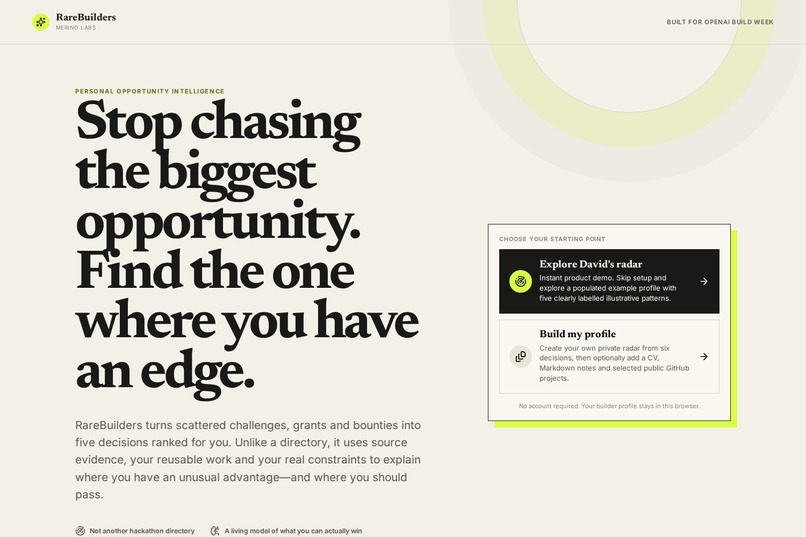
Landing
-
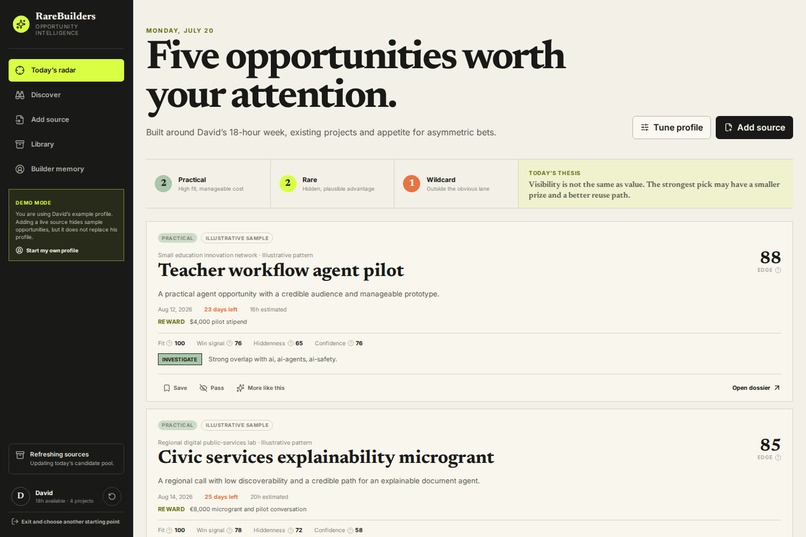
Radar
-
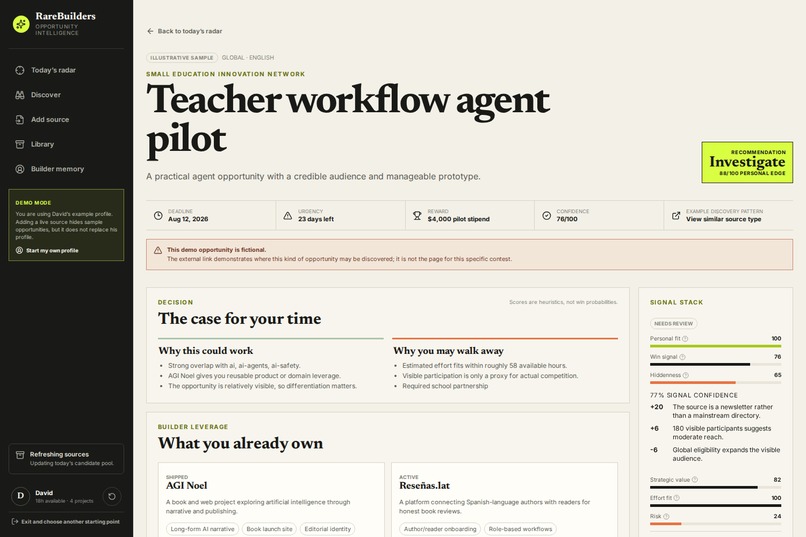
Dossier signals
-
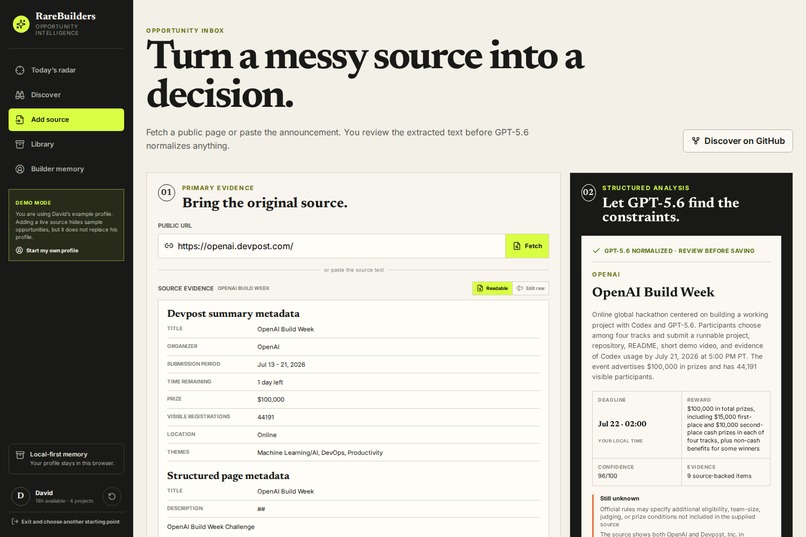
Openai build week analysis
Inspiration
AI is creating a new generation of Renaissance builders: people who can research, design, code, and launch across disciplines. The same is true of the small multidisciplinary teams they form.
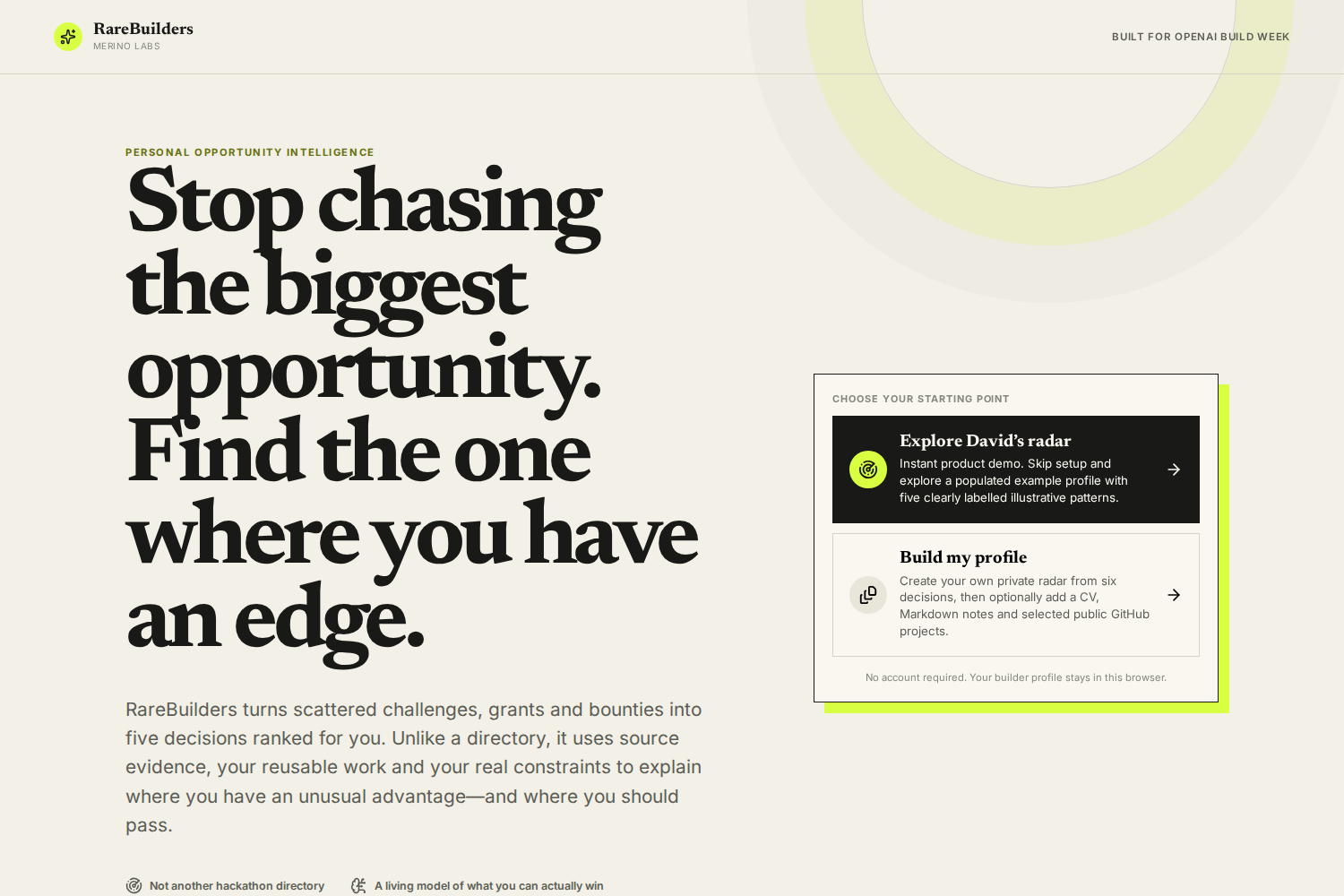
Their problem is no longer capability. It is focus. Grants, competitions, bounties, pilots, and open calls are scattered across platforms, institutional websites, repositories, newsletters, and local communities.
Existing directories help people discover what is popular, but they do not answer a more personal question:
Where do my skills, interests, projects, and constraints give me an unusual edge?
I built RareBuilders because I needed that answer myself. I did not want another infinite feed. I wanted a small, honest set of decisions that could help me choose what deserves my limited time.
What it does
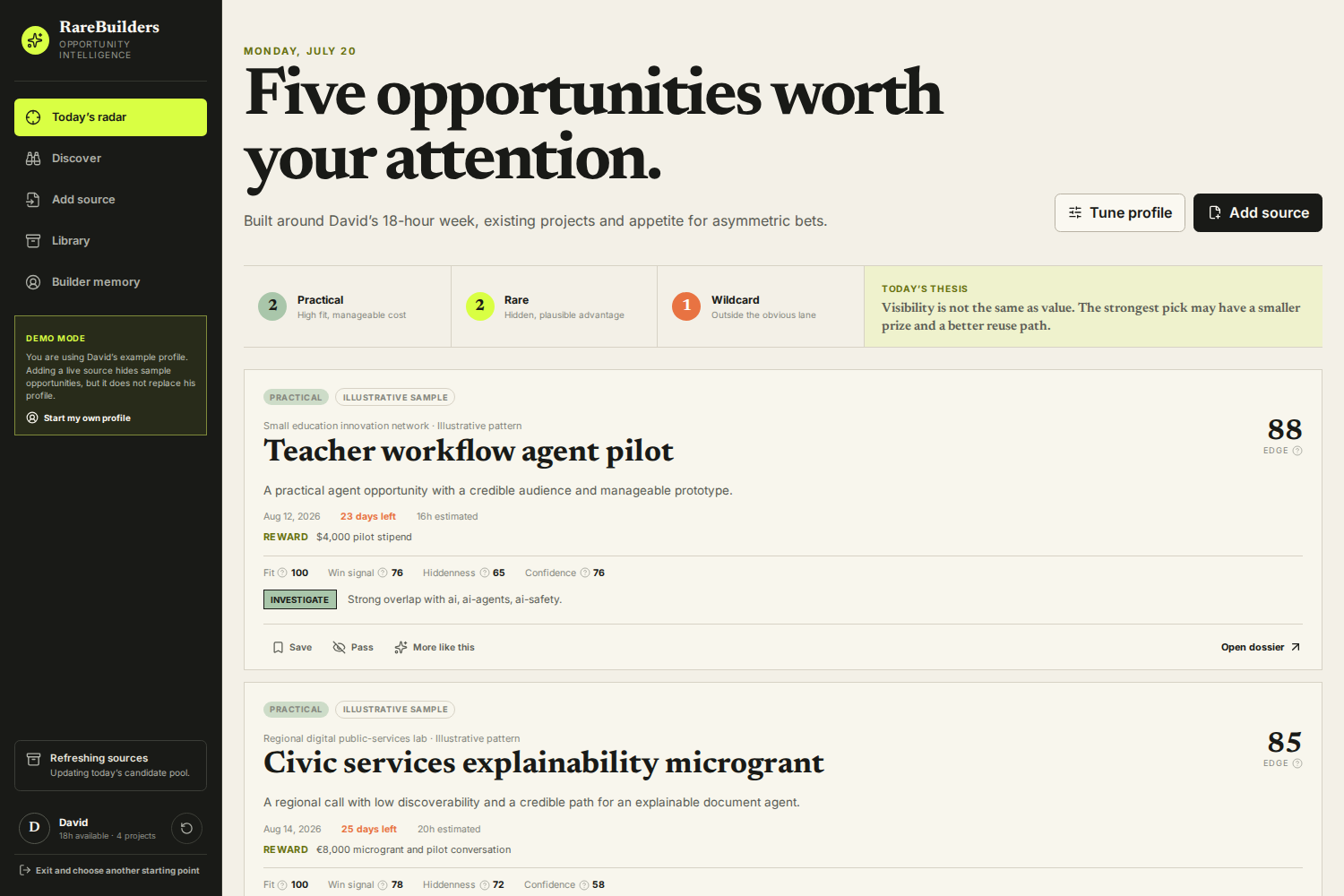
RareBuilders is an explainable opportunity radar for independent builders and small teams. It combines a builder's skills, interests, experience, projects, constraints, and selected sources to recommend a finite radar of up to five opportunities:
- two practical moves;
- two rare opportunities;
- one wildcard.
When the available evidence cannot honestly satisfy a category, RareBuilders labels the recommendation closest available instead of silently changing the definition.
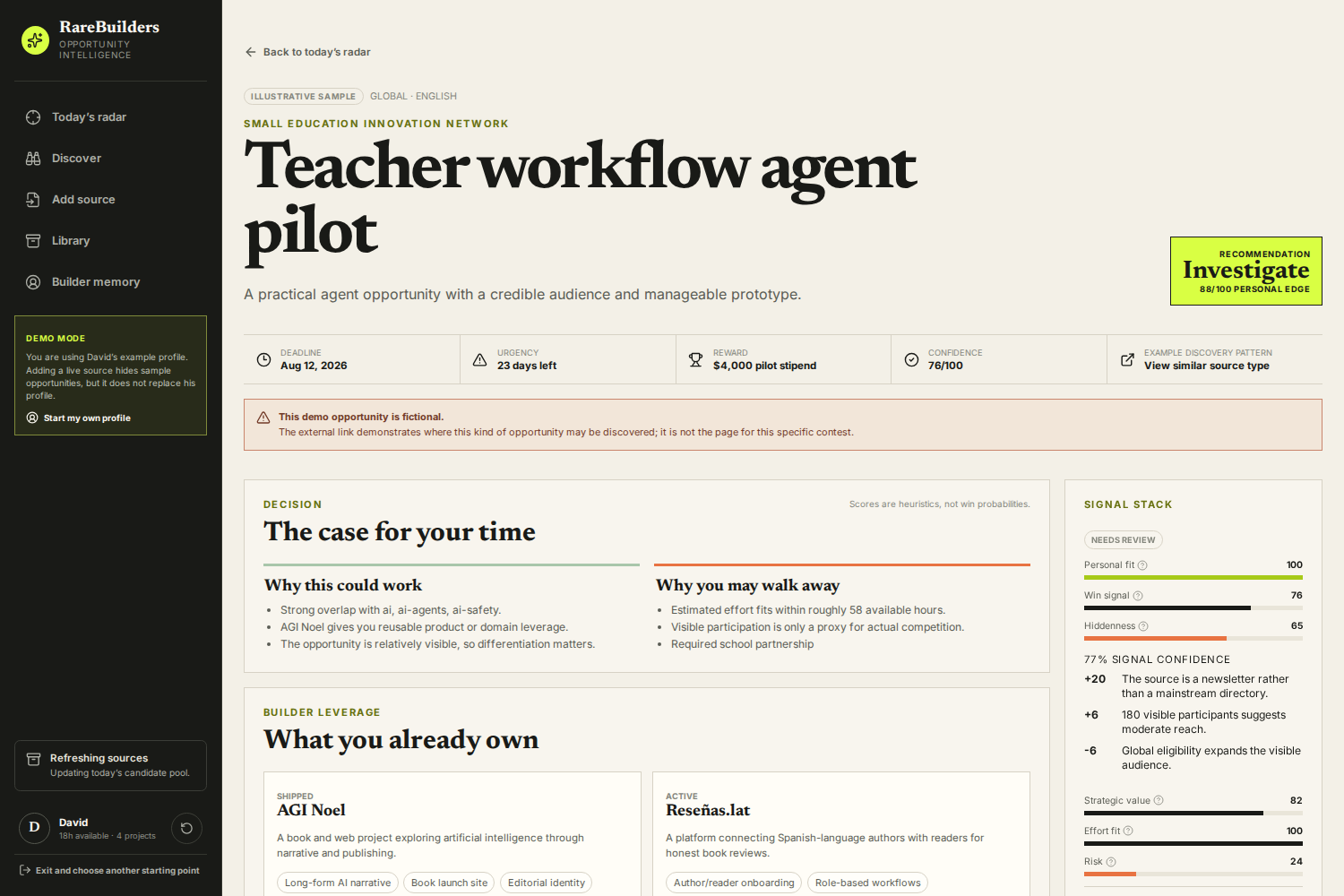
Each opportunity opens into a decision dossier containing:
- reasons to pursue it and reasons to walk away;
- matching skills, interests, and reusable project assets;
- reward, deadline, eligibility, participation cost, and missing information;
- separate Fit, Win Signal, Hiddenness, Strategic Value, Effort, Risk, and Confidence signals;
- observable factors explaining Hiddenness;
- a source-grounded participation strategy, hard risks, and three concrete first actions.
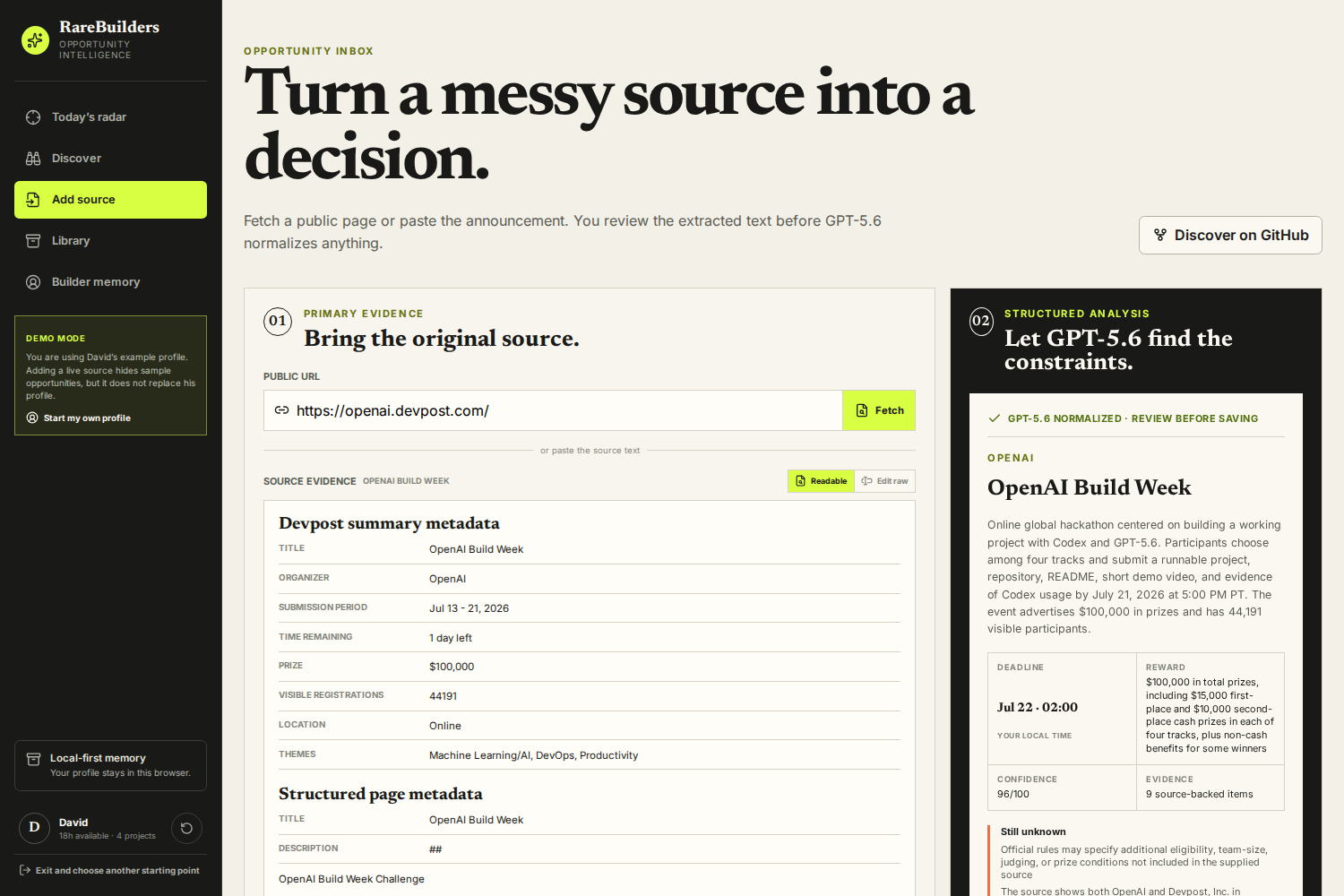
Users can start immediately with a clearly labelled demo or create a personal radar through six decisions. They can add public URLs, pasted text, a CV, selected Markdown notes, or selected public GitHub repositories. Public discovery connectors support GitHub, Devpost, EU opportunities, and Kaggle.
Decisions and preferences remain separate. Pass removes an opportunity from the active radar but keeps it recoverable. More like this and Less like this teach future ranking. Structured pass reasons adjust relevant constraints, while private notes remain in the browser.
How I built it
RareBuilders is a React and TypeScript application deployed on Vercel. GPT-5.6 acts as the language-intelligence layer through validated structured outputs. It performs three essential tasks:
- It converts unstructured opportunity evidence into source-linked facts, requirements, deadlines, deliverables, and explicit unknowns.
- It builds an editable project inventory from only the CV, notes, and public repositories the user explicitly selects.
- It proposes a builder-specific participation angle, hard risks, and exactly three first actions.
The model does not control the final decision. Deterministic TypeScript calculates Fit, Hiddenness, Win Signal, Strategic Value, Effort, Risk, hard gates, radar composition, persistence, and feedback learning. Hiddenness is calculated from observable signals such as source type, reach, language, region, aggregator presence, and participant data, not invented by GPT.
The backend uses Vercel functions, the OpenAI API, Zod validation, and Upstash Redis. Factual analysis is cached by normalized source evidence rather than the changing user profile. Atomic quota reservations protect the shared AI budget, while the URL ingestion layer includes SSRF protection, redirect limits, content limits, and strict competition matching.
Codex was my primary engineering collaborator. I used it to:
- audit the competition requirements;
- transform the initial prototype into typed domain contracts;
- design deterministic scoring and feedback learning;
- integrate GPT-5.6 structured outputs;
- build and debug source adapters;
- harden caching, quotas, and URL ingestion;
- refine the product's visual and interaction system;
- create unit and end-to-end tests;
- review the product from judge, QA, UX, and first-time-user perspectives.
I made the product thesis, audience, privacy boundaries, track, interface, budget, and release decisions. Codex helped implement those decisions, challenge weak assumptions, test the result, and turn feedback into working product behavior.
Challenges I ran into
The hardest challenge was keeping the product honest while still making AI genuinely useful.
Opportunity sources are inconsistent. They omit fields, use different terminology, contain marketing language, and sometimes expose only partial public information. GPT-5.6 is effective at interpreting that material, but asking a model to invent final scores would create false precision.
We therefore separated language interpretation from deterministic decision logic. GPT-5.6 extracts and explains evidence; observable code calculates the decision signals.
Source ingestion created another difficult boundary. A Devpost URL can contain tracking parameters, API metadata, dynamic HTML, or incomplete content. RareBuilders canonicalizes references, combines safe public evidence, rejects mismatched competition results, and reports unknown fields instead of filling them with guesses.
The learning loop also required careful normalization. Labels such as AI Agents, ai-agents, and AI agents must teach the same preference, while a new vote must replace the previous effect rather than accumulate contradictory weights.
Finally, the radar had to remain honest when there were not enough suitable candidates. Instead of filling every bucket with a misleading recommendation, RareBuilders explicitly identifies the closest available alternative.
Accomplishments I'm proud of
- A no-sign-up judge path that communicates the product in about one minute.
- A real source pipeline capable of normalizing the OpenAI Build Week page itself.
- Explainable scoring where deterministic code owns Hiddenness and ranking.
- Honest radar composition with visible closest available fallbacks.
- Consent-driven builder memory from CVs, Markdown, and selected public repositories.
- Reversible decisions, structured learning, and candidate history.
- Browser-local private notes.
- Quota, cache, URL-safety, and graceful-degradation controls suitable for a public demo.
- 63 passing unit tests and 7 passing end-to-end tests.
- A complete production experience rather than a technical proof of concept.
What I learned
Personalization is not simply collecting more profile fields. The valuable part is connecting a builder's capabilities, interests, constraints, and existing assets to the cost and shape of a specific opportunity.
I also learned that an AI product becomes more credible when it clearly shows where the model stops. GPT-5.6 interprets language and proposes strategy; observable rules calculate the decision signals.
A finite shortlist also creates a better learning loop than an endless feed. Passing one opportunity becomes meaningful when it promotes a visible next candidate and the user can understand what changed.
RareBuilders does not give multidisciplinary builders more possibilities. They already have too many. It gives them the clarity to choose.
What's next for RareBuilders
My first next step would be moving RareBuilders beyond browser-only persistence.
I would add accounts, durable personal profiles, and a secure database for the builder inventory, radar, feedback history, saved decisions, and imported sources. That would let me keep one evolving profile across devices instead of tying it to a single browser.
I would keep privacy boundaries explicit: users should choose which CV, repository, note, or source becomes part of their persistent profile, while private notes remain private by default.
After that foundation, I would expand reliable source coverage beyond hackathons into grants, pilots, bounties, residencies, calls for proposals, and local programs. I would add deadline monitoring, source-change alerts, and evaluation against actual applications and outcomes.
Shared workspaces and privacy-preserving project inventories for small multidisciplinary teams would follow the individual account experience. That is a future direction, not a claim about the current single-builder product.
My long-term goal is not to predict winners. It is to help independent builders allocate scarce time where their skills, interests, and projects create the strongest asymmetric advantage.
Built With
- cheerio
- codex
- githubapi
- gpt-5.6
- kaggleapi
- openaiapi
- playwright
- react
- redis
- typescript
- vercel
- vite
- vitest
- zod

Log in or sign up for Devpost to join the conversation.