Inspiration
Resource allocation decisions often happen under time pressure and uncertainty.
In many real-world situations, the difficulty is not only choosing what to do, but understanding the trade-offs behind each choice.
The initial inspiration came from emergency response scenarios, where time pressure is extreme and decisions can carry serious consequences.
That high-stakes environment raised a question:
Can AI help people reason about allocation decisions under pressure?
While exploring this idea, it became clear that the same reasoning framework could apply beyond emergencies.
With small adjustments, it could support logistics scenarios, which are more common and commercially relevant.
This led to the design of two modes:
- A logistics mode for broader applicability
- An emergency mode for urgency-driven scenarios
RapidResponse Planner was shaped by this evolution.
What it does
RapidResponse Planner is an AI-powered decision intelligence demo for resource allocation.
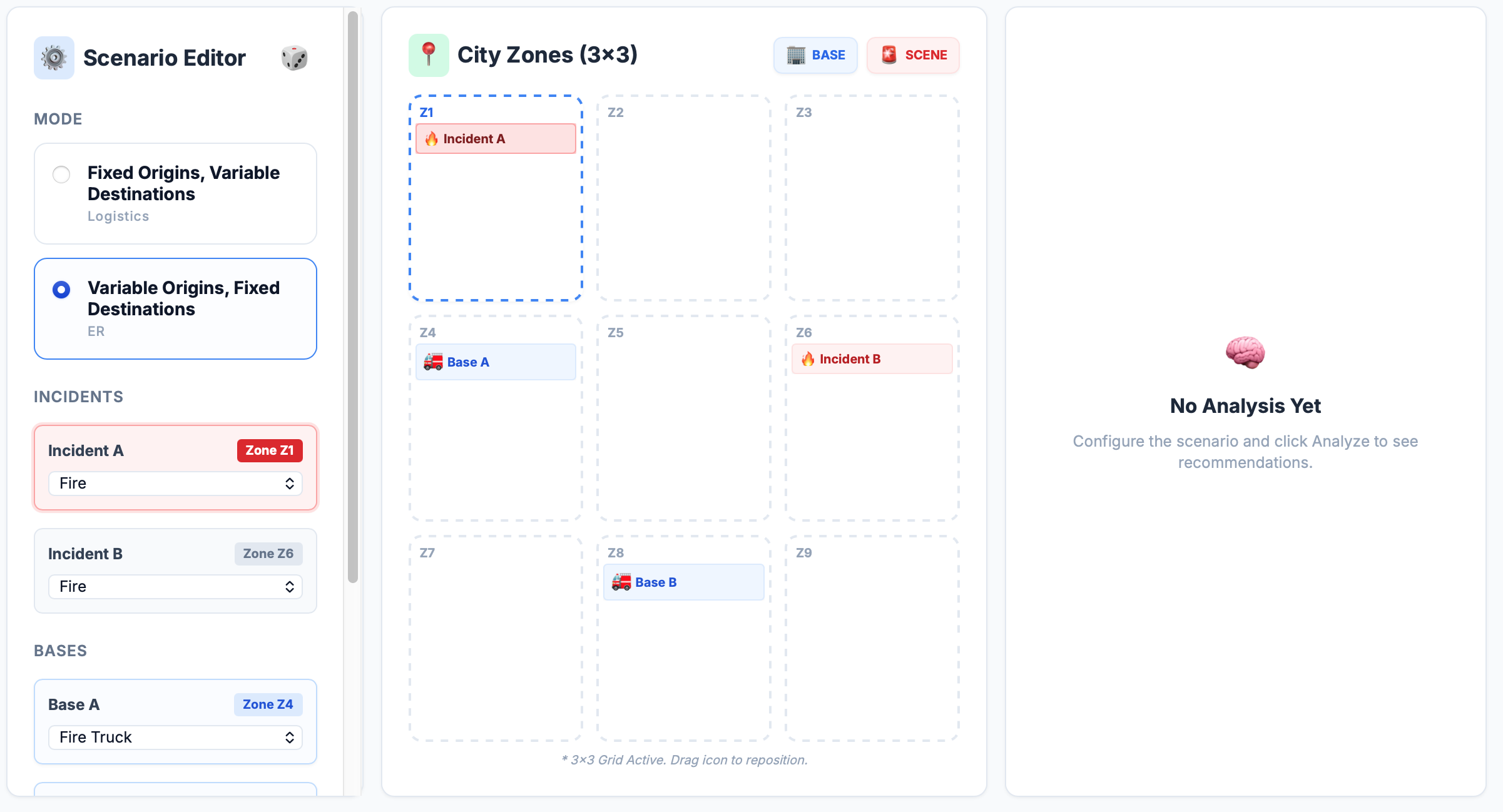
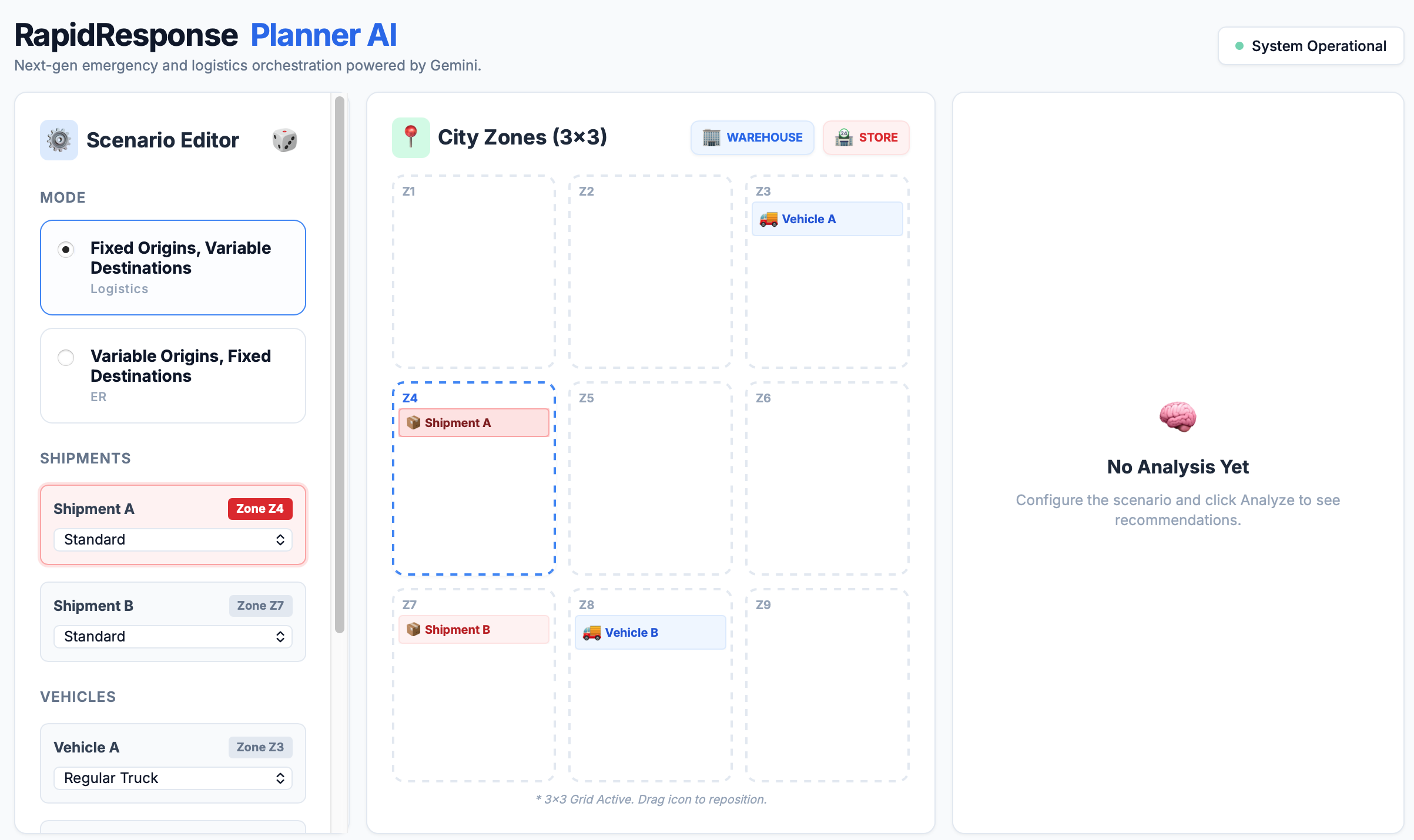
It supports two domains:
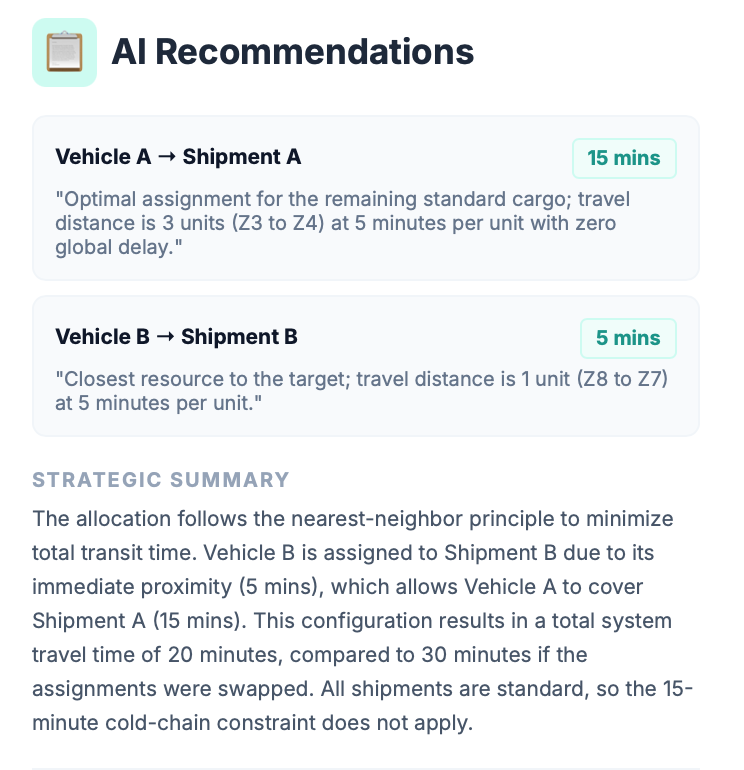
- Logistics delivery (compatibility and priority-driven decisions)
- Emergency response (urgency-driven decisions)
Instead of performing real optimization, the system focuses on:
- Generating plausible allocation suggestions
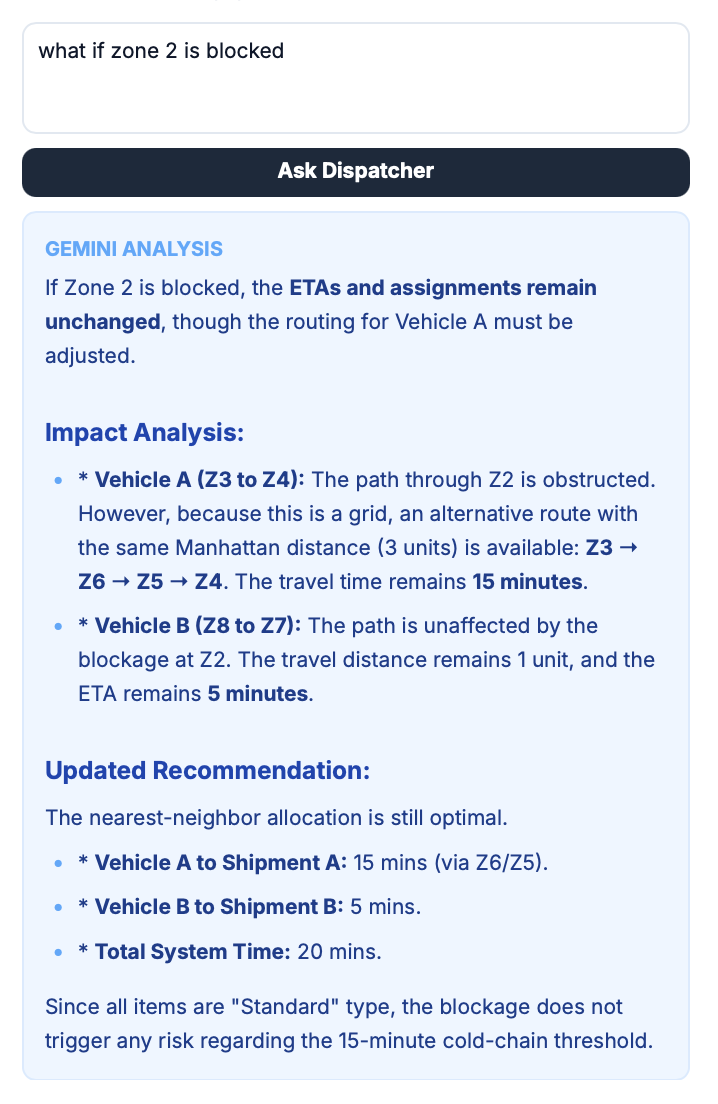
- Explaining the reasoning in human-readable terms
- Showing how delays change risk and outcomes
The goal is transparency and learning, not automation.
How we built it
We designed a simplified environment using:
- A 3×3 mock city grid (Z1–Z9) for abstract spatial reasoning
- Structured scenario inputs (tasks, resources, delay)
- Carefully designed prompts in Google AI Studio
The AI is guided to:
- Avoid claiming real-world accuracy
- Focus on trade-offs and explanations
- Stay scenario-consistent across domains
This allowed rapid prototyping without building a full dispatch system.
Challenges
One key challenge was avoiding the illusion of “AI optimization.”
It is easy for AI demos to overpromise.
We intentionally constrained the system to:
- Not compute real routes
- Not claim optimality
- Not replace human decision-makers
Another challenge was prompt stability — ensuring consistent, meaningful explanations across different scenarios and modes.
What we learned
We learned that AI can be valuable not as a decision-maker, but as a decision explainer.
Even simple scenarios become more insightful when trade-offs are made explicit.
This project also showed how lightweight prototypes can explore serious system design questions without heavy engineering.
What's next
Future directions could include:
- Training and simulation use cases
- Educational tools for operations planning
- Expanded scenario libraries
RapidResponse Planner explores how AI can assist human reasoning in allocation decisions — not by replacing judgment, but by making trade-offs clearer.
Built With
- css
- gemini3
- google-cloud
- googleaistudio
- html
- react
- typescript

Log in or sign up for Devpost to join the conversation.