-
-
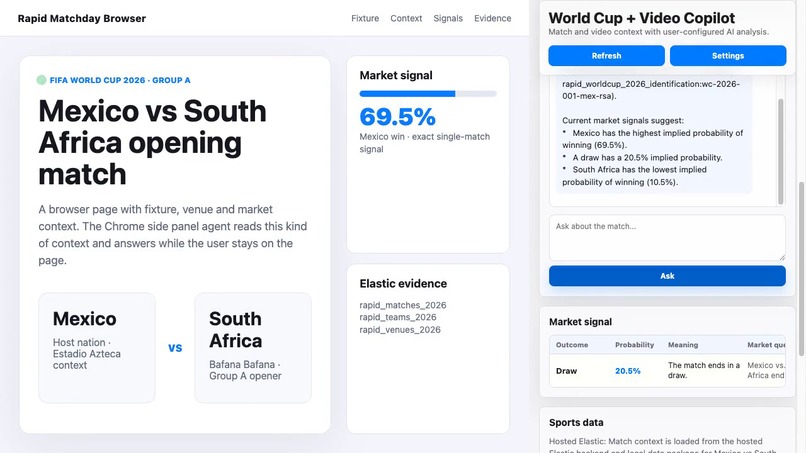
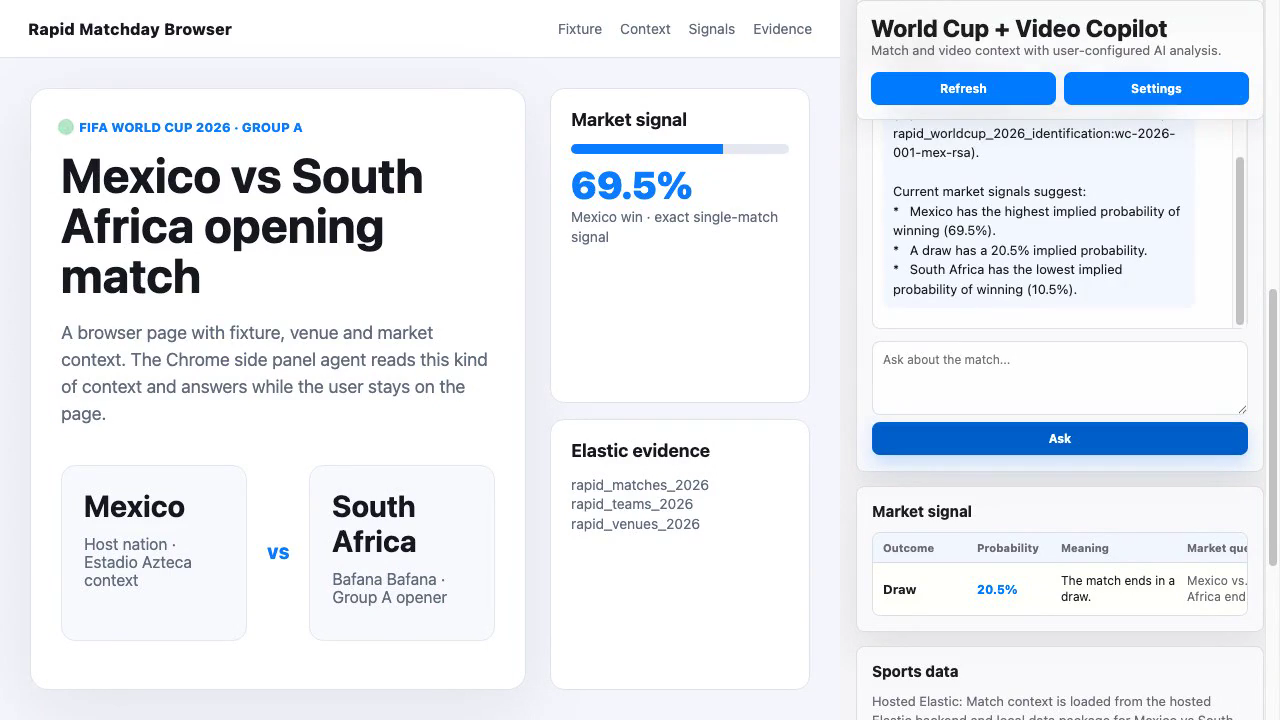
Chrome side panel reading exact World Cup match context, market signals, and Elastic evidence.
Inspiration
What it does
How we built it
Challenges we ran into
Accomplishments that we're proud of
What we learned
What's next for Rapid Elastic Matchday Agent
Inspiration
Watching a World Cup match or a long-form video often creates the same problem: the user has questions right now, but the useful context is scattered across the page, schedules, team data, player data, commentary, captions, and external evidence sources. We built Rapid Elastic Matchday Agent so the user can stay on the page and ask a normal question from a Chrome side panel instead of opening tabs, searching manually, or learning how to prompt an AI assistant.
What it does
Rapid Elastic Matchday Agent is a Chrome side-panel agent for matchday and video context.
For World Cup pages, the extension identifies the current fixture and loads compact structured context: teams, kickoff, venue, group/stage, roster previews, and exact-match market signals. The goal is to let a user understand a match, the teams, and the players with minimal effort while they are watching or reading.
For video pages, the same browser-context layer can use metadata, visible captions when available, short user-triggered replay windows, and page context to explain what is happening in the video or commentary. It is designed with a strict no-spoiler rule: it should not reveal future plot or match context beyond what the user has already reached.
The system also exposes a hosted API path so the browser extension, web demo, and future clients can all call the same agent backend.
Key features
- Chrome side-panel UX: ask questions without leaving the active page.
- World Cup context: fixture recognition, match data, team/player context, venue context, and exact-match signals.
- Video and commentary understanding: metadata, captions, and short user-triggered media windows for pages that need richer context.
- Evidence-backed answers: the agent preserves Elastic evidence IDs so judges and developers can inspect where an answer came from.
- API-ready architecture: a hosted Cloud Run API normalizes browser context and routes requests to the agent backend.
- User-first context loading: the user does not need to manually explain the page, teams, players, or current video state.
How we built it
The browser extension captures only the active-page context needed for the current question. It sends that context to a hosted API on Google Cloud Run. The backend uses Google Cloud Agent Builder / Vertex AI Agent Engine with Gemini as the only LLM provider for the competition version.
Elastic is used as the evidence and retrieval layer. Match, team, venue, video, and market-context records are stored and retrieved through Elasticsearch and Elastic MCP. The agent returns evidence IDs alongside answers so the response is traceable instead of being a black-box guess.
Google Cloud is used for the hosted agent path, Gemini model execution, and the deployed API surface. Elastic is used for structured retrieval, evidence memory, and MCP-backed tool access.
Challenges
The hardest part was making the product useful inside the browser without overloading the model with unnecessary tokens. We kept the extension lightweight, used exact-match retrieval for sports context, and treated video analysis as user-triggered short windows rather than continuous surveillance. Another challenge was keeping the competition build compliant: it uses Gemini only, removes other AI provider selectors, and keeps API keys out of the browser.
What we learned
A good browser agent should not ask the user to become a prompt engineer. It should first understand the page, identify the domain context, retrieve the right structured data, and then let the user ask natural questions. Google Cloud and Elastic work well together for this pattern: Gemini handles reasoning and answer generation, while Elastic provides fast, inspectable retrieval and evidence.
What's next
Next steps include deeper player-level data coverage, better automatic video context packaging, richer no-spoiler controls for shows and films, and broader API support so the same evidence-backed agent can be embedded in other live sports or media experiences.
Built With
- chrome
- cloud-run
- elastic
- elastic-mcp
- elasticsearch
- fifa-world-cup-2026-data
- gemini
- google-cloud
- google-cloud-agent-builder
- javascript
- manifest-v3
- node.js
- polymarket-api
- react
- typescript
- vertex-ai-agent-engine
- vite

Log in or sign up for Devpost to join the conversation.