Inspiration
ranveerAI — Human-Like Conversational Voice AI
Inspiration
Most businesses lose customers because they cannot respond instantly or maintain high-quality communication at scale. Traditional IVR systems feel robotic, frustrating, and incapable of understanding natural conversations.
We were inspired by the idea of creating an AI voice agent that sounds genuinely human, responds in real time, and can handle sales, support, scheduling, and customer engagement without making conversations feel artificial.
The goal behind ranveerAI was simple: build an AI communication system that people actually enjoy talking to.
We also explored how modern LLMs, speech synthesis, and real-time audio pipelines could work together to create emotionally natural and context-aware conversations.
What it does
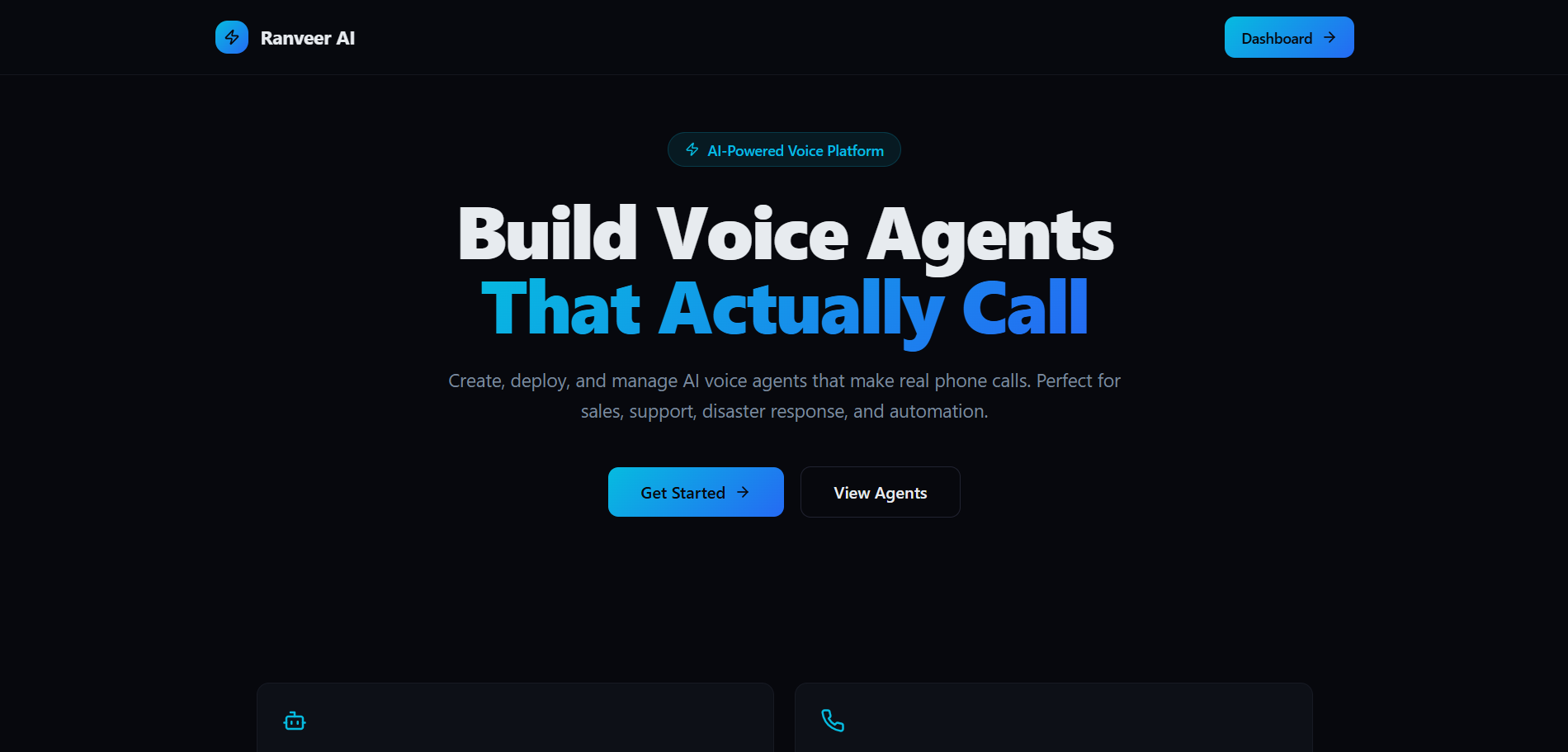
ranveerAI is a real-time AI voice platform that can:
- Handle inbound and outbound phone calls
- Talk naturally with human-like voice responses
- Understand user intent using conversational AI
- Schedule appointments automatically
- Provide customer support 24/7
- Perform AI-powered lead qualification
- Integrate with CRM systems and workflows
- Generate conversation summaries and analytics
Unlike traditional bots, ranveerAI focuses heavily on:
- low latency
- emotional voice realism
- contextual memory
- interruption handling
- intelligent dialogue flow
How we built it
We designed ranveerAI using a modular AI pipeline architecture:
User Speech
   ↓
Speech-to-Text Engine
   ↓
LLM Conversation Layer
   ↓
Context + Memory Engine
   ↓
Text-to-Speech Synthesis
   ↓
Human-like Voice Output
The backend handles:
- real-time audio streaming
- session management
- prompt orchestration
- latency optimization
- conversational state tracking
We used:
- streaming speech recognition
- transformer-based LLMs
- vector memory systems
- websocket communication
- cloud-hosted APIs
- scalable backend microservices
We also optimized response timing mathematically to reduce conversational delay:
$$ Latency = T_{STT} + T_{LLM} + T_{TTS} $$
Our focus was minimizing total response latency while maintaining high conversational quality.
Challenges we ran into
Building realistic conversational AI was much harder than expected.
Some major challenges included:
Real-Time Latency
Even small delays make AI conversations feel unnatural. We had to optimize streaming pipelines aggressively.
Human-Like Voice Interaction
Generating speech that feels emotionally natural while remaining responsive required careful tuning.
Context Retention
Maintaining conversation memory across long calls without hallucinations was difficult.
Interruptions & Turn-Taking
Humans interrupt each other naturally during conversations. Handling overlapping speech in real time was a major engineering challenge.
Scalability
Designing infrastructure capable of handling multiple simultaneous voice sessions efficiently required careful backend optimization.
What we learned
Through this project we learned:
- Real-time AI systems are fundamentally different from normal web apps
- Voice interaction design matters as much as the AI model itself
- Low latency is critical for natural conversations
- Conversation memory dramatically improves user experience
- Building production-grade AI requires balancing speed, accuracy, and scalability
Most importantly, we learned that conversational AI is moving beyond chatbots into fully interactive digital agents.
Future Scope
In the future, we plan to add:
- multilingual real-time translation
- emotion-aware voice modulation
- AI sales coaching
- enterprise analytics dashboard
- autonomous workflow execution
- custom voice cloning
- healthcare and banking integrations
- AI agents for recruitment and education
Our vision is to make ranveerAI a complete operating system for AI-powered business communication.
Built With
- amazon-web-services
- apis
- css
- databases
- docker
- fastapi
- node.js
- openai
- postgresql
- python
- react
- stt
- tailwind
- tts
- typescript
- vector
- websockets
- whisper


Log in or sign up for Devpost to join the conversation.