-
-
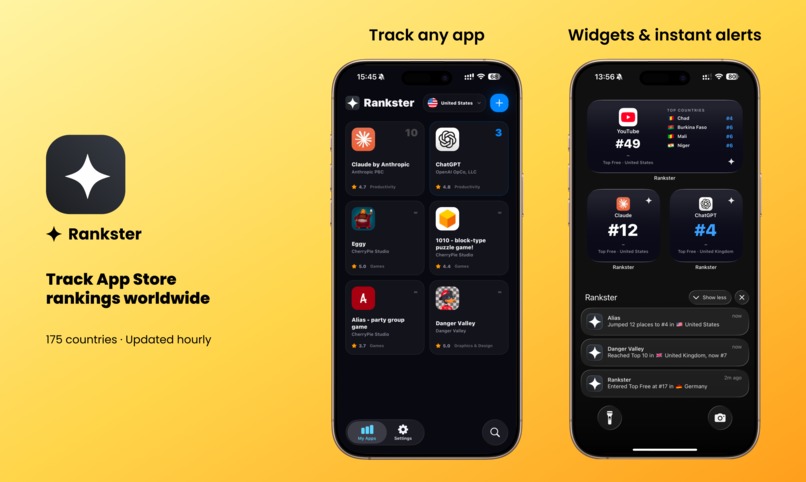
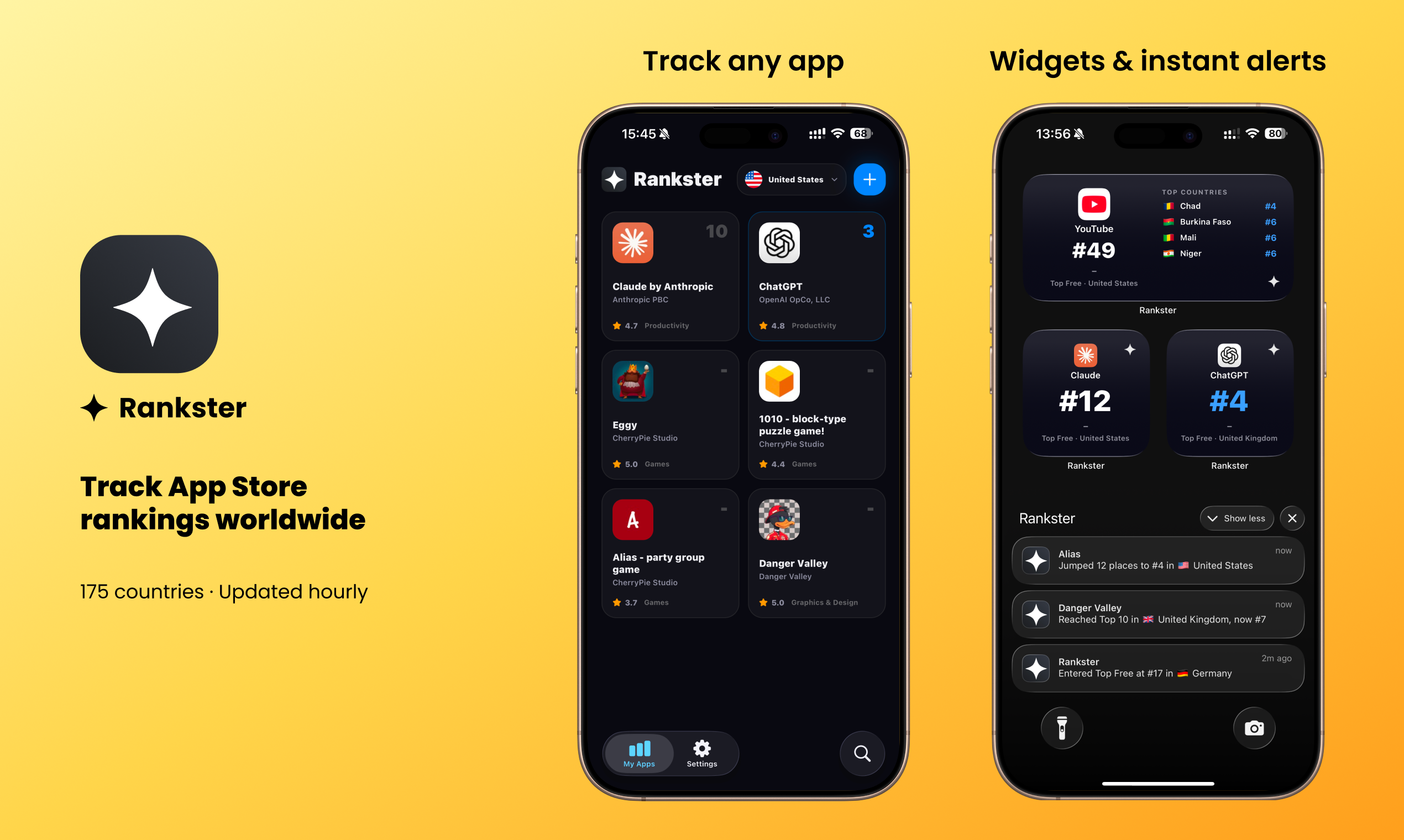
Track App Store rankings worldwide
-
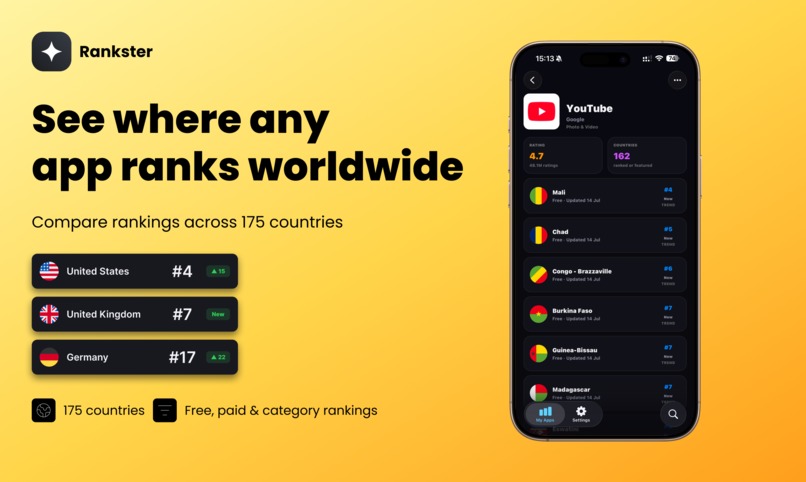
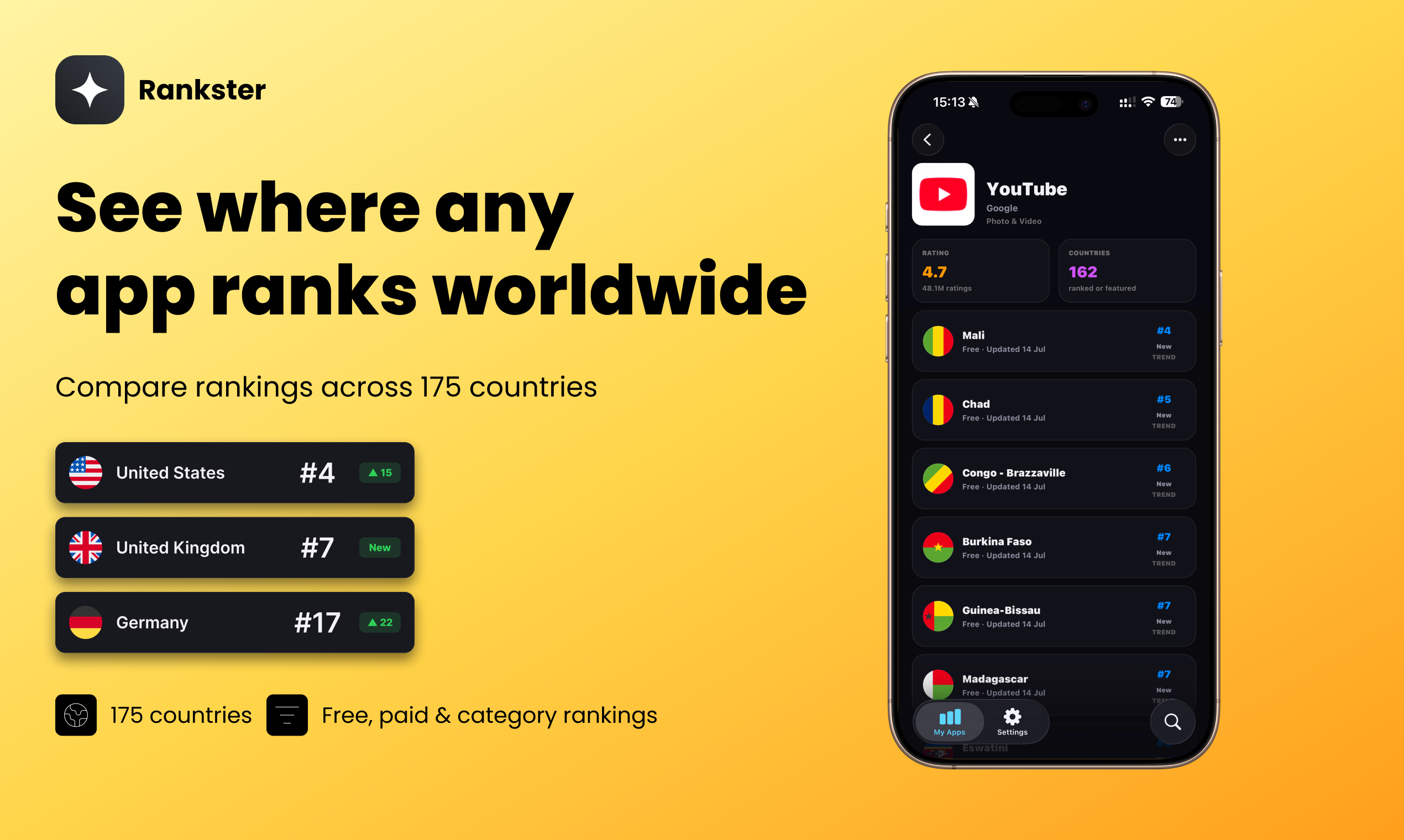
See where any app ranks worldwide
-
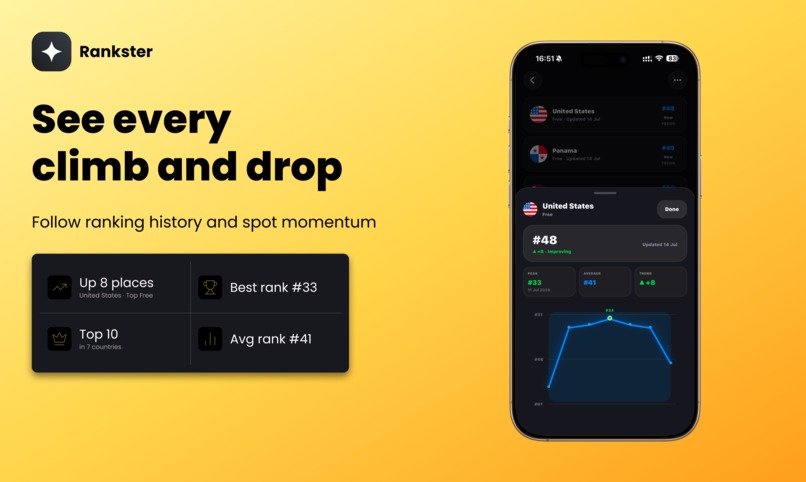
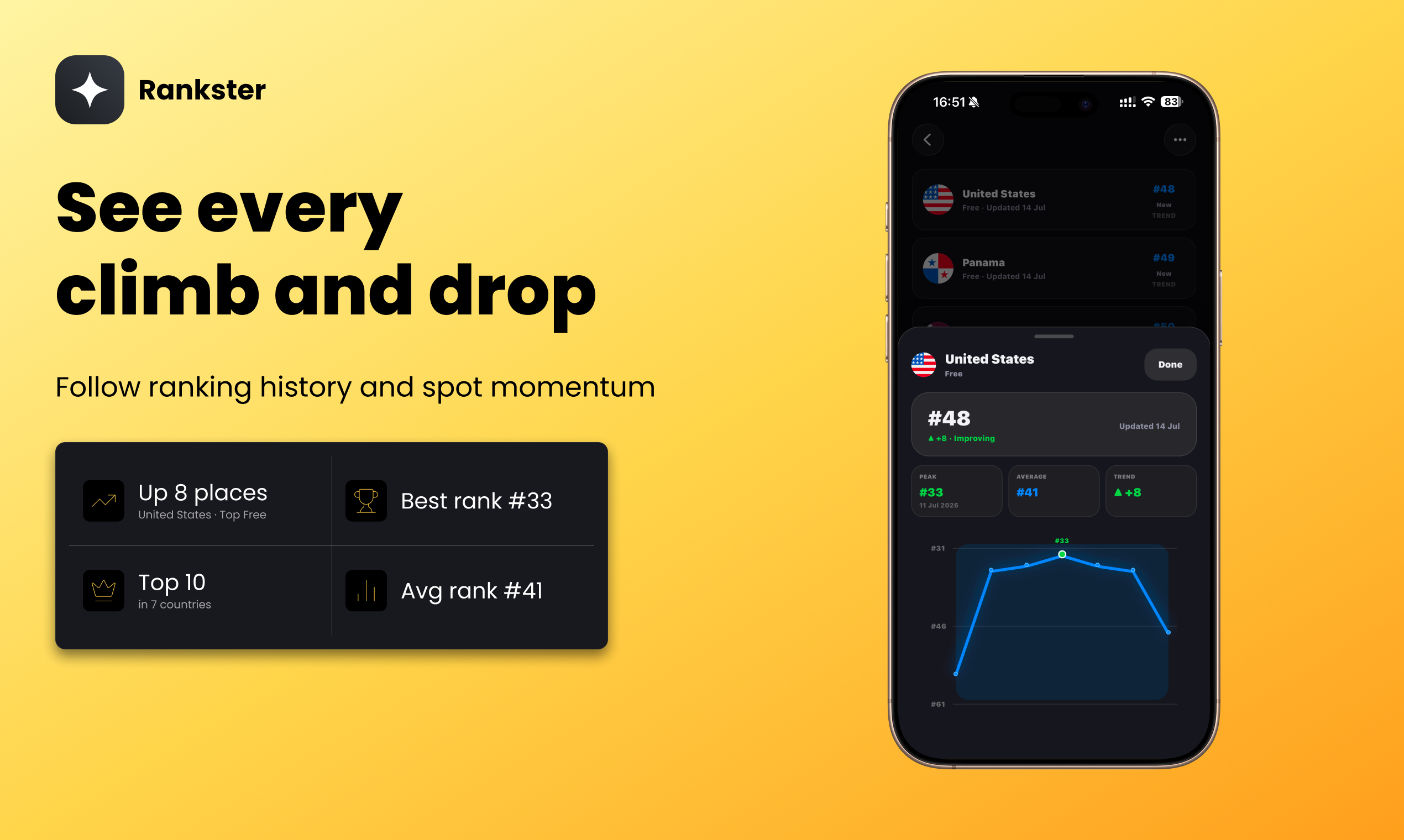
See every climb and drop
-
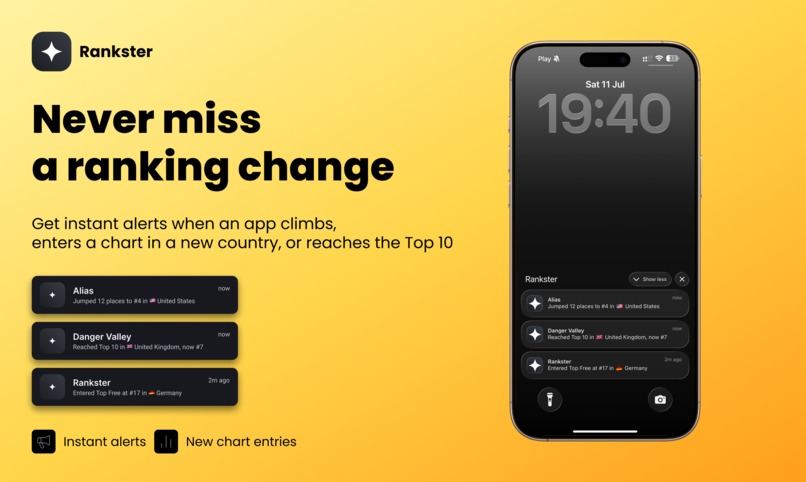
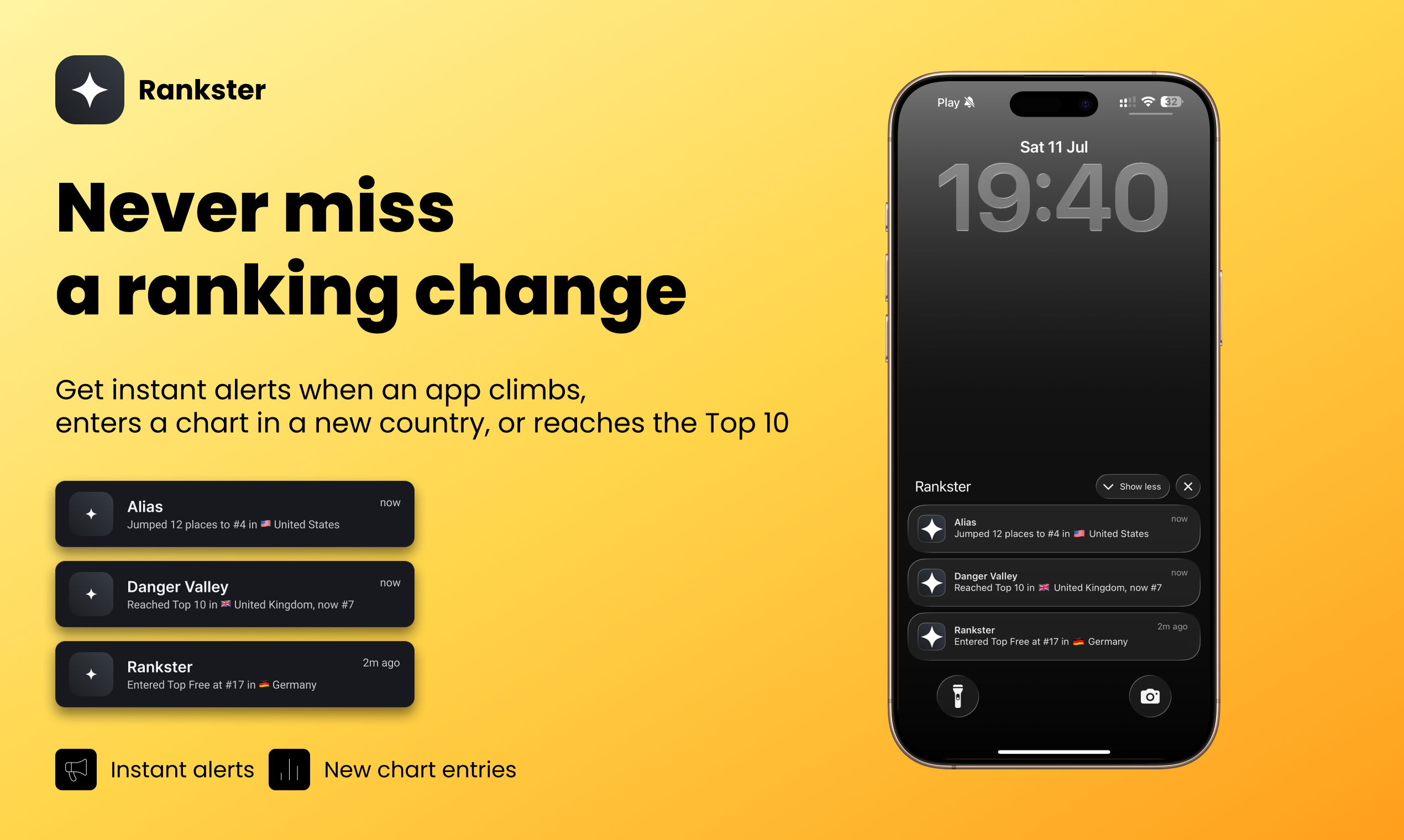
Never miss a ranking change
-
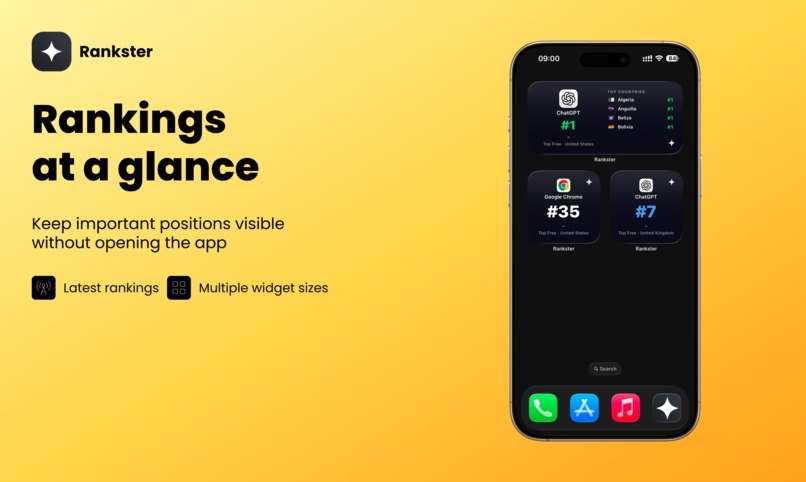
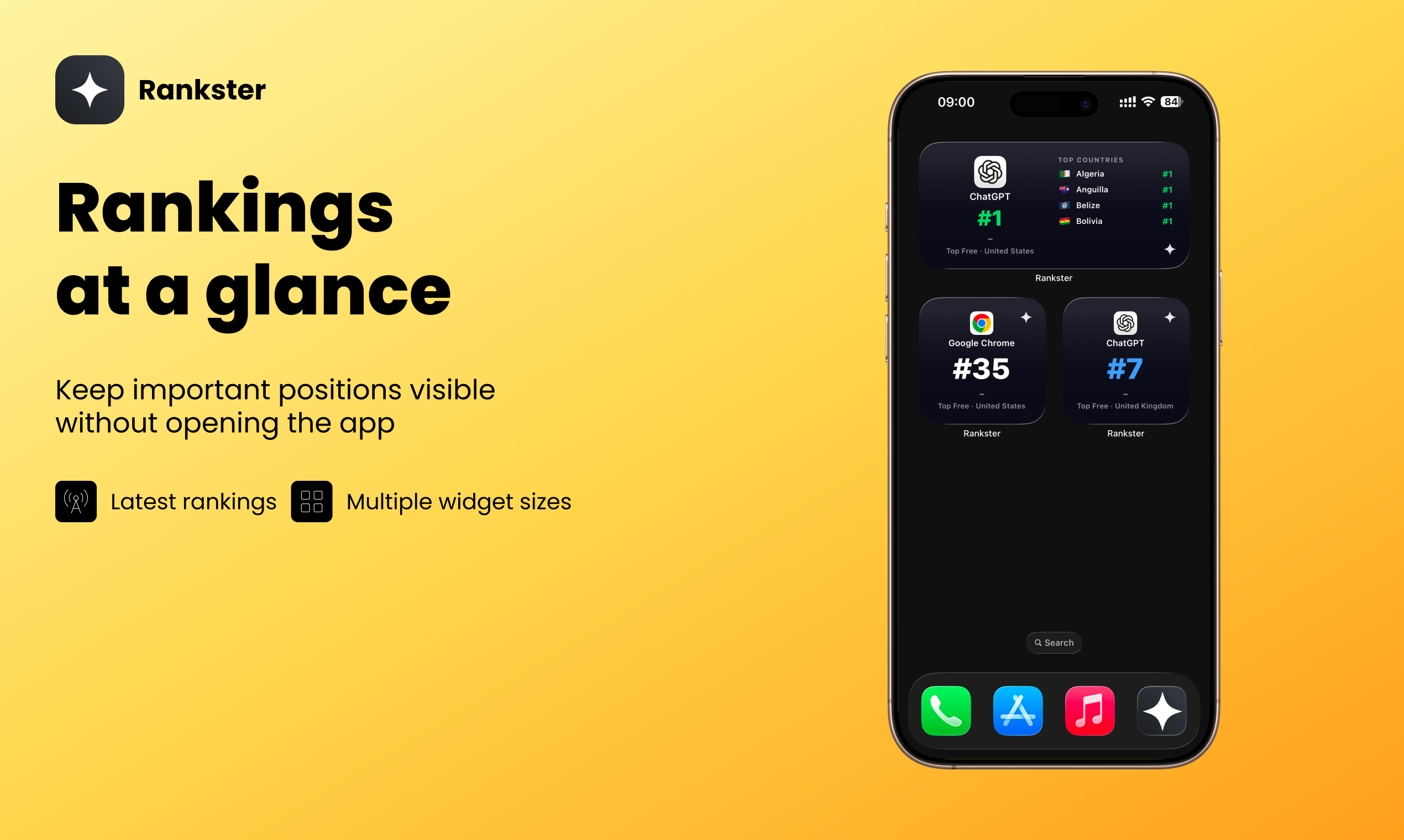
Rankings at a glance
Inspiration
App rankings are global, but the tools for monitoring them are still surprisingly manual. An app can enter the Top 10 in Germany, start climbing in Japan, or appear in a new chart overnight—and the team behind it may never notice. Developers and marketers often check countries one by one, rely on delayed reports, or only watch their home market.
I built Rankster to make those moments visible. It is a ranking intelligence app that monitors iOS, macOS, and Android products across storefronts, preserves their history, and alerts people when something important changes.
What it does
Rankster lets users search for any public app, add it to a watchlist, and see where it ranks across countries and chart types. Users can explore historical movement, compare markets, receive alerts for climbs and new chart entries, and keep important positions visible through iPhone Home Screen widgets.
When an app reaches a milestone, Rankster can also turn the result into a shareable image or animated video. This helps indie developers and app teams turn ranking data into something they can understand, act on, and celebrate.
How I built it
Rankster has a React Native and TypeScript mobile client backed by a Node.js/Express API and MongoDB. A scheduled scanning pipeline collects chart data for iOS, the Mac App Store, and Google Play, normalizes different store identifiers into one shared model, and stores current and historical ranking snapshots.
The mobile app uses Firebase for anonymous identity and push delivery, RevenueCat for subscription state, and a native WidgetKit extension for Home Screen widgets. A native Swift media exporter renders ranking achievements as images and looping videos directly on the device.
What I built during OpenAI Build Week
The whole Rankster app was built during the Build Week. I used Codex with GPT-5.6 as my engineering partner to turn it into a broader, cross-platform product.
Work includes:
- iOS App Store app tracker
- Mac App Store search, chart scanning, ranking history, categories, and featured placements
- Google Play search and chart ingestion for Android apps
- Android category placements, local ratings, and country availability
- A unified storefront model across iOS, macOS, and Android
- Storefront-aware watchlists, ranking pages, alerts, links, and share cards
- Scanner health monitoring by storefront
- A redesigned ranking-history chart
- Shareable ranking images and client-side animated MP4 achievements
- Native save-to-Photos and sharing flows
- An animated onboarding experiment controlled through Firebase Remote Config
- Production and App Store reliability improvements
Codex helped me reason through the cross-store data model, implement backend and mobile changes together, debug native Swift and React Native boundaries, review edge cases, and iterate quickly without losing consistency across the product.
Challenges I faced
The largest technical challenge was that the three stores do not expose equivalent data. Apple’s iOS feeds, legacy Mac feeds, App Store web pages, and Google Play all use different identifiers, chart structures, country availability, metadata, and failure behavior. Treating them as interchangeable would create misleading results.
I solved this by introducing an explicit storefront dimension throughout the system. Database indexes, API contracts, cache keys, watchlist identities, scan health, ranking history, notifications, and UI state all include the storefront. Each source has its own adapter, while Rankster exposes one consistent experience to the user.
Another challenge was producing shareable video entirely on-device. React Native could define the composition, but reliable MP4 export and Photos integration required a native Swift bridge, careful timing, and defensive handling of permissions and interrupted exports.
What I learned
I learned that expanding a product from one store to three is not a matter of adding a platform picker. The real work is preserving the meaning and provenance of every ranking while keeping the interface simple.
I also learned where an agentic coding workflow is most valuable. Codex was especially effective when a feature crossed several layers at once—shared TypeScript types, database models, scanners, API routes, React Native UI, native iOS code, analytics, and release configuration. It let me spend more time validating product behavior and less time manually coordinating repetitive changes across the stack.
What's next
Next, I plan to deepen Google Play coverage, add better cross-platform comparisons, and turn ranking changes into smarter explanations: not just that an app moved, but where the momentum started and which markets deserve attention next.
Rankster is live at rankster.app and available on the App Store.


Log in or sign up for Devpost to join the conversation.