
Inspiration
SEO tools show data. Founders still don't know what to do next.
I kept seeing the same pattern: dashboards full of metrics, audits with hundreds of issues, and endless SEO checklists. The real problem wasn't lack of information—it was lack of judgment.
RankQuest was built around a simple question:
What if an SEO system could observe a website continuously and tell you the single most important thing to fix next?
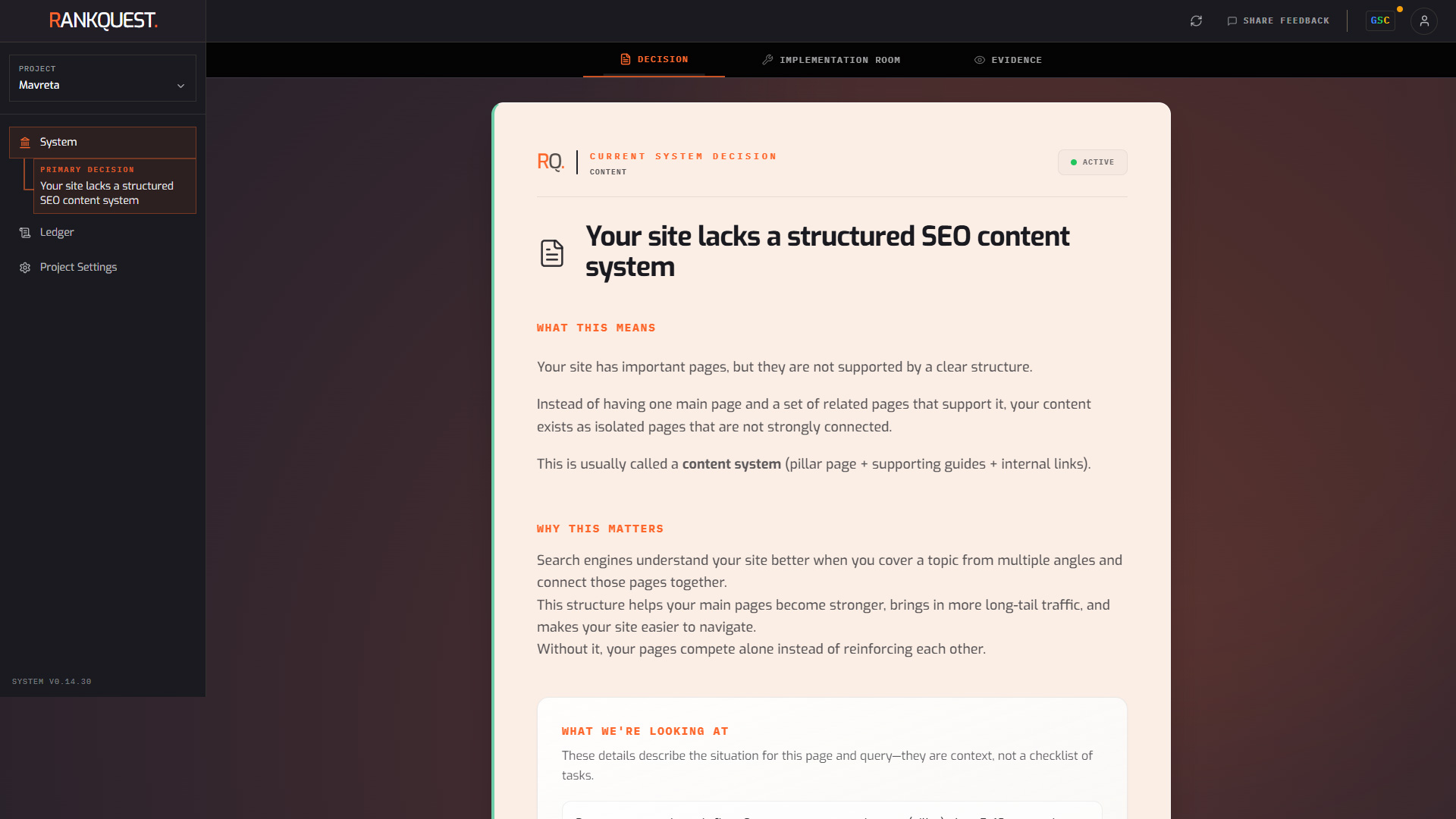
Instead of creating another SEO dashboard, I wanted to build a decision system that transforms observations into actionable judgments and guides users through implementation.
What it does
RankQuest continuously observes a website, evaluates signals, and issues one prioritized SEO decision at a time.
The system:
- Crawls and analyzes websites
- Detects technical, content, and structural SEO issues
- Prioritizes what matters most
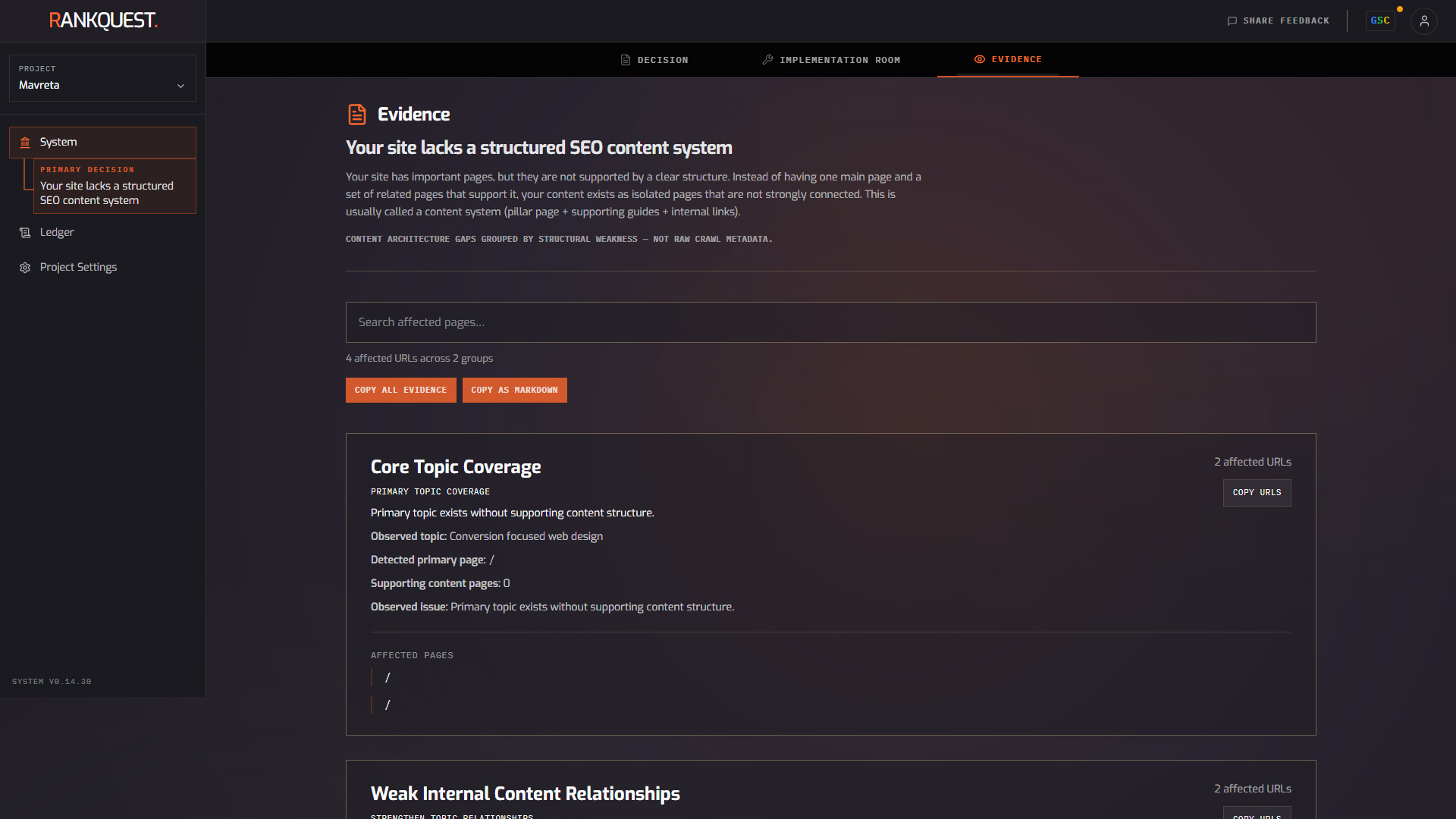
- Provides evidence explaining why a decision was issued
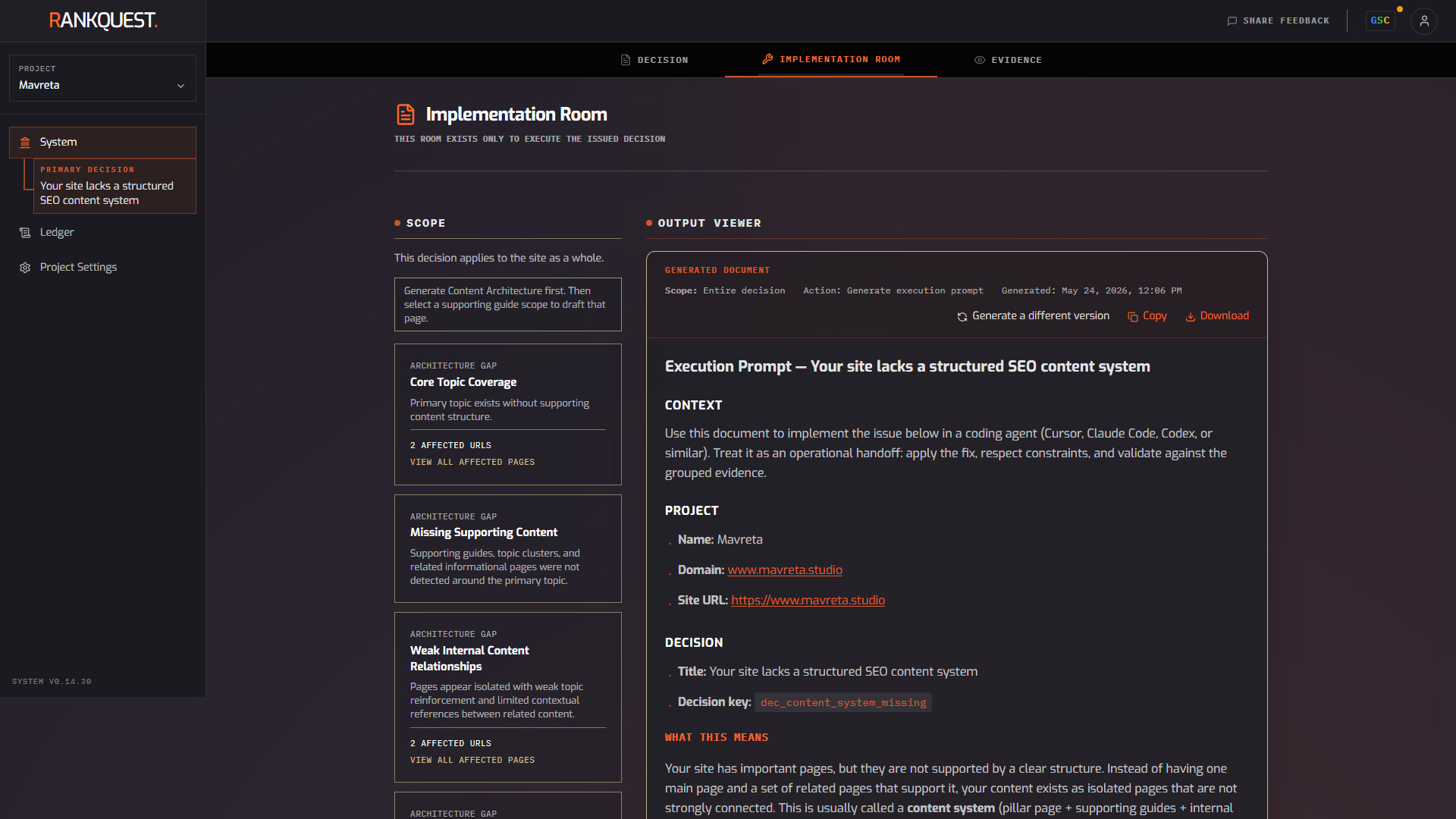
- Generates implementation guidance and execution artifacts
- Re-evaluates the site after changes are made
Users never see hundreds of tasks or SEO scores. They see a single decision, the evidence supporting it, and a guided path toward implementation.
How I built it
RankQuest is built around a custom judgment architecture.
The platform follows a deterministic pipeline:
Observations→ Signals→ Evaluation→ Decision→ Implementation
Key components include:
- A crawling and observation engine
- A signal generation layer
- A deterministic decision engine
- Evidence transformation and grouping systems
- An Implementation Room that generates execution outputs
- AI-assisted content and implementation workflows
- PostgreSQL for persistence
- Background workers for continuous observation and evaluation
A major focus was separating intelligence from execution:
Intelligence decidesGeneration executes
This allows RankQuest to remain predictable, explainable, and auditable while still using AI where it provides value.
Challenges I ran into
The biggest challenge was resisting the temptation to build another dashboard.
Most SEO software surfaces everything it knows. RankQuest intentionally hides complexity and only surfaces what matters.
Some of the hardest problems included:
- Designing a system that issues only one active decision at a time
- Making evidence transparent without overwhelming users
- Building implementation workflows that stay scoped and actionable
- Creating content recommendations that align with business goals instead of chasing traffic
- Maintaining deterministic decision-making while integrating AI generation
Building trust required saying less, not more.
Accomplishments that I'm proud of
- Built a complete observation → decision → implementation architecture from scratch
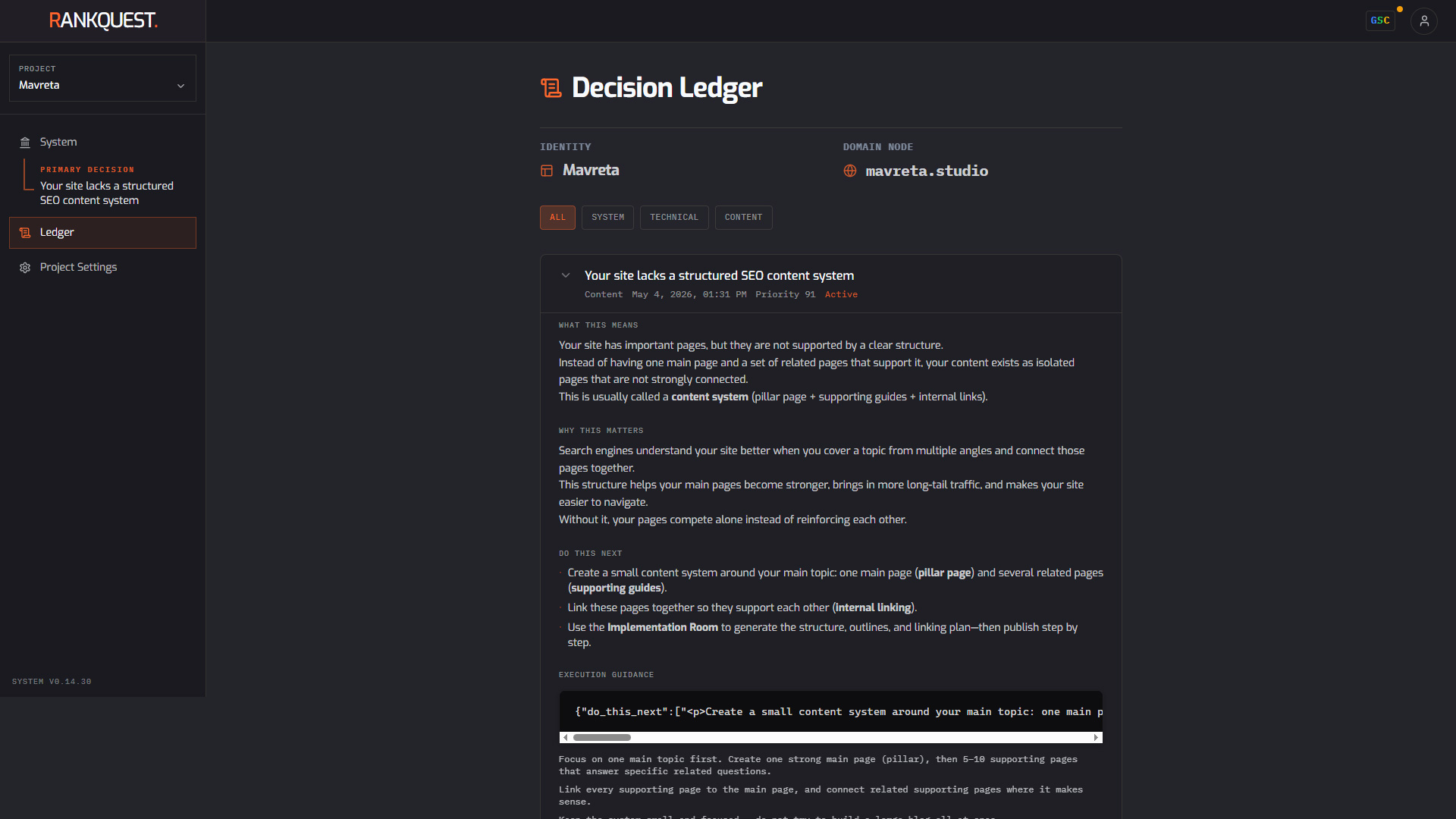
- Created a system that continuously re-evaluates websites instead of running one-off audits
- Developed decision-specific evidence systems to explain recommendations clearly
- Built AI-assisted implementation workflows that generate practical outputs rather than generic advice
- Designed a product that intentionally avoids dashboards, scores, and SEO overwhelm
- Successfully dogfooded RankQuest on its own website to improve the product itself
Most importantly, I built a product that tries to reduce decision fatigue rather than create more of it.
What I learned
Building RankQuest taught me that users rarely need more information.
They need better prioritization.
The biggest lesson was that SEO is often treated as a data problem when it's actually a judgment problem. The challenge isn't discovering issues—it's deciding which issue matters most right now.
I also learned that AI becomes far more useful when it operates inside a structured system instead of replacing the system itself.
Good products don't just provide answers.
They provide clarity.
What's next for RankQuest
The next phase is expanding RankQuest from a decision system into a complete SEO growth protocol.
Upcoming areas include:
- Search Console integration and performance-aware decisions
- Content opportunity intelligence
- Competitor and SERP analysis
- Authority and backlink decisions
- Historical learning from previous decisions and outcomes
- More advanced content strategy generation
- A feedback loop that continuously adapts SEO strategy based on real-world results
The long-term vision is simple:
Create a system that continuously observes a website, understands its goals, learns from outcomes, and tells founders exactly what matters next for organic growth.
Built With
- nextjs
- node.js
- postgresql
- react

Log in or sign up for Devpost to join the conversation.