-
-
Home
-

Image

Inspiration
My drive is full of question papers. Coaching modules, pre-boards, random PDFs at midnight. Great material — useless format.
Practicing them properly meant paying test-series platforms for questions that aren't mine. All I wanted was my own papers, in a real exam interface, without a printer or a payment plan.
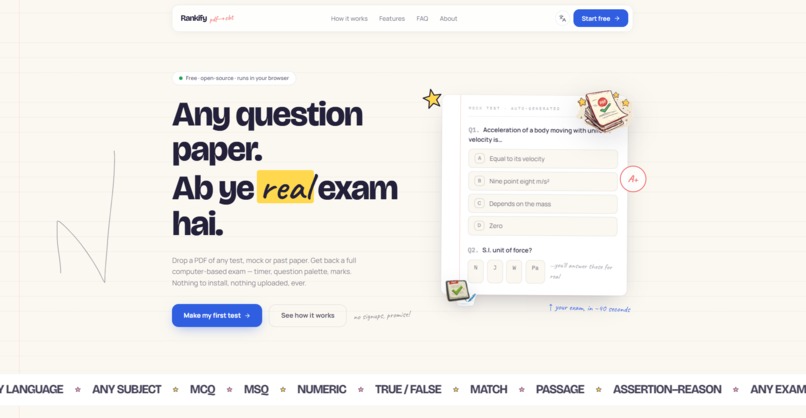
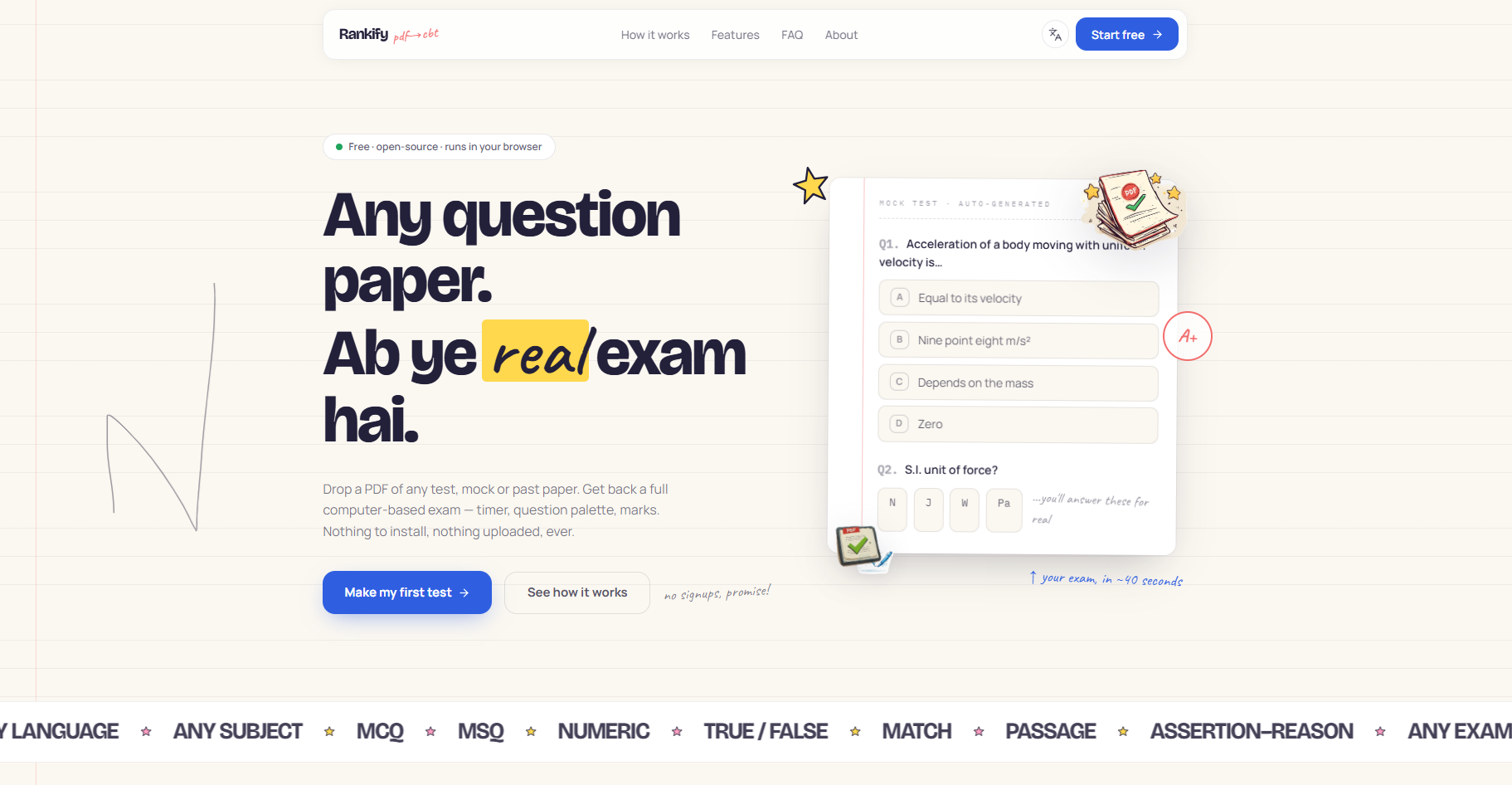
So I built Rankify. One job: PDF in → CBT out. Free. No account. Nothing leaves your browser.
What it does
Three steps. That's the whole product.
1. Extract — Drop a PDF. The primary path is our public Gemini GEM: upload there, copy the JSON back, paste here. No key, no signup. Or let the built-in AI Agent read it page-by-page on any free provider — Groq, Mistral, NVIDIA, even local Ollama. Long paper? It checkpoints after every page and resumes after crashes.
2. Review — AI drafts, you approve. Every question is editable before test day. Diagrams are never AI-guessed: you drag a box on the real PDF page and that exact crop ships with the question.
3. Attempt — A genuine CBT. Timer, palette, mark-for-review, auto-save. Submit → per-section analytics instantly.
Papers become plain JSON (our UniversalPaper schema) — 9 question types: MCQ, MSQ, numeric, true/false, fill-blank, match, assertion–reason, passage, long answer. Math survives as LaTeX:
{ "type": "numeric", "text": "Find $\\int_0^1 x^2 dx$", "answer": 0.33 }
Privacy is structural, not promised: there is no backend. Papers, answers, results live in your browser's IndexedDB.
How we built it
Vue 3 + TypeScript + Vite, Tailwind v4 — a plain SPA on Vercel's CDN.
- pdfjs-dist pulls text per page; empty text layer? Auto-routes through OCR.
- Dexie / IndexedDB stores papers, test state, checkpoints.
- Provider manager: BYOK keys stay local; presets hit free tiers via an optional proxy.
- Custom cropper boxes diagram regions straight off the rendered page.
- The design is a notebook — ruled paper, washi tape, sticky notes, handwriting fonts, a pencil ink-trail cursor, and a WebGL-dithered footer that ripples under your mouse. GSAP + Lenis underneath, tuned hard (off-screen pausing, transforms only).
- UI speaks English, हिन्दी and Hinglish — new languages arrive via a GitHub issue form anyone can file.
Open source under PolyForm Noncommercial 1.0.0.
Challenges we ran into
Models invent things. Confident nonsense options, baseless answers. Fix: strict JSON schema + validation warnings + a review step no question can skip.
Diagrams broke trust first. Instead of fighting hallucination and missing diagram, we removed it — manual crops from the actual PDF. Slower, but correct.
Free-tier limits vs. 100-page papers. Page-chunked runs with delays and per-page checkpoints. A crash costs one page now, not eighty.
Math turned to soup. Naive extraction mangles equations. The schema forces $...$ passthrough verbatim.
Accomplishments that we're proud of
- Whole pipeline — parse, extract, review, attempt, analyze — runs client-side. Zero required servers.
- Nine question types behind one schema a human can actually read.
- Same paper on Groq today, Ollama tomorrow, whatever's free ai provider next semester.
- People mention the sticky notes and dither footer unprompted. The design has fans.
What we learned
Schema-first prompting beats clever prompting. A rigid contract catches more errors than asking nicely ever will.
The UX around failure matters more than accuracy. Every paper breaks some assumption; usable means nothing fails silently.
Killing features is shipping. Accounts, cloud sync, auto-diagram-detection — all cut. The demo got less shiny and the product got better.
What's next
- More languages — community translations from the issue-form pipeline land in the switcher.
- Side-by-side review — question ↔ source-page jump highlighting.
- Portable papers — export as a single file a friend imports and attempts.
- Time-per-question heatmaps across attempts. -Robust-Logics across many usecases and scenerios.
Built With
- dexiedb
- gsap
- indexeddb
- javascript
- lenis
- open-source
- openai
- openai-compatible-apis
- pdfjs-dist
- tailwindcss
- typescript
- vercel
- vite
- vue
- webgl

Log in or sign up for Devpost to join the conversation.