-
-
Home Page
-
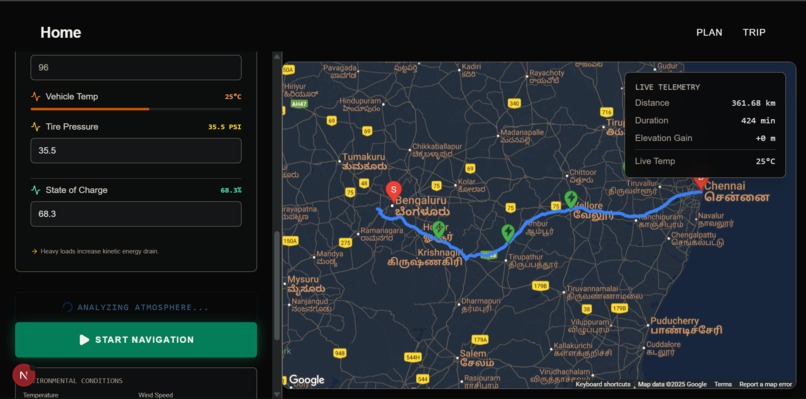
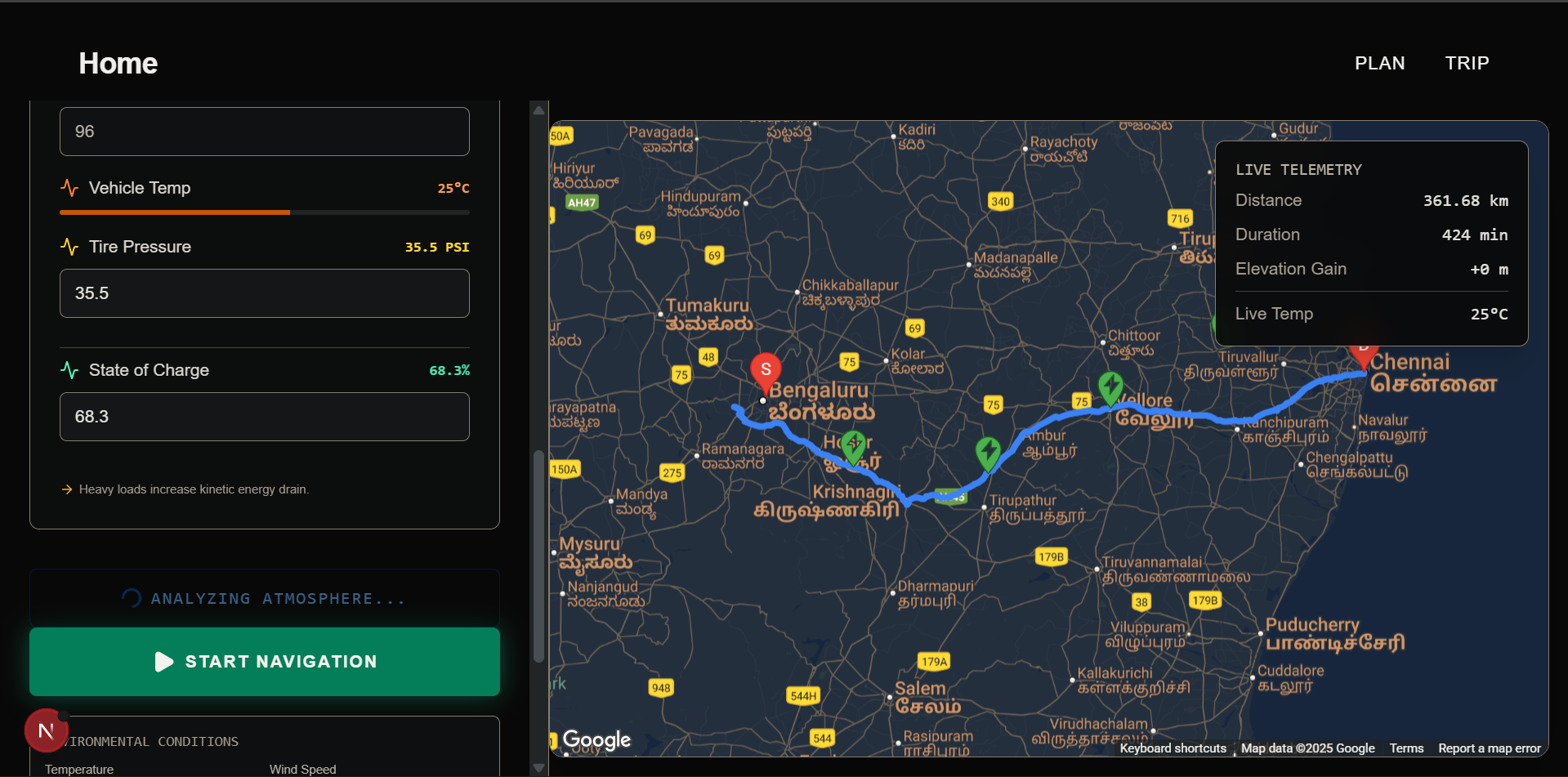
Plan page allowing the user to plan their journey ahead and obtain rough idea of Battery Usage
-
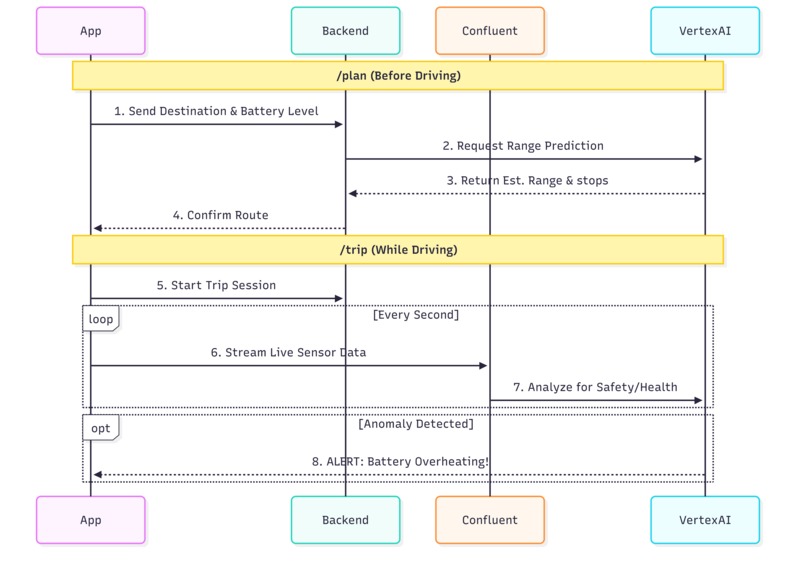
Workflow
Inspiration
The rapid adoption of Electric Vehicles (EVs) creates a critical need for accurate, real-time battery analytics to eliminate range anxiety. We recognized that the existing infrastructure for processing vehicle telemetry is often fragmented. Our primary inspiration was the realization of how feasible and simple it is to connect real-time EV IoT sensors directly to streaming platforms like Confluent. This seamless connectivity creates an immediate opportunity to transform raw sensor data into actionable safety and range insights without complex overhead.
What it does
RangeShield AI is a comprehensive telemetry platform that provides real-time monitoring and predictive maintenance for electric vehicles. It aggregates live sensor data including voltage, amperage, and thermal metrics and streams it instantly for analysis.
Predictive Intelligence: By integrating Google Cloud Vertex AI, the system forecasts battery degradation and provides hyper-accurate, dynamic range estimates based on current driving conditions.
Novelty & Impact: Unlike legacy systems that rely on delayed batch processing or OEM-locked data silos, RangeShield operates on a continuous stream. It offers immediate anomaly detection, alerting users to potential thermal runaways or cell failures milliseconds after they are detected. This low-latency approach fundamentally shifts safety protocols from reactive to proactive.
How we built it
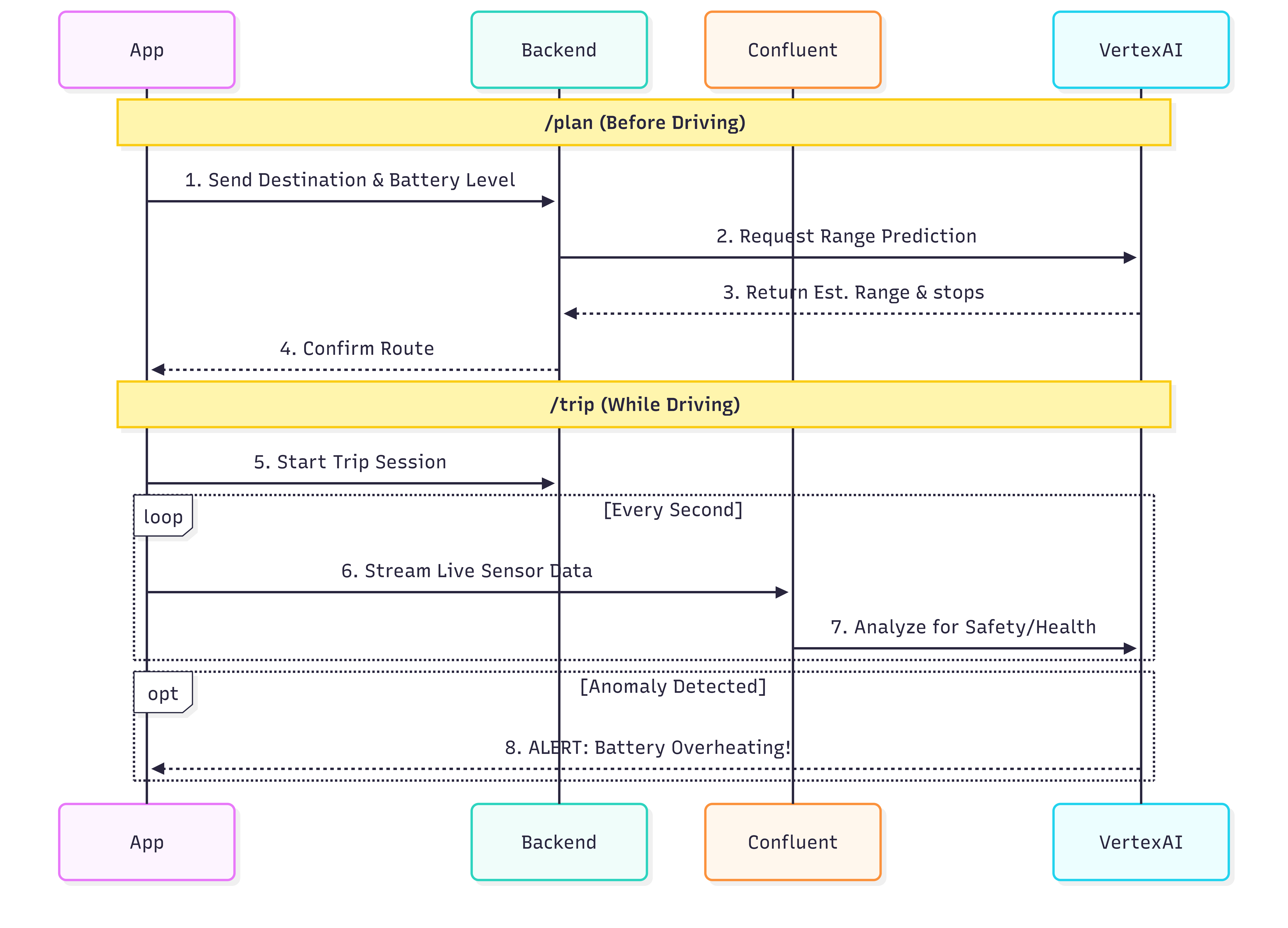
We engineered a highly efficient, event-driven architecture designed for scalability and ease of integration:
Seamless IoT Ingestion: We utilized Confluent Cloud as our central nervous system (metaphor removed per instruction) backbone. By leveraging Confluent's native connectors, we bridged EV IoT sensors (via MQTT) directly to Kafka topics. This process was remarkably simple, allowing us to ingest high-velocity telemetry with minimal configuration.
AI Integration: We bypassed traditional model training pipelines by leveraging Google Cloud Vertex AI. The streaming data from Confluent is fed directly into Vertex AI, which processes the signals to generate real-time health scores and range predictions.
Backend & Frontend: The processed insights are consumed by a lightweight Python backend and visualized on a responsive React dashboard, providing drivers with a clean, real-time interface
Challenges we ran into
Data Synchronization: ensuring that telemetry data arriving at different latencies was processed in the correct order for the AI model.
Model Latency: tuning the machine learning inference to provide predictions in milliseconds without lagging behind the live data stream.
Noise Reduction: filtering out erratic sensor signals to prevent false positive alerts for the user.
Accomplishments that we're proud of
Successfully established a low-latency data pipeline that processes telemetry updates in near real-time.
Universal EV Integration: We successfully designed the system to be hardware-agnostic, meaning it can be integrated with any electric vehicle model that supports standard telemetry output.
Achieved high accuracy in our range prediction model compared to static baseline estimates.
Created a seamless user interface that translates complex battery metrics into simple, at-a-glance health indicators.
Simplified Architecture: Proved that enterprise-grade telemetry does not require complex, proprietary hardware just a standard IoT connection and a powerful streaming platform.
What we learned
We gained deep insights into the criticality of event-driven architectures for IoT. We learned that decoupling data producers (cars) from consumers (dashboards) using a streaming platform significantly increases system resilience. We also discovered that even small variations in battery temperature data can be strong predictors of long-term health when analyzed continuously.
What's next for RangeShield AI
The immediate next step is scaling our integration capabilities. We plan to demonstrate how Confluent can connect to real-time EV IoT ecosystems with extreme simplicity. By utilizing standard IoT protocols (like MQTT) bridged to Confluent, we can scale from monitoring one vehicle to managing entire fleets with minimal configuration changes. This integration proves that enterprise-grade data streaming is not only feasible but easily implementable for modern EV infrastructures.
Built With
- confluent
- google-cloud
- google-maps
- nextjs
- vertexai


Log in or sign up for Devpost to join the conversation.