Inspiration
Surgeons have no flight simulator. They learn on real patients — and when things go wrong, the consequences are devastating.
In Stokes v. Shah (2018, UK), a misplaced pedicle screw severed a nerve root during lumbar fusion, leaving the patient with permanent foot drop. The surgeon had never had the chance to rehearse the patient's unusual anatomy. The hospital paid £1.2 million in damages.
In Daniels v. North Bristol NHS Trust (2020), a screw breached the anterior cortex and lacerated the aorta. The patient died on the operating table. The coroner noted the surgeon was in their first year as a consultant with limited exposure to complex cases.
The FDA's MAUDE database records over 4,700 adverse events from pedicle screw misplacement between 2019 and 2024 — including 312 revision surgeries and 47 cases of permanent neurological damage.
These are not rare events. Pedicle screw fixation is one of the most common spinal procedures in the world, and the margin for error is measured in millimetres — a pedicle is 7mm wide, and the spinal cord sits 2mm away.
Cadaver labs cost £2,000–5,000 per session, run a few times a year, and never match the patient on tomorrow's list. There is no way for a surgeon — whether a trainee building foundational skills or a consultant facing a difficult case — to rehearse a specific operation before walking into the OR.
We asked: what if they could? What if they could put on a headset tonight and practise tomorrow's case — in their own room, on the real patient's anatomy, with the same instruments and the same team — and get objective feedback on every action?
What it does
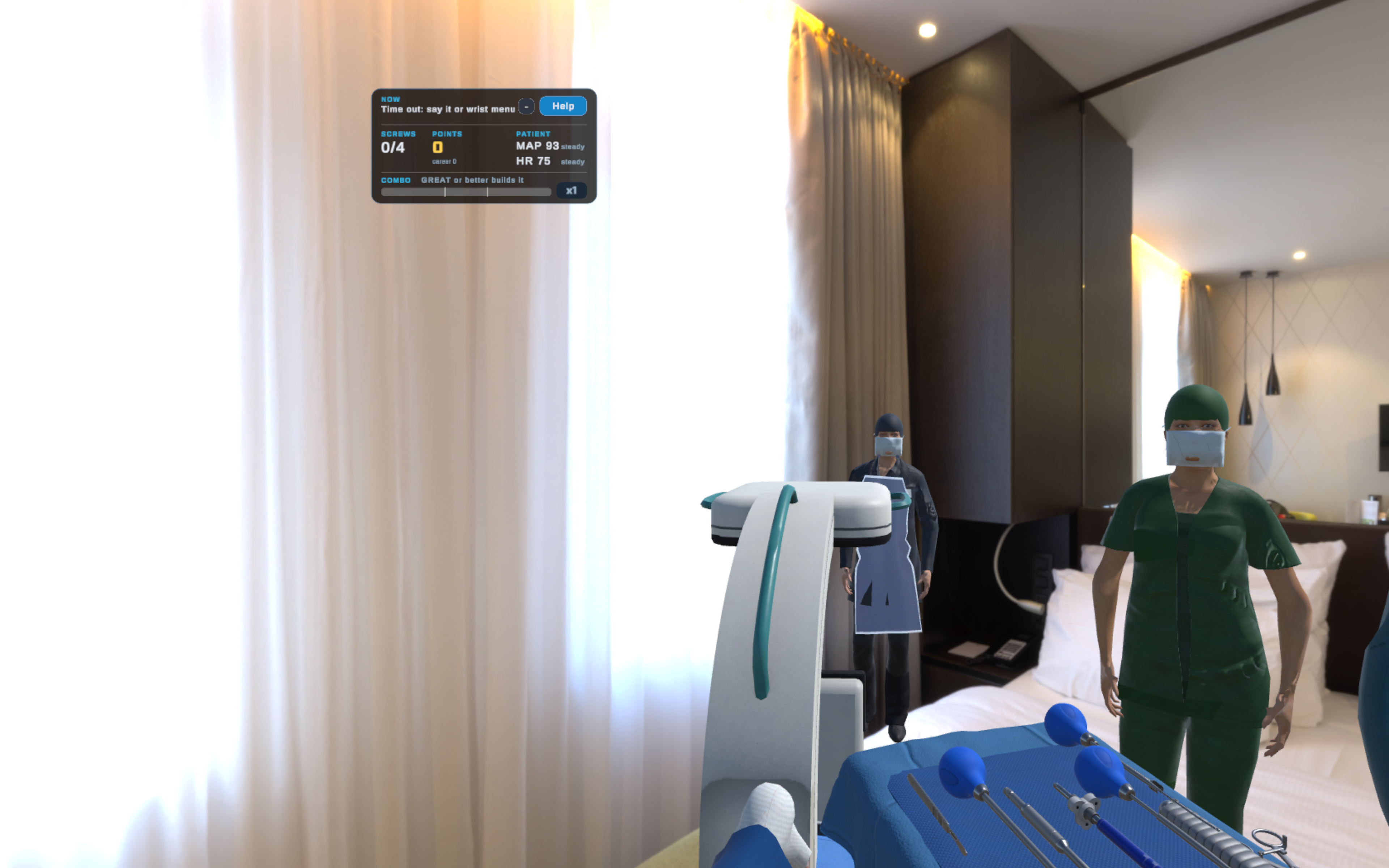
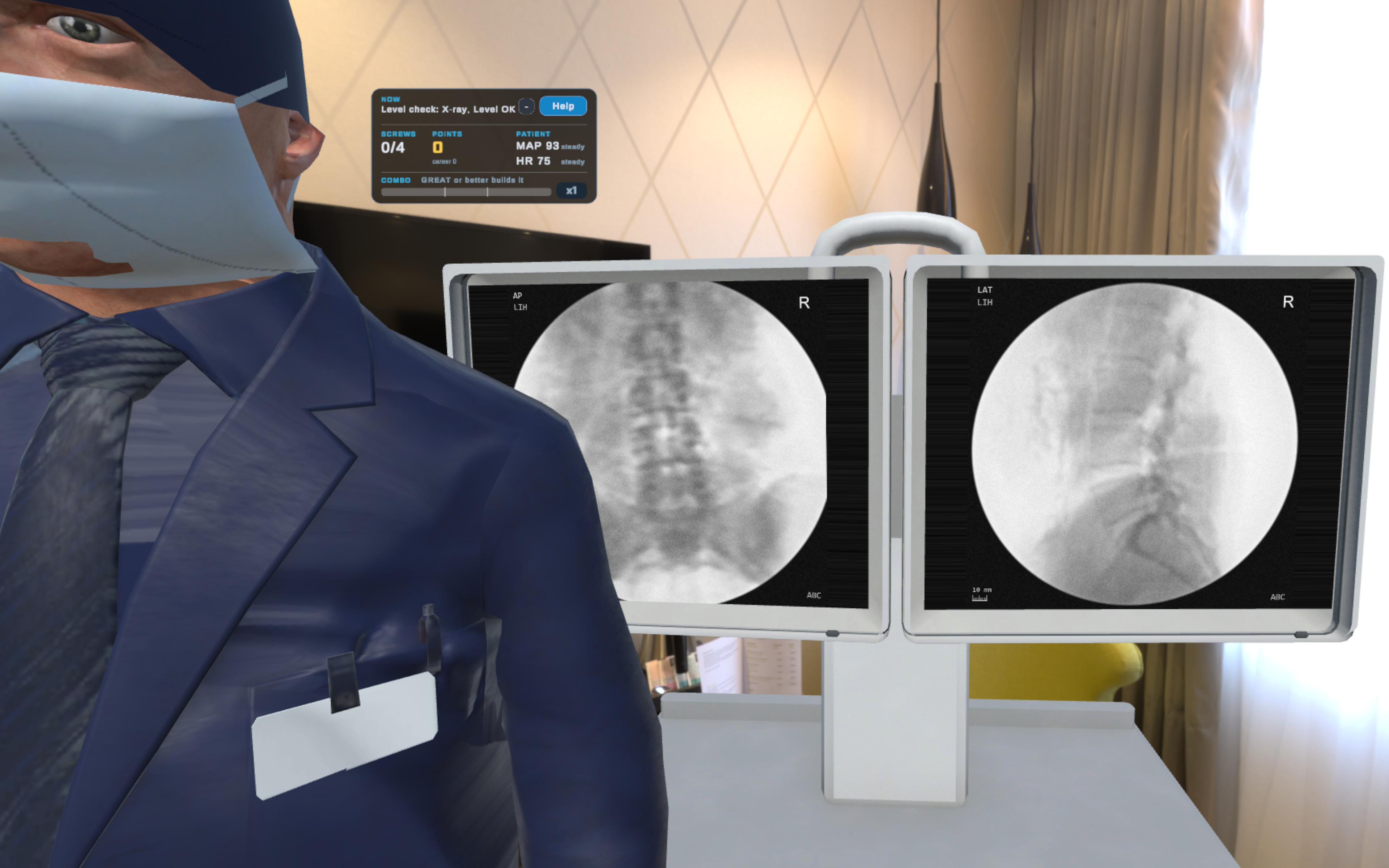
Range turns your Meta Quest into a surgical training environment. Put on the headset, and your room becomes a fully staffed operating theatre. Your desk becomes the operating table. On the table lies a patient reconstructed from a real, open-source CT scan, rendered at true anatomical scale. Around you stands a full surgical team: a scrub nurse ready to pass any instrument you call for, an anaesthetist at the head of the table watching the vitals, and a radiographer manning the C-arm fluoroscope.
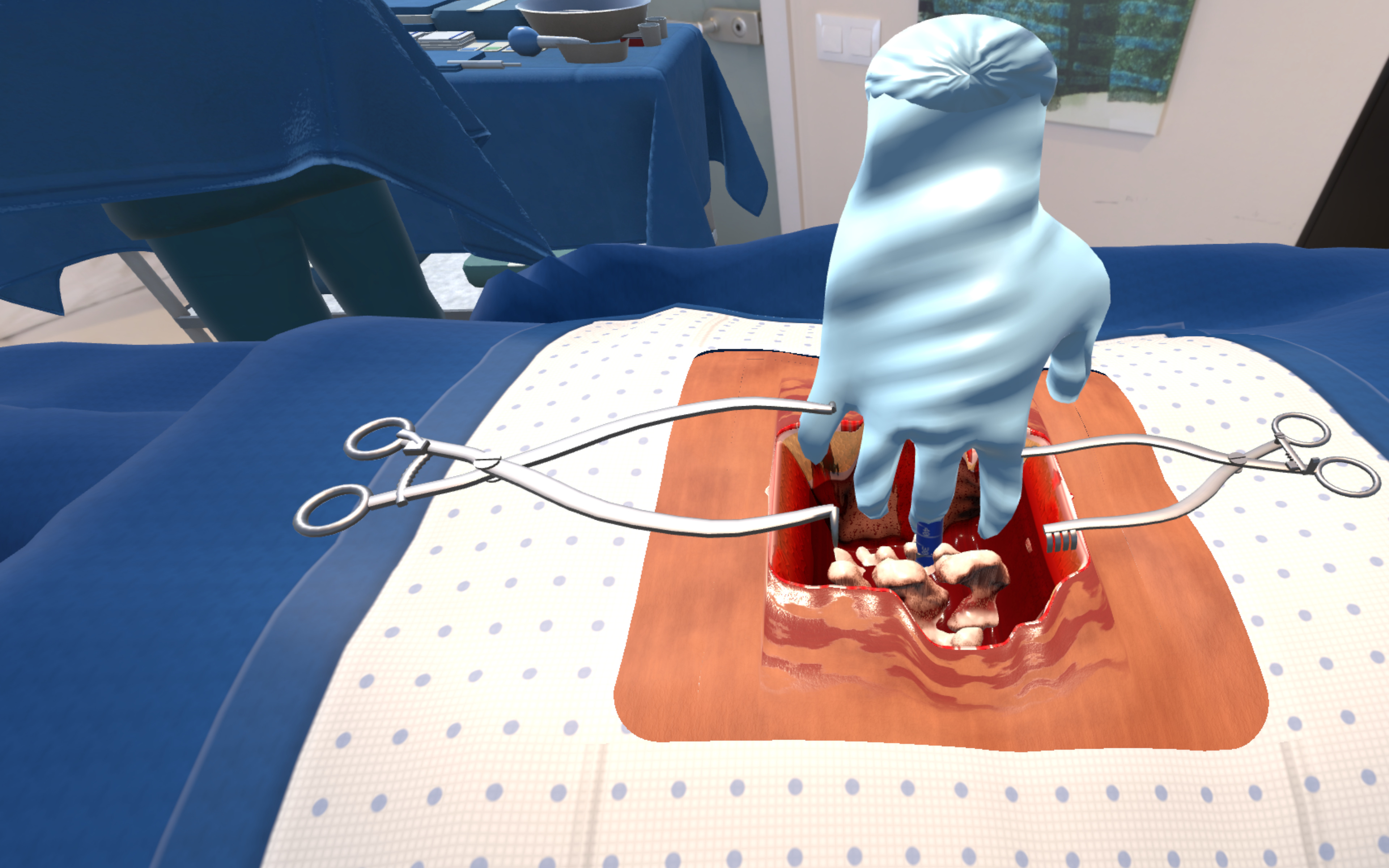
You perform a posterior lumbar pedicle screw fixation, entirely with hand tracking, no controllers. You make the incision, expose the spine, identify pedicle entry points, drill pilot holes, and place titanium screws while the patient's physiology runs in real time.
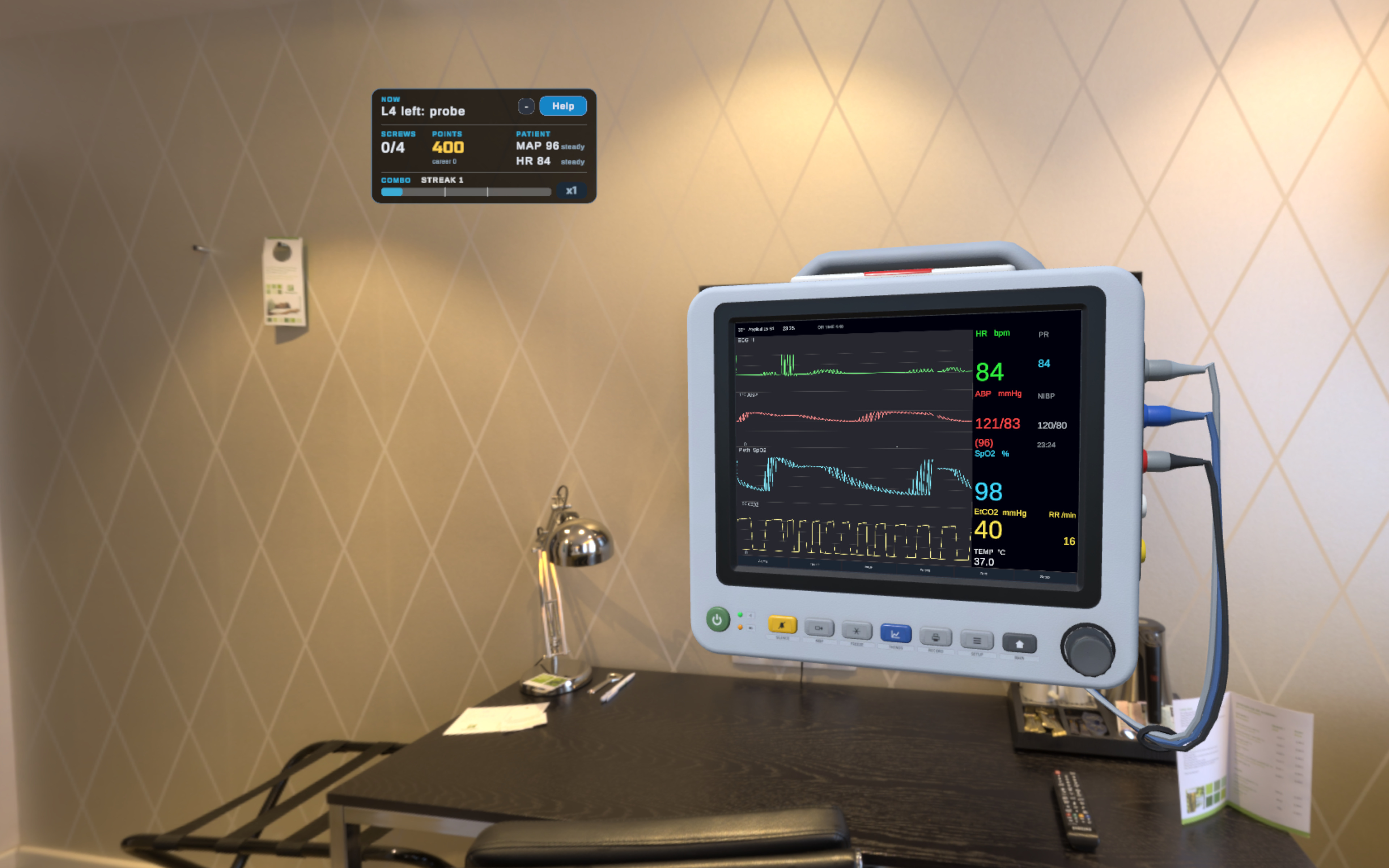
The patient responds like a real patient. Blood pressure drops when there is blood loss. The anaesthetist reacts. Complications arise — epidural bleeding, pedicle breach, EMG alarms — and you must make the right clinical decision under pressure.
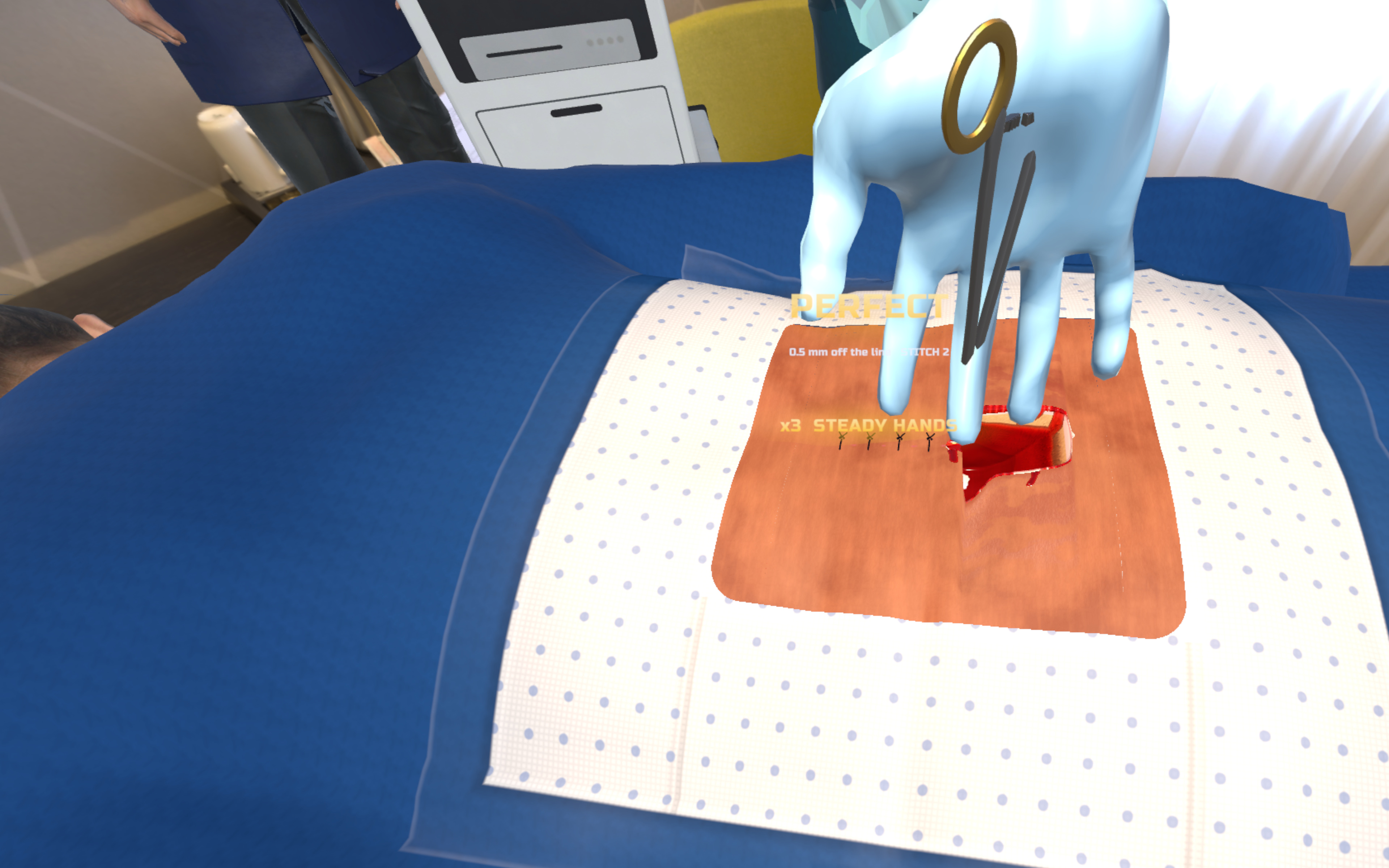
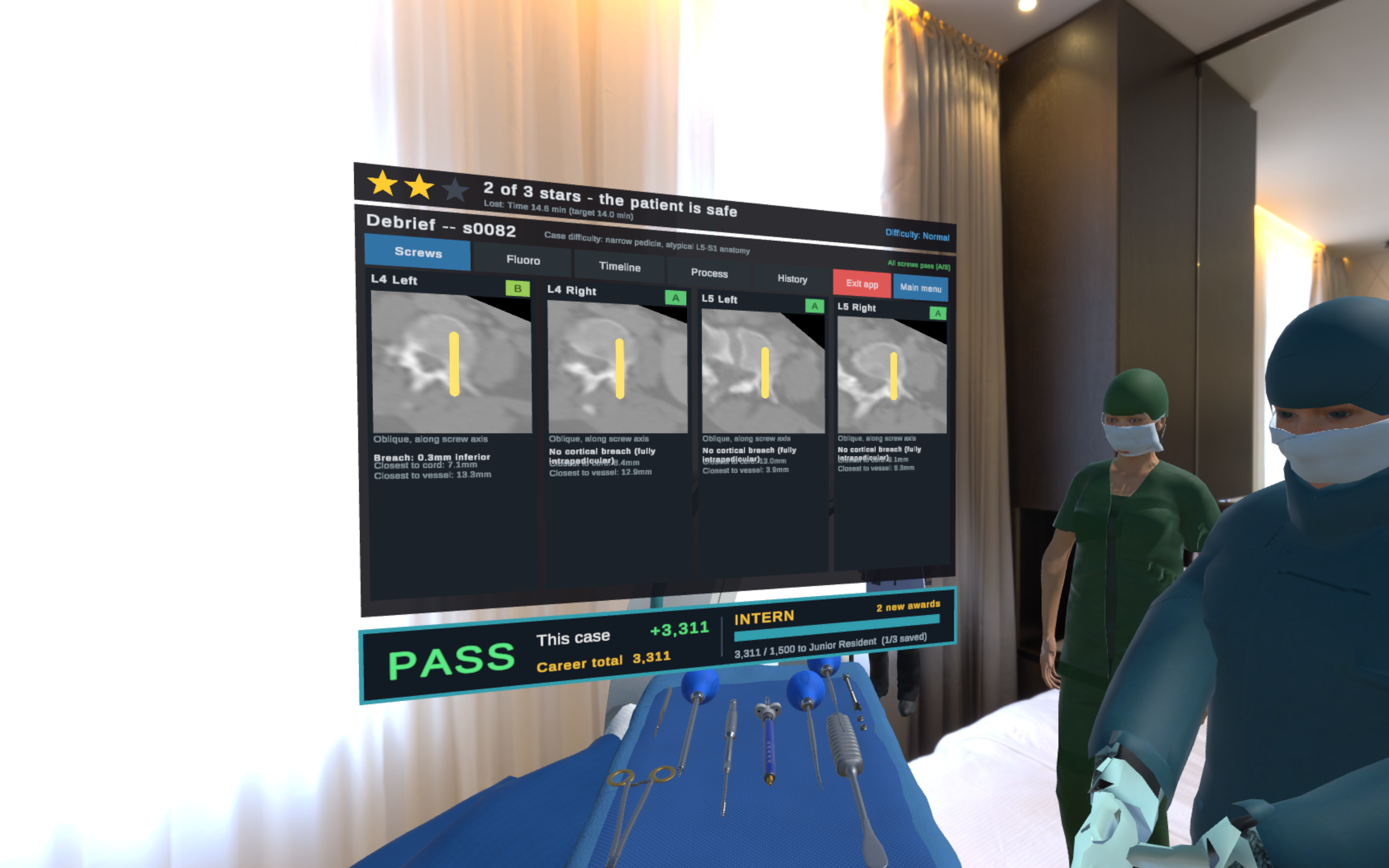
Objective skill measurement: Every action is graded in real time: PERFECT, GREAT, GOOD, or MISS, based on your accuracy in millimetres and your angle in degrees. The Gertzbein-Robbins grading system (the clinical standard surgeons actually use) evaluates your final screw positions after every case. You see exactly where you were accurate and where you were not. A trainee cannot get this feedback in a real OR without post-operative imaging.
Engagement through game design: The hardest problem in surgical training is getting people to practise enough. Range solves it the way Duolingo solves language learning: make the practice loop short, make progress visible, make improvement feel good. Consecutive precise actions build a combo multiplier (x1.5 at 3, x2 at 5, x3 "Steady Hands" at 8). One sloppy action breaks the streak. A three-star mastery system per patient case drives replay: one star for completing the case, two for hitting the accuracy threshold, three for reaching "Steady Hands" within par time. Personal leaderboards track your top 5 runs per patient. People replay because they want to, not because they have to.
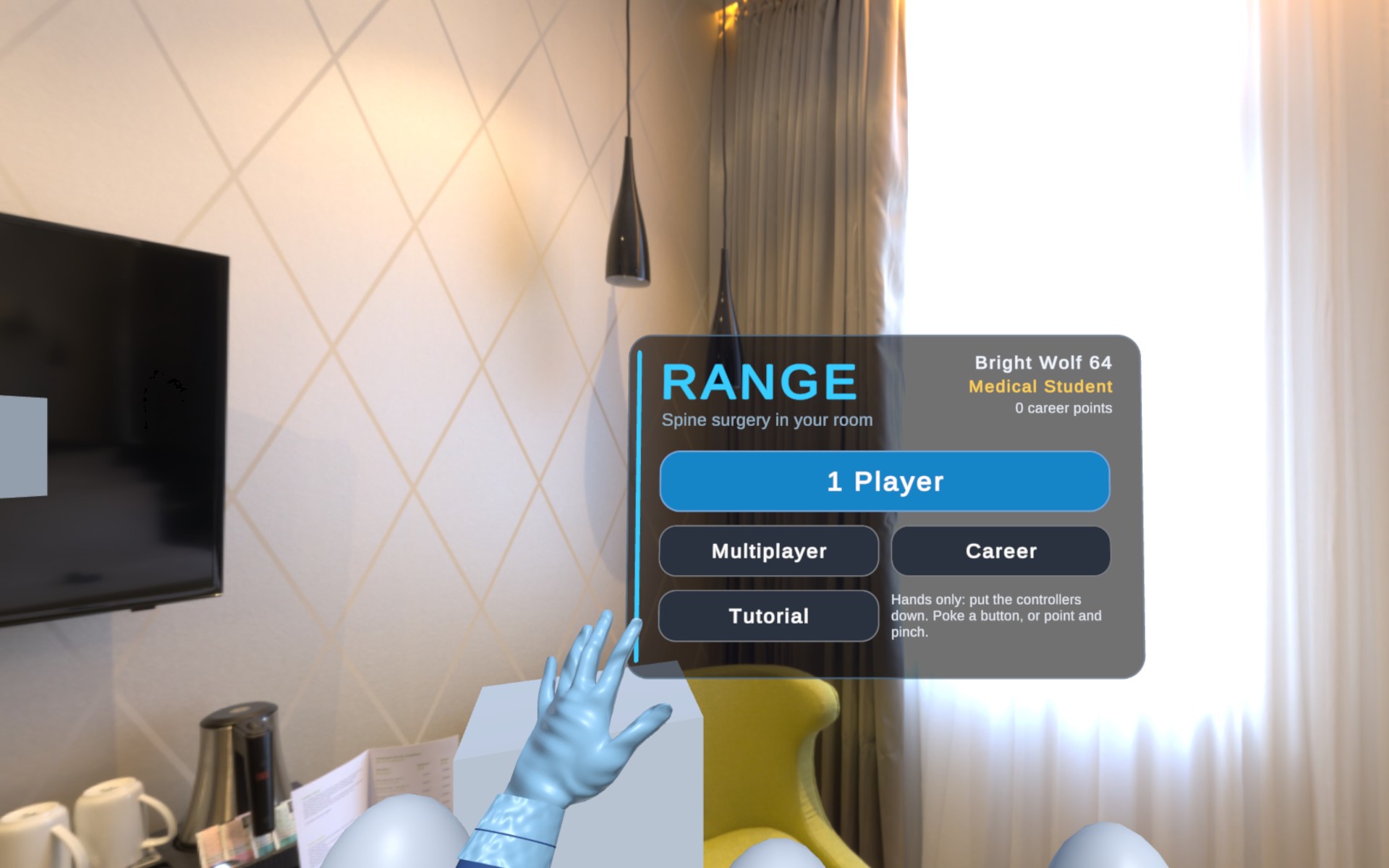
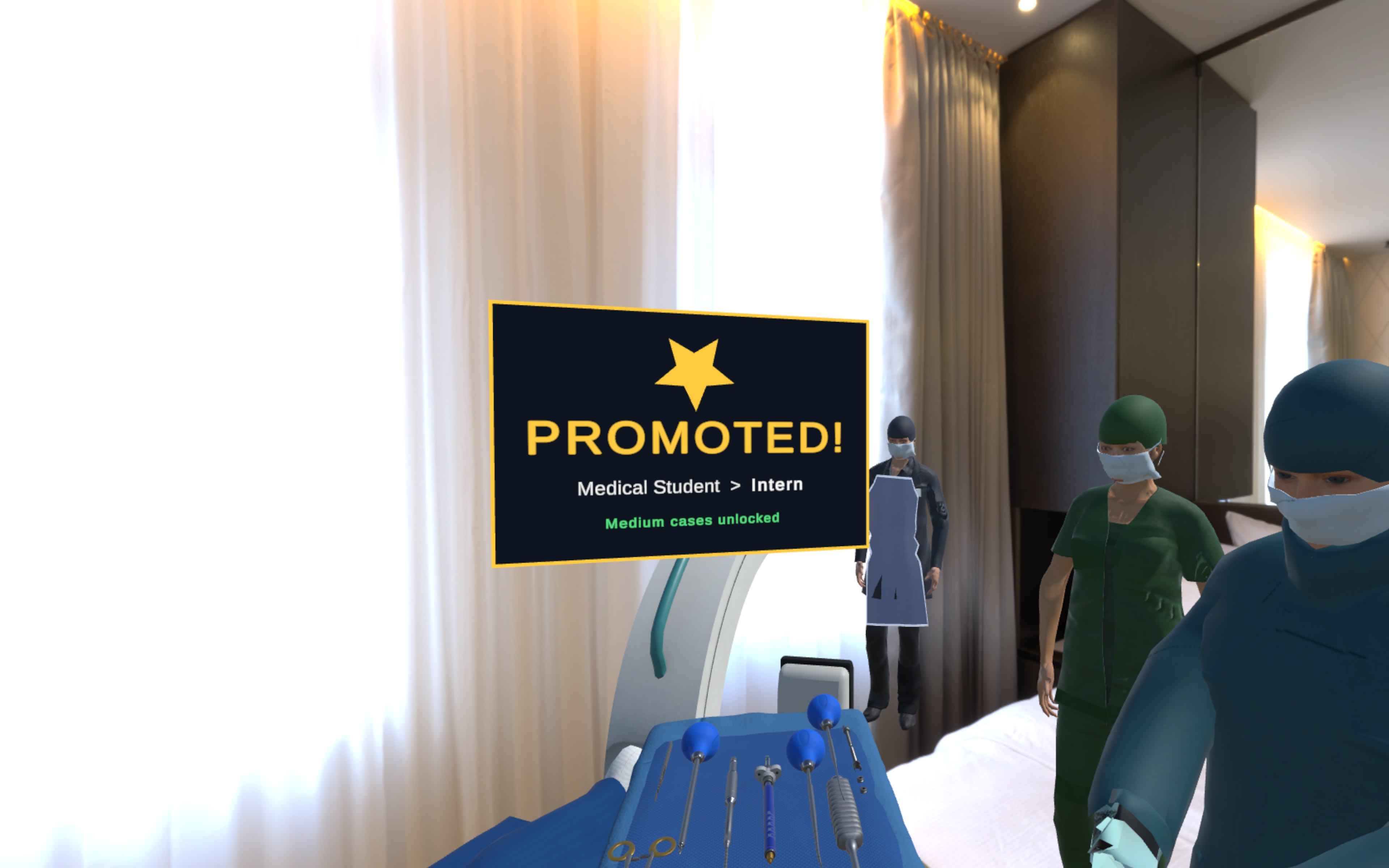
Structured progression: You start as a Medical Student with access to straightforward cases. As you demonstrate competence, you advance through 9 levels that mirror the real surgical training pathway:
Medical Student → Intern → Junior Resident → Senior Resident → Chief Resident → Spine Fellow → Attending Surgeon → Consultant → Chief of Spine Surgery
Each level unlocks harder cases: more complex anatomy, denser bone, narrower pedicles, more frequent complications. You advance by getting better, not by logging hours.
Who it is for:
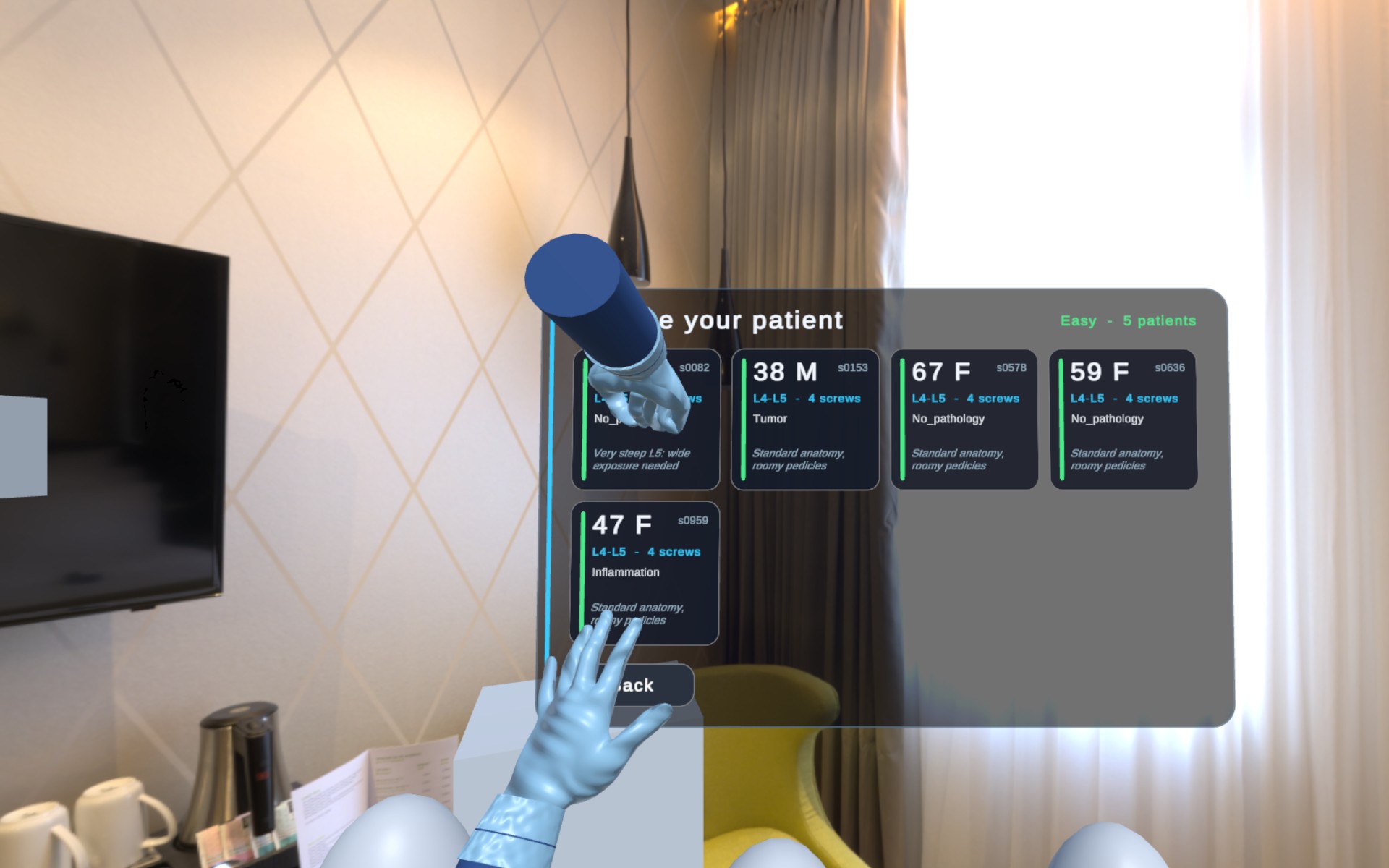
- Surgical trainees building foundational technique and decision-making through repeated, measured practice on diverse patient anatomy
- Practising surgeons preparing for complex or unfamiliar cases — rehearsing the specific patient's anatomy before the real operation
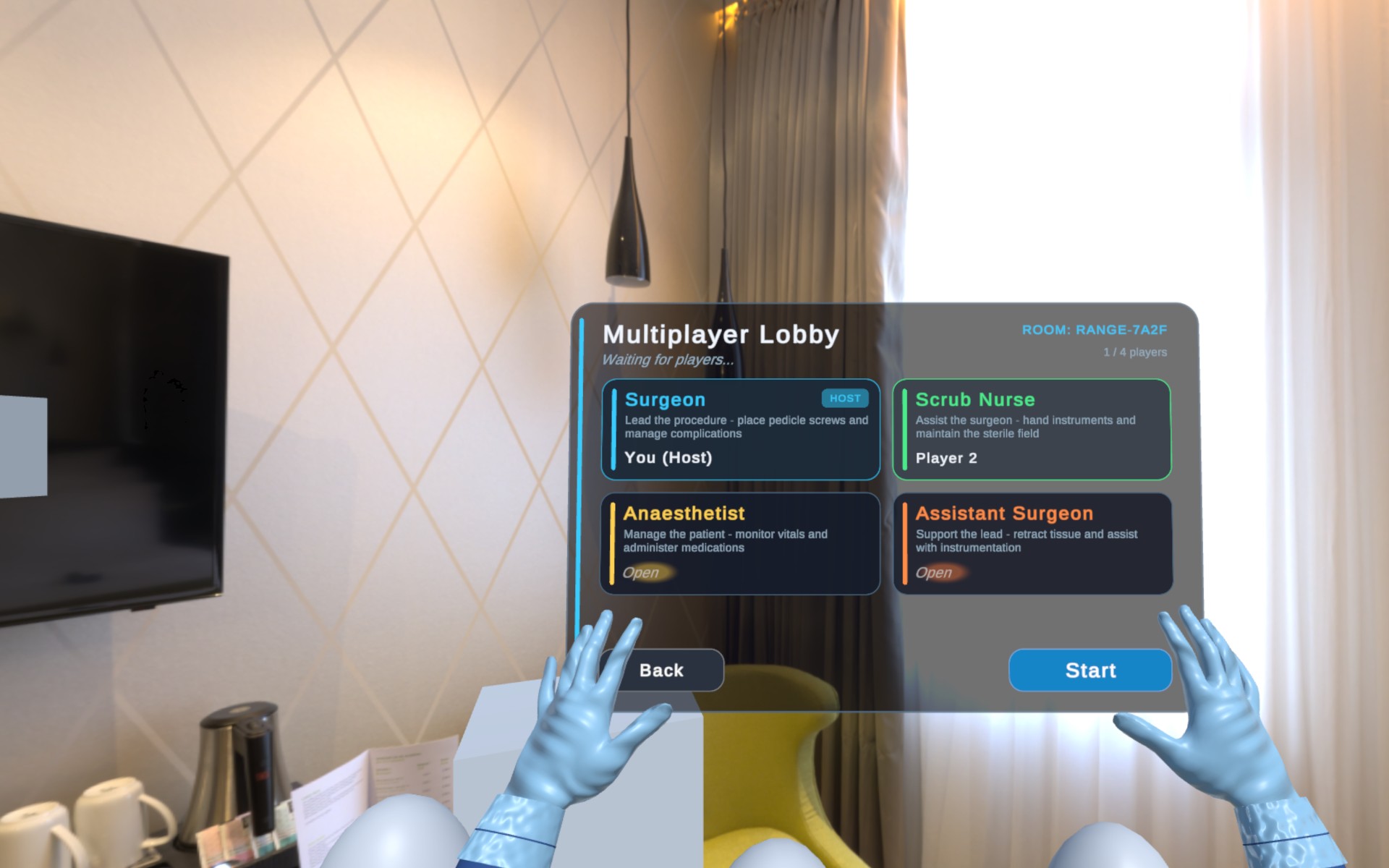
- Surgical teams training together — a second player can join as the scrub nurse, anaesthetist, or assistant surgeon in multiplayer mode
- Teaching hospitals that want an objective skills assessment tool to supplement cadaver labs and supervised training
Key features:
- Open Sourced Patient-specific anatomy from real CT scans — bone density affects screw purchase, pedicle width sets difficulty
- Full OR team with role-based AI behaviour and spoken dialogue
- Real-time cardiovascular physiology — MAP, heart rate, blood loss, drug responses
- Complication engine — bleeds, breaches, and alarms requiring the right clinical decision under time pressure
- Objective skill measurement: millimetre-accurate grading on every action with real-time visual feedback
- Combo multiplier, three-star mastery, personal leaderboards: game mechanics that make you want to replay
- 9 training levels from Medical Student to Chief of Spine Surgery
- Per-patient performance tracking: stars, run history, full results breakdown after every case
- Multiplayer team training — each player takes a different OR role
- Mixed reality — your room IS the OR; passthrough integrates the training into your physical space
- No controllers — hand tracking mirrors the real surgical interaction
How we built it
Engine: Unity 6 (URP) with Meta XR SDK v207 (Interaction SDK for hand tracking, MRUK for room layout, Passthrough for mixed reality) and OpenXR.
CT-to-Patient Pipeline: A Python pipeline (nibabel, trimesh, scikit-image) takes a real Open Sourced CT scan in DICOM format and segments the vertebrae, spinal cord, and major blood vessels into 3D meshes. It extracts bone density (Hounsfield units) per vertebral level — this drives screw purchase difficulty in the simulation, based on published clinical thresholds (Schreiber et al., 2005, 503-patient study).
Physiology Engine: A C# cardiovascular model running in real time: mean arterial pressure, heart rate, systemic vascular resistance, cardiac output, blood loss, and drug pharmacokinetics (propofol, remifentanil, tranexamic acid), all following published Marsh/Schnider anaesthetic models.
Assessment and Progression System: A C# engine that grades every action against clinical thresholds. It tracks streaks, multiplier steps, and break conditions. The progression system manages training levels, case unlocks, per-patient mastery records, and performance history. All unit-tested.
3D Assets: Every model is built in Blender or generated from open-licence reference photos using TRELLIS, with PBR textures baked from high-poly source models. Zero purchased assets, zero AI-generated video.
Voice System: Pre-rendered speech with a per-role priority queue — each team member (surgeon, anaesthetist, scrub nurse, radiographer) has an independent audio channel. At accelerated playback speeds, voices serialise globally so dialogue never overlaps.
Open-licence data — nothing proprietary, nothing patient-identifiable:
| Data | Source | Licence |
|---|---|---|
| Open Sourced CT scans (40 patients) | TotalSegmentator / OpenNeuro | CC0 / CC-BY |
| Anatomy segmentation reference | Visible Human Project (NLM) | Public domain (US Gov) |
| Surgical workflow data | Published clinical literature | Fair use (cited) |
| OR equipment reference photos | Wikimedia Commons | CC BY-SA / CC0 |
| Bone density thresholds | Schreiber et al. (2005) | Published research |
| Pedicle screw grading | Gertzbein-Robbins classification | Published standard |
| Drug pharmacokinetics | Marsh/Schnider models | Published research |
| Voice synthesis | Custom TTS pipeline | Self-generated |
All data used in this project is open-licence. No proprietary datasets, no patient-identifiable information, and no copyrighted assets were used.
Challenges we ran into
Making training addictive without cheapening surgery — The scoring had to reward genuine surgical skill, not gaming. We based grading on real clinical standards (Gertzbein-Robbins for screw accuracy, published pedicle dimensions for trajectory tolerances). Someone who scores well is also learning to operate well. Getting that alignment right took many iterations.
Precision with hand tracking — A pedicle is 7mm wide. The spinal cord is 2mm behind it. Making hand-tracked instrument placement precise enough that the grading actually means something took a lot of tuning: interaction zones, audio feedback, gesture thresholds.
The engagement loop had to feel earned — Early versions of the combo system were too easy (users maintained x3 through an entire case) or too punishing (a single hesitation broke a 20-action streak). We settled on a three-step multiplier (x1.5, x2, x3) with a hesitation timer that pauses during complications and decision panels, so the system rewards sustained focus without punishing its own interruptions.
Realism vs. session length — A real pedicle screw fixation takes 2-3 hours. Our Quick Case runs in 8-10 minutes. Finding the right compression, keeping every step that matters and cutting the dead time, meant close reference to published surgical workflows. If people are going to use this daily, it has to fit into a day.
Performance on a mobile GPU — Running a full operating room (team AI, real-time physiology, voice dialogue, assessment effects, passthrough rendering, hand tracking) at 72 fps on a Quest's mobile chipset. Every triangle and draw call is budgeted.
Every room is different — The OR layout has to work in rooms we have never seen. MRUK handles placement, but making the team, equipment, and table look right in a studio flat, a living room, or a bedroom meant writing a lot of fallback logic. If this is going to be used at home, it has to work in any home.
Accomplishments that we're proud of
- A complete surgical procedure from first incision to final closure, driven entirely by real Open Sourced patient CT data, with every step objectively measured
- People say "just one more case" and mean it. That voluntary repetition is what actually builds surgical skill
- Hand-tracked instrument placement that follows real surgical technique. A spinal surgeon would recognise the approach, the landmarks, and the feel. The grading layer gives feedback no real OR can give in real time
- Advancing from Medical Student to Consultant requires genuine improvement, not just hours logged
- The moment the OR materialises in your own room and you look down at the patient on your desk — that is when you understand what spatial computing is for
- Multiplayer team training — because surgery is never a solo activity, and training should not be either
What we learned
We did not expect this, but defining what "PERFECT" means for a screw placement taught us more about surgical technique than reading the literature did. When you have to decide exactly how many millimetres from ideal, exactly how many degrees of angulation, you end up understanding the procedure at a level most training resources never reach.
Building the engagement system taught us about the rhythm of surgery: the flow state a good surgeon enters, where each action follows the last without hesitation. Building the complication engine taught us the hardest part is not the technique. It is making the right decision when everything is going wrong and the clock is running.
The game mechanics are not decoration on top of a simulation. They are what turns a training tool into a daily habit. People come back tomorrow because they want to beat their last run, not because someone told them to practise. That voluntary repetition is what actually builds surgical competence.
What's next for Range
- More procedures — cervical fixation, thoracic instrumentation, decompression — each with its own skill measurements and mastery tracks
- Patient-specific pre-operative rehearsal — a surgeon uploads their patient's CT scan and practises the exact case the night before
- Curriculum integration — structured training modules aligned with surgical residency programmes at teaching hospitals
- Objective assessment reports — exportable performance data for training programme directors and credentialing bodies
- Full multiplayer team training with real-time voice chat and role-specific performance measurement
- Online performance benchmarking — compare your accuracy against other trainees at the same level on the same patient cases
Gallery
Your Room Becomes the OR
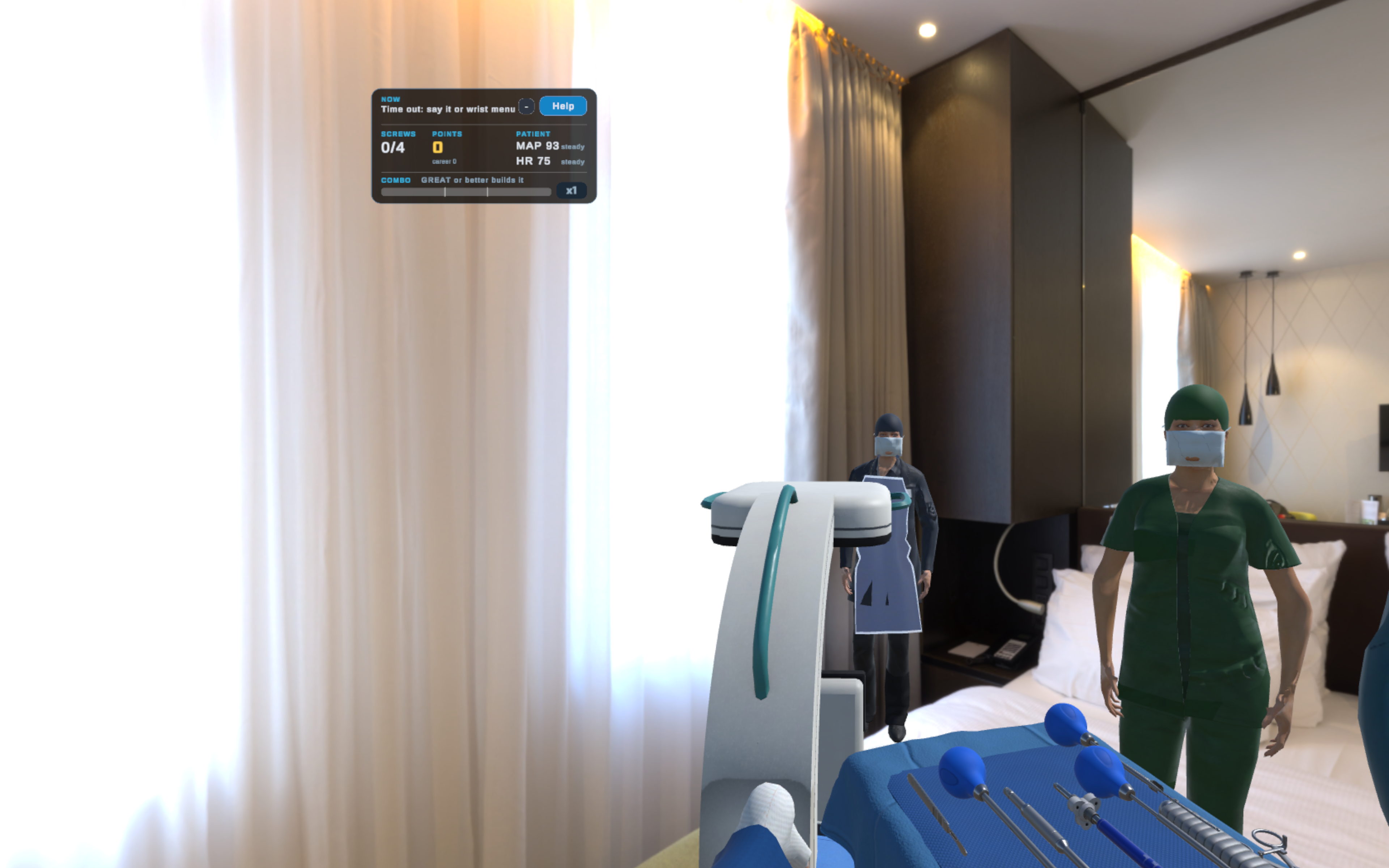
Your room becomes the operating theatre. The team stands on your floor for the time-out, the C-arm is parked ready for X-rays, and the instruments are laid out on the tray. The progress HUD in the corner tracks the current step, screws placed, points and the patient's live vitals.
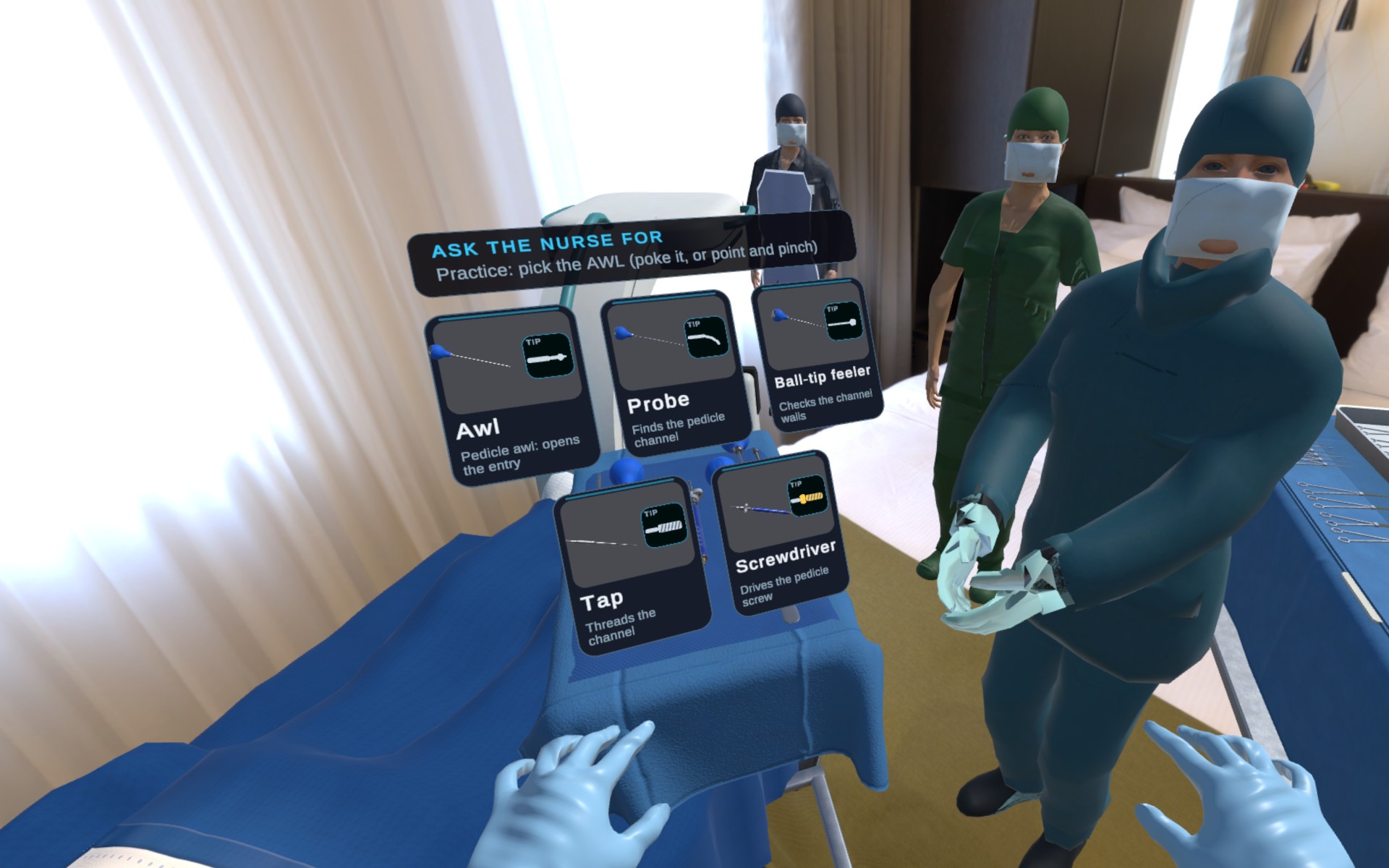
Ask the Nurse for Instruments
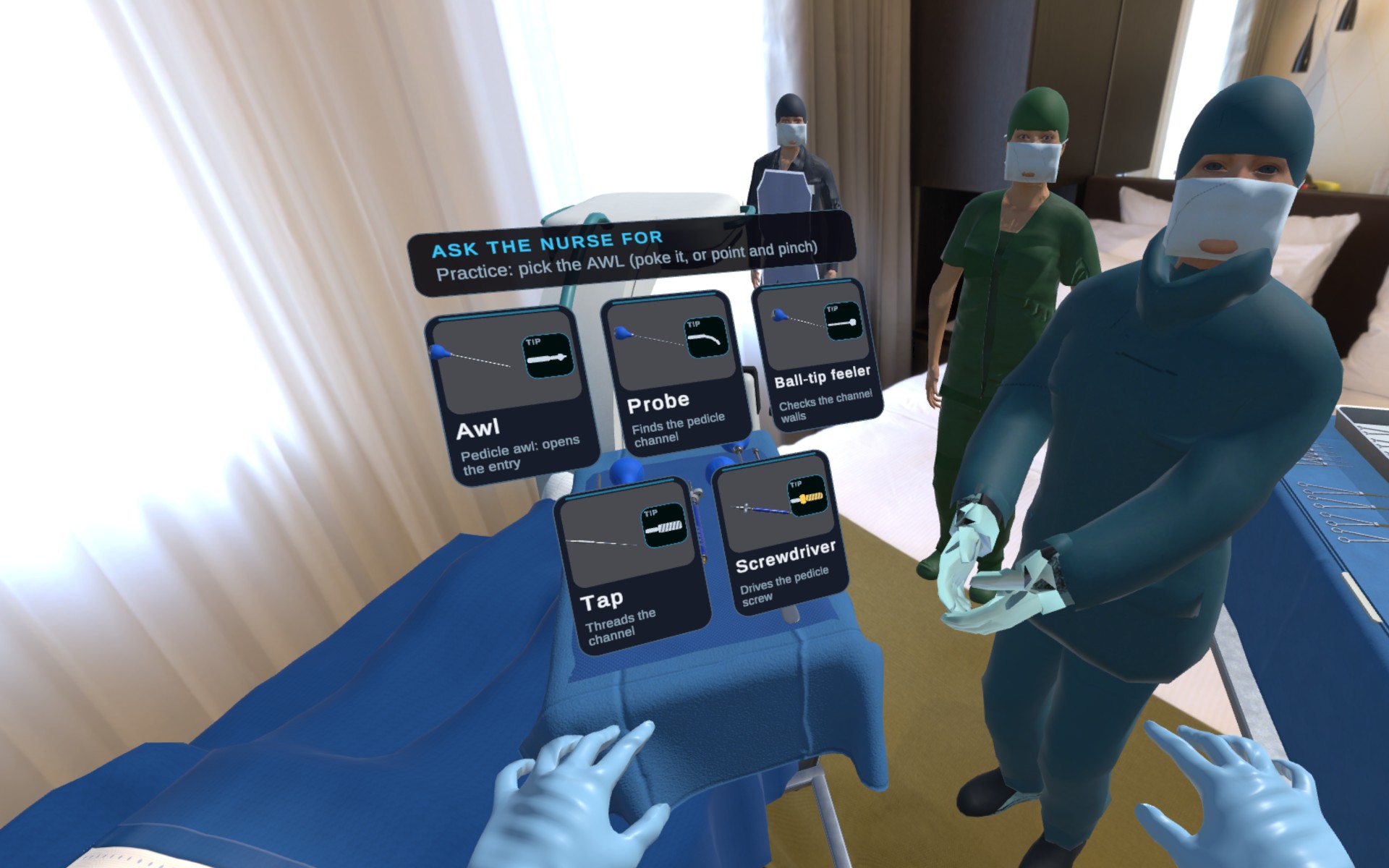
You ask the scrub nurse for each instrument by voice, or by poking or pinching a card on the list. Every card shows the instrument and what it is for. The nurse places the tool in your hand, and you hand it back when you are done.
Incision
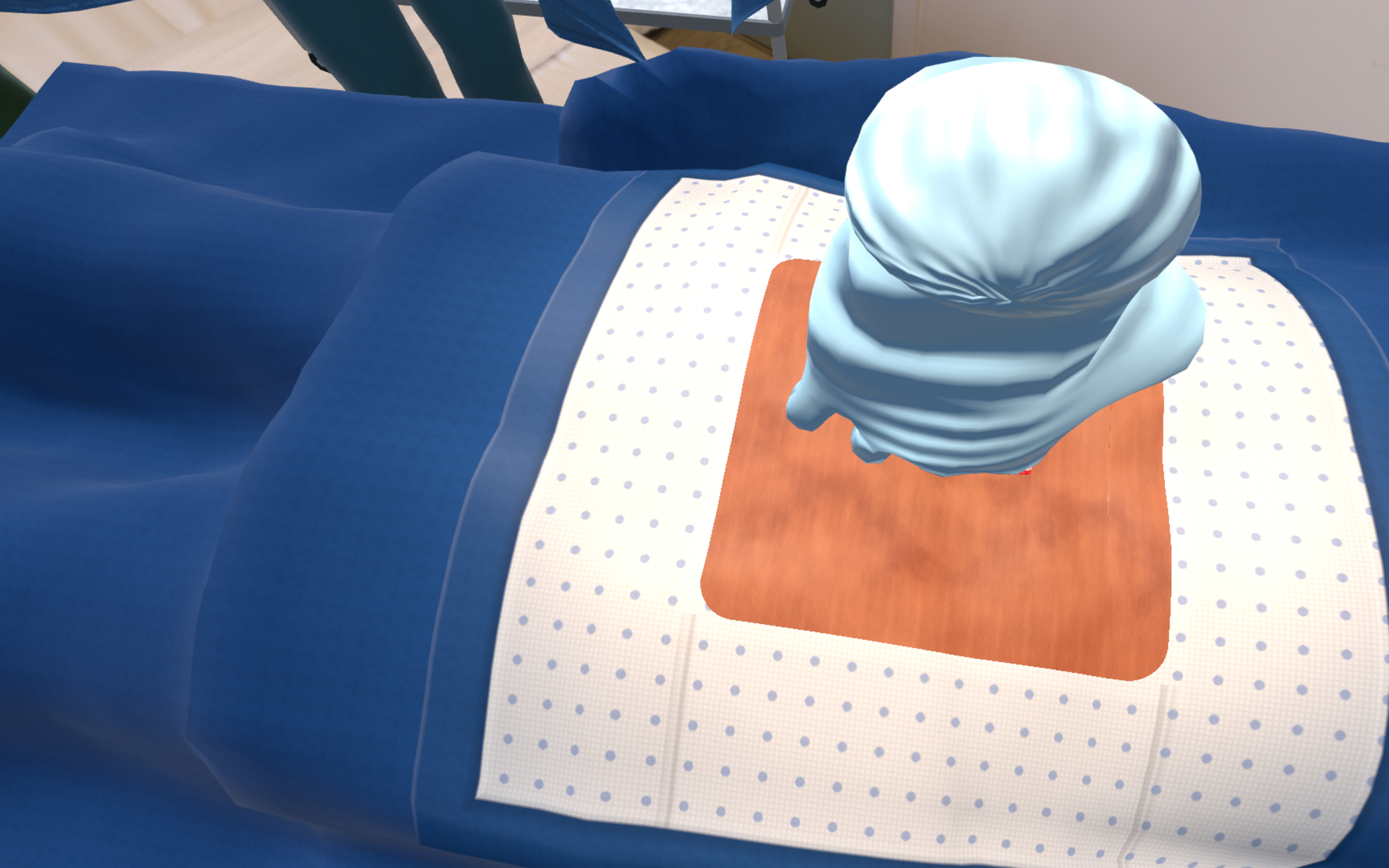
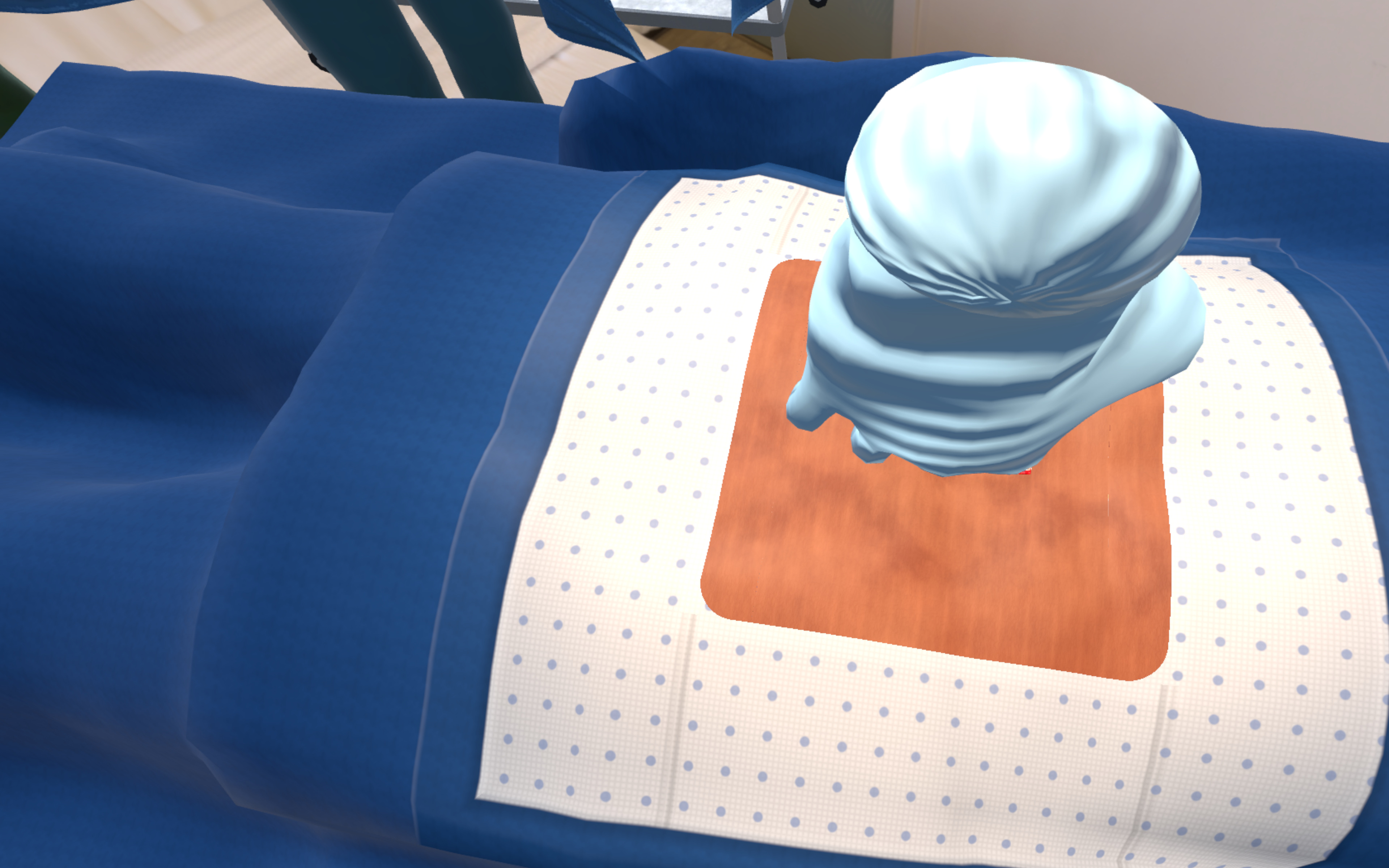
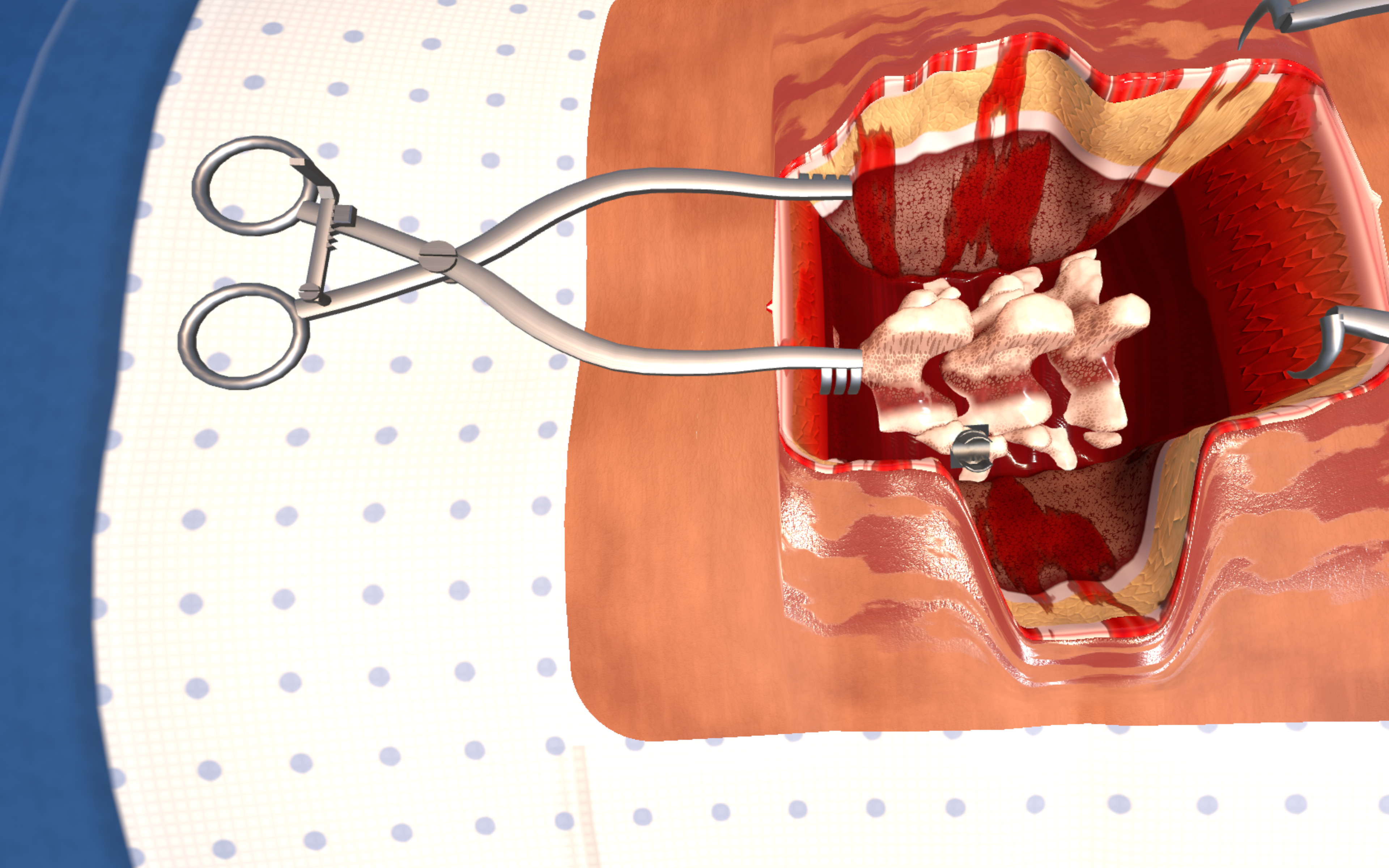
The patient lies prone, draped and prepped. A midline incision opens the skin over L4–L5, at the level you confirmed on X-ray.
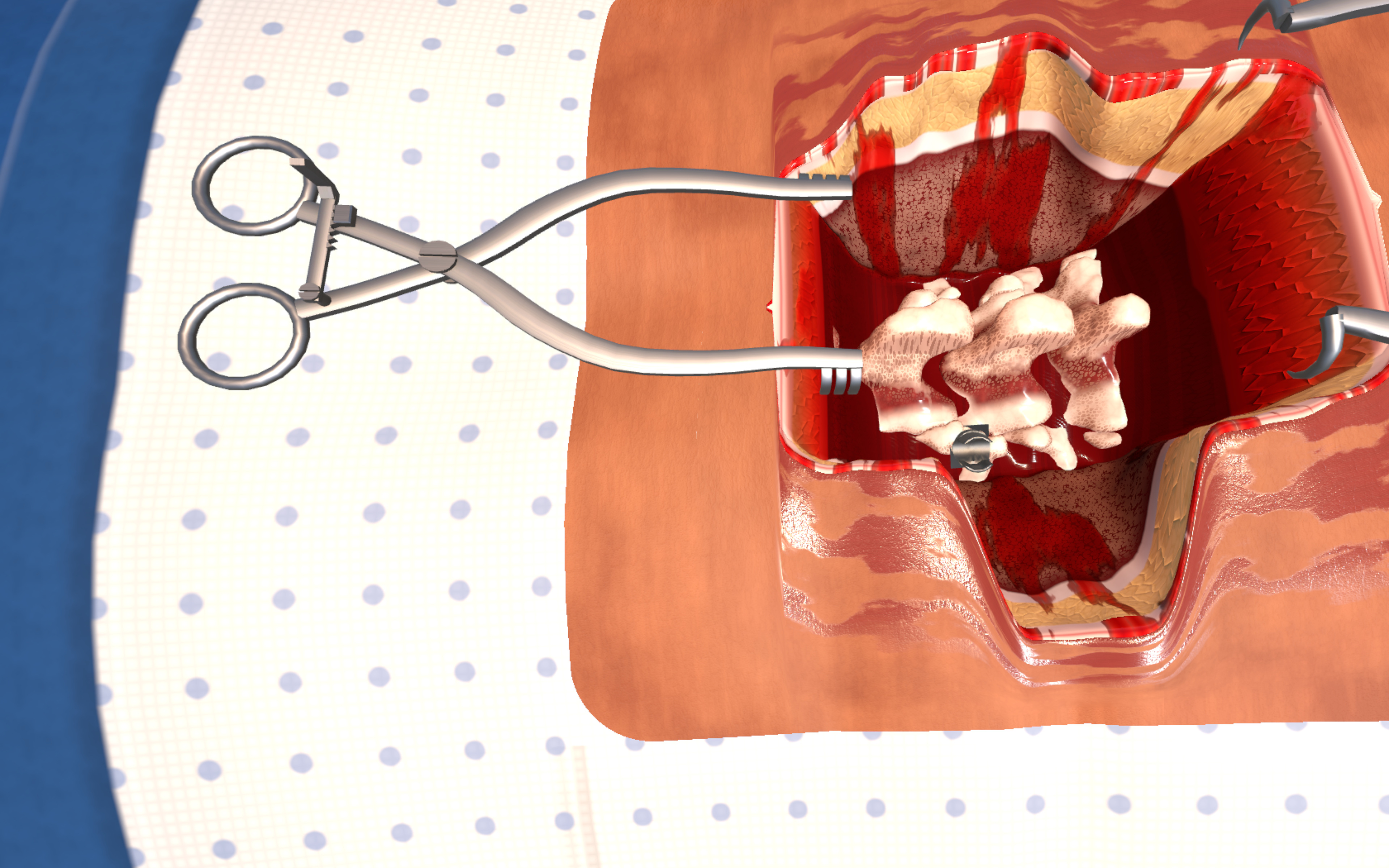
Exposed Spine
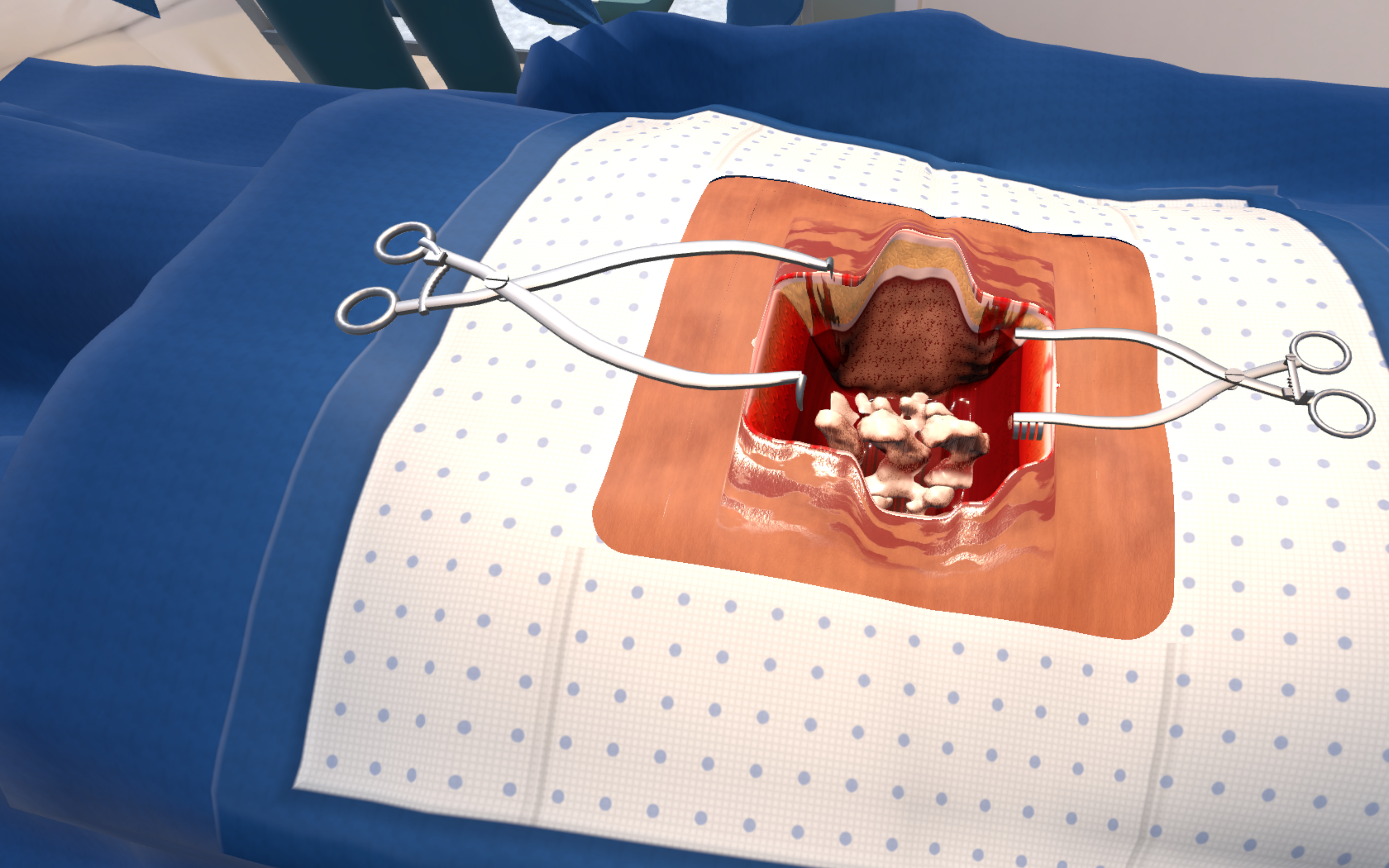
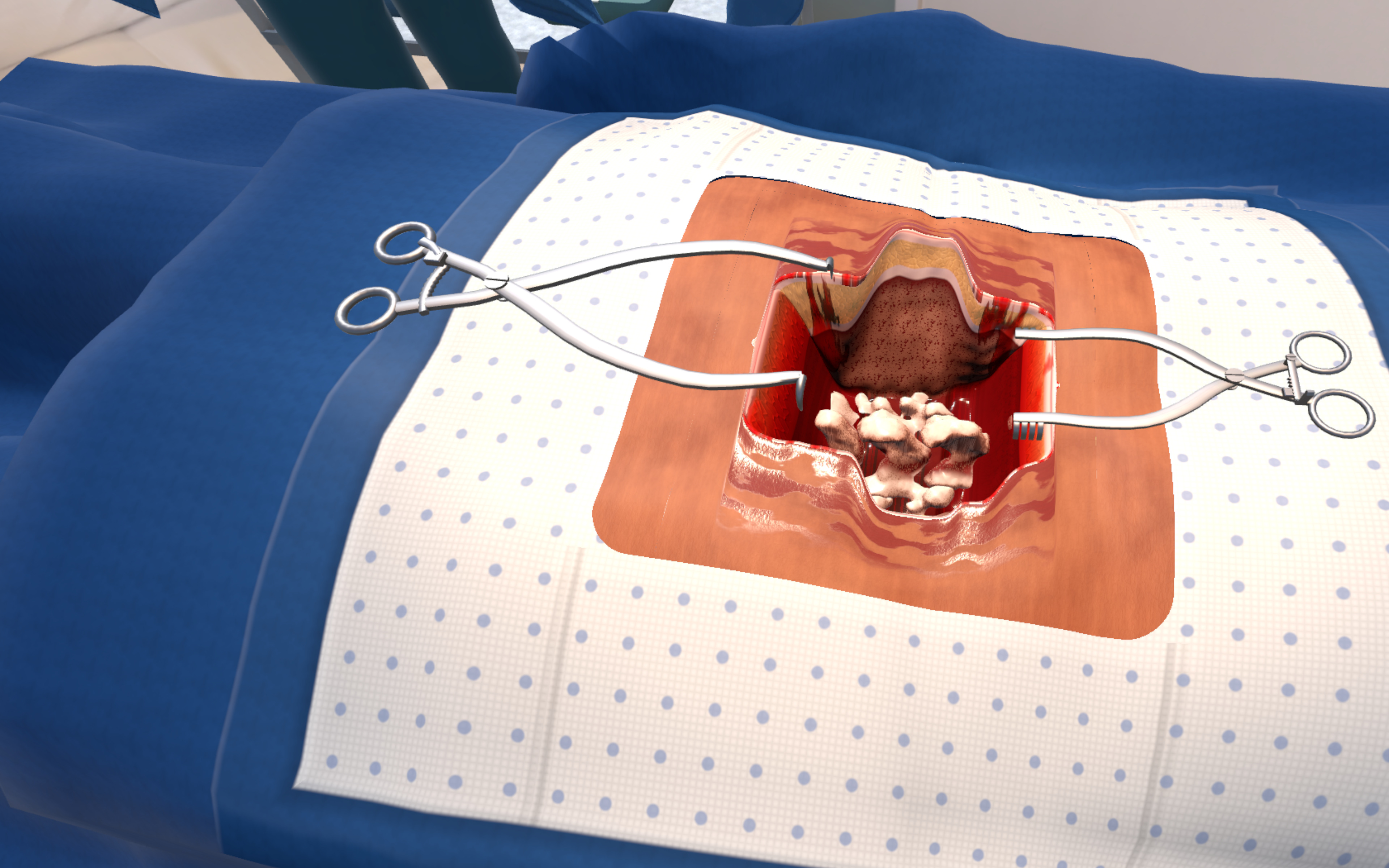
Retractors hold the wound open and the posterior spine is exposed through skin, fat and muscle. The vertebrae are built from a real, anonymised CT scan from an open-source dataset, so every patient's anatomy is different.
Driving a Pedicle Screw
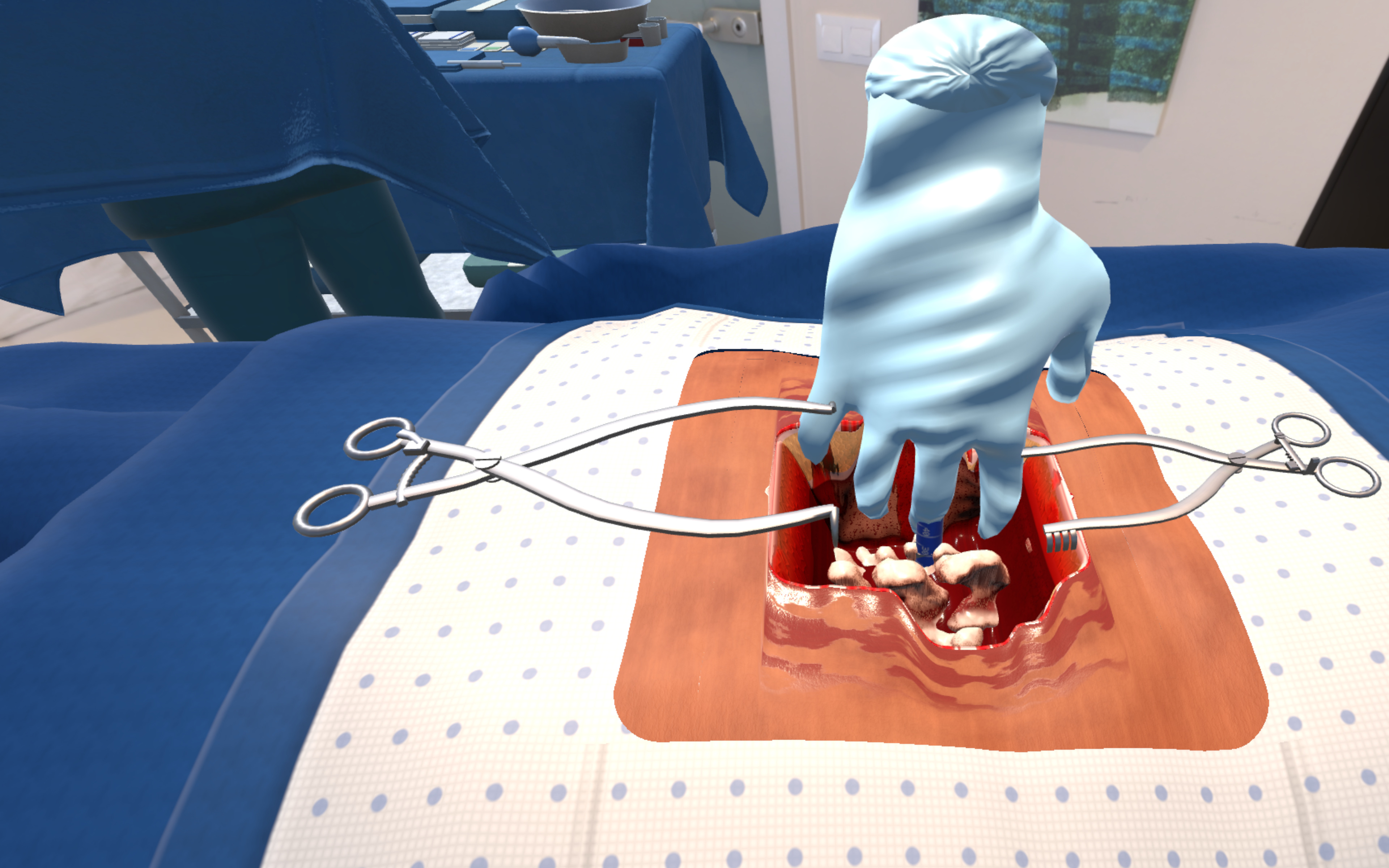
Your hand drives the screw down the channel you prepared with the awl, probe, feeler and tap. Every step is graded on the spot (PERFECT, GREAT, GOOD or MISS) from your accuracy in millimetres and your angle in degrees.
Screws in Place
A close-up of the seated screws. Each one is checked against the pedicle walls; on the inner side, only about 2 mm separates the bone from the nerve roots.
Complication Under Pressure
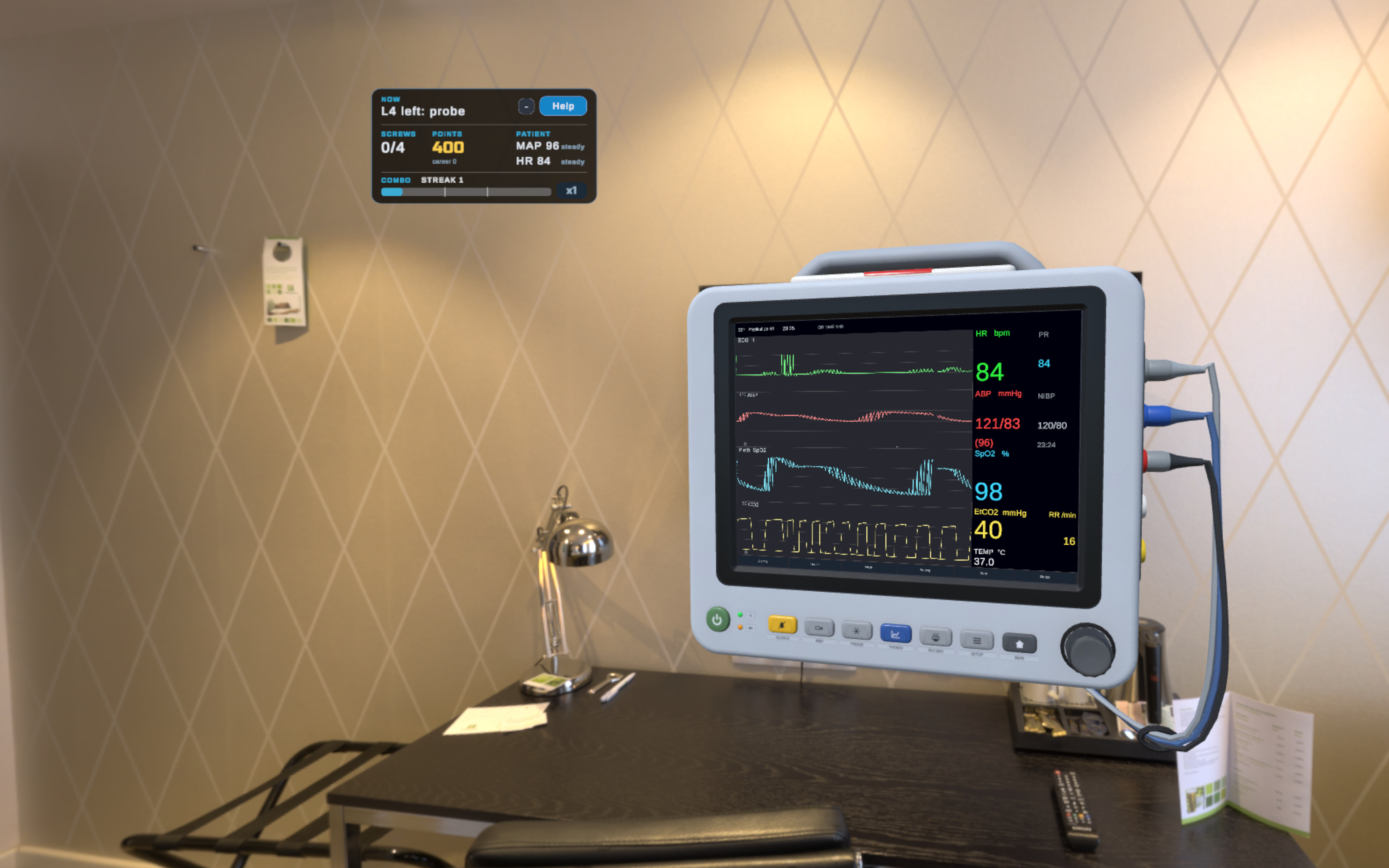
Complications do not wait. The patient monitor shows the live vitals: blood pressure falls with blood loss and the heart rate climbs. You choose the response on a decision panel, and the team acts on it. Call for blood and the anaesthetist hangs a unit.
Final X-ray
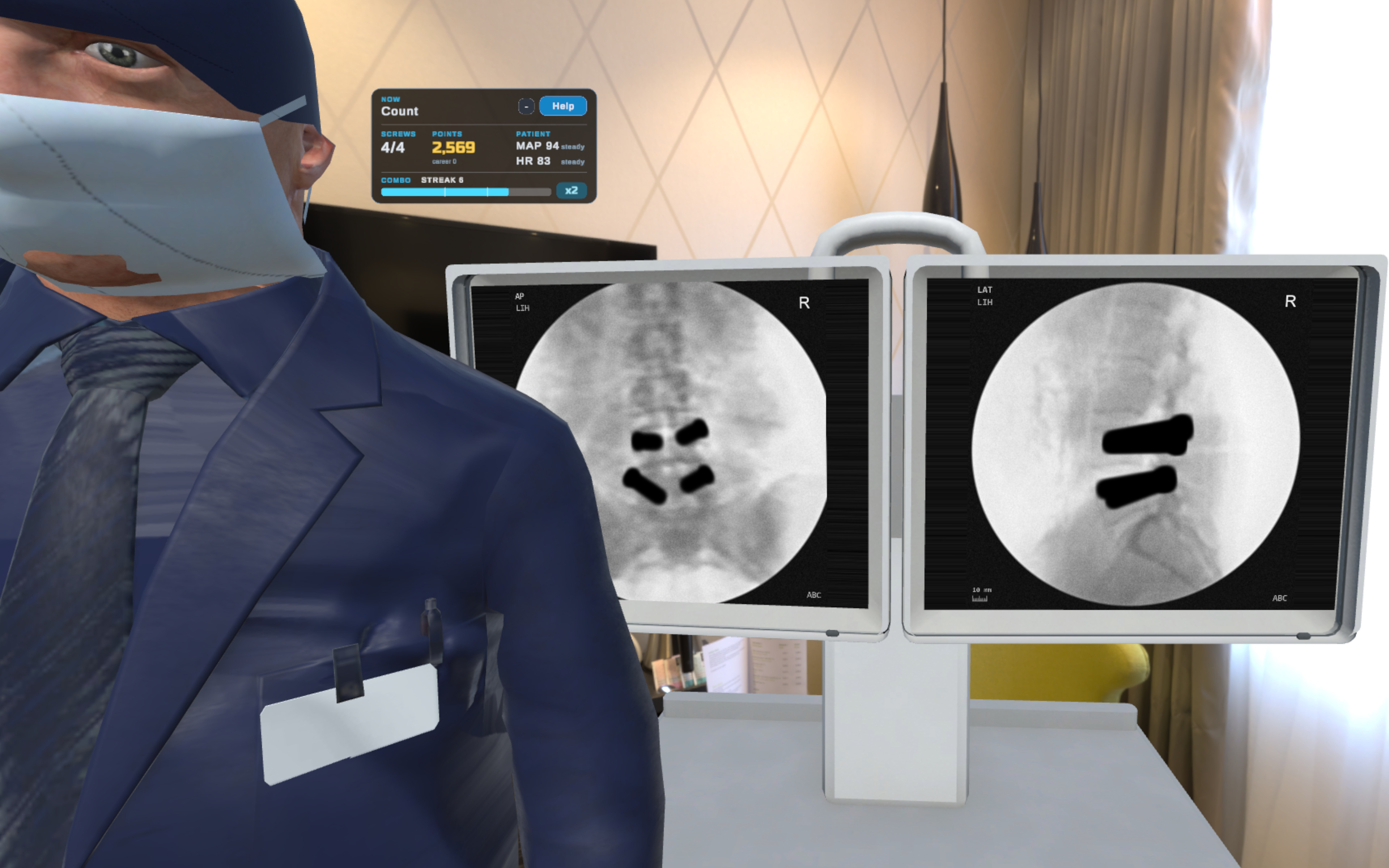
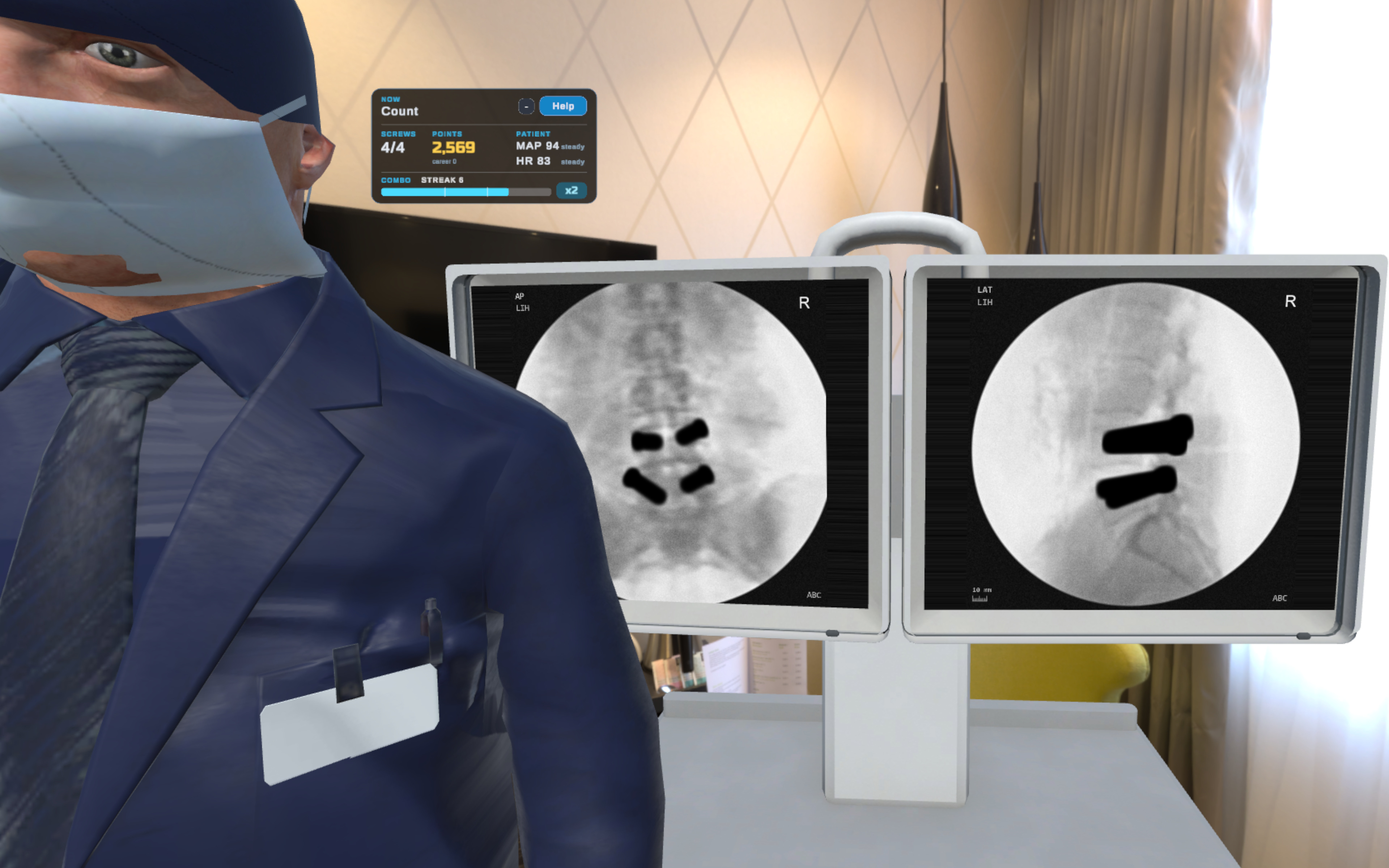
The final AP and lateral X-rays show all four screws at L4–L5, just as a surgeon checks before closing.
Promoted
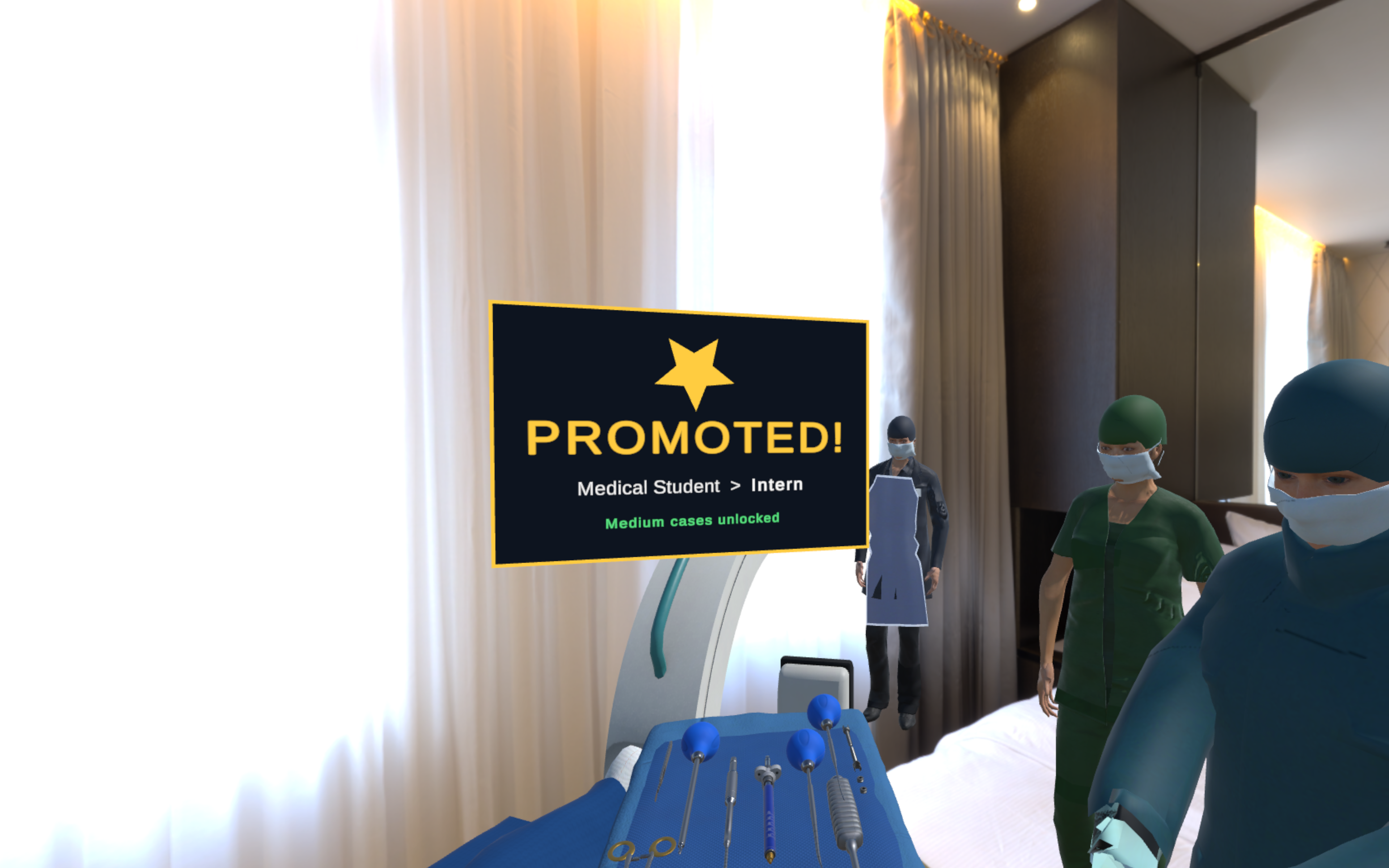
Save the patient and the points add up. Promoted from Medical Student to Intern, with Medium cases and harder anatomy now unlocked.
Graded Debrief
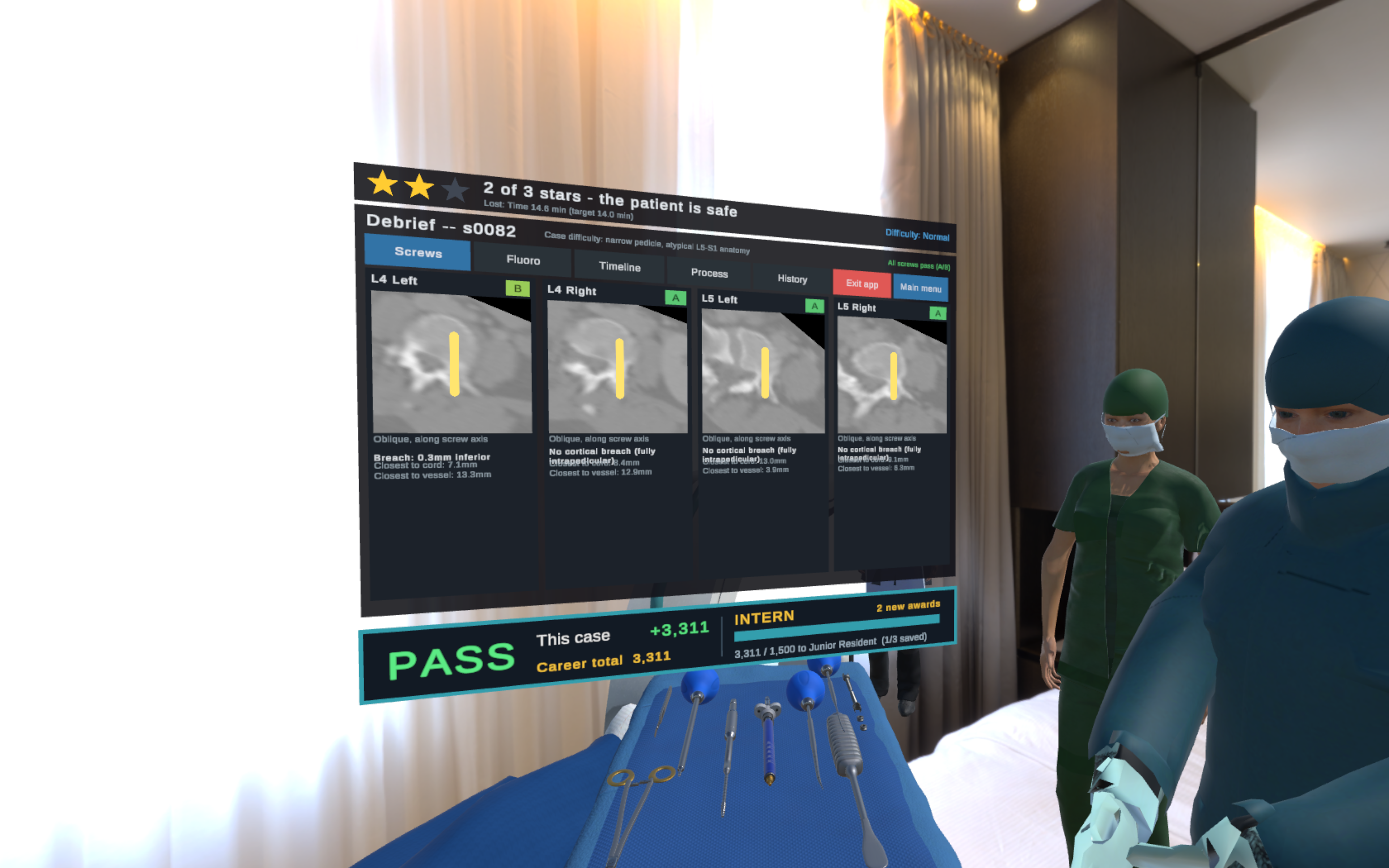
The debrief grades every screw on X-ray and CT views using the Gertzbein–Robbins classification, the clinical standard. You see your stars, your points and your rank, and whether you set a new personal best.
Disclaimer
Range is a surgical training tool. It is not a medical device and is not intended to replace clinical training, cadaver labs, or supervised surgical education. All patient data used is from open-licence, publicly available research datasets. No real patient-identifiable information is used in any part of the application.
