-
Random Animal Generator LOGO
-
Random Animal Generator WEB
-
Random Animal Generator WEB
Inspiration
To be honest, I never even thought about creating a “product” at first. I was just spending the weekend at home with my kid when I noticed he really loved pointing at animals in picture books and asking me to make up stories. But my imagination is pretty limited—I can manage two or three stories, but when I have to come up with a dozen or so in a single day, my brain just freezes up. I thought to myself, “If only there were a little tool that could generate an animal with just a tap, complete with some fun clues—that would make things so much easier.” Later, when I chatted with a few friends who were also raising kids, they agreed that this kind of “guess the animal” game was a great way to pass the time and learn something at the same time. So I decided to just go ahead and build one.
What it does
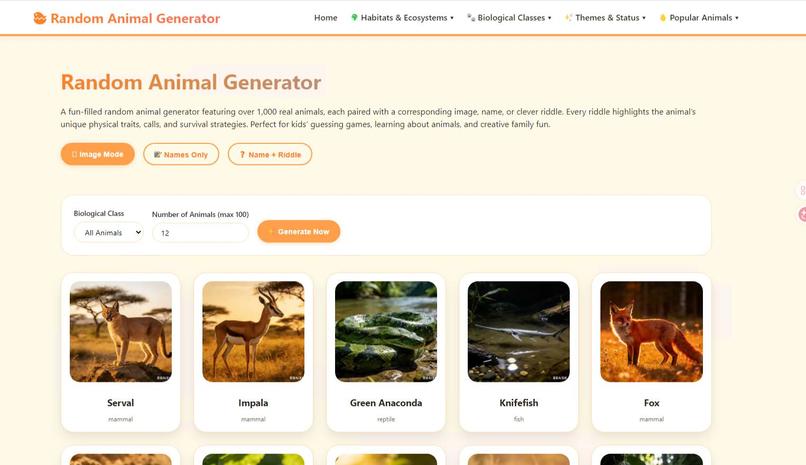
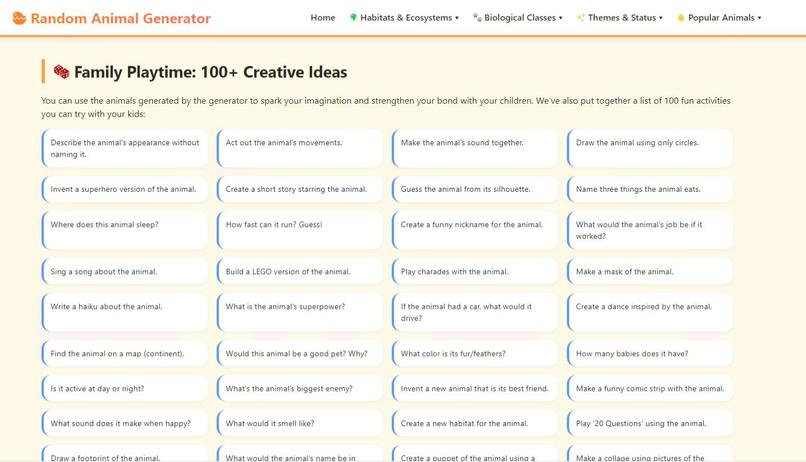
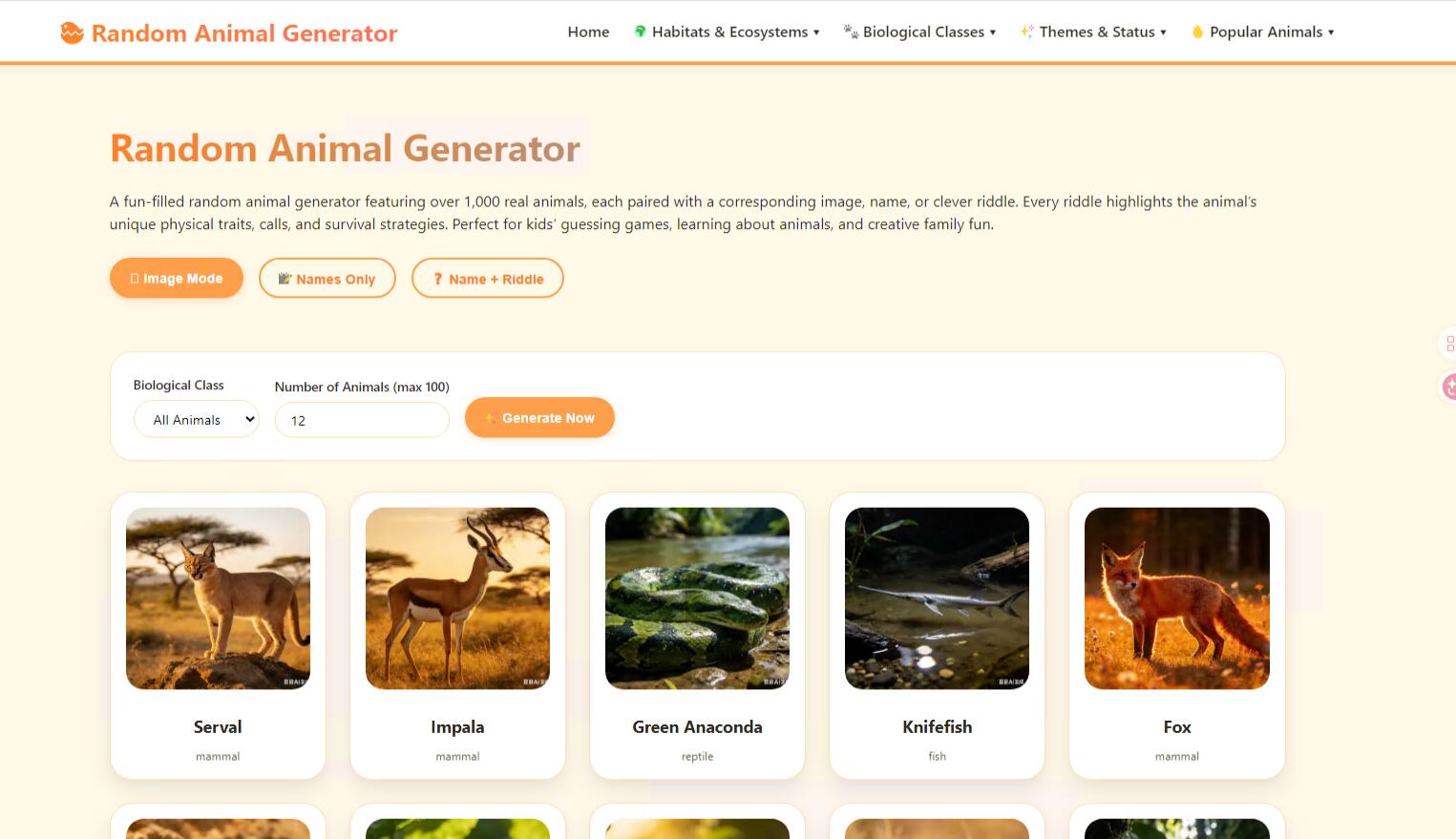
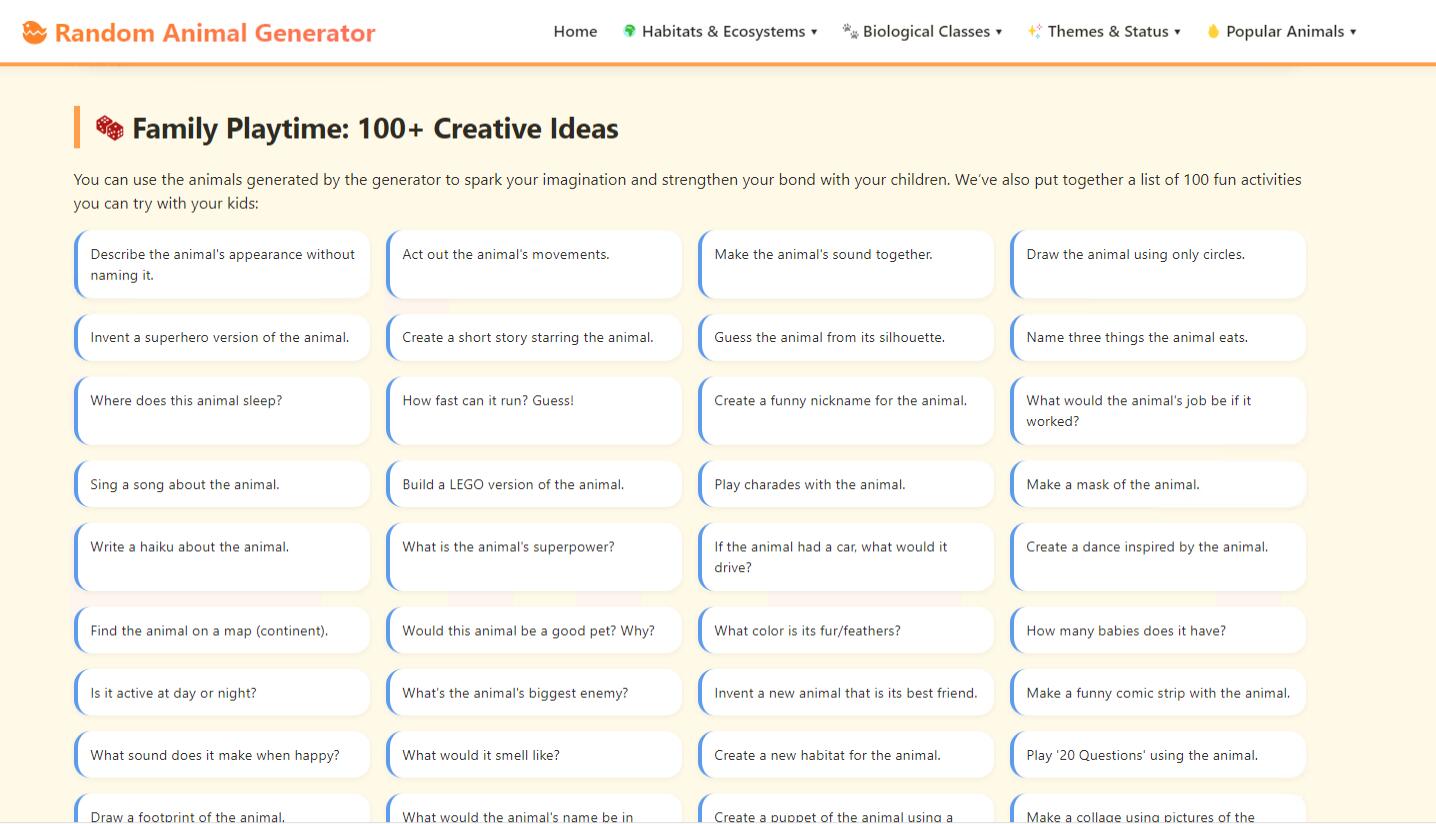
Simply put, the Random Animal Generator does three things: it shows you pictures of animals, tells you their names, or gives you a riddle-like description for you to guess. You can choose to see just the names, view them with pictures, or play the riddle mode exclusively. It’s packed with over a thousand real animals, ranging from lions and tigers to sea slugs and water bears. And it’s not just a random list of names—each animal comes with a specially written riddle that describes its appearance, call, habitat, diet, and how it protects itself. There’s also a filter function to sort by biological category—whether you want just mammals or just insects, you can narrow it down. Beyond generating animal facts, I’ve compiled over a hundred ideas for activities to enjoy with your kids, like “imitating animal sounds,” “giving an animal a superhero identity,” or “drawing its footprints.” Simply put, it’s a parent-child activity kit that’s both educational and a great way to pass the time.
How I built it
Technically, there's nothing fancy about it—it's just a static page, pure front-end, with no database. All the animal information is stored in a large JavaScript array. Every time you click the "Generate" button, the code randomly selects a few entries from the pool and renders them on the page according to the mode you've chosen. As for the riddles, I didn't write thousands of them by hand; instead, I created sentence templates based on animal categories in advance, and when generating the riddles, I randomly combine them to ensure that each one is unique. The images are pre-downloaded and stored on the server, named after the animals' English names to facilitate direct path concatenation—and I later spun off a separate Random Cute Animal Generator just for the fluffiest, most adorable critters, which ended up being a hit with younger kids. The overall interface uses bright, warm colors and large rounded corners to make it easy on the eyes for both adults and children.
Challenges I ran into
The first headache was the sheer volume of data. At first, I thought three or five hundred animal species would be enough, but as I wrote, I found I couldn’t stop, and eventually expanded the list to over a thousand. Just organizing the names and verifying the classifications took several days. The second pitfall was balancing the riddle templates—if they were too random, they’d end up being ridiculous, like “I’m a mammal, and I live in a coral reef,” which is completely unrealistic. I spent a significant amount of time limiting the vocabulary for each biological category—specifically regarding habitats, food sources, and defense mechanisms—to ensure the generated riddles made logical sense. Another minor challenge was responsive design; I had to prevent the control buttons from getting crammed together on mobile devices. I tried several different approaches before settling on the current version.
Accomplishments that I'm proud of
What makes me happiest is that these riddles really get the kids thinking. Once, a friend’s child was staring at the screen trying to guess the answer to “I have eight legs, I spin webs, and I hide in corners.” After thinking for a while, he suddenly shouted, “Spider!” His excitement was even more intense than when he wins a game. Also, I came up with those 100-plus family game ideas one by one—I didn’t copy any templates. A lot of the inspiration came from making them up on the spot while spending time with my kid. Now, seeing the screen filled with them gives me a real sense of accomplishment. I also really like the visual style of the page—it’s warm and cozy, like a moving fairy tale book.
What I learned
This project made me realize that when creating tools for young children, the most important thing isn’t how comprehensive the features are, but rather “how intuitive it is to use and how visually appealing it is.” For example, with the biological category filter, I initially only included mammals and birds, but later discovered that children were also very curious about reptiles and amphibians, so I gradually added them all. There was also an unexpected bonus: I had underestimated parents’ creativity. Many people emailed me to say they’d adapted these riddles into treasure hunts and bedtime stories—ways of playing that went far beyond my original design. This made me realize that a good tool should leave room for users to get creative on their own.
What's next for Random Animal Generator
Next, I’d like to add a sound playback feature so that when you tap an animal, you can hear its call—this is especially appealing to young children. Also, several teachers have asked me if I could create a “classroom mode” that displays only one animal at a time, with larger images and clues shown one at a time, making it easier to use with a projector in the classroom. Also, the current riddles are only available in English, so we’ll need to develop a Chinese version at the very least so that children in China can enjoy it too. Looking further ahead, perhaps we could turn it into a mini-program that works without opening a browser—that would be even more convenient.
Log in or sign up for Devpost to join the conversation.